
koala73/worldmonitorConnectors
Real-time global intelligence dashboard. AI-powered news aggregation, geopolitical monitoring, and infrastructure tracking in a unified situational awareness interface
86k
This repository provides an MCP server that connects an agent to a DuckDB database file. The agent can send SQL through one `query` tool instead of using separate database actions.
Builders who want their agent to query, inspect, and update a DuckDB database through MCP.
You can use an agent to work with DuckDB data without leaving your chat or editor.
Exposes one `query` tool that runs any valid DuckDB SQL statement.
Supports `--readonly` so the database opens with native read-only protection and blocks writes.
Supports `--keep-connection` to reuse one DuckDB connection for the server lifetime.
Shows an MCP config example that launches the server with `uvx`.
npx -y @smithery/cli install mcp-server-duckdb --client claude


A Model Context Protocol (MCP) server implementation for DuckDB, providing database interaction capabilities through MCP tools. It would be interesting to have LLM analyze it. DuckDB is suitable for local analysis.
This server enables interaction with a DuckDB database through the Model Context Protocol, allowing for database operations like querying, table creation, and schema inspection.
Currently, no custom resources are implemented.
Currently, no custom prompts are implemented.
The server implements the following database interaction tool:
query (string) - Any valid DuckDB SQL statement[!NOTE] The server provides a single unified
queryfunction rather than separate specialized functions, as modern LLMs can generate appropriate SQL for any database operation (SELECT, CREATE TABLE, JOIN, etc.) without requiring separate endpoints.
[!NOTE] When the server is running in
readonlymode, DuckDB's native readonly protection is enforced. This ensures that the Language Model (LLM) cannot perform any write operations (CREATE, INSERT, UPDATE, DELETE), maintaining data integrity and preventing unintended changes.
--readonly is specified and the database file doesn't exist, the server will fail to start with an errorfalse)
read_only=True, preventing any write operations.false)
To install DuckDB Server for Claude Desktop automatically via Smithery:
npx -y @smithery/cli install mcp-server-duckdb --client claude
Configure the MCP server in Claude Desktop's configuration file:
Location: ~/Library/Application Support/Claude/claude_desktop_config.json
Location: %APPDATA%/Claude/claude_desktop_config.json
{
  "mcpServers": {
    "duckdb": {
      "command": "uvx",
      "args": [
        "mcp-server-duckdb",
        "--db-path",
        "~/mcp-server-duckdb/data/data.db"
      ]
    }
  }
}
~/mcp-server-duckdb/data/data.db should be replaced with the actual path to the DuckDB database file.uv package managerDebugging MCP servers can be challenging due to their stdio-based communication. We recommend using the MCP Inspector for the best debugging experience.
npx @modelcontextprotocol/inspector uv --directory ~/codes/mcp-server-duckdb run mcp-server-duckdb --db-path ~/mcp-server-duckdb/data/data.db
The inspector provides visibility into:
Sign in to join the discussion.
No comments yet. Be the first to say what this is good for.
Real-time global intelligence dashboard. AI-powered news aggregation, geopolitical monitoring, and infrastructure tracking in a unified situational awareness interface
High-performance code intelligence MCP server. Indexes codebases into a persistent knowledge graph — average repo in milliseconds. 158 languages, sub-ms queries, 99% fewer tokens. Single static binary, zero dependencies.
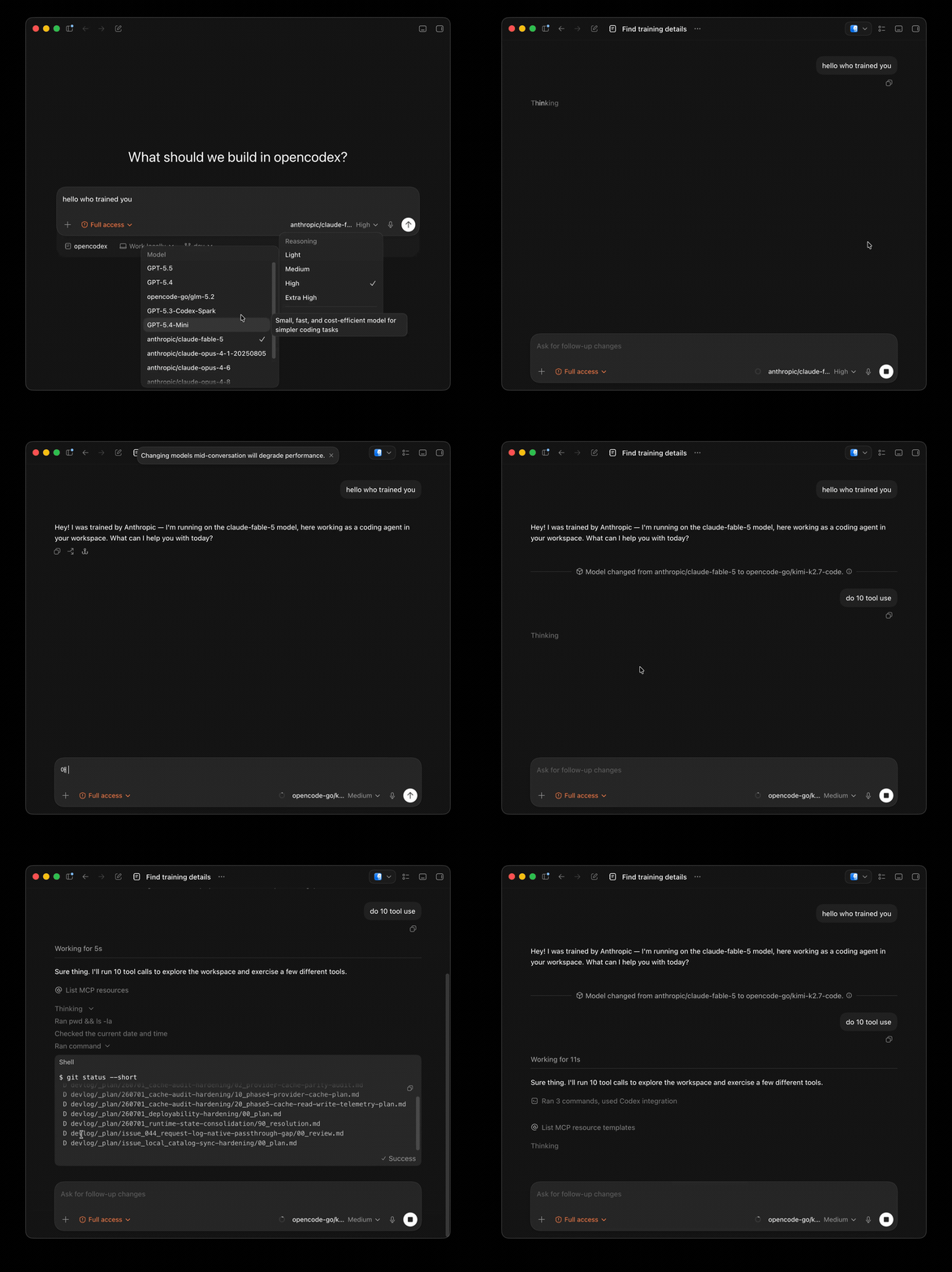
Universal provider proxy for OpenAI Codex & Claude Code — use any LLM (Claude, Gemini, Grok, DeepSeek, Ollama…) with Codex CLI, App, SDK, and Claude Code

Git-native persistent memory for AI coding agents. Implements Google OKF v0.2 with sub-300µs in-memory BM25 search, embedded MCP server, and progressive disclosure. Slashes token bloat by 80% with zero external databases or dependencies. Built in pure Go.

Local-first code intelligence graph for MCP and CLI. Builds a persistent map of your codebase so AI coding tools read only what matters, with benchmarked context reductions on reviews and large-repo workflows.

Stop your AI from making things up — it proposes, deterministic tools decide, every claim checked against ground truth with evidence. Grounded facts and context survive resets. Reverse engineering is the proving ground. MCP server + CLI.