
koala73/worldmonitorConnectors
Real-time global intelligence dashboard. AI-powered news aggregation, geopolitical monitoring, and infrastructure tracking in a unified situational awareness interface
86k
This is an MCP server that connects agent editors to a real browser through browser-use. It supports SSE and stdio transport, can stream the browser over VNC, and uses Playwright plus an OpenAI API key for tasks.
Builders who want their agent to open pages, click through flows, and report back from the browser.
You can let your agent browse the web instead of copying steps by hand.
Lets agents control a browser through browser-use.
Supports both SSE and stdio MCP connections.
Lets you watch the browser session in real time.
Runs browser operations asynchronously.
Shows MCP client config paths for Cursor, Windsurf, and Claude.
# Install dependencies
uv sync
uv pip install playwright
uv run playwright install --with-deps --no-shell chromium
# Run directly from source
uv run server --port 8000
# 1. Build and install globally
uv build
uv tool uninstall browser-use-mcp-server 2>/dev/null || true
uv tool install dist/browser_use_mcp_server-*.whl

# 2. Run with stdio transport
browser-use-mcp-server run server --port 8000 --stdio --proxy-port 9000



An MCP server that enables AI agents to control web browsers using browser-use.
🌐 Want to Vibe Browse the Web? Open-source AI-powered web browser - Vibe Browser.
🔗 Managing multiple MCP servers? Simplify your development workflow with agent-browser
# Install prerequisites
curl -LsSf https://astral.sh/uv/install.sh | sh
uv tool install mcp-proxy
uv tool update-shell
Create a .env file:
OPENAI_API_KEY=your-api-key
CHROME_PATH=optional/path/to/chrome
PATIENT=false  # Set to true if API calls should wait for task completion
# Install dependencies
uv sync
uv pip install playwright
uv run playwright install --with-deps --no-shell chromium
# Run directly from source
uv run server --port 8000
# 1. Build and install globally
uv build
uv tool uninstall browser-use-mcp-server 2>/dev/null || true
uv tool install dist/browser_use_mcp_server-*.whl

# 2. Run with stdio transport
browser-use-mcp-server run server --port 8000 --stdio --proxy-port 9000
{
  "mcpServers": {
    "browser-use-mcp-server": {
      "url": "http://localhost:8000/sse"
    }
  }
}
{
  "mcpServers": {
    "browser-server": {
      "command": "browser-use-mcp-server",
      "args": [
        "run",
        "server",
        "--port",
        "8000",
        "--stdio",
        "--proxy-port",
        "9000"
      ],
      "env": {
        "OPENAI_API_KEY": "your-api-key"
      }
    }
  }
}
| Client | Configuration Path |
|---|---|
| Cursor | ./.cursor/mcp.json |
| Windsurf | ~/.codeium/windsurf/mcp_config.json |
| Claude (Mac) | ~/Library/Application Support/Claude/claude_desktop_config.json |
| Claude (Windows) | %APPDATA%\Claude\claude_desktop_config.json |
To develop and test the package locally:
Build a distributable wheel:
# From the project root directory
uv build
Install it as a global tool:
uv tool uninstall browser-use-mcp-server 2>/dev/null || true
uv tool install dist/browser_use_mcp_server-*.whl
Run from any directory:
# Set your OpenAI API key for the current session
export OPENAI_API_KEY=your-api-key-here

# Or provide it inline for a one-time run
OPENAI_API_KEY=your-api-key-here browser-use-mcp-server run server --port 8000 --stdio --proxy-port 9000
After making changes, rebuild and reinstall:
uv build
uv tool uninstall browser-use-mcp-server
uv tool install dist/browser_use_mcp_server-*.whl
Using Docker provides a consistent and isolated environment for running the server.
# Build the Docker image
docker build -t browser-use-mcp-server .

# Run the container with the default VNC password ("browser-use")
# --rm ensures the container is automatically removed when it stops
# -p 8000:8000 maps the server port
# -p 5900:5900 maps the VNC port
docker run --rm -p8000:8000 -p5900:5900 browser-use-mcp-server

# Run with a custom VNC password read from a file
# Create a file (e.g., vnc_password.txt) containing only your desired password
echo "your-secure-password" > vnc_password.txt
# Mount the password file as a secret inside the container
docker run --rm -p8000:8000 -p5900:5900 \
  -v $(pwd)/vnc_password.txt:/run/secrets/vnc_password:ro \
  browser-use-mcp-server
Note: The :ro flag in the volume mount (-v) makes the password file read-only inside the container for added security.
# Browser-based viewer
git clone https://github.com/novnc/noVNC
cd noVNC
./utils/novnc_proxy --vnc localhost:5900
Default password: browser-use (unless overridden using the custom password method)
Try asking your AI:
open https://news.ycombinator.com and return the top ranked article
For issues or inquiries: cobrowser.xyz
Sign in to join the discussion.
No comments yet. Be the first to say what this is good for.
Real-time global intelligence dashboard. AI-powered news aggregation, geopolitical monitoring, and infrastructure tracking in a unified situational awareness interface
High-performance code intelligence MCP server. Indexes codebases into a persistent knowledge graph — average repo in milliseconds. 158 languages, sub-ms queries, 99% fewer tokens. Single static binary, zero dependencies.
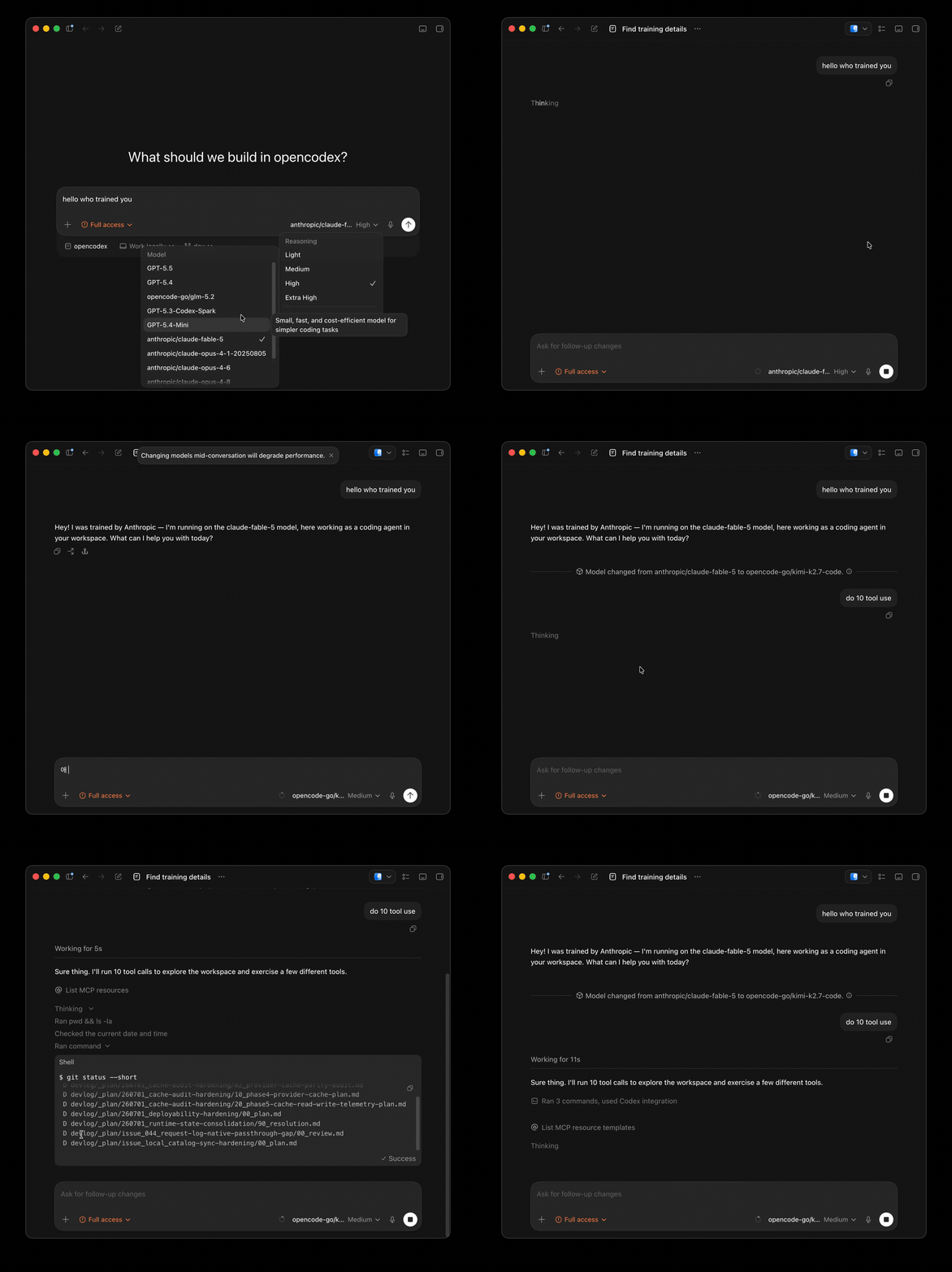
Universal provider proxy for OpenAI Codex & Claude Code — use any LLM (Claude, Gemini, Grok, DeepSeek, Ollama…) with Codex CLI, App, SDK, and Claude Code

Git-native persistent memory for AI coding agents. Implements Google OKF v0.2 with sub-300µs in-memory BM25 search, embedded MCP server, and progressive disclosure. Slashes token bloat by 80% with zero external databases or dependencies. Built in pure Go.

Local-first code intelligence graph for MCP and CLI. Builds a persistent map of your codebase so AI coding tools read only what matters, with benchmarked context reductions on reviews and large-repo workflows.

Stop your AI from making things up — it proposes, deterministic tools decide, every claim checked against ground truth with evidence. Grounded facts and context survive resets. Reverse engineering is the proving ground. MCP server + CLI.