
koala73/worldmonitorConnectors
Real-time global intelligence dashboard. AI-powered news aggregation, geopolitical monitoring, and infrastructure tracking in a unified situational awareness interface
86k
Kaimon connects an MCP client to a running Julia session so the agent can execute code, inspect methods and types, debug pauses, run tests, and search code by meaning. The main package manages sessions, a terminal dashboard, tool routing, and client setup, while `KaimonGate` exposes custom Julia functions as agent-callable tools. It also includes Qdrant-backed semantic search, VS Code command tools, and templates for Claude Code, Cursor, Gemini CLI, and VS Code configs.

Builders who want their agent to work inside Julia instead of only editing files.
You can let an agent execute, inspect, debug, and search real Julia code with live state.
Runs Julia code in persistent REPL sessions with streaming output and shared state.
Exposes types, methods, lowered IR, inferred code, macro expansion, and symbol lookup.
Lets you register Julia functions from another process through `KaimonGate` and make them callable by the agent.
Integrates with Infiltrator.jl for breakpoints, variable inspection, and expression evaluation at pause points.
Indexes projects into Qdrant and supports natural-language code search alongside exact grep.
Shows sessions, tool calls, tests, and search results in a TUI.
Runs tests, filters by pattern, stress tests concurrent agents, and profiles code.
Generates config files and startup snippets for Claude Code, Cursor, VS Code, Gemini CLI, and other MCP clients.
kaimon
Opening the gate between AI and Julia.


Kaimon is an MCP (Model Context Protocol) server that gives AI agents full access to Julia's runtime. Connect Claude Code, Cursor, or any MCP client to a live Julia session with a focused default surface of 49 tools for code execution, introspection, debugging, testing, and code search.
]app add Kaimon
This installs the kaimon command to ~/.julia/bin/ (make sure it's on your PATH). Then:
kaimon
The first run opens a setup wizard (security mode, API key, port). After that, the terminal dashboard launches:

From the dashboard:
i in the Config tab to write MCP config for Claude Code, Cursor, VS Code, or Gemini CLIg to add a Gate snippet to ~/.julia/config/startup.jl so every Julia session auto-connects]add KaimonGate; using KaimonGate; KaimonGate.serve()| Category | Tools | Description |
|---|---|---|
| Code Execution | ex, manage_repl | Evaluate code, restart/shutdown sessions |
| Introspection | investigate_environment, search_methods, type_info, list_names, workspace_symbols, document_symbols, macro_expand | Explore types, methods, and symbols |
| Code Analysis | code_lowered, code_typed, format_code, lint_package | IR inspection, formatting, linting |
| Navigation | goto_definition, navigate_to_file | Jump to definitions and source locations |
| VS Code | execute_vscode_command, list_vscode_commands | VS Code command execution |
| Debugging | debug_ctrl, debug_eval, debug_exfiltrate, debug_safehouse | Infiltrator.jl breakpoint debugging |
| Packages | pkg_add, pkg_rm | Add/remove packages |
| Testing | run_tests, stress_test | Test execution, load testing |
| Search | search_code, grep_code, qdrant_index_project, qdrant_sync_index, qdrant_reindex_file, qdrant_list_collections | search_code finds code by meaning (hybrid semantic + lexical); grep_code runs an exact pattern/regex over the live tree and returns each hit's enclosing symbol |
| Agents | agent_open, agent_send, agent_run, agent_output, agent_status, agent_list, agent_interrupt, agent_close | Spawn & drive headless claude agents |
| Extensions | extension_info, manage_extension | Inspect & control extension lifecycle |
| Info | ping, usage_instructions, usage_quiz, tool_help | Server status and documentation |
Advanced/infra tools (IR inspection code_lowered/code_typed, macro_expand, profile_code, lint_package, and the raw Qdrant vector-DB admin tools) are gated off the default surface to keep tool selection focused -- enable them per project in .kaimon/tools.json.
The gate is a separately installable, lightweight package — KaimonGate
(ZMQ + stdlib only, no heavy deps) — so you can drop it into any project, or
onto a remote/compute node, without the full Kaimon dependency tree:
]add KaimonGate
Connect any Julia process and expose domain-specific tools to AI agents:
using KaimonGate: GateTool, serve

function analyze_data(path::String, threshold::Float64=0.95)
    data = load(path)
    filter(x -> x.score > threshold, data)
end

# Kaimon auto-generates the MCP schema from the function signature
serve(tools=[GateTool("analyze_data", analyze_data)])
The connected REPL appears as a session in Kaimon's TUI. The agent can call
analyze_data alongside all built-in tools, with full argument validation
and type checking. The full Kaimon install bundles KaimonGate automatically
(a deprecated Kaimon.Gate alias keeps old Gate.serve() snippets working).
Full documentation: kahliburke.github.io/Kaimon.jl
i in the Config tab to write the client config (.vscode/mcp.json).v (or run Kaimon.install_vscode_remote_control()) — to enable the in-editor command tools (execute_vscode_command, list_vscode_commands, navigate_to_file).Contributions are welcome. Please open an issue to discuss changes before submitting a pull request.
MIT
Kaimon (開門) — "opening the gate." The gate between AI agents and the Julia ecosystem.
Sign in to join the discussion.
No comments yet. Be the first to say what this is good for.
Real-time global intelligence dashboard. AI-powered news aggregation, geopolitical monitoring, and infrastructure tracking in a unified situational awareness interface
High-performance code intelligence MCP server. Indexes codebases into a persistent knowledge graph — average repo in milliseconds. 158 languages, sub-ms queries, 99% fewer tokens. Single static binary, zero dependencies.
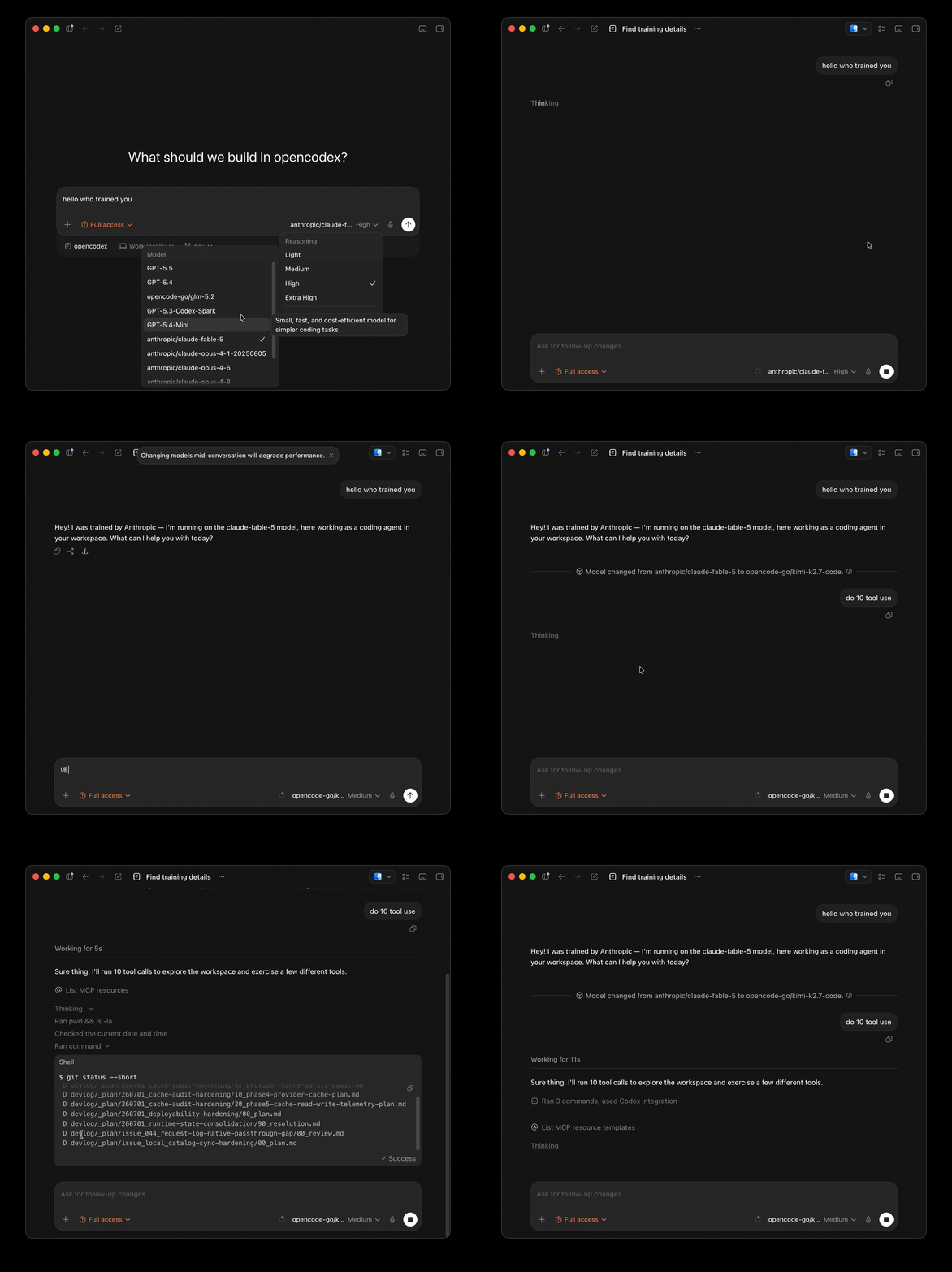
Universal provider proxy for OpenAI Codex & Claude Code — use any LLM (Claude, Gemini, Grok, DeepSeek, Ollama…) with Codex CLI, App, SDK, and Claude Code

Git-native persistent memory for AI coding agents. Implements Google OKF v0.2 with sub-300µs in-memory BM25 search, embedded MCP server, and progressive disclosure. Slashes token bloat by 80% with zero external databases or dependencies. Built in pure Go.

Local-first code intelligence graph for MCP and CLI. Builds a persistent map of your codebase so AI coding tools read only what matters, with benchmarked context reductions on reviews and large-repo workflows.

Stop your AI from making things up — it proposes, deterministic tools decide, every claim checked against ground truth with evidence. Grounded facts and context survive resets. Reverse engineering is the proving ground. MCP server + CLI.