

koala73/worldmonitorConnectors
Real-time global intelligence dashboard. AI-powered news aggregation, geopolitical monitoring, and infrastructure tracking in a unified situational awareness interface
86k
Shim MCP turns a WordPress site into an MCP server so AI clients can read and change content, users, plugins, menus, widgets, comments, options, and system settings. It supports stdio over WP-CLI for local use and Streamable HTTP for remote sites, with capabilities checked on each call.
Builders who want their AI client to control a local or remote WordPress site.
You can run WordPress tasks from Claude Code, Cursor, or any MCP client without a separate bridge service.
Runs as a local stdio server through WP-CLI, or as a remote Streamable HTTP MCP server.
Registers 56 abilities for posts, pages, media, users, plugins, menus, widgets, comments, options, and system management.
Generates and revokes application passwords from the WordPress admin dashboard for HTTP access.
Shows ready-made config snippets for Claude Code, Claude Desktop, and Cursor.
Checks capabilities on every call, including per-object checks like edit and delete permissions.
Keeps the connection self-contained on your server with no companion service or telemetry.
git clone https://github.com/justadityaraj/shim-mcp.git wp-content/plugins/shim-mcp
wp plugin activate shim-mcp
wp shim-mcp serve --user=admin
claude mcp add shim -- wp shim-mcp serve --user=admin --path=/full/path/to/wordpress




A self-contained Model Context Protocol (MCP) server for WordPress, built for developers. Install one plugin and your WordPress site becomes an MCP server that Claude Code, Claude Desktop, Cursor, Windsurf, Cline, or any MCP-compatible AI client can drive — 56 abilities across posts, pages, media, users, plugins, menus, widgets, comments, options and system management.
No companion plugins. No cloud relay. No account anywhere. Your site talks to your AI client and nothing sits in between.
Developers who live in a terminal or an editor.
If you run wp commands, keep VS Code open all day, and want Claude Code or Cursor to work on a local WordPress install the same way it works on the rest of your codebase — that's the case this was built for. It works fine as a remote server for a production site too, but the local-first path is the one that got the attention.
1. Local, over stdio (WP-CLI) — the reason this plugin exists.
wp shim-mcp serve --user=admin
That runs the MCP server as a plain stdio process: JSON-RPC in on STDIN, responses out on STDOUT. No HTTP, no ports, no tunnel, no application password, no OAuth dance. Point Claude Code or Cursor at that command and it connects the way any other local MCP server does.
Worth being precise about what's different here, because several WordPress MCP plugins mention WP-CLI. In those, WP-CLI is a tool the AI can call — the model asks the remote server to run a wp command on your behalf, over an authenticated HTTP connection. Useful, but the connection is still remote, still HTTP, still needs a token.
Shim uses WP-CLI as the transport itself. The server runs as a local process on your machine and speaks MCP over a pipe. There is no HTTP request, no token to issue or revoke, and nothing listening on a port. For a site you have checked out locally, that removes the entire authentication surface rather than securing it.
2. Remote, over HTTP — for sites you aren't sitting in front of.
Generate an application password from Tools → Shim MCP, copy the config snippet, done. Streamable HTTP transport, MCP spec-compliant, capability-checked on every call.
In systems programming, a shim is a thin layer that sits between two interfaces so they can work together without either side changing.
That is exactly what this is. WordPress speaks the Abilities API. AI clients speak MCP. Shim translates between the two and does nothing else.
The name is a promise about scope. It is not an AI product. It does not bundle a chatbot, a content generator, a credits system, or a dashboard that wants to become your workflow. It does not phone home. It is the adapter, not the appliance — and when WordPress core ships the Abilities API natively, the plugin gets smaller, not bigger.
wp_register_ability(). Nothing lives in a private tool registry, so abilities registered by other plugins are exposed too, automatically, with no adapter code.edit_post, delete_post, read_post, edit_user, delete_user, edit_comment) against that object before reading or mutating it. A contributor's client cannot edit an editor's post. Holding edit_posts is not treated as permission to edit any post.wp-config.php stays disabled unless you opt in explicitly with define( 'SHIM_MCP_ALLOW_CONFIG_WRITES', true );.Local development (stdio)
git clone https://github.com/justadityaraj/shim-mcp.git wp-content/plugins/shim-mcp
wp plugin activate shim-mcp
wp shim-mcp serve --user=admin
Then register it with your client. For Claude Code:
claude mcp add shim -- wp shim-mcp serve --user=admin --path=/full/path/to/wordpress
Remote site (HTTP)
Ready-made snippets for Claude Code, Claude Desktop and Cursor are on the dashboard.
wp shim-mcp serve [--server=<server-id>] [--user=<id|login|email>]   # run the MCP server over stdio
wp shim-mcp list  [--format=<format>]                                # list registered MCP servers
Approved and live on the WordPress.org Plugin Directory. Install it directly from Plugins → Add New in wp-admin, or download the zip from the releases page here.
It is feature-complete and the abilities are documented, but it has not yet run across a broad range of hosting environments. Issues and reports are welcome.
Verified on WordPress 7.1 / PHP 8.5.9 — activation, the admin dashboard, the MCP handshake, all 56 abilities registering through core's native Abilities API, and a full create, update, patch, read and delete cycle.
| Check | Result |
|---|---|
| WordPress Plugin Check (all categories) | 0 errors, 0 warnings |
| PHP_CodeSniffer, WordPress-Extra | 0 violations |
| PHPStan level 5 with WordPress stubs | 0 issues |
php -l, all files | pass |
| PHPCompatibility, PHP 8.0 to 8.5 | 0 issues |
Plugin Check is an automated scan of the directory's coding requirements. Passing it says the code meets those standards; it is not a review outcome and implies no endorsement by WordPress.org.
Stable releases come from main and are what the WordPress.org listing serves. Work in progress lives on dev.
If you want to try unreleased changes, take the newest pre-release from the releases page — those are built the same way as stable releases and install normally through Plugins → Add New → Upload Plugin.
To track dev directly instead:
git clone -b dev https://github.com/justadityaraj/shim-mcp.git wp-content/plugins/shim-mcp
Clone into a directory named exactly shim-mcp. GitHub's "Download ZIP" button produces a shim-mcp-dev folder, which WordPress treats as a second, separate plugin.
Pre-release builds are unreleased by definition: they have not been through the release checks, and they are not on WordPress.org. Do not run them on a production site.
Built and maintained by Aditya Raj Singh at BNCW Enterprises.
Shim MCP builds its protocol layer on WordPress's own MCP work: everything under includes/Server/ is derived from the WordPress MCP Adapter (GPL-2.0). The abilities are registered through WordPress's own Abilities API, which core ships from 6.9. The 56 abilities, the admin dashboard, the WP-CLI stdio bridge and the packaging are original to this plugin. See CREDITS.md for the full breakdown.
GPL-2.0-or-later. See LICENSE for the full text.
Sign in to join the discussion.
No comments yet. Be the first to say what this is good for.
Real-time global intelligence dashboard. AI-powered news aggregation, geopolitical monitoring, and infrastructure tracking in a unified situational awareness interface
High-performance code intelligence MCP server. Indexes codebases into a persistent knowledge graph — average repo in milliseconds. 158 languages, sub-ms queries, 99% fewer tokens. Single static binary, zero dependencies.
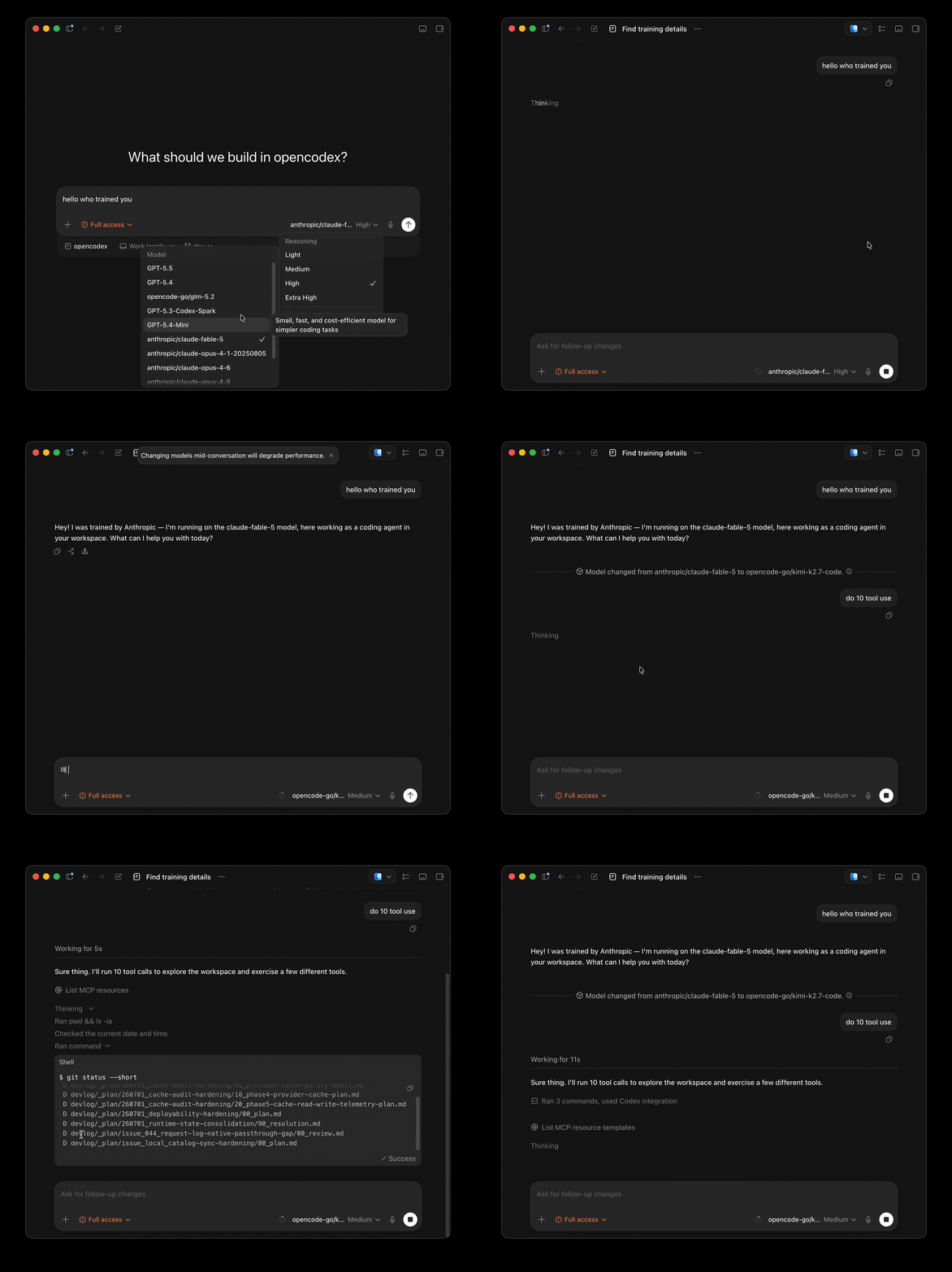
Universal provider proxy for OpenAI Codex & Claude Code — use any LLM (Claude, Gemini, Grok, DeepSeek, Ollama…) with Codex CLI, App, SDK, and Claude Code

Git-native persistent memory for AI coding agents. Implements Google OKF v0.2 with sub-300µs in-memory BM25 search, embedded MCP server, and progressive disclosure. Slashes token bloat by 80% with zero external databases or dependencies. Built in pure Go.

Local-first code intelligence graph for MCP and CLI. Builds a persistent map of your codebase so AI coding tools read only what matters, with benchmarked context reductions on reviews and large-repo workflows.

Stop your AI from making things up — it proposes, deterministic tools decide, every claim checked against ground truth with evidence. Grounded facts and context survive resets. Reverse engineering is the proving ground. MCP server + CLI.