
koala73/worldmonitorConnectors
Real-time global intelligence dashboard. AI-powered news aggregation, geopolitical monitoring, and infrastructure tracking in a unified situational awareness interface
86k
This repo turns PBIXRay into an MCP server so agents can inspect Power BI .pbix files from their own tools. It exposes actions for loading a file, listing tables, reading metadata, viewing Power Query and DAX, checking schema and relationships, and paging through table contents.
Builders who want their agent to read and explore Power BI model files during analysis or development.
You can ask an agent to inspect a .pbix file instead of opening Power BI and rechecking the model by hand.
Opens a Power BI .pbix file for analysis before other tools run.
Lists tables, gets metadata, checks model size, and returns a model summary or statistics.
Shows Power Query M code, M parameters, DAX calculated tables, measures, and calculated columns.
Returns column types, schema details, and table relationships from the model.
Fetches rows from a table with pagination and configurable page size.
Supports `--disallow [tool_names]` to turn off selected tools in the MCP server config.
git clone https://github.com/username/pbixray-mcp.git
cd pbixray-mcp
pip install -e .
python -m venv venv
source venv/bin/activate  # On Windows: venv\Scripts\activate
pip install mcp pbixray numpy

those interested in this project might also be interested in this follow-up project, tabular-mcp, which allows running DAX queries against a local PowerBI model. support is highly appreciated !
A Model Context Protocol (MCP) server for PBIXRay.
This MCP server exposes the capabilities of PBIXRay as tools and resources for LLM clients to interact with Power BI (.pbix) files.
The list of tools is configurable, so you can choose which tools you want to make available to the MCP client. This is useful if you don't use certain functionality or if you don't want to expose sensitive information.
| Tool | Category | Description |
|---|---|---|
load_pbix_file | Core | Load a Power BI (.pbix) file for analysis |
get_tables | Model | List all tables in the model |
get_metadata | Model | Get metadata about the Power BI configuration |
get_power_query | Query | Display all M/Power Query code used for data transformation |
get_m_parameters | Query | Display all M Parameters values |
get_model_size | Model | Get the model size in bytes |
get_dax_tables | Query | View DAX calculated tables |
get_dax_measures | Query | Access DAX measures with filtering by table or measure name |
get_dax_columns | Query | Access calculated column DAX expressions with filtering options |
get_schema | Structure | Get details about the data model schema and column types |
get_relationships | Structure | Get the details about the data model relationships |
get_table_contents | Data | Retrieve the contents of a specified table with pagination |
get_statistics | Model | Get statistics about the model with optional filtering |
get_model_summary | Model | Get a comprehensive summary of the current Power BI model |
Add the server configuration to your client configuration file. For example, for Claude Desktop:
{
  "mcpServers": {
    "pbixray": {
      "command": "wsl.exe",
      "args": [
        "bash",
        "-c",
        "source ~/dev/pbixray-mcp/venv/bin/activate && python ~/dev/pbixray-mcp/src/pbixray_server.py"
      ]
    }
  }
}
When using the PBIXRay MCP Server in WSL with Claude Desktop on Windows, you need to be aware of path differences when loading PBIX files.
Windows paths (like C:\Users\name\file.pbix) cannot be directly accessed in WSL. Let your AI assistant know how to convert between pats by adding
"Note that mcp server is running in wsl. Windows paths (like C:\Users\name\file.pbix) cannot be directly accessed in WSL. Instead, use WSL paths when referencing files:
Windows: C:\Users\name\Downloads\file.pbix"
WSL: /mnt/c/Users/name/Downloads/file.pbix" to project instructions or similar.
The server supports several command line options:
--disallow [tool_names]: Disable specific tools for security reasons--max-rows N: Set maximum number of rows returned (default: 100)--page-size N: Set default page size for paginated results (default: 20)Command-line options can be added as needed in config json:
{
 "mcpServers": {
   "pbixray": {
     "command": "wsl.exe",
     "args": [
       "bash",
       "-c",
        "source ~/dev/pbixray-mcp/venv/bin/activate && python ~/dev/pbixray-mcp/src/pbixray_server.py --max-rows 100 --page-size 50 --disallow get_power_query"
      ],
      "env": {}
    }
  }
}
Tools support additional parameters for filtering and pagination:
Tools like get_dax_measures, get_dax_columns, get_schema and others support filtering by specific names:
# Get measures from a specific table
get_dax_measures(table_name="Sales")

# Get a specific measure
get_dax_measures(table_name="Sales", measure_name="Total Sales")
The get_table_contents tool supports pagination to handle large tables efficiently:
# Get first page of Customer table (default 20 rows per page)
get_table_contents(table_name="Customer")

# Get second page with 50 rows per page
get_table_contents(table_name="Customer", page=2, page_size=50)
You can install PBIXRay MCP Server:
pip install pbixray-mcp-server
For developers working on the project:
Clone the repository:
git clone https://github.com/username/pbixray-mcp.git
cd pbixray-mcp
Install in development mode:
pip install -e .
If installing from source, create a virtual environment and install dependencies:
python -m venv venv
source venv/bin/activate  # On Windows: venv\Scripts\activate
pip install mcp pbixray numpy
The repository includes sample files and test scripts to help you get started:
# Test with sample AdventureWorks Sales.pbix file in demo/ folder
python tests/test_with_sample.py

# Try the interactive demo
python examples/demo.py

# For isolated tests of specific features
python test_pagination.py
python test_metadata_fix.py
The test scripts will help you understand how to interact with the server using the sample PBIX files provided in the demo/ directory.
To test the server during development, use the MCP Inspector:
# Activate your environment first
source venv/bin/activate

# Run the MCP Inspector
mcp dev src/pbixray_server.py
This starts an interactive session where you can call tools and test responses.
pbixray-mcp/
├── README.md            - This file
├── INSTALLATION.md      - Detailed installation instructions
├── src/                 - Source code
│   ├── __init__.py
│   └── pbixray_server.py
├── tests/               - Test scripts
│   ├── __init__.py
│   ├── conftest.py
│   ├── test_server.py
│   └── test_with_sample.py
├── examples/            - Example scripts and configs
│   ├── demo.py
│   └── config/
├── demo/                - Sample PBIX files
│   ├── README.md
│   └── AdventureWorks Sales.pbix
└── docs/                - Additional documentation
    └── ROADMAP.md
Contributions are much welcomed!
Sign in to join the discussion.
No comments yet. Be the first to say what this is good for.
Real-time global intelligence dashboard. AI-powered news aggregation, geopolitical monitoring, and infrastructure tracking in a unified situational awareness interface
High-performance code intelligence MCP server. Indexes codebases into a persistent knowledge graph — average repo in milliseconds. 158 languages, sub-ms queries, 99% fewer tokens. Single static binary, zero dependencies.
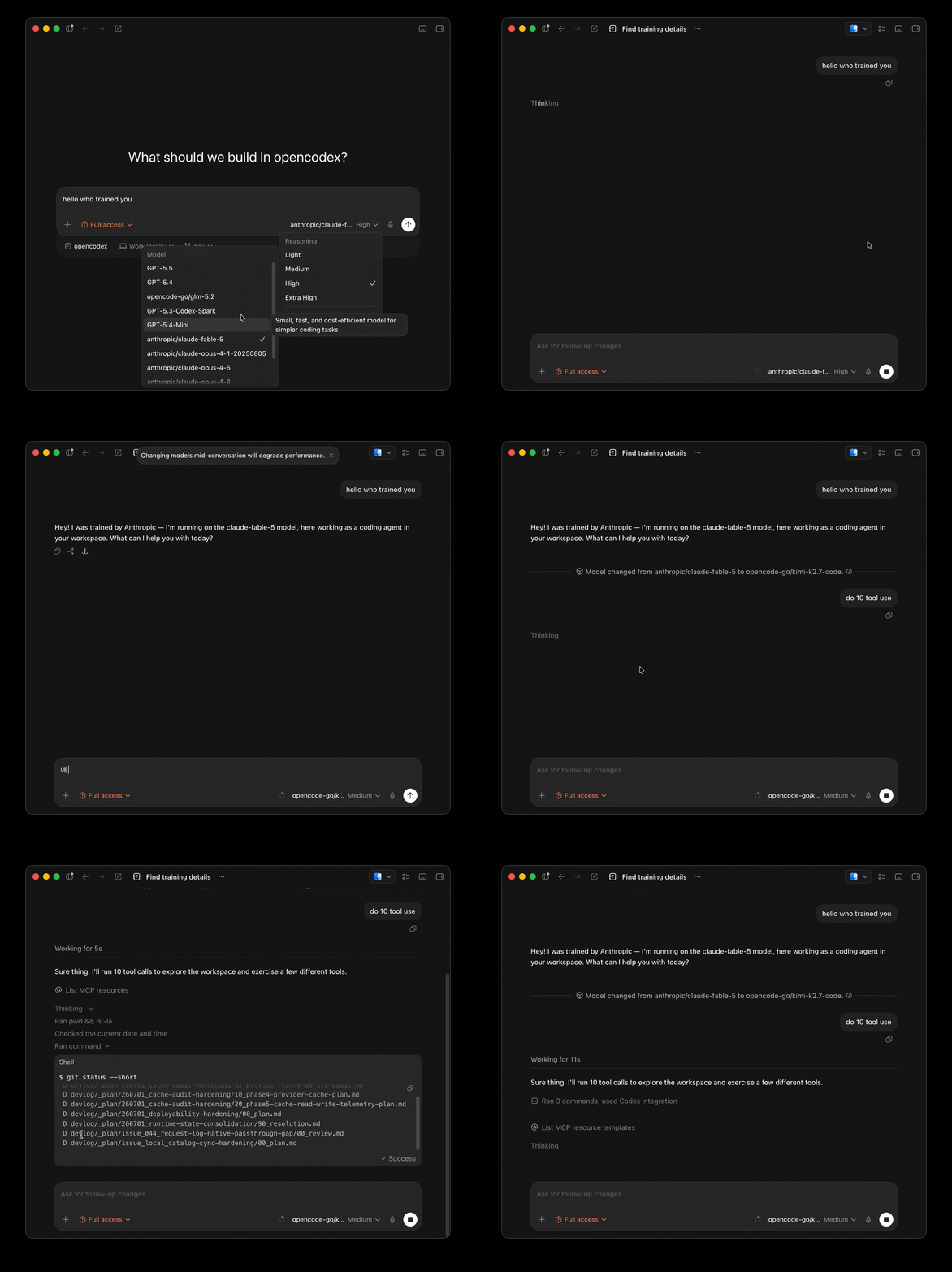
Universal provider proxy for OpenAI Codex & Claude Code — use any LLM (Claude, Gemini, Grok, DeepSeek, Ollama…) with Codex CLI, App, SDK, and Claude Code

Git-native persistent memory for AI coding agents. Implements Google OKF v0.2 with sub-300µs in-memory BM25 search, embedded MCP server, and progressive disclosure. Slashes token bloat by 80% with zero external databases or dependencies. Built in pure Go.

Local-first code intelligence graph for MCP and CLI. Builds a persistent map of your codebase so AI coding tools read only what matters, with benchmarked context reductions on reviews and large-repo workflows.

Stop your AI from making things up — it proposes, deterministic tools decide, every claim checked against ground truth with evidence. Grounded facts and context survive resets. Reverse engineering is the proving ground. MCP server + CLI.