
koala73/worldmonitorConnectors
Real-time global intelligence dashboard. AI-powered news aggregation, geopolitical monitoring, and infrastructure tracking in a unified situational awareness interface
86k
jDocMunch indexes docs into a heading tree, stores byte offsets, and serves retrieval through MCP so agents can ask for one section, a subtree, or a ranked match. It keeps retrieval local, supports lexical and optional semantic search, and is designed to cut context use when an agent only needs part of a document.
Builders who want their agent to pull the exact doc section they need instead of loading whole files.
You can answer documentation questions with one section fetch instead of reading an entire file.
Indexes documentation by heading hierarchy so retrieval is based on sections, not files.
Returns content from exact byte offsets in the original file with `get_section` and related tools.
Supports ranked search, TOC views, section paths, descendants, and neighbors for structural exploration.
Finds stale pages, broken links, orphan sections, missing coverage, and other documentation gaps.
Treats API specs as first-class documents with endpoint and schema lookup tools.
Runs on your machine with no hosted service required for indexing or retrieval.
Adds hybrid search with embeddings when a provider is configured, while keeping lexical search available by default.
uv tool install jdocmunch-mcp
jdocmunch-mcp init
jdocmunch-mcp --version
claude mcp add -s user jdocmunch -- uvx jdocmunch-mcp
jdocmunch-mcp index-local --path ./docs
jDocMunch is an MCP server for coding agents that retrieves the exact documentation section a task needs, without loading whole files into the context window.
Index a documentation set once by heading hierarchy, then fetch a single section, a heading subtree, or a ranked search result — extracted byte-precisely from the original file.
Install · Quickstart · Benchmarks · Commercial licensing






Free for personal use. Commercial use requires a paid license — terms below.
The problem. An agent asked "how do I configure authentication?" opens a documentation file, skims hundreds of paragraphs it does not need, opens another, and repeats. Large context windows do not fix this. They just make the waste affordable enough to ignore until the bill arrives, and they crowd out the context the model actually needed.
The mechanism. jDocMunch parses a documentation set into a section tree keyed by heading hierarchy, stores each section's byte offsets into the original file, and exposes retrieval over MCP. Sections keep durable identities across re-indexing as long as path, heading text, and heading level are unchanged.
The outcome. The unit of access changes from file to section. An agent retrieves the installation section, one configuration block, or a specific heading subtree — and nothing else.
Search and retrieve documentation by section, not just file path or keyword match.
Full content is pulled on demand from exact byte offsets into the original file.
Sections retain durable identities across re-indexing when path, heading text, and heading level remain unchanged.
Four benchmarks against public documentation corpora, each with the corpus, date, and per-query results recorded in benchmarks/.
| Corpus | Scale | Indexed in | Result |
|---|---|---|---|
Kubernetes (kubernetes/website, 2026-03-04) | 1,569 .md files, 4,355 sections, 16 MB | 3,352 ms | 27,285 tokens saved on a single node-affinity query; 100 ms latency |
| SciPy | 10,402 sections, ~855,000 corpus tokens | 2,247 ms | 135–152 ms per query across sparse-solver, FFT, and optimization lookups |
| LangChain (MDX) | 5,973 sections | 5,204 ms | MDX-aware sectioning found 754% more sections than the naive pass |
| Wiki | 7,449-token corpus | — | Search returns ranked metadata in ~190 tokens against a 7,449-token whole-corpus read |
Read these as per-corpus results, not as a single headline multiple. Savings depend on how large the containing file is relative to the section you needed: a small file with one heading saves almost nothing, and the Kubernetes corpus saves a great deal. The benchmark files record the queries that did poorly alongside the ones that did well.
A separate, measured result from the v1.121.0 projection work, on this repository's own docs at max_results=10: a search row went 1,989 chars → 319 with compact=true (−84%), or 431 with snippet_bytes=200 (−78%) while removing the follow-up get_section call entirely.
Retrieval quality is gated, not assumed. Every release runs a replay fixture over a frozen golden set and fails below nDCG 0.95. That gate has failed builds and blocked releases; it is not decorative.
Requirements: Python 3.10+, any MCP-compatible client.
uv tool install jdocmunch-mcp
jdocmunch-mcp init
No virtualenv to manage, nothing written into system Python, and it works as-is on PEP 668 distros (Ubuntu 24.04+, Debian 12+) where bare pip install is refused. Don't have uv yet?
init detects your MCP clients, writes their config entries, installs the doc-exploration prompt policy so your agent actually reaches for the tools, and optionally installs hooks and indexes your docs.
| Command | Use it when |
|---|---|
uvx jdocmunch-mcp | Zero install. Runs from an ephemeral environment — nothing lands on disk permanently. The client entries init writes already invoke the server this way, so for most setups this is all that ever runs. ⚠ Hooks are the exception: they're spawned by a minimal-PATH subshell and resolve the executable by name, so they need uv tool install (or pipx/pip) to work. |
pipx install jdocmunch-mcp | You already standardise on pipx |
pip install jdocmunch-mcp | Inside a virtualenv you manage yourself |
Verify:
jdocmunch-mcp --version
Manual Claude Code setup:
claude mcp add -s user jdocmunch -- uvx jdocmunch-mcp
No install step — uvx fetches and runs the server on demand. Prefer it on your PATH (and required for hooks)? uv tool install jdocmunch-mcp, then claude mcp add -s user jdocmunch jdocmunch-mcp.
Installing the server makes the tools available; it does not break an agent's habit of brute-reading files. One line in your CLAUDE.md does that:
Call the jdocmunch_guide tool and strictly follow its instructions.
Assumes: jDocMunch installed and registered with your client, and a folder of documentation.
Index a local documentation folder:
jdocmunch-mcp index-local --path ./docs
It prints JSON naming the corpus and what it found:
{
  "success": true,
  "repo": "local/docs",
  "file_count": 1,
  "section_count": 4,
  "doc_types": { ".md": 1 },
  "semantic_search": false
}
section_count greater than file_count is the whole point: the index addresses headings, not files.
Then, inside your agent:
Using jdocmunch, search the docs for "authentication configuration" and show me that section.
The agent should call search_sections, then get_section on the top hit — returning one section rather than a file. _meta.tokens_saved on the response reports what that cost versus reading the containing document.
Next step: get_toc_tree for a structural view of the whole corpus, or index_repo to index documentation straight from a GitHub repository.
get_section and get_sections pull byte-precise content from the original file; get_section_excerpt narrows further.search_sections fuses BM25 with semantic cosine when an embedding provider is configured. compact=true, fields=[...], and snippet_bytes=N cut the response further.get_toc, get_toc_tree, get_section_path, get_section_descendants, and section_neighbors traverse the heading tree without reading content.get_doc_coverage, get_undocumented_symbols, get_stale_pages, get_orphan_sections, get_broken_links, and doc_health_radar.find_endpoint, list_endpoints_by_tag, find_operations_using_schema, and get_schema_graph treat OpenAPI documents as first-class.check_section_delete_safe and get_section_blast_radius before you remove or restructure._meta.freshness, _meta.verdict, and which source layer answered.64 tools in total. The full reference is in USER_GUIDE.md.
Everything runs locally. Indexes live under your home directory; no hosted service is required for indexing or retrieval.
docs/ ──► parser (per format) ──► section tree ──► local index
                                                      │
                          MCP client ◄── retrieval ◄──┘
[office] extra — PDF, DOCX, PPTX, and EPUB.INDEX_VERSION = 3) that auto-migrates on first load. A 1.x release never forces a reindex.Deeper detail: ARCHITECTURE.md and SPEC.md.
Local-first by design. Your documentation is parsed and stored on your machine, and the base package's only default network behavior is an anonymous savings counter — a random ID plus aggregate token counts, no content, no paths, no PII.
Opt out completely:
JDOCMUNCH_SHARE_SAVINGS=0
Embedding and summarizer providers call their configured API only when you enable them, and never by default. watch-install registers a login service only when you run it yourself.
A model download, the first time a local embedding provider runs. Both offline providers fetch their model from HuggingFace on first use and cache it on disk. Nothing downloads until you enable embeddings, and a lexical-only install never contacts the hub. Startup warmup is skipped when the model is not already cached, so a first run defers the download to your first search rather than stalling the MCP handshake behind it (#110).
FastEmbed as the offline provider. pip install jdocmunch-mcp[fastembed]
runs the same all-MiniLM-L6-v2 model through onnxruntime instead of torch,
which is a much smaller install. When both offline providers are present
FastEmbed is preferred; JDOCMUNCH_EMBEDDING_PROVIDER=sentence-transformers
selects the other one. On the shared model the two write the same vector
store, so switching runtimes does not re-embed your corpus. Point FastEmbed at
a different model with JDOCMUNCH_FASTEMBED_MODEL and it keeps its own vectors
instead, because vectors from two models are not interchangeable
(#126).
A child process, when local embeddings are in use. When the
sentence-transformers provider is active, jDocMunch runs the embedding model
in a child process (python -m jdocmunch_mcp.embeddings.worker) instead of
inside the server. It:
This exists because importing the embedding stack inside the server process can
deadlock in the Windows loader
(#118), hanging every
tool call for as long as the server runs. Disable it with
JDOCMUNCH_EMBED_WORKER=0, which restores the previous in-process import.
A login service, only if you install one. jdocmunch-mcp watch-install
registers the doc watcher to start at login (systemd user unit, launchd agent,
or a Task Scheduler task named jdocmunch-watch). Nothing installs it for you.
Once installed it:
jdocmunch-mcp watch with the flags you passed to
watch-install — --no-ai-summaries to keep the summarizer out of it,
--quiet to suppress its per-change log lines;watch.log and watch.err under your doc-index directory;jdocmunch-mcp watch-uninstall.⚠ Re-running watch-install rewrites the service definition, so a
hand-edited one is replaced. It now prints what it replaced; pass the flags to
watch-install itself so an upgrade keeps them
(#120).
Path traversal prevention, symlink escape protection, secret exclusion, file-size limits, binary detection, and encoding safety are documented in SECURITY.md, along with how to report a vulnerability.
[office] extra and are supported for local indexing only.unknown rather than assumed current.| Doc | What it covers |
|---|---|
| USER_GUIDE.md | Full tool reference, workflows, and best practices |
| ARCHITECTURE.md | Storage model, parsing pipeline, extension points |
| SPEC.md | Response contracts and reason-code vocabulary |
| SECURITY.md | Security controls and vulnerability reporting |
| TOKEN_SAVINGS.md | How savings are counted and reported |
| CONTRIBUTING.md | Development setup and the CLA requirement |
| CHANGELOG.md · ROADMAP.md | Release history and what's next |
Released under the jDocMunch-MCP Dual-Use License (full terms). Free for non-commercial use. Commercial use requires a paid license, one-time, sold by jMunch LLC.
jDocMunch only: Builder, $29 (1 developer) · Studio, $99 (up to 5) · Platform, $499 (org-wide internal deployment)
Full jMunch suite (code + docs + data): Trio Builder, $99 · Trio Studio, $449 · Trio Platform, $2,499
Individual developers and non-commercial projects need no license. Organizations deploying jDocMunch across internal teams do.
Every 1.x license entitles you to every future 1.x release. We will never ship a 1.x version that:
Section field from the response shape,Anything that would require breaking these promises is reserved for a future major version (2.x). The full machine-checked contract is enforced via tests/test_server.py (tool-name and required-field invariants) and the replay-fixture gate that runs on every release.
Actively maintained. Issues and bug reports: GitHub Issues. Security reports: see SECURITY.md. Commercial licensing questions go through jcodemunch.com.
Part of the jMunch suite alongside jcodemunch-mcp (code symbols) and jdatamunch-mcp (tabular data). All three implement jMRI, the open retrieval interface spec.
Sign in to join the discussion.
No comments yet. Be the first to say what this is good for.
Real-time global intelligence dashboard. AI-powered news aggregation, geopolitical monitoring, and infrastructure tracking in a unified situational awareness interface
High-performance code intelligence MCP server. Indexes codebases into a persistent knowledge graph — average repo in milliseconds. 158 languages, sub-ms queries, 99% fewer tokens. Single static binary, zero dependencies.
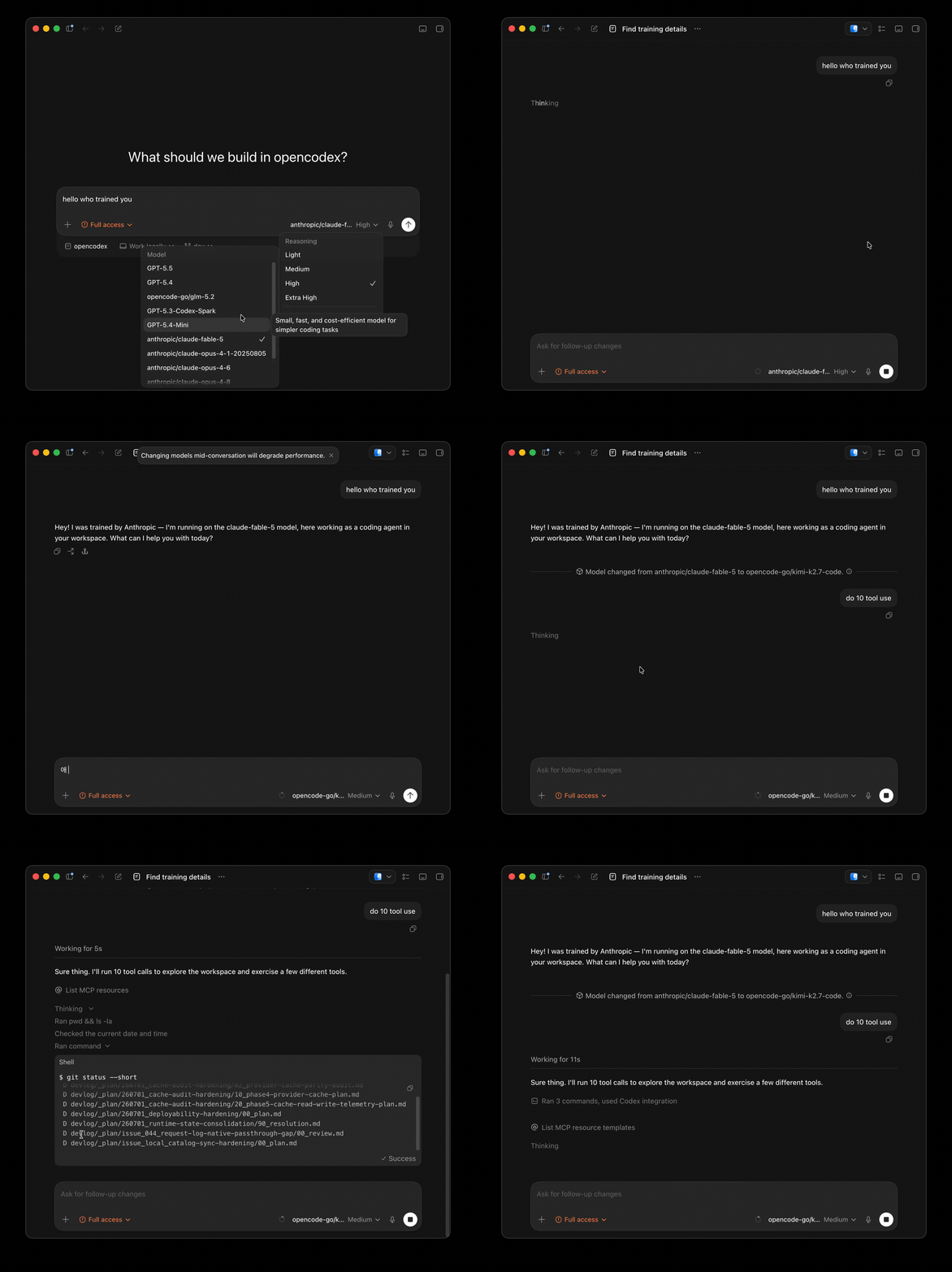
Universal provider proxy for OpenAI Codex & Claude Code — use any LLM (Claude, Gemini, Grok, DeepSeek, Ollama…) with Codex CLI, App, SDK, and Claude Code

Git-native persistent memory for AI coding agents. Implements Google OKF v0.2 with sub-300µs in-memory BM25 search, embedded MCP server, and progressive disclosure. Slashes token bloat by 80% with zero external databases or dependencies. Built in pure Go.

Local-first code intelligence graph for MCP and CLI. Builds a persistent map of your codebase so AI coding tools read only what matters, with benchmarked context reductions on reviews and large-repo workflows.

Stop your AI from making things up — it proposes, deterministic tools decide, every claim checked against ground truth with evidence. Grounded facts and context survive resets. Reverse engineering is the proving ground. MCP server + CLI.