
koala73/worldmonitorConnectors
Real-time global intelligence dashboard. AI-powered news aggregation, geopolitical monitoring, and infrastructure tracking in a unified situational awareness interface
86k
This server connects an agent to Odoo through MCP so it can search records, read fields, create entries, update data, delete records, and run safe business actions. It also exposes resources, session context, aggregation, and attachment access, with access controls and a YOLO mode for testing.

Builders who want their agent to work with Odoo data and workflows.
You can ask your agent to inspect and change Odoo data instead of switching into the ERP UI.
Searches Odoo models with domains, fetches individual records, and returns smart field selections by default.
Adds CRUD tools with field validation, permission checks, and model-level access control.
Groups, sums, and counts records in Odoo without pulling raw rows back to the client.
Posts messages to `mail.thread` records and, in YOLO mode, can call public business methods for workflows like confirm or post.
Reads binary fields and `ir.attachment` files through MCP resource URIs, with size limits and safety checks.
Exposes current user, company, timezone, and model field metadata so the agent can answer in the right context.
curl -LsSf https://astral.sh/uv/install.sh | sh
powershell -c "irm https://astral.sh/uv/install.ps1 | iex"
claude mcp add odoo \
  --env ODOO_URL=https://your-odoo-instance.com \
  --env ODOO_API_KEY=your-api-key-here \
  --env ODOO_DB=your-database-name \
  -- uvx mcp-server-odoo
docker run --rm -p 8000:8000 \
  -e ODOO_URL=http://host.docker.internal:8069 \
  -e ODOO_API_KEY=your-api-key-here \
  ivnvxd/mcp-server-odoo --transport streamable-http --host 0.0.0.0
# Install globally
pip install mcp-server-odoo

# Or use pipx for isolated environment
pipx install mcp-server-odoo
git clone https://github.com/ivnvxd/mcp-server-odoo.git
cd mcp-server-odoo
pip install -e .





An MCP server that enables AI assistants like Claude to interact with Odoo ERP systems. Access business data, search records, create new entries, update existing data, and manage your Odoo instance through natural language.
Works with any Odoo instance! Use YOLO mode for quick testing and demos with any standard Odoo installation. For enterprise security, access controls, and production use, install the Odoo MCP module.
ir.attachment files via resource URIsThe MCP server runs on your local computer (where Claude Desktop is installed), not on your Odoo server. You need to install UV on your local machine:
curl -LsSf https://astral.sh/uv/install.sh | sh
powershell -c "irm https://astral.sh/uv/install.ps1 | iex"
After installation, restart your terminal to ensure UV is in your PATH.
Add this configuration to your MCP settings:
{
  "mcpServers": {
    "odoo": {
      "command": "uvx",
      "args": ["mcp-server-odoo"],
      "env": {
        "ODOO_URL": "https://your-odoo-instance.com",
        "ODOO_API_KEY": "your-api-key-here"
      }
    }
  }
}
Add to ~/Library/Application Support/Claude/claude_desktop_config.json:
{
  "mcpServers": {
    "odoo": {
      "command": "uvx",
      "args": ["mcp-server-odoo"],
      "env": {
        "ODOO_URL": "https://your-odoo-instance.com",
        "ODOO_API_KEY": "your-api-key-here",
        "ODOO_DB": "your-database-name"
      }
    }
  }
}
Add to .mcp.json in your project root:
{
  "mcpServers": {
    "odoo": {
      "command": "uvx",
      "args": ["mcp-server-odoo"],
      "env": {
        "ODOO_URL": "https://your-odoo-instance.com",
        "ODOO_API_KEY": "your-api-key-here",
        "ODOO_DB": "your-database-name"
      }
    }
  }
}
Or use the CLI:
claude mcp add odoo \
  --env ODOO_URL=https://your-odoo-instance.com \
  --env ODOO_API_KEY=your-api-key-here \
  --env ODOO_DB=your-database-name \
  -- uvx mcp-server-odoo
Add to ~/.cursor/mcp.json:
{
  "mcpServers": {
    "odoo": {
      "command": "uvx",
      "args": ["mcp-server-odoo"],
      "env": {
        "ODOO_URL": "https://your-odoo-instance.com",
        "ODOO_API_KEY": "your-api-key-here",
        "ODOO_DB": "your-database-name"
      }
    }
  }
}
Add to .vscode/mcp.json in your workspace:
{
  "servers": {
    "odoo": {
      "type": "stdio",
      "command": "uvx",
      "args": ["mcp-server-odoo"],
      "env": {
        "ODOO_URL": "https://your-odoo-instance.com",
        "ODOO_API_KEY": "your-api-key-here",
        "ODOO_DB": "your-database-name"
      }
    }
  }
}
Note: VS Code uses
"servers"as the root key, not"mcpServers".
Add to ~/.codeium/windsurf/mcp_config.json:
{
  "mcpServers": {
    "odoo": {
      "command": "uvx",
      "args": ["mcp-server-odoo"],
      "env": {
        "ODOO_URL": "https://your-odoo-instance.com",
        "ODOO_API_KEY": "your-api-key-here",
        "ODOO_DB": "your-database-name"
      }
    }
  }
}
Add to ~/.config/zed/settings.json:
{
  "context_servers": {
    "odoo": {
      "command": {
        "path": "uvx",
        "args": ["mcp-server-odoo"],
        "env": {
          "ODOO_URL": "https://your-odoo-instance.com",
          "ODOO_API_KEY": "your-api-key-here",
          "ODOO_DB": "your-database-name"
        }
      }
    }
  }
}
Run with Docker — no Python installation required:
{
  "mcpServers": {
    "odoo": {
      "command": "docker",
      "args": [
        "run", "-i", "--rm",
        "-e", "ODOO_URL=http://host.docker.internal:8069",
        "-e", "ODOO_API_KEY=your-api-key-here",
        "ivnvxd/mcp-server-odoo"
      ]
    }
  }
}
Note: Use
host.docker.internalinstead oflocalhostto connect to Odoo running on the host machine.
For HTTP transport:
docker run --rm -p 8000:8000 \
  -e ODOO_URL=http://host.docker.internal:8069 \
  -e ODOO_API_KEY=your-api-key-here \
  ivnvxd/mcp-server-odoo --transport streamable-http --host 0.0.0.0
⚠️ Security: the HTTP transport has no built-in authentication — anyone who can reach the port gets Odoo access through the server's credentials. Publish the port only on trusted networks, or front it with an authenticating reverse proxy. See Transport Options.
The image is also available on GHCR: ghcr.io/ivnvxd/mcp-server-odoo
# Install globally
pip install mcp-server-odoo

# Or use pipx for isolated environment
pipx install mcp-server-odoo
Then use mcp-server-odoo as the command in your MCP configuration.
git clone https://github.com/ivnvxd/mcp-server-odoo.git
cd mcp-server-odoo
pip install -e .
Then use the full path to the package in your MCP configuration.
The server requires the following environment variables:
| Variable | Required | Description | Example |
|---|---|---|---|
ODOO_URL | Yes | Your Odoo instance URL | https://mycompany.odoo.com |
ODOO_API_KEY | Yes* | API key for authentication | 0ef5b399e9ee9c11b053dfb6eeba8de473c29fcd |
ODOO_USER | Yes* | Username (if not using API key) | admin |
ODOO_PASSWORD | Yes* | Password (if not using API key) | admin |
ODOO_DB | No | Database name (auto-detected if not set) | mycompany |
ODOO_LOCALE | No | Language/locale for Odoo responses | es_ES, fr_FR, de_DE |
ODOO_YOLO | No | YOLO mode - bypasses MCP security (⚠️ DEV ONLY) | off, read, true |
ODOO_MCP_ENABLE_METHOD_CALLS | No | Enable the call_model_method tool — requires ODOO_YOLO=true (⚠️ Dangerous, see call_model_method) | false, true |
*Either ODOO_API_KEY or both ODOO_USER and ODOO_PASSWORD are required. In YOLO mode, ODOO_USER is required even when using an API key.
Notes:
ODOO_DB.env file in the working directory| Variable | Default | Description |
|---|---|---|
ODOO_MCP_DEFAULT_LIMIT | 10 | Default number of records returned per search |
ODOO_MCP_MAX_LIMIT | 100 | Maximum allowed record limit per request |
ODOO_MCP_MAX_SMART_FIELDS | 15 | Maximum fields returned by smart field selection |
ODOO_MCP_LOG_LEVEL | INFO | Log level (DEBUG, INFO, WARNING, ERROR, CRITICAL) |
ODOO_MCP_LOG_JSON | false | Enable structured JSON log output |
ODOO_MCP_LOG_FILE | — | Path for rotating log file (10 MB, 5 backups) |
ODOO_MCP_LOG_FORMAT | — | Custom Python logging format string (default: %(asctime)s - %(name)s - %(levelname)s - %(message)s) |
ODOO_MCP_SLOW_OPERATION_THRESHOLD_MS | 1000 | Threshold in milliseconds above which an operation is logged as slow |
ODOO_MCP_TRANSPORT | stdio | Transport type (stdio, streamable-http) |
ODOO_MCP_HOST | localhost | Host to bind for HTTP transport |
ODOO_MCP_PORT | 8000 | Port to bind for HTTP transport |
ODOO_MCP_ALLOWED_HOSTS | — | Comma-separated Host headers to accept for HTTP transport (DNS-rebinding protection). Set when running streamable-http behind a reverse proxy that forwards an external host, e.g. odoo.example.com,localhost. IPv6 literals may be bracketed or bare ([::1]:8000, ::1). Unset, protection is only auto-enabled for a loopback bind — binding any other host (e.g. 0.0.0.0) runs with no Host/Origin validation at all. |
ODOO_MCP_SESSION_IDLE_TIMEOUT | — | Seconds of inactivity before a streamable-http session is closed and its server-side state freed, e.g. 600. Unset means sessions never expire. |
ODOO_MCP_MAX_BINARY_SIZE | 52428800 | Maximum bytes returned by a single binary/attachment resources/read. Checked before the payload is fetched (a bin_size probe for record fields, the stored file_size for attachments), so an oversized read is refused with a clean error instead of being pulled into memory and re-encoded to base64 for the wire. |
The server supports multiple transport protocols for different use cases:
Standard input/output transport - used by desktop AI applications like Claude Desktop.
# Default transport - no additional configuration needed
uvx mcp-server-odoo
Standard HTTP transport for REST API-style access and remote connectivity.
⚠️ Security: this transport has no built-in client authentication. Any client that can reach the port can use every tool and resource with the Odoo credentials the server holds — including writes in YOLO full-access mode. Keep the default
localhostbind unless the network is trusted, and front the server with an authenticating reverse proxy (e.g. nginx with basic auth or OAuth) for remote access. The server logs a warning when binding a non-loopback host.
# Run with HTTP transport (localhost only — safe default)
uvx mcp-server-odoo --transport streamable-http --port 8000

# Binding 0.0.0.0 exposes the server to the network — see the security note above
uvx mcp-server-odoo --transport streamable-http --host 0.0.0.0 --port 8000

# Or use environment variables
export ODOO_MCP_TRANSPORT=streamable-http
export ODOO_MCP_HOST=0.0.0.0
export ODOO_MCP_PORT=8000
uvx mcp-server-odoo
The HTTP endpoint will be available at: http://localhost:8000/mcp/
Note: SSE (Server-Sent Events) transport has been deprecated in MCP protocol version 2025-03-26. Use streamable-http transport instead for HTTP-based communication. Requires MCP library v1.27.0 or higher.
{
  "mcpServers": {
    "odoo-remote": {
      "command": "uvx",
      "args": ["mcp-server-odoo", "--transport", "streamable-http", "--port", "8080"],
      "env": {
        "ODOO_URL": "https://your-odoo-instance.com",
        "ODOO_API_KEY": "your-api-key-here",
        "ODOO_DB": "your-database-name"
      }
    }
  }
}
Install the MCP module:
Enable models for MCP access:
Generate an API key:
YOLO mode allows the MCP server to connect directly to any standard Odoo instance without requiring the MCP module. This mode bypasses all MCP security controls and is intended ONLY for development, testing, and demos.
🚨 WARNING: Never use YOLO mode in production environments!
Read-Only Mode (ODOO_YOLO=read):
Full Access Mode (ODOO_YOLO=true):
{
  "mcpServers": {
    "odoo-demo": {
      "command": "uvx",
      "args": ["mcp-server-odoo"],
      "env": {
        "ODOO_URL": "http://localhost:8069",
        "ODOO_USER": "admin",
        "ODOO_PASSWORD": "admin",
        "ODOO_DB": "demo",
        "ODOO_YOLO": "read"
      }
    }
  }
}
{
  "mcpServers": {
    "odoo-test": {
      "command": "uvx",
      "args": ["mcp-server-odoo"],
      "env": {
        "ODOO_URL": "http://localhost:8069",
        "ODOO_USER": "admin",
        "ODOO_PASSWORD": "admin",
        "ODOO_DB": "test",
        "ODOO_YOLO": "true"
      }
    }
  }
}
✅ Appropriate Uses:
❌ Never Use For:
Once configured, you can ask Claude:
Search & Retrieve:
Create & Manage:
search_recordsSearch for records in any Odoo model with filters.
{
  "model": "res.partner",
  "domain": [["is_company", "=", true], ["country_id.code", "=", "ES"]],
  "fields": ["name", "email", "phone"],
  "limit": 10
}
Field Selection Options:
fields or set to null: Returns smart selection of common fields[] is treated like null (smart defaults)["__all__"]: Returns all fields (use with caution) — credential-like fields are withheld and listed in the response's note; request them explicitly by name if neededget_recordRetrieve a specific record by ID.
{
  "model": "res.partner",
  "record_id": 42,
  "fields": ["name", "email", "street", "city"]
}
Field Selection Options:
fields or set to null: Returns smart selection of common fields with metadata[] is treated like null (smart defaults)["__all__"]: Returns all fields — credential-like fields are withheld and noted in the response metadata; request them explicitly by name if neededResponses also include related_summaries: display names for one2many/many2many collections holding at most 5 ids, so small relations are readable without extra lookups.
get_fieldsDescribe a model's fields — type, label, required/readonly, relation target, and selection options. Use it to discover a model's schema before reading or writing records. Omit attributes for the curated default set (type, string, required, readonly, relation, selection); an explicit list replaces the curated set — include the defaults in your list if you still need them (e.g. ["type", "string", "help", "store"]). Omit field_names to describe every field on the model. An empty list [] for either parameter is treated like omitting it.
{
  "model": "res.partner",
  "field_names": ["name", "email", "parent_id"]
}
get_current_contextReturn the current session context: the connected user, their timezone, the active company plus any other allowed companies, and UTC datetime-handling guidance. Useful when unsure which user or company a request runs as, or how to interpret datetimes. Spec-compliant clients also receive this context through the initialize response instructions.
{}
list_modelsList all models enabled for MCP access.
{}
list_resource_templatesList available resource URI templates and their patterns.
{}
create_recordCreate a new record in Odoo.
{
  "model": "res.partner",
  "values": {
    "name": "New Customer",
    "email": "customer@example.com",
    "is_company": true
  }
}
update_recordUpdate an existing record.
{
  "model": "res.partner",
  "record_id": 42,
  "values": {
    "phone": "+1234567890",
    "website": "https://example.com"
  }
}
delete_recordDelete a record from Odoo.
{
  "model": "res.partner",
  "record_id": 42
}
post_messagePost a message to a record's chatter (mail.thread). subtype="note" (default) is an internal log; subtype="comment" notifies followers. Set body_is_html=true for HTML markup. Optional subject sets a message subject line; optional partner_ids and attachment_ids reference existing partners and attachments.
{
  "model": "res.partner",
  "record_id": 42,
  "body": "Called customer, will follow up Tuesday"
}
{
  "model": "sale.order",
  "record_id": 17,
  "body": "<p>Shipping confirmed for Monday</p>",
  "subtype": "comment",
  "body_is_html": true
}
aggregate_recordsServer-side aggregation. Use this whenever the question is "totals/counts/groupings" rather than "list of records" — it pushes the work down to PostgreSQL instead of pulling raw rows. Dispatches to formatted_read_group on Odoo 19+ (the new dedicated method) and falls back to read_group with response normalization on older versions. Callers see a consistent response shape on every supported version. When aggregates is omitted, defaults to ["__count"] so each group always carries a count. When more groups exist beyond the requested page, the response sets has_more: true and a next_hint with the follow-up offset.
{
  "model": "sale.order",
  "groupby": ["date_order:month"],
  "aggregates": ["amount_total:sum"],
  "domain": [["state", "in", ["sale", "done"]]]
}
{
  "model": "res.partner",
  "groupby": ["country_id"]
}
call_model_methodGeneric XML-RPC execute_kw escape hatch — invokes public business methods, for workflow actions not covered by CRUD (post invoice, confirm sale order, validate picking, etc.). Available only when both ODOO_YOLO=true (full YOLO) and ODOO_MCP_ENABLE_METHOD_CALLS=true are set; otherwise the tool is not registered. Only public ASCII Python identifiers are accepted as method names — dotted, dashed, whitespace, non-ASCII, and _-prefixed names are rejected.
Some calls are blocked for safety even in full YOLO mode:
ir.actions.* / ir.cron models — their methods run with elevated privileges (server actions, scheduled jobs)run / method_direct_trigger on any model — same escalation risk via proxiescreate, write, unlink, read, search*, copy, sudo, ...) — use the dedicated tools insteadweb_* methods — the web-client data-access familyList results are truncated to 100 items.
[!WARNING] This tool can still invoke destructive workflow methods (e.g.
button_draft,action_cancel,toggle_active, custom methods). Enable only in trusted environments where you accept the blast radius. Odoo's record rules and ACLs still apply for the authenticated user.
{
  "model": "account.move",
  "method": "action_post",
  "arguments": [[42]]
}
{
  "model": "sale.order",
  "method": "action_confirm",
  "arguments": [[7]],
  "keyword_arguments": {"context": {"lang": "en_US"}}
}
When you omit the fields parameter (or set it to null), the server automatically selects the most relevant fields for each model using a scoring algorithm:
id, name, display_name, and active are always included*password, *_pass like smtp_pass, passwd, *secret, *_token, *apikey, or a *_key compound such as api_key/secret_key) are exSign in to join the discussion.
No comments yet. Be the first to say what this is good for.
Real-time global intelligence dashboard. AI-powered news aggregation, geopolitical monitoring, and infrastructure tracking in a unified situational awareness interface
High-performance code intelligence MCP server. Indexes codebases into a persistent knowledge graph — average repo in milliseconds. 158 languages, sub-ms queries, 99% fewer tokens. Single static binary, zero dependencies.
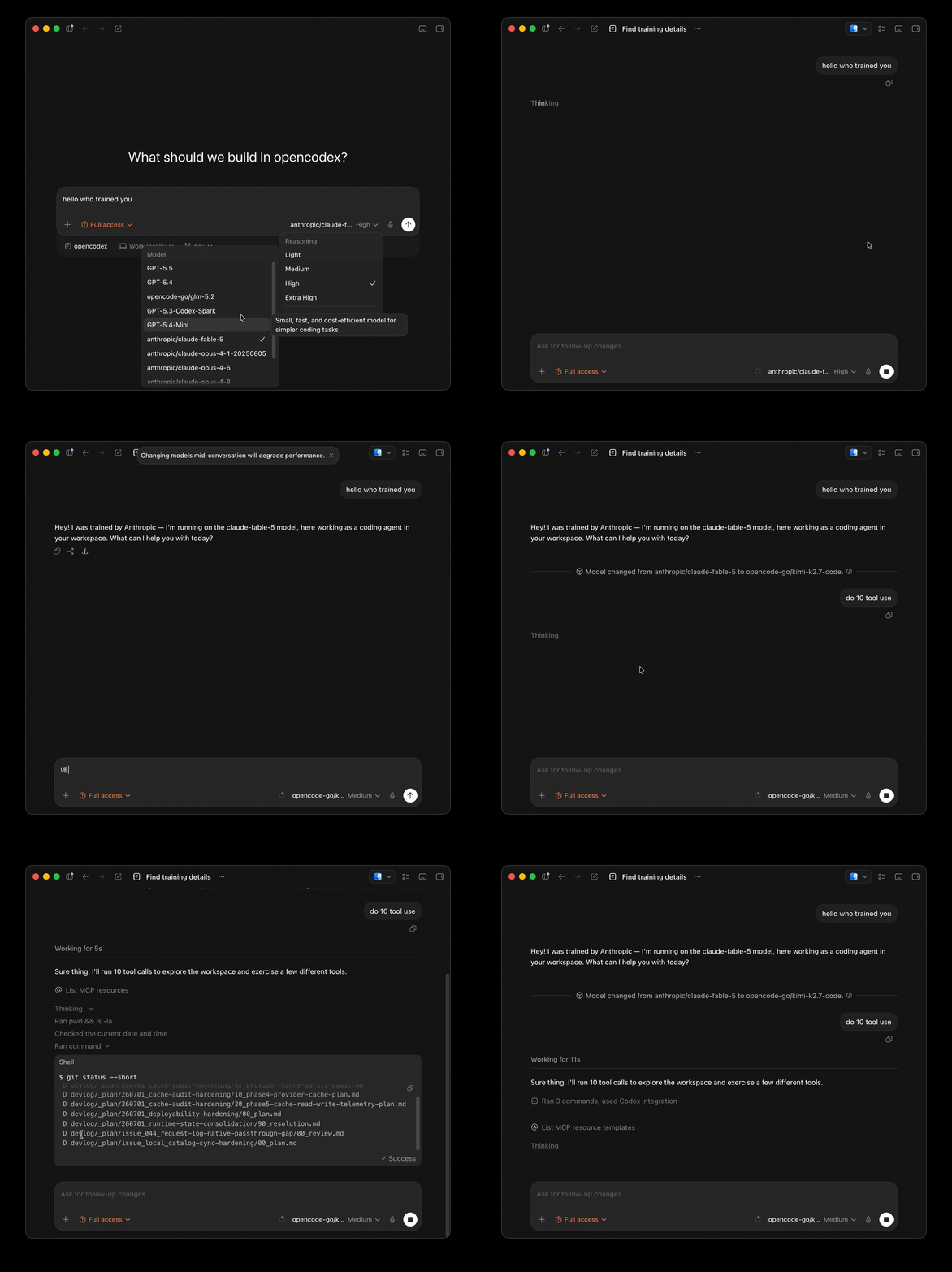
Universal provider proxy for OpenAI Codex & Claude Code — use any LLM (Claude, Gemini, Grok, DeepSeek, Ollama…) with Codex CLI, App, SDK, and Claude Code

Git-native persistent memory for AI coding agents. Implements Google OKF v0.2 with sub-300µs in-memory BM25 search, embedded MCP server, and progressive disclosure. Slashes token bloat by 80% with zero external databases or dependencies. Built in pure Go.

Local-first code intelligence graph for MCP and CLI. Builds a persistent map of your codebase so AI coding tools read only what matters, with benchmarked context reductions on reviews and large-repo workflows.

Stop your AI from making things up — it proposes, deterministic tools decide, every claim checked against ground truth with evidence. Grounded facts and context survive resets. Reverse engineering is the proving ground. MCP server + CLI.