


koala73/worldmonitorConnectors
Real-time global intelligence dashboard. AI-powered news aggregation, geopolitical monitoring, and infrastructure tracking in a unified situational awareness interface
86k
This repository provides an MCP server that exposes Naver search endpoints and DataLab trend endpoints to connected agents. It supports web, news, blog, cafe, image, KnowledgeiN, encyclopedia, local search, category lookup, and shopping or search trend analysis.
Builders who want Claude Code or another MCP-capable agent to query Naver search results and trend data.
You can search Naver and analyze trend data without leaving your agent workflow.
Provides tools for web, news, blog, cafe article, image, KnowledgeiN, encyclopedia, and local place search.
Exposes search-term and shopping trend tools across category, device, gender, age, and keyword views.
Includes `find_category` so you can describe a category in natural language instead of hunting for category numbers.
Ships as an MCP server and also includes an OpenClaw skill wrapper for installation through ClawHub.
Supports both NAVER API HUB and legacy Naver Developers keys, with environment variables choosing the platform.
openclaw skills install naver-search-mcp
npx -y @isnow890/naver-search-mcp
git clone https://github.com/isnow890/naver-search-mcp.git
cd naver-search-mcp
npm install
npm run build
cd /path/to/naver-search-mcp
npm install
npm run build
# Check current location
pwd

# Absolute path examples
# Windows: C:\Users\username\Downloads\naver-search-mcp
# macOS: /Users/username/Downloads/naver-search-mcp
# Linux: /home/username/Downloads/naver-search-mcp
MCP server for Naver Search API and DataLab API integration, enabling comprehensive search across various Naver services and data trend analysis.
Naver is moving Search, Search Trend, and Shopping Insight from the Naver Developers Center to NAVER API HUB on NAVER Cloud Platform, and is shutting down three search APIs entirely.
| Date | What happens |
|---|---|
| 2026-07-31 | Developers Center stops accepting new key applications. Shopping / Book / Academic search APIs shut down completely. |
| 2027-06-30 | Developers Center support ends — existing keys stop working. |
Source: Naver Developers Center official notice (Korean) — "Search API, Search Trend, Shopping Insight 서비스 종료 및 NAVER API HUB 이관 안내".
Setting this up for the first time? Get your keys from NAVER API HUB. The Developers Center path closes to new applicants on 2026-07-31, so it is no longer the place to start. Step-by-step instructions are in Option A: NAVER API HUB below.
Already running with Developers Center keys? Nothing to change. They keep working until 2027-06-30, and this version supports both platforms from the same install. When you're ready, get a HUB key and swap the two environment variables — no other changes.
Support plan for this server: both platforms stay supported side by side through Naver's 2027-06-30 cutoff. The Developers Center path will be dropped in a later major version only after that date, once it can no longer work for anyone — so upgrading in the meantime will never take your working setup away.
Three tools were removed in 1.0.49: search_shop, search_book, search_academic. Naver shuts those search APIs down on 2026-07-31 with no replacement on any platform, so there is nothing this server can do to keep them. Shopping Insight (datalab_shopping_*) and find_category are a different API and are not affected.
You can install this MCP server as an OpenClaw skill from ClawHub:
openclaw skills install naver-search-mcp
The ClawHub skill uses the published npm package internally and needs one credential pair in your OpenClaw environment — either the NAVER API HUB pair (NCP_APIGW_API_KEY_ID / NCP_APIGW_API_KEY) or the Developers Center pair (NAVER_CLIENT_ID / NAVER_CLIENT_SECRET). OpenClaw's apiKey field maps to NAVER_CLIENT_SECRET; HUB users should set both HUB variables explicitly in the environment instead of using apiKey.
You can use this server immediately without API keys through Kakao PlayMCP. Simply visit the link and start using it right away!
Removed in 1.0.49:
search_shop,search_book,search_academic. Naver shuts down the Shopping / Book / Academic search APIs on 2026-07-31 with no replacement on any platform. This is not a limitation of this server. Shopping Insight (datalab_shopping_*) is a different API and is unaffected.
Two platforms issue keys for this server. Set one pair of environment variables — see Configuration below for how the pair you set determines the platform used.
NCP_APIGW_API_KEY_ID (Client ID) and NCP_APIGW_API_KEY (Client Secret) in the configuration below.Naver Developers Center stops accepting new applications on 2026-07-31. If you don't already have a Client ID/Secret from this platform, use NAVER API HUB above instead. Existing Developers Center keys keep working until 2027-06-30.
NAVER_CLIENT_ID / NAVER_CLIENT_SECRET in the configuration belowTwo platforms are supported. Set one pair — the server picks the platform from which variables you set, since the key strings themselves are indistinguishable.
| Variables | Platform | Endpoint |
|---|---|---|
NCP_APIGW_API_KEY_ID, NCP_APIGW_API_KEY | NAVER API HUB (NCP) | naverapihub.apigw.ntruss.com |
NAVER_CLIENT_ID, NAVER_CLIENT_SECRET | Naver Developers (legacy) | openapi.naver.com |
If both pairs are set, NAVER API HUB wins.
The installation examples below use the legacy NAVER_CLIENT_ID / NAVER_CLIENT_SECRET
pair; swap in the HUB pair from the table above if that's what you have.
Naver is moving these APIs from the Developers Center to NAVER API HUB on NAVER Cloud Platform.
| Date | What happens |
|---|---|
| 2026-06-25 | NAVER API HUB launched |
| 2026-07-31 | Developers Center stops accepting new applications |
| 2027-06-30 | Developers Center support ends — existing keys stop working |
Existing keys keep working until 2027-06-30. To migrate, get a key from the
NAVER Cloud Platform console and set NCP_APIGW_API_KEY_ID / NCP_APIGW_API_KEY.
Developers Center keys cannot be used against NAVER API HUB.
The most reliable way to use this MCP server is through NPX. For detailed package information, see the NPM package page.
Add to Claude Desktop config file (%APPDATA%\Claude\claude_desktop_config.json on Windows, ~/Library/Application Support/Claude/claude_desktop_config.json on macOS/Linux):
{
  "mcpServers": {
    "naver-search": {
      "command": "npx",
      "args": ["-y", "@isnow890/naver-search-mcp"],
      "env": {
        "NAVER_CLIENT_ID": "your_client_id",
        "NAVER_CLIENT_SECRET": "your_client_secret"
      }
    }
  }
}
Add to your Claude Code settings:
{
  "mcpServers": {
    "naver-search": {
      "command": "npx",
      "args": ["-y", "@isnow890/naver-search-mcp"],
      "env": {
        "NAVER_CLIENT_ID": "your_client_id",
        "NAVER_CLIENT_SECRET": "your_client_secret"
      }
    }
  }
}
This MCP server can also be used from OpenClaw through the ClawHub skill wrapper. Install it with:
openclaw skills install naver-search-mcp
The ClawHub skill uses the same published npm package internally:
npx -y @isnow890/naver-search-mcp
Make sure one credential pair is configured in your OpenClaw environment before using the skill — the NAVER API HUB pair (NCP_APIGW_API_KEY_ID / NCP_APIGW_API_KEY) or the Developers Center pair (NAVER_CLIENT_ID / NAVER_CLIENT_SECRET). OpenClaw's apiKey field maps to NAVER_CLIENT_SECRET; HUB users should set both HUB variables explicitly instead.
For local development or custom modifications:
git clone https://github.com/isnow890/naver-search-mcp.git
cd naver-search-mcp
npm install
npm run build
cd /path/to/naver-search-mcp
npm install
npm run build
⚠️ Important: You must run npm run build after installation to generate the dist folder that contains the compiled JavaScript files.
After building, you'll need the following information:
Add to Claude Desktop config file (%APPDATA%\Claude\claude_desktop_config.json):
{
  "mcpServers": {
    "naver-search": {
      "type": "stdio",
      "command": "cmd",
      "args": [
        "/c",
        "node",
        "C:\\path\\to\\naver-search-mcp\\dist\\src\\index.js"
      ],
      "cwd": "C:\\path\\to\\naver-search-mcp",
      "env": {
        "NAVER_CLIENT_ID": "your-naver-client-id",
        "NAVER_CLIENT_SECRET": "your-naver-client-secret"
      }
    }
  }
}
Add to Claude Desktop config file (~/Library/Application Support/Claude/claude_desktop_config.json):
{
  "mcpServers": {
    "naver-search": {
      "type": "stdio",
      "command": "node",
      "args": ["/path/to/naver-search-mcp/dist/src/index.js"],
      "cwd": "/path/to/naver-search-mcp",
      "env": {
        "NAVER_CLIENT_ID": "your-naver-client-id",
        "NAVER_CLIENT_SECRET": "your-naver-client-secret"
      }
    }
  }
}
⚠️ Important: You must change the following paths in the above configuration to your actual installation paths:
C:\\path\\to\\naver-search-mcp to your actual downloaded folder path/path/to/naver-search-mcp to your actual downloaded folder pathdist/src/index.js (not just index.js)Finding your path:
# Check current location
pwd

# Absolute path examples
# Windows: C:\Users\username\Downloads\naver-search-mcp
# macOS: /Users/username/Downloads/naver-search-mcp
# Linux: /home/username/Downloads/naver-search-mcp
After completing the configuration, completely close and restart Claude Desktop to activate the Naver Search MCP server.
MIT License
NCP_APIGW_API_KEY_ID / NCP_APIGW_API_KEY to call the new platform. Existing NAVER_CLIENT_ID / NAVER_CLIENT_SECRET keep working unchanged — the platform is chosen by which variable pair you setsearch_shop, search_book, search_academic. Naver shuts those search APIs down on 2026-07-31 with no replacement on any platformError instead of the raw AxiosError. Code branching on error.response?.status sees undefined; the same detail is in Error.messagefind_category data loading when the MCP server is launched by npx from a different working directorysearch_webkr tool for Korean web searchget_current_korean_time tool for essential Korea Standard Time contextfind_category tool with fuzzy matching so you no longer need to check category numbers manually in URLsSign in to join the discussion.
No comments yet. Be the first to say what this is good for.
Real-time global intelligence dashboard. AI-powered news aggregation, geopolitical monitoring, and infrastructure tracking in a unified situational awareness interface
High-performance code intelligence MCP server. Indexes codebases into a persistent knowledge graph — average repo in milliseconds. 158 languages, sub-ms queries, 99% fewer tokens. Single static binary, zero dependencies.
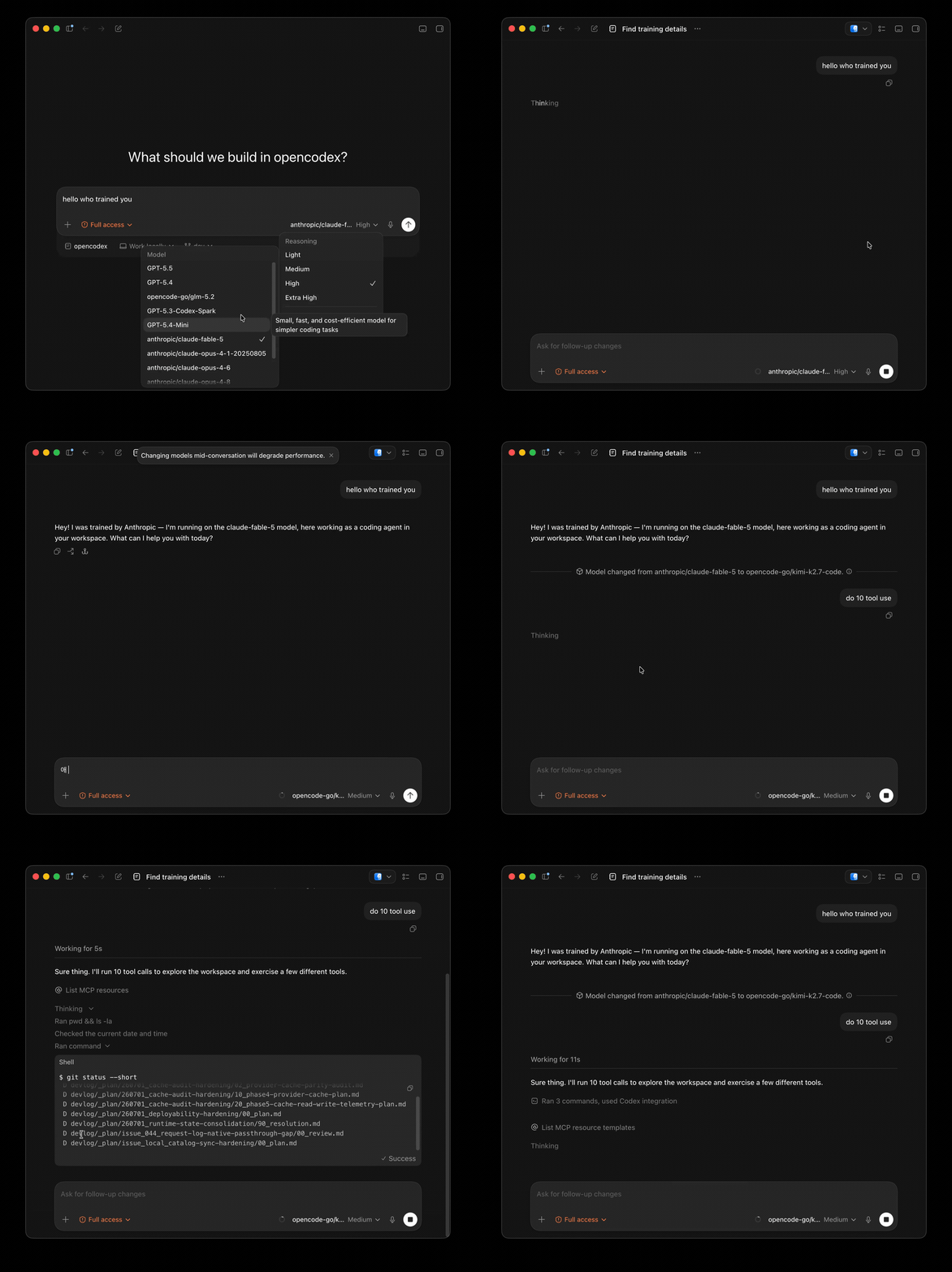
Universal provider proxy for OpenAI Codex & Claude Code — use any LLM (Claude, Gemini, Grok, DeepSeek, Ollama…) with Codex CLI, App, SDK, and Claude Code

Git-native persistent memory for AI coding agents. Implements Google OKF v0.2 with sub-300µs in-memory BM25 search, embedded MCP server, and progressive disclosure. Slashes token bloat by 80% with zero external databases or dependencies. Built in pure Go.

Local-first code intelligence graph for MCP and CLI. Builds a persistent map of your codebase so AI coding tools read only what matters, with benchmarked context reductions on reviews and large-repo workflows.

Stop your AI from making things up — it proposes, deterministic tools decide, every claim checked against ground truth with evidence. Grounded facts and context survive resets. Reverse engineering is the proving ground. MCP server + CLI.