
koala73/worldmonitorConnectors
Real-time global intelligence dashboard. AI-powered news aggregation, geopolitical monitoring, and infrastructure tracking in a unified situational awareness interface
86k
This repo turns a folder of PDFs into a searchable knowledge base for MCP-compatible agents. The backend processes documents into vectors, the frontend manages uploads and search, and the MCP endpoint exposes the data to tools like Cursor.
Builders who want Cursor or another MCP client to search PDF documents from inside their workflow.
You can ask your agent questions about PDFs without manually opening and skimming each file.
Uploads PDFs, extracts text, chunks it, and stores embeddings for later search.
Searches across processed documents using vector similarity instead of keyword matches.
Exposes the document store through MCP so Cursor can query it directly.
Uses WebSockets to show document processing progress in the web UI.
Provides a React and Chakra UI app for managing documents and running queries.
git clone https://github.com/yourusername/PdfRagMcpServer.git
cd PdfRagMcpServer
curl -sS https://astral.sh/uv/install.sh | bash
uv init .
uv venv
source .venv/bin/activate
uv pip install -r backend/requirements.txt
uv run run.py
# Make the script executable if needed
chmod +x build_frontend.py

# Run the script
./build_frontend.py
cd backend
uv pip install -r requirements.txt
python -m app.main
A powerful document knowledge base system that leverages PDF processing, vector storage, and MCP (Model Context Protocol) to provide semantic search capabilities for PDF documents. This system allows you to upload, process, and query PDF documents through a modern web interface or via the MCP protocol for integration with AI tools like Cursor.
The system consists of:
Clone the repository:
git clone https://github.com/yourusername/PdfRagMcpServer.git
cd PdfRagMcpServer
Install uv if you don't have it already:
curl -sS https://astral.sh/uv/install.sh | bash
Install dependencies using uv:
uv init .
uv venv
source .venv/bin/activate
uv pip install -r backend/requirements.txt
Start the application with the convenient script:
uv run run.py
Access the web interface at http://localhost:8000
Using with Cursor
Go Settings -> Cursor Settings -> MCP -> Add new global MCP server, paste below into your Cursor ~/.cursor/mcp.json file. See Cursor MCP docs for more info.
{
  "mcpServers": {
    "pdf-rag": {
      "url": "http://localhost:7800/mcp"
    }
  }
}
You could also change localhost into the host ip you deployed the service. After this confige added to the mcp json, you will see the mcp server showes at the Cursor mcp config page, switch it on to enable the server:
If you need to rebuild the frontend, you have two options:
# Make the script executable if needed
chmod +x build_frontend.py

# Run the script
./build_frontend.py
This script will automatically:
# Navigate to frontend directory
cd frontend

# Install dependencies
npm install

# Build the frontend
npm run build

# Create static directory if it doesn't exist
mkdir -p ../backend/static

# Copy build files
cp -r dist/* ../backend/static/
After building the frontend, you can start the application using the run.py script.
For a production environment where the static files have already been built:
backend/static directorycd backend
uv pip install -r requirements.txt
python -m app.main
If you want to run the services separately for development:
Navigate to the backend directory:
cd backend
Install the dependencies with uv:
uv pip install -r requirements.txt
Run the backend server:
python -m uvicorn app.main:app --host 0.0.0.0 --port 8000 --reload
Navigate to the frontend directory:
cd frontend
Install the dependencies:
npm install
Run the development server:
npm run dev
http://localhost:8000/mcp/v1PdfRagMcpServer/
├── backend/ # FastAPI backend
│ ├── app/
│ │ ├── __init__.py
│ │ ├── main.py # Main FastAPI application
│ │ ├── database.py # Database models
│ │ ├── pdf_processor.py # PDF processing logic
│ │ ├── vector_store.py # Vector database interface
│ │ └── websocket.py # WebSocket handling
│ ├── static/ # Static files for the web interface
│ └── requirements.txt # Backend dependencies
├── frontend/ # React frontend
│ ├── public/
│ ├── src/
│ │ ├── components/ # UI components
│ │ ├── context/ # React context
│ │ ├── pages/ # Page components
│ │ └── App.jsx # Main application component
│ ├── package.json # Frontend dependencies
│ └── vite.config.js # Vite configuration
├── uploads/ # PDF file storage
└── README.md # This documentation
Contributions are welcome! Please feel free to submit a Pull Request.
This project is licensed under the MIT License - see the LICENSE file for details.
Sign in to join the discussion.
No comments yet. Be the first to say what this is good for.
Real-time global intelligence dashboard. AI-powered news aggregation, geopolitical monitoring, and infrastructure tracking in a unified situational awareness interface
High-performance code intelligence MCP server. Indexes codebases into a persistent knowledge graph — average repo in milliseconds. 158 languages, sub-ms queries, 99% fewer tokens. Single static binary, zero dependencies.
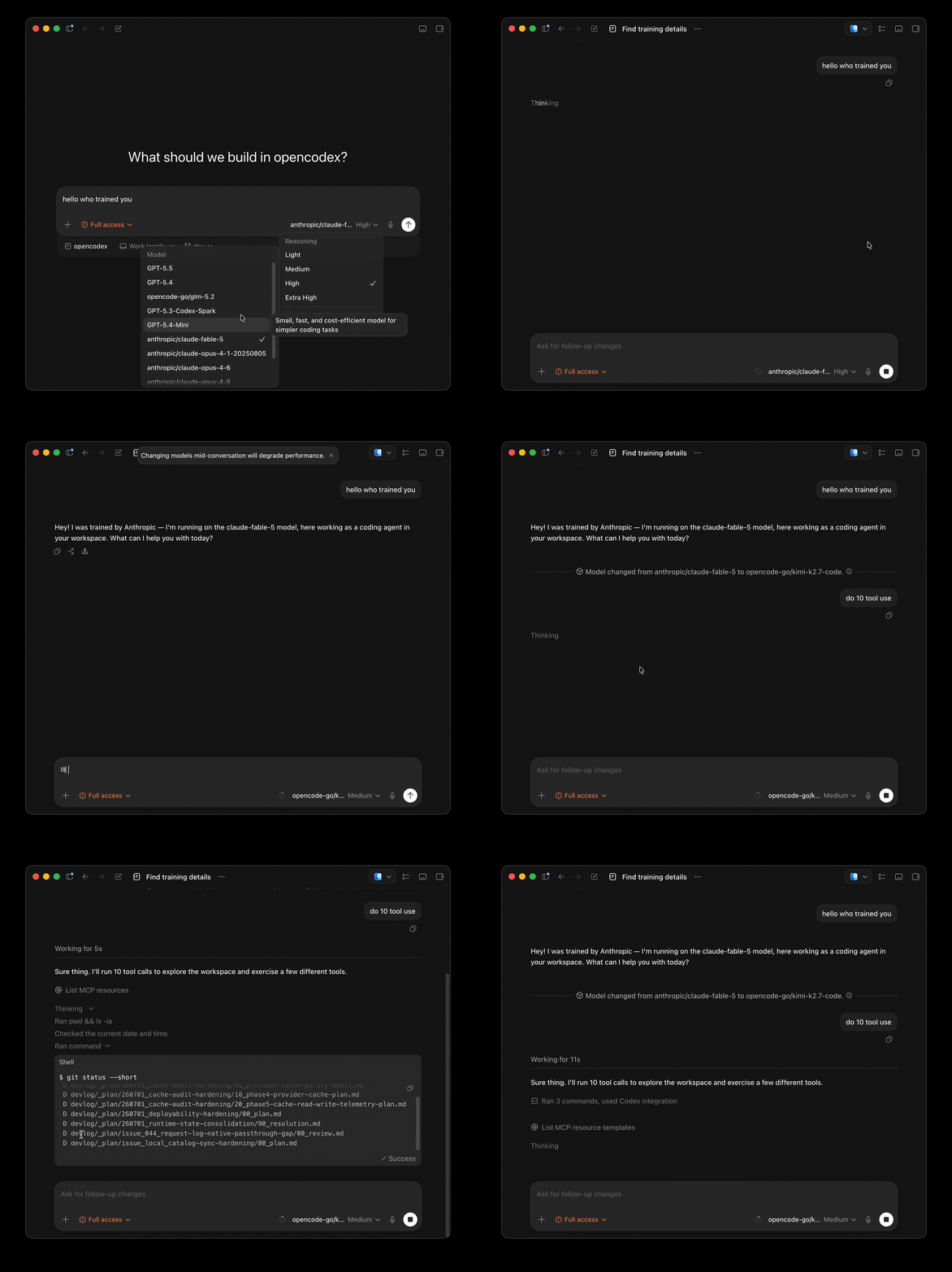
Universal provider proxy for OpenAI Codex & Claude Code — use any LLM (Claude, Gemini, Grok, DeepSeek, Ollama…) with Codex CLI, App, SDK, and Claude Code

Git-native persistent memory for AI coding agents. Implements Google OKF v0.2 with sub-300µs in-memory BM25 search, embedded MCP server, and progressive disclosure. Slashes token bloat by 80% with zero external databases or dependencies. Built in pure Go.

Local-first code intelligence graph for MCP and CLI. Builds a persistent map of your codebase so AI coding tools read only what matters, with benchmarked context reductions on reviews and large-repo workflows.

Stop your AI from making things up — it proposes, deterministic tools decide, every claim checked against ground truth with evidence. Grounded facts and context survive resets. Reverse engineering is the proving ground. MCP server + CLI.