
koala73/worldmonitorConnectors
Real-time global intelligence dashboard. AI-powered news aggregation, geopolitical monitoring, and infrastructure tracking in a unified situational awareness interface
86k
MCP ECharts exposes Apache ECharts as an MCP server for agents. It lets them build charts from data, validate ECharts options, and export results as PNG, SVG, or raw option JSON. When MinIO is configured, it can store chart images and return URLs instead of base64.

Builders who want their agent to create ECharts charts from data and return shareable outputs.
You can ask your agent for charts and get valid ECharts output without hand-writing chart config.
Generates Apache ECharts options with support for data, style, and theme settings.
Returns chart output as `png`, `svg`, or `option`.
Validates ECharts options so agents can fix syntax across multiple rounds.
Stores chart images in MinIO-compatible object storage and returns URLs instead of base64.
Runs locally without remote services.
Supports stdio, SSE, and streamable HTTP transport.
npm install -g mcp-echarts
# For SSE transport (default endpoint: /sse)
mcp-echarts -t sse

# For Streamable transport with custom endpoint
mcp-echarts -t streamable
# Download MinIO (macOS example)
brew install minio/stable/minio

# Start MinIO server
minio server ~/minio-data --console-address :9001
npm install
npm run build
npm run start
MCP ECharts 



Generate Apache ECharts with AI MCP dynamically for chart generation and data analysis. Also you can use 

ECharts, include data, style, theme and so on.png, svg, and option formats, with validation for ECharts to facilitate the model's multi-round output of correct syntax and graphics.MinIO object storage and return URLs instead of Base64 data for better performance and sharing capabilities.zero dependence.secure, fully generated locally, without relying on any remote services.To use with Desktop APP, such as Claude, VSCode, Cline, Cherry Studio, and so on, add the MCP server config below. On Mac system:
{
  "mcpServers": {
    "mcp-echarts": {
      "command": "npx",
      "args": [
        "-y",
        "mcp-echarts"
      ]
    }
  }
}
On Window system:
{
  "mcpServers": {
    "mcp-echarts": {
      "command": "cmd",
      "args": [
        "/c",
        "npx",
        "-y",
        "mcp-echarts"
      ]
    }
  }
}
Also, you can use it on modelscope, glama.ai, skillselion.com or others with HTTP, SSE Protocol.
Install the package globally.
npm install -g mcp-echarts
Run the server with your preferred transport option:
# For SSE transport (default endpoint: /sse)
mcp-echarts -t sse

# For Streamable transport with custom endpoint
mcp-echarts -t streamable
Then you can access the server at:
http://localhost:3033/ssehttp://localhost:3033/mcpYou can also use the following CLI options when running the MCP server. Command options by run cli with -h.
MCP ECharts CLI

Options:
  --transport, -t  Specify the transport protocol: "stdio", "sse", or "streamable" (default: "stdio")
  --port, -p       Specify the port for SSE or streamable transport (default: 3033)
  --endpoint, -e   Specify the endpoint for the transport:
                    - For SSE: default is "/sse"
                    - For streamable: default is "/mcp"
  --help, -h       Show this help message
For better performance and sharing capabilities, you can configure MinIO object storage to store chart images as URLs instead of Base64 data.
[!NOTE] If MinIO is not configured or unavailable, the system automatically falls back to
Base64data output, ensuring compatibility.
We can Integrate with MinIO object storage providers below.
Also, we can setup MinIO locally for free.
Install and start MinIO locally:
# Download MinIO (macOS example)
brew install minio/stable/minio

# Start MinIO server
minio server ~/minio-data --console-address :9001
Configure environment variables:
# Copy the example environment file
cp .env.example .env

# Edit .env with your MinIO settings
MINIO_ENDPOINT=localhost
MINIO_PORT=9000
MINIO_USE_SSL=false
MINIO_ACCESS_KEY=minioadmin
MINIO_SECRET_KEY=minioadmin
MINIO_BUCKET_NAME=mcp-echarts
Install dependencies:
npm install
Build the server:
npm run build
Start the MCP server:
npm run start
15+ charting MCP tool. #2MinIO to save the chart image base64 and return the url. #10@napi-rs/canvas instead node-canvas. #3outputType schema for all chart tools. #24MIT@hustcc.
Sign in to join the discussion.
No comments yet. Be the first to say what this is good for.
Real-time global intelligence dashboard. AI-powered news aggregation, geopolitical monitoring, and infrastructure tracking in a unified situational awareness interface
High-performance code intelligence MCP server. Indexes codebases into a persistent knowledge graph — average repo in milliseconds. 158 languages, sub-ms queries, 99% fewer tokens. Single static binary, zero dependencies.
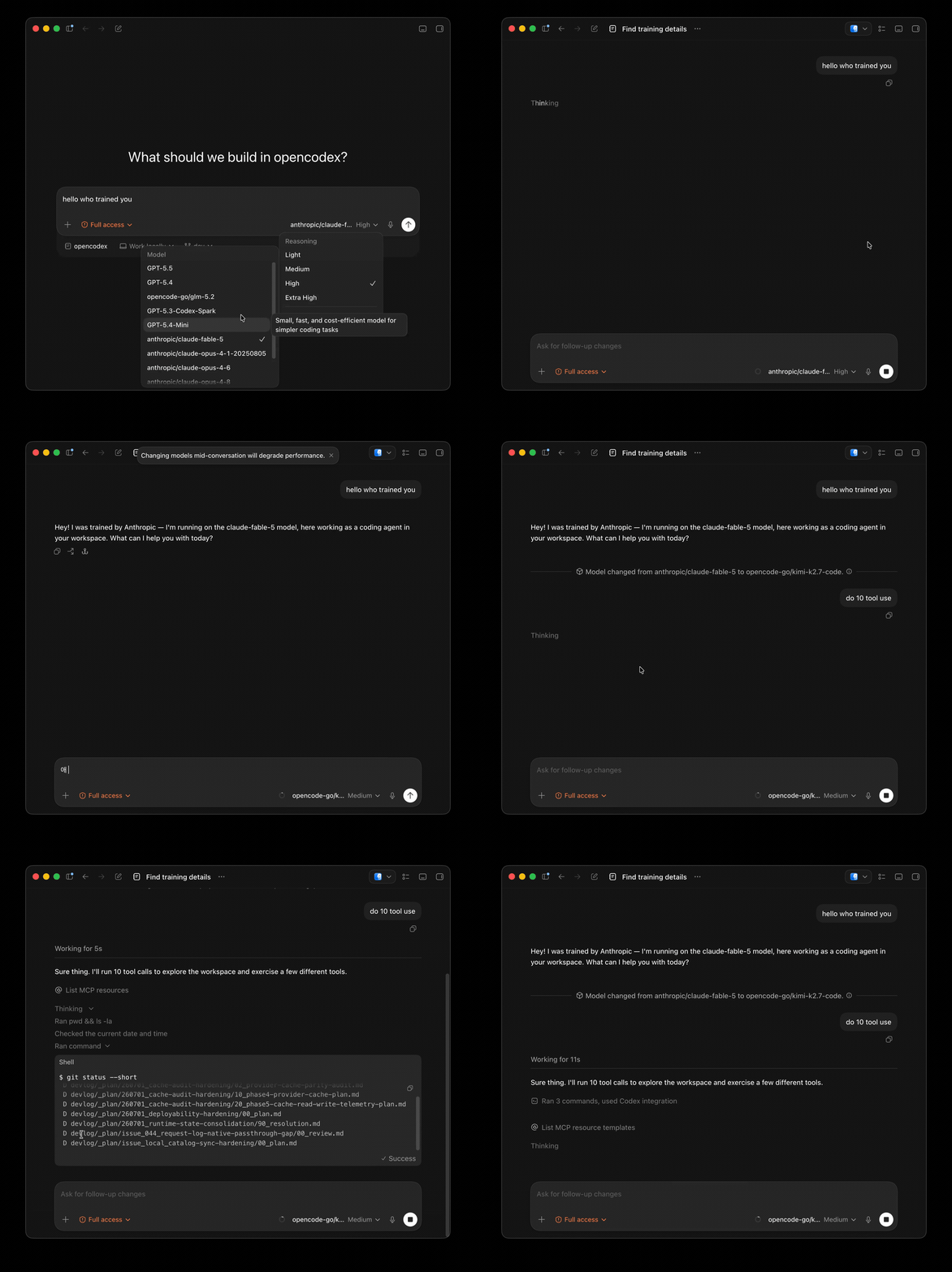
Universal provider proxy for OpenAI Codex & Claude Code — use any LLM (Claude, Gemini, Grok, DeepSeek, Ollama…) with Codex CLI, App, SDK, and Claude Code

Git-native persistent memory for AI coding agents. Implements Google OKF v0.2 with sub-300µs in-memory BM25 search, embedded MCP server, and progressive disclosure. Slashes token bloat by 80% with zero external databases or dependencies. Built in pure Go.

Local-first code intelligence graph for MCP and CLI. Builds a persistent map of your codebase so AI coding tools read only what matters, with benchmarked context reductions on reviews and large-repo workflows.

Stop your AI from making things up — it proposes, deterministic tools decide, every claim checked against ground truth with evidence. Grounded facts and context survive resets. Reverse engineering is the proving ground. MCP server + CLI.