
koala73/worldmonitorConnectors
Real-time global intelligence dashboard. AI-powered news aggregation, geopolitical monitoring, and infrastructure tracking in a unified situational awareness interface
86k
Conductor Tasks connects to editors through MCP or runs from the terminal as a CLI. It reads requirements, breaks them into tasks and steps, tracks progress, and can show kanban, dependency, and dashboard views.
Builders who want an agent to manage tasks, plans, and progress inside their editor or terminal.
You can turn a PRD or rough notes into actionable tasks and keep the work organized as you build.
Parses PRDs, markdown files, or notes into structured tasks.
Creates subtasks and step-by-step implementation plans for a task.
Includes commands like `init`, `parse-prd`, `list`, `next`, `get`, `update`, and `generate-steps` for terminal use.
Shows work as kanban boards, dependency trees, and summary dashboards.
Works with OpenAI, Anthropic, Groq, Mistral, Google Gemini, Perplexity, xAI, Azure OpenAI, and custom OpenAI-compatible endpoints.
Creates tasks from built-in or custom templates to standardize repeated work.
# Install globally (recommended for CLI use)
npm install -g conductor-tasks

# Or use npx without installing globally
# npx conductor-tasks <command>


Transform requirements into actionable tasks, generate implementation plans, track progress, and accelerate development – all powered by AI, directly within your workflow.
Conductor Tasks is an intelligent assistant designed for developers. It integrates seamlessly into your editor (via MCP) or works as a standalone CLI tool, leveraging multiple LLMs to streamline your development process from planning to execution.
While many AI-powered task management tools offer valuable assistance, Conductor Tasks is engineered to provide a more comprehensive, flexible, and deeply integrated AI development assistant. Here's how Conductor Tasks stands out:
True Multi-LLM Architecture for Optimal Results & Cost: Conductor Tasks is built with a foundational multi-LLM strategy, not just as an add-on. It seamlessly integrates with a broad spectrum of providers (OpenAI, Anthropic, Groq, Mistral, Google Gemini, Perplexity, xAI, Azure OpenAI, OpenRouter) and local/custom endpoints (e.g., Ollama, LM Studio). This empowers you to:
Unlike systems that may rely heavily on a single primary LLM or offer limited provider choices, Conductor Tasks offers genuine flexibility and strategic LLM utilization at its core.
Advanced AI-Driven Development & Task Lifecycle Management: Beyond basic PRD parsing, Conductor Tasks offers a richer suite of AI tools that assist throughout the development lifecycle:
generate-implementation-steps and expand-task provide detailed, actionable plans.suggest-task-improvements to iteratively refine task definitions and scope.research-topic command allows AI to gather information directly related to a task, embedding knowledge gathering into your workflow.generate-diff help in visualizing and creating code changes.This provides a more in-depth AI partnership from planning through to aspects of implementation, exceeding the scope of simpler task generation tools.
Built-in Visual Project Oversight: Gain clearer insights into your project's status and structure with:
visualize-tasks-kanban for a familiar agile overview.visualize-tasks-dependency-tree to understand task relationships.visualize-tasks-dashboard for a high-level statistical view.Many task systems require external tools for such visualizations; Conductor Tasks integrates them.
Versatile Task Templating Engine: Standardize common project setups and repetitive task structures with:
list-task-templates, get-task-template, and create-task-from-template.This feature promotes reusability and efficiency, often not found in less comprehensive task systems.
In essence, Conductor Tasks aims to be a more powerful, adaptable, and economically sensible AI co-pilot for the entire development process.
mcp.json, settings.json):
{
  "mcpServers": {
    "conductor-tasks": {
      "command": "npx",
      // Ensure conductor-tasks is installed or use the correct path
      "args": ["conductor-tasks", "--serve-mcp"],
      // Set API keys and preferences via environment variables
      "env": {
        "OPENAI_API_KEY": "YOUR_OPENAI_KEY_HERE",
        "ANTHROPIC_API_KEY": "YOUR_ANTHROPIC_KEY_HERE",
        "GOOGLE_API_KEY": "YOUR_GOOGLE_KEY_HERE",
        // Add other keys (MISTRAL, GROQ, PERPLEXITY, OPENROUTER, XAI, AZURE) as needed
        "DEFAULT_LLM_PROVIDER": "openai" // Or your preferred default
      }
    }
  }
}
"Initialize conductor-tasks for my project.""Parse the PRD at 'docs/requirements.md' into tasks.""What's the next task I should work on?""Help me implement task <ID>.""Generate implementation steps for task <ID>.""Show me the tasks as a kanban board."# Install globally (recommended for CLI use)
npm install -g conductor-tasks
# Or use npx without installing globally
# npx conductor-tasks <command>
.env file in your project or export variables (e.g., export OPENAI_API_KEY="sk-..."). See Configuration below.# Initialize Conductor Tasks in a new or existing project
conductor-tasks init --projectName "My Awesome App" --projectDescription "Building the future"
# Parse a PRD file and create/update TASKS.md
conductor-tasks parse-prd ./path/to/your/prd.md --createTasksFile
# List all tasks
conductor-tasks list
# Get the next suggested task
conductor-tasks next
# Get details for a specific task
conductor-tasks get --id <TASK_ID>
# Update a task (e.g., set status to 'in_progress')
conductor-tasks update --id <TASK_ID> --status in_progress
# Generate detailed implementation steps for a task
conductor-tasks generate-steps --id <TASK_ID>
# Visualize tasks
conductor-tasks visualize --kanban
conductor-tasks visualize --dependency-tree
For more detailed information, check out the documentation in the docs directory or explore the CLI help (conductor-tasks --help or conductor-tasks <command> --help).
docs/mcp-setup.md) (Detailed guide for MCP-specific environment variables and editor integration)Conductor Tasks uses environment variables for configuration, typically loaded from a .env file in your project root or set via MCP. For a detailed guide on environment variable settings, please see the MCP Configuration Guide.
Required:
OPENAI_API_KEY, ANTHROPIC_API_KEY, GOOGLE_API_KEY, MISTRAL_API_KEY, GROQ_API_KEY, PERPLEXITY_API_KEY, OPENROUTER_API_KEY, XAI_API_KEY, AZURE_OPENAI_API_KEY).Optional:
DEFAULT_LLM_PROVIDER: (e.g., openai, anthropic, google) Sets the default provider if multiple keys are present.OPENAI_MODEL, ANTHROPIC_MODEL, etc.: Specify default models for each provider.OPENAI_BASE_URL: Use a custom OpenAI-compatible endpoint (e.g., for Ollama, LM Studio).LOG_LEVEL: (e.g., info, debug) Control logging verbosity.Example .env file:
# Required Keys (add all you intend to use)
OPENAI_API_KEY=sk-...
ANTHROPIC_API_KEY=ant-...
GOOGLE_API_KEY=AIza...

# Optional Defaults & Customization
DEFAULT_LLM_PROVIDER=openai
OPENAI_MODEL=gpt-4o
ANTHROPIC_MODEL=claude-3-opus-20240229
# OPENAI_BASE_URL=http://localhost:11434/v1 # Example for local Ollama
LOG_LEVEL=info
Contributions, issues, and feature requests are welcome!
This project is licensed under the MIT License. See the LICENSE file for details.
Sign in to join the discussion.
No comments yet. Be the first to say what this is good for.
Real-time global intelligence dashboard. AI-powered news aggregation, geopolitical monitoring, and infrastructure tracking in a unified situational awareness interface
High-performance code intelligence MCP server. Indexes codebases into a persistent knowledge graph — average repo in milliseconds. 158 languages, sub-ms queries, 99% fewer tokens. Single static binary, zero dependencies.
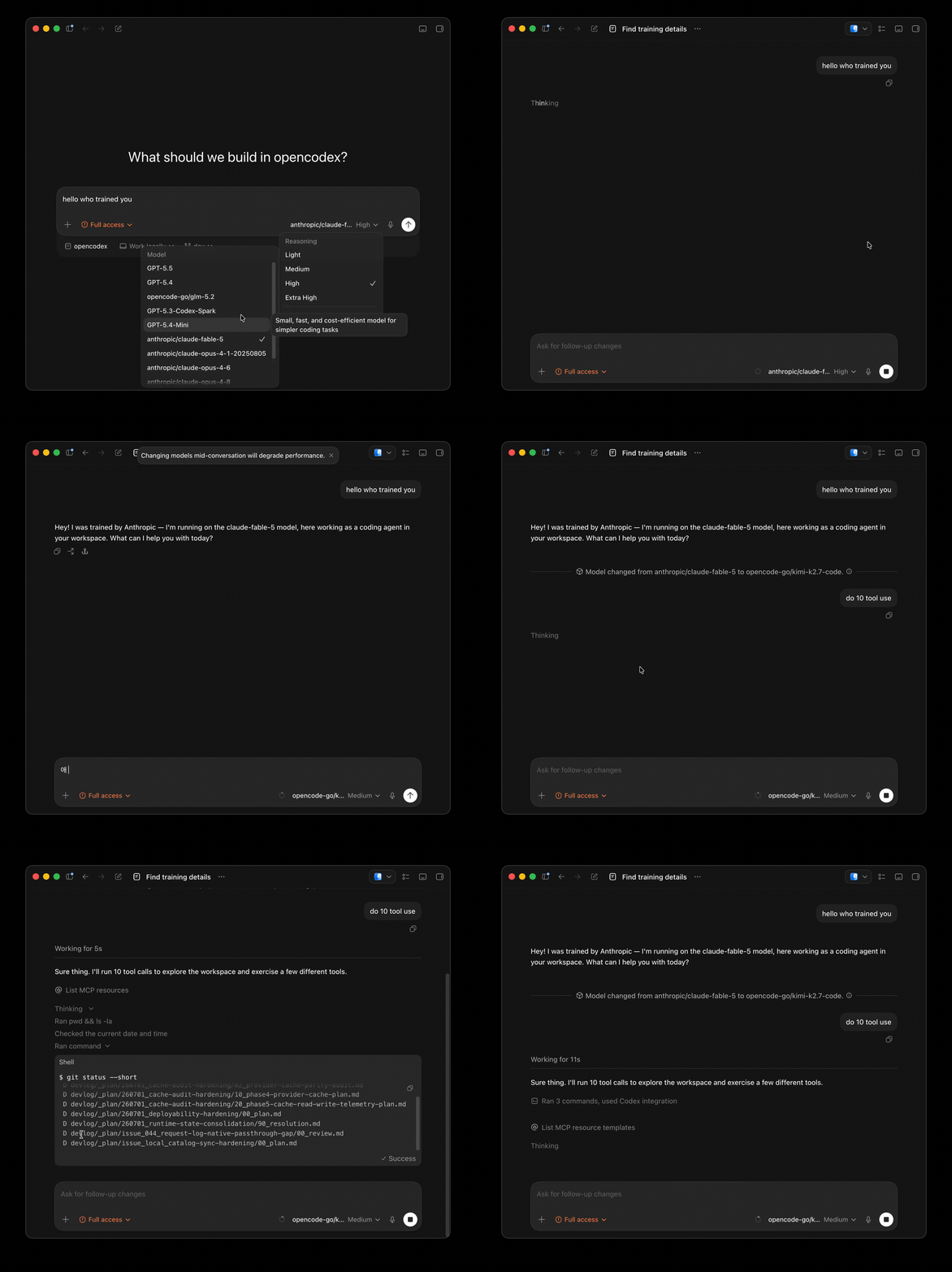
Universal provider proxy for OpenAI Codex & Claude Code — use any LLM (Claude, Gemini, Grok, DeepSeek, Ollama…) with Codex CLI, App, SDK, and Claude Code

Git-native persistent memory for AI coding agents. Implements Google OKF v0.2 with sub-300µs in-memory BM25 search, embedded MCP server, and progressive disclosure. Slashes token bloat by 80% with zero external databases or dependencies. Built in pure Go.

Local-first code intelligence graph for MCP and CLI. Builds a persistent map of your codebase so AI coding tools read only what matters, with benchmarked context reductions on reviews and large-repo workflows.

Stop your AI from making things up — it proposes, deterministic tools decide, every claim checked against ground truth with evidence. Grounded facts and context survive resets. Reverse engineering is the proving ground. MCP server + CLI.