
koala73/worldmonitorConnectors
Real-time global intelligence dashboard. AI-powered news aggregation, geopolitical monitoring, and infrastructure tracking in a unified situational awareness interface
86k
This is an MCP server that gives an agent tools for Excel workbooks. It supports creating, reading, updating, formatting, charting, pivot tables, and sheet management through stdio or HTTP transport.

Builders who want Claude Code, Cursor, Codex, or another MCP-capable agent to handle Excel files.
You can edit Excel workbooks through your agent instead of opening Excel and copying data by hand.
Create, read, update, copy, rename, and delete workbooks and sheets.
Work with formulas, ranges, validation, and data integrity checks.
Apply fonts, colors, borders, alignment, and conditional formatting.
Create styled Excel tables, chart types, and pivot tables for analysis.
Run over stdio for local use, or over SSE and streamable HTTP for remote connections.
Uses `EXCEL_FILES_PATH` for server-side file access and rejects absolute paths and traversal in remote transports.
uvx excel-mcp-server stdio
uvx excel-mcp-server sse
uvx excel-mcp-server streamable-http




A Model Context Protocol (MCP) server that lets you manipulate Excel files without needing Microsoft Excel installed. Create, read, and modify Excel workbooks with your AI agent.
The server supports three transport methods:
uvx excel-mcp-server stdio
{
   "mcpServers": {
      "excel": {
         "command": "uvx",
         "args": ["excel-mcp-server", "stdio"]
      }
   }
}
uvx excel-mcp-server sse
SSE transport connection:
{
   "mcpServers": {
      "excel": {
         "url": "http://localhost:8000/sse",
      }
   }
}
uvx excel-mcp-server streamable-http
Streamable HTTP transport connection:
{
   "mcpServers": {
      "excel": {
         "url": "http://localhost:8000/mcp",
      }
   }
}
When running the server with the SSE or Streamable HTTP protocols, you must set the EXCEL_FILES_PATH environment variable on the server side. This variable tells the server where to read and write Excel files.
./excel_files.filepath values must be relative to that directory (e.g. reports/q1.xlsx); absolute paths and directory traversal are rejected.You can also set the FASTMCP_PORT environment variable to control the port the server listens on (default is 8017 if not set).
$env:EXCEL_FILES_PATH="E:\MyExcelFiles"
$env:FASTMCP_PORT="8007"
uvx excel-mcp-server streamable-http
EXCEL_FILES_PATH=/path/to/excel_files FASTMCP_PORT=8007 uvx excel-mcp-server streamable-http
When using the stdio protocol, the file path is provided with each tool call, so you do not need to set EXCEL_FILES_PATH on the server. The server will use the path sent by the client for each operation.
The server provides a comprehensive set of Excel manipulation tools. See TOOLS.md for complete documentation of all available tools.
MIT License - see LICENSE for details.
Sign in to join the discussion.
No comments yet. Be the first to say what this is good for.
Real-time global intelligence dashboard. AI-powered news aggregation, geopolitical monitoring, and infrastructure tracking in a unified situational awareness interface
High-performance code intelligence MCP server. Indexes codebases into a persistent knowledge graph — average repo in milliseconds. 158 languages, sub-ms queries, 99% fewer tokens. Single static binary, zero dependencies.
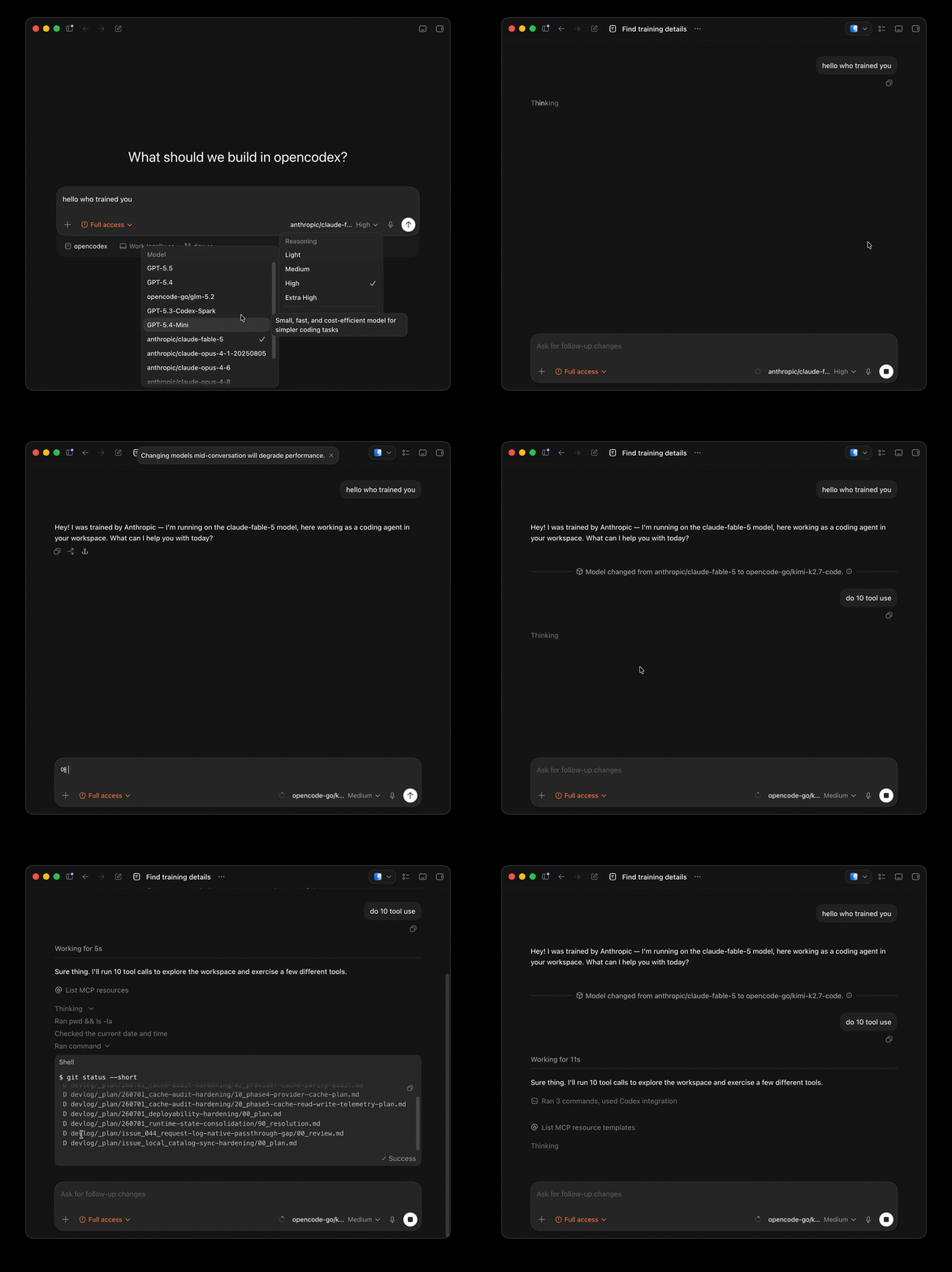
Universal provider proxy for OpenAI Codex & Claude Code — use any LLM (Claude, Gemini, Grok, DeepSeek, Ollama…) with Codex CLI, App, SDK, and Claude Code

Git-native persistent memory for AI coding agents. Implements Google OKF v0.2 with sub-300µs in-memory BM25 search, embedded MCP server, and progressive disclosure. Slashes token bloat by 80% with zero external databases or dependencies. Built in pure Go.

Local-first code intelligence graph for MCP and CLI. Builds a persistent map of your codebase so AI coding tools read only what matters, with benchmarked context reductions on reviews and large-repo workflows.

Stop your AI from making things up — it proposes, deterministic tools decide, every claim checked against ground truth with evidence. Grounded facts and context survive resets. Reverse engineering is the proving ground. MCP server + CLI.