
koala73/worldmonitorConnectors
Real-time global intelligence dashboard. AI-powered news aggregation, geopolitical monitoring, and infrastructure tracking in a unified situational awareness interface
86k
Comet MCP connects Claude Code to Perplexity Comet through MCP and CDP. Claude sends the goal, Comet handles browsing, login flows, page interaction, and long-running research tasks, then returns the results back to Claude.
Builders who use Claude Code or another MCP client and want browser work handled by Comet.
You can delegate web research and site navigation to Comet while Claude stays focused on the task.
Starts or connects to Perplexity Comet through remote debugging when a task needs the browser.
Lets Claude hand off research, navigation, and login-heavy workflows to Comet instead of controlling the page directly.
Provides tools to check progress on long-running tasks and stop work when needed.
Lets Claude request a screenshot of the current page for visual checking.
Supports Comet modes like search, research, labs, and learn.
You: "Use Comet to research the top AI frameworks in 2025"
Claude: [delegates to Comet, monitors progress, returns results]

You: "Log into my GitHub and check my notifications"
Claude: [Comet handles the login flow and navigation]

Give Claude Code a browser that thinks.
An MCP server that connects Claude Code to Perplexity Comet - enabling agentic web browsing, deep research, and real-time task monitoring.
Existing web tools for Claude Code fall into two categories, both with limitations:
Return static text. No interaction, no login, no dynamic content. Great for quick lookups, but can't navigate complex sites or fill forms.
Can interact with pages, but use a one-agent-do-all approach: the same reasoning model that's writing your code is also deciding where to click, what to type, and how to navigate. This overwhelms the context window and fragments focus.
Comet MCP takes a different approach. Instead of Claude controlling a browser directly, it delegates to Perplexity Comet - an AI purpose-built for web research and browsing.
Add to ~/.claude.json or .mcp.json:
{
  "mcpServers": {
    "comet-bridge": {
      "command": "npx",
      "args": ["-y", "comet-mcp"]
    }
  }
}
Download and install Perplexity Comet.
That's it! The MCP server automatically launches Comet with remote debugging when needed.
You: "Use Comet to research the top AI frameworks in 2025"
Claude: [delegates to Comet, monitors progress, returns results]

You: "Log into my GitHub and check my notifications"
Claude: [Comet handles the login flow and navigation]
| Tool | Description |
|---|---|
comet_connect | Connect to Comet (auto-starts if needed) |
comet_ask | Send a task and wait for response |
comet_poll | Check progress on long-running tasks |
comet_stop | Stop current task |
comet_screenshot | Capture current page |
comet_mode | Switch modes: search, research, labs, learn |
Claude Code  →  MCP Server  →  CDP  →  Comet Browser  →  Perplexity AI
   (reasoning)     (bridge)                              (web browsing)
Claude sends high-level goals ("research X", "log into Y"). Comet figures out the clicks, scrolls, and searches. Results flow back to Claude.
Works out of the box. Comet MCP auto-detects Windows and launches Comet from its default install location.
WSL2 requires mirrored networking to connect to Comet running on Windows:
Enable mirrored networking (one-time setup):
# Create/edit %USERPROFILE%\.wslconfig (Windows side)
[wsl2]
networkingMode=mirrored
Restart WSL:
wsl --shutdown
# Then reopen your WSL terminal
That's it! Comet MCP auto-detects WSL and uses PowerShell to communicate with Windows.
If mirrored networking isn't available, you'll see a helpful error message with setup instructions.
If Comet is installed in a non-standard location:
{
  "mcpServers": {
    "comet-bridge": {
      "command": "npx",
      "args": ["-y", "comet-mcp"],
      "env": {
        "COMET_PATH": "/path/to/your/Comet"
      }
    }
  }
}
"Cannot connect to Comet"
/Applications/Comet.app%LOCALAPPDATA%\Perplexity\Comet\Application\"WSL cannot connect to Windows localhost"
"Tools not showing in Claude"
MIT
Sign in to join the discussion.
No comments yet. Be the first to say what this is good for.
Real-time global intelligence dashboard. AI-powered news aggregation, geopolitical monitoring, and infrastructure tracking in a unified situational awareness interface
High-performance code intelligence MCP server. Indexes codebases into a persistent knowledge graph — average repo in milliseconds. 158 languages, sub-ms queries, 99% fewer tokens. Single static binary, zero dependencies.
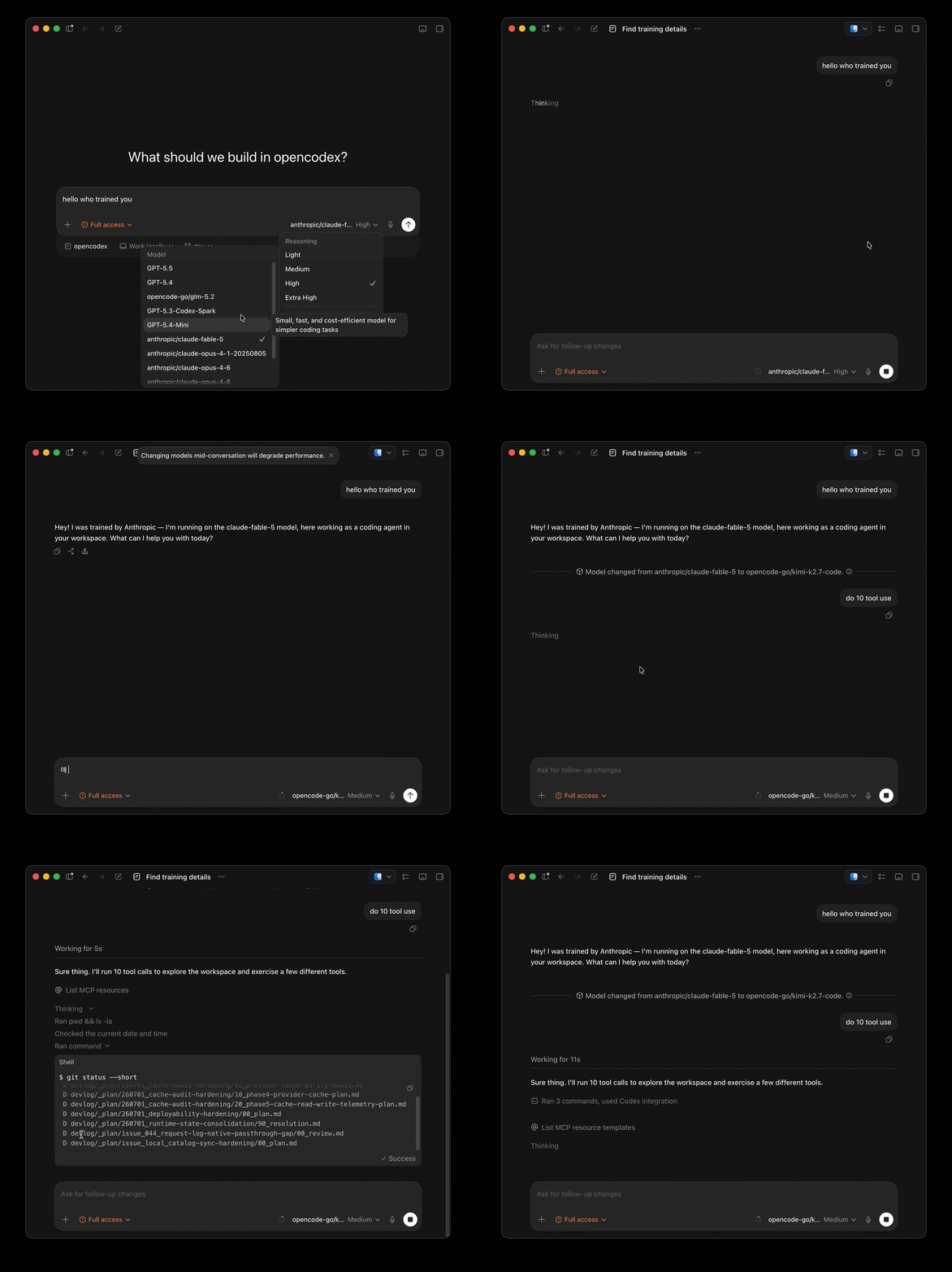
Universal provider proxy for OpenAI Codex & Claude Code — use any LLM (Claude, Gemini, Grok, DeepSeek, Ollama…) with Codex CLI, App, SDK, and Claude Code

Git-native persistent memory for AI coding agents. Implements Google OKF v0.2 with sub-300µs in-memory BM25 search, embedded MCP server, and progressive disclosure. Slashes token bloat by 80% with zero external databases or dependencies. Built in pure Go.

Local-first code intelligence graph for MCP and CLI. Builds a persistent map of your codebase so AI coding tools read only what matters, with benchmarked context reductions on reviews and large-repo workflows.

Stop your AI from making things up — it proposes, deterministic tools decide, every claim checked against ground truth with evidence. Grounded facts and context survive resets. Reverse engineering is the proving ground. MCP server + CLI.