

koala73/worldmonitorConnectors
Real-time global intelligence dashboard. AI-powered news aggregation, geopolitical monitoring, and infrastructure tracking in a unified situational awareness interface
86k
This server connects MCP clients to Graphlit so they can ingest content, query collections, and retrieve relevant sources from a shared knowledge base. It also exposes web crawling, web search, extraction, notifications, and connector tools for services like Slack, Google Drive, GitHub, Jira, and Notion.
Builders who use Cursor, Windsurf, Claude Desktop, or any MCP client and want Graphlit-backed knowledge and ingestion.
You can turn your agent into a searchable knowledge worker that pulls from your docs, messages, issues, and web sources.
Ingest files, web pages, messages, posts, emails, issues, text, and short-term memory into a Graphlit project.
Query contents, collections, feeds, and conversations, then retrieve relevant sources or similar images for context.
Use built-in web crawling, web search, web mapping, and page screenshots without adding separate services.
Connect Graphlit to Slack, Discord, Google Drive, GitHub, Jira, Linear, Notion, Outlook, OneDrive, SharePoint, Dropbox, Box, and more.
Extract structured JSON from text and publish content as audio or images through MCP tools.
Expose project, contents, feeds, collections, workflows, conversations, and specifications as MCP resources.
npx -y graphlit-mcp-server
npx -y graphlit-mcp-server
npx -y graphlit-mcp-server
npx -y @smithery/cli install @graphlit/graphlit-mcp-server --client claude
"command": "C:\\Windows\\System32\\cmd.exe /c npx"

The Model Context Protocol (MCP) Server enables integration between MCP clients and the Graphlit service. This document outlines the setup process and provides a basic example of using the client.
Ingest anything from Slack, Discord, websites, Google Drive, email, Jira, Linear or GitHub into a Graphlit project - and then search and retrieve relevant knowledge within an MCP client like Cursor, Windsurf, Goose or Cline.
Your Graphlit project acts as a searchable, and RAG-ready knowledge base across all your developer and product management tools.
Documents (PDF, DOCX, PPTX, etc.) and HTML web pages will be extracted to Markdown upon ingestion. Audio and video files will be transcribed upon ingestion.
Web crawling and web search are built-in as MCP tools, with no need to integrate other tools like Firecrawl, Exa, etc. separately.
You can read more about the MCP Server use cases and features on our blog.
Watch our latest YouTube video on using the Graphlit MCP Server with the Goose MCP client.
For any questions on using the MCP Server, please join our Discord community and post on the #mcp channel.
Before you begin, ensure you have the following:
The Graphlit MCP Server supports environment variables to be set for authentication and configuration:
GRAPHLIT_ENVIRONMENT_ID: Your environment ID.GRAPHLIT_ORGANIZATION_ID: Your organization ID.GRAPHLIT_JWT_SECRET: Your JWT secret for signing the JWT token.You can find these values in the API settings dashboard on the Graphlit Platform.
For quick installation, use one of the one-click install buttons below:

For manual installation, add the following JSON block to your User Settings (JSON) file in VS Code. You can do this by pressing Ctrl + Shift + P and typing Preferences: Open User Settings (JSON).
Optionally, you can add it to a file called .vscode/mcp.json in your workspace. This will allow you to share the configuration with others.
Note that the
mcpkey is not needed in the.vscode/mcp.jsonfile.
{
  "mcp": {
    "inputs": [
      {
        "type": "promptString",
        "id": "organization_id",
        "description": "Graphlit Organization ID",
        "password": true
      },
      {
        "type": "promptString",
        "id": "environment_id",
        "description": "Graphlit Environment ID",
        "password": true
      },
      {
        "type": "promptString",
        "id": "jwt_secret",
        "description": "Graphlit JWT Secret",
        "password": true
      }
    ],
    "servers": {
      "graphlit": {
        "command": "npx",
        "args": ["-y", "graphlit-mcp-server"],
        "env": {
          "GRAPHLIT_ORGANIZATION_ID": "${input:organization_id}",
          "GRAPHLIT_ENVIRONMENT_ID": "${input:environment_id}",
          "GRAPHLIT_JWT_SECRET": "${input:jwt_secret}"
        }
      }
    }
  }
}
To install graphlit-mcp-server in Windsurf IDE application, Cline should use NPX:
npx -y graphlit-mcp-server
Your mcp_config.json file should be configured similar to:
{
    "mcpServers": {
        "graphlit-mcp-server": {
            "command": "npx",
            "args": [
                "-y",
                "graphlit-mcp-server"
            ],
            "env": {
                "GRAPHLIT_ORGANIZATION_ID": "your-organization-id",
                "GRAPHLIT_ENVIRONMENT_ID": "your-environment-id",
                "GRAPHLIT_JWT_SECRET": "your-jwt-secret",
            }
        }
    }
}
To install graphlit-mcp-server in Cline IDE application, Cline should use NPX:
npx -y graphlit-mcp-server
Your cline_mcp_settings.json file should be configured similar to:
{
    "mcpServers": {
        "graphlit-mcp-server": {
            "command": "npx",
            "args": [
                "-y",
                "graphlit-mcp-server"
            ],
            "env": {
                "GRAPHLIT_ORGANIZATION_ID": "your-organization-id",
                "GRAPHLIT_ENVIRONMENT_ID": "your-environment-id",
                "GRAPHLIT_JWT_SECRET": "your-jwt-secret",
            }
        }
    }
}
To install graphlit-mcp-server in Cursor IDE application, Cursor should use NPX:
npx -y graphlit-mcp-server
Your mcp.json file should be configured similar to:
{
    "mcpServers": {
        "graphlit-mcp-server": {
            "command": "npx",
            "args": [
                "-y",
                "graphlit-mcp-server"
            ],
            "env": {
                "GRAPHLIT_ORGANIZATION_ID": "your-organization-id",
                "GRAPHLIT_ENVIRONMENT_ID": "your-environment-id",
                "GRAPHLIT_JWT_SECRET": "your-jwt-secret",
            }
        }
    }
}
To install graphlit-mcp-server for Claude Desktop automatically via Smithery:
npx -y @smithery/cli install @graphlit/graphlit-mcp-server --client claude
To use the Graphlit MCP Server in any MCP client application, use:
{
    "mcpServers": {
        "graphlit-mcp-server": {
            "command": "npx",
            "args": [
                "-y",
                "graphlit-mcp-server"
            ],
            "env": {
                "GRAPHLIT_ORGANIZATION_ID": "your-organization-id",
                "GRAPHLIT_ENVIRONMENT_ID": "your-environment-id",
                "GRAPHLIT_JWT_SECRET": "your-jwt-secret",
            }
        }
    }
}
Optionally, you can configure the credentials for data connectors, such as Slack, Google Email and Notion. Only GRAPHLIT_ORGANIZATION_ID, GRAPHLIT_ENVIRONMENT_ID and GRAPHLIT_JWT_SECRET are required.
{
    "mcpServers": {
        "graphlit-mcp-server": {
            "command": "npx",
            "args": [
                "-y",
                "graphlit-mcp-server"
            ],
            "env": {
                "GRAPHLIT_ORGANIZATION_ID": "your-organization-id",
                "GRAPHLIT_ENVIRONMENT_ID": "your-environment-id",
                "GRAPHLIT_JWT_SECRET": "your-jwt-secret",
                "SLACK_BOT_TOKEN": "your-slack-bot-token",
                "DISCORD_BOT_TOKEN": "your-discord-bot-token",
                "TWITTER_TOKEN": "your-twitter-token",
                "GOOGLE_EMAIL_REFRESH_TOKEN": "your-google-refresh-token",
                "GOOGLE_EMAIL_CLIENT_ID": "your-google-client-id",
                "GOOGLE_EMAIL_CLIENT_SECRET": "your-google-client-secret",
                "LINEAR_API_KEY": "your-linear-api-key",
                "GITHUB_PERSONAL_ACCESS_TOKEN": "your-github-pat",
                "JIRA_EMAIL": "your-jira-email",
                "JIRA_TOKEN": "your-jira-token",
                "NOTION_API_KEY": "your-notion-api-key"
            }
        }
    }
}
NOTE: when running 'npx' on Windows, you may need to explicitly call npx via the command prompt.
"command": "C:\\Windows\\System32\\cmd.exe /c npx"
Please refer to the Graphlit API Documentation.
For support with the Graphlit MCP Server, please submit a GitHub Issue.
For further support with the Graphlit Platform, please join our Discord community.
Sign in to join the discussion.
No comments yet. Be the first to say what this is good for.
Real-time global intelligence dashboard. AI-powered news aggregation, geopolitical monitoring, and infrastructure tracking in a unified situational awareness interface
High-performance code intelligence MCP server. Indexes codebases into a persistent knowledge graph — average repo in milliseconds. 158 languages, sub-ms queries, 99% fewer tokens. Single static binary, zero dependencies.
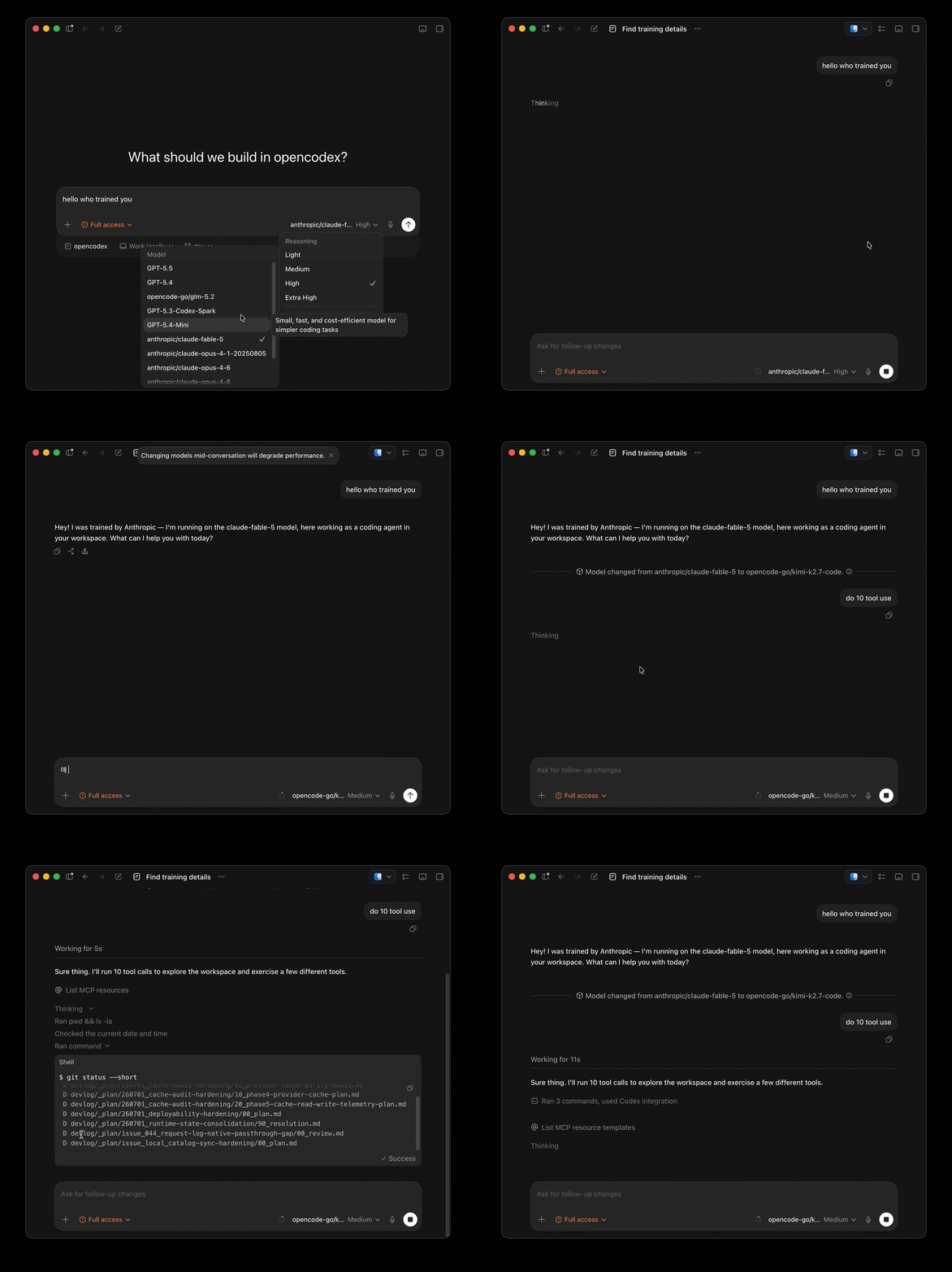
Universal provider proxy for OpenAI Codex & Claude Code — use any LLM (Claude, Gemini, Grok, DeepSeek, Ollama…) with Codex CLI, App, SDK, and Claude Code

Git-native persistent memory for AI coding agents. Implements Google OKF v0.2 with sub-300µs in-memory BM25 search, embedded MCP server, and progressive disclosure. Slashes token bloat by 80% with zero external databases or dependencies. Built in pure Go.

Local-first code intelligence graph for MCP and CLI. Builds a persistent map of your codebase so AI coding tools read only what matters, with benchmarked context reductions on reviews and large-repo workflows.

Stop your AI from making things up — it proposes, deterministic tools decide, every claim checked against ground truth with evidence. Grounded facts and context survive resets. Reverse engineering is the proving ground. MCP server + CLI.