

heygen-com/hyperframesFrameworks & SDKs
Write HTML. Render video. Built for agents.
49k
This SDK gives you a higher-level Python layer for building agents on Google Antigravity. It handles the agent lifecycle, conversation state, tool calls, hooks, triggers, and MCP servers so you can focus on the agent’s behavior.
Builders who want to build stateful agents in Python with Google Antigravity and Gemini.
You can build agents with managed state, tools, hooks, and external integrations without wiring the full runtime yourself.
The `Agent` class runs the lifecycle behind a single async context manager.
`ChatResponse` can stream text tokens, thoughts, and tool calls as they arrive.
`Conversation` keeps step history, turn count, and the last response across a session.
You can register Python functions as tools the agent can call.
`McpStdioServer` lets the agent connect to external MCP servers and use their tools.
Declarative policies like `deny`, `allow`, and `ask_user` control what the agent can do.
Background triggers like `every()` can send events into the agent on a schedule.
You can pass images, video, audio, and documents from memory or files.
pip install google-antigravity
export GEMINI_API_KEY="your_api_key_here"
python ./examples/getting_started/hello_world.py
The Google Antigravity SDK is a Python SDK for building AI agents powered by Antigravity and Gemini. It provides a secure, scalable, and stateful infrastructure layer that abstracts the agentic loop, letting you focus on what your agent does rather than how it runs.
pip install google-antigravity
[!IMPORTANT] The Google Antigravity SDK relies on a compiled runtime binary that is included in the platform-specific wheels published to PyPI. Cloning this repository alone is not sufficient to run the SDK. Always install from PyPI with
pip install google-antigravityto obtain the binary.
Get started by running one of the examples/, such as the
hello_world example with:
export GEMINI_API_KEY="your_api_key_here"
python ./examples/getting_started/hello_world.py
To use the SDK with Gemini Enterprise Agent Platform (formerly Vertex AI), the SDK supports two authentication modes:
For fast setup without requiring Google Cloud projects, regional configuration,
or Application Default Credentials (ADC), provide an API key with vertex=True:
from google.antigravity import Agent, LocalAgentConfig

config = LocalAgentConfig(
    vertex=True,
    api_key="your_api_key_here",
)

async with Agent(config) as agent:
    response = await agent.chat("Hello!")
    print(await response.text())
For enterprise deployments routing to regional endpoints, configure
LocalAgentConfig with vertex=True, project, and location. By default,
this mode authenticates via Application Default Credentials (ADC).
from google.antigravity import Agent, LocalAgentConfig

config = LocalAgentConfig(
    vertex=True,
    project="your-gcp-project",
    location="us-central1",
)

async with Agent(config) as agent:
    response = await agent.chat("Hello!")
    print(await response.text())
Alternatively, you can leave these fields unset in LocalAgentConfig and
export the environment variables instead:
# Either GOOGLE_GENAI_USE_VERTEXAI or GOOGLE_GENAI_USE_ENTERPRISE enable Vertex.
export GOOGLE_GENAI_USE_VERTEXAI=True
export GOOGLE_CLOUD_PROJECT="your-gcp-project"
export GOOGLE_CLOUD_LOCATION="us-central1"
Explicit kwargs always take precedence over env vars.
Ensure you have authenticated locally before running the agent in Standard Mode:
gcloud auth application-default login
See vertex.py for a complete example.
The Agent class is the easiest way to get started. It manages the full
lifecycle — binary discovery, tool wiring, hook registration, and policy
defaults — behind a single async context manager.
The system_instructions parameter is optional.
import asyncio
from google.antigravity import Agent, LocalAgentConfig

async def main():
    config = LocalAgentConfig(
        system_instructions="You are an expert assistant for codebase navigation.",
        # api_key="your_api_key_here",
    )
    async with Agent(config) as agent:
        response = await agent.chat("What files are in the current directory?")
        print(await response.text())

async def run():
    await main()

if __name__ == "__main__":
    asyncio.run(run())
To stream agent output in real-time (e.g., for fluid UI or console applications), simply iterate over the ChatResponse object using an async for loop. The stream wrapper natively yields conversational str text tokens as they arrive, with zero network overhead:
import asyncio
import sys
from google.antigravity import Agent, LocalAgentConfig

async def main():
    config = LocalAgentConfig()
    async with Agent(config) as agent:
        # Returns instantly — does not block
        response = await agent.chat("Write a short poem about space.")

        async for token in response:
            sys.stdout.write(token)
            sys.stdout.flush()
        print()

asyncio.run(main())
For more complex use cases, you can also stream internal model reasoning/thinking or intercept tool call dispatches in real-time using dedicated async stream properties:
# 1. Stream reasoning/thinking deltas
async for thought in response.thoughts:
    show_thinking_bubble(thought)

# 2. Stream strongly-typed ToolCall events
async for call in response.tool_calls:
    show_executing_spinner(call.name)
By default, Agent runs in read-only mode for safety. Pass
capabilities=CapabilitiesConfig() to enable all tools (including writes).
from google.antigravity import LocalAgentConfig, CapabilitiesConfig
from google.antigravity.utils.interactive import run_interactive_loop

config = LocalAgentConfig(
    # api_key="your_api_key_here",
    capabilities=CapabilitiesConfig(),
)
await run_interactive_loop(config)
For full control over the connection lifecycle, use Conversation with a
ConnectionStrategy directly. Conversation is a stateful session that
accumulates step history, provides a chat() convenience method, and exposes
state introspection:
import asyncio
from google.antigravity.connections.local import LocalConnectionStrategy
from google.antigravity.conversation.conversation import Conversation
from google.antigravity.tools.tool_runner import ToolRunner

async def main():
    tool_runner = ToolRunner()
    strategy = LocalConnectionStrategy(
        tool_runner=tool_runner,
    )

    async with Conversation.create(strategy) as conversation:
        # High-level: one-call send + collect
        response = await conversation.chat("What files are here?")
        print(await response.text())

        # Step history accumulates automatically
        print(f"Total steps: {len(conversation.history)}")
        print(f"Turns: {conversation.turn_count}")
        print(f"Last response: {conversation.last_response}")

        # Low-level: streaming steps
        await conversation.send("Tell me more.")
        async for step in conversation.receive_steps():
            if step.is_complete_response:
                print(step.content)

asyncio.run(main())
Pass rich multimedia file attachments (images, videos, audio, and documents) to the agent alongside textual instruction prompt lists.
You can attach assets directly using content classes (perfect for in-memory bytes) or conveniently from a filesystem path (which automatically resolves types and guesses MIME formats):
from google.antigravity import Agent, LocalAgentConfig
from google.antigravity.types import Image, from_file

config = LocalAgentConfig(system_instructions="You are an expert software architect.")
async with Agent(config) as agent:
    # 1. Flat filesystem shortcut (automatically resolves as types.Document)
    pdf_spec = from_file("spec.pdf")

    # 2. Direct constructor instantiation (perfect for in-memory raw bytes)
    chart_image = Image(
        data=b"raw_png_bytes_here",
        mime_type="image/png",
        description="Architecture blueprint"
    )

    # Send a mixed list of text instructions and content classes
    prompt = [
        "Analyze this chart against the specification and list three security vulnerabilities:",
        chart_image,
        pdf_spec
    ]
    response = await agent.chat(prompt)
    print(await response.text())
Register Python functions as tools that the agent can call:
def get_weather(city: str) -> str:
    """Returns the current weather for a city."""
    return f"It's sunny in {city}."

config = LocalAgentConfig(
    tools=[get_weather],
)
async with Agent(config) as agent:
    response = await agent.chat("What's the weather in Tokyo?")
Connect to external MCP servers and expose their tools to the agent:
from google.antigravity import Agent, LocalAgentConfig
from google.antigravity.types import McpStdioServer

config = LocalAgentConfig(
    mcp_servers=[McpStdioServer(name="my_server", command="npx", args=["my-mcp-server"])],
)
async with Agent(config) as agent:
    response = await agent.chat("Use the MCP tools to help me.")
Control agent behavior with a declarative policy system:
from google.antigravity import LocalAgentConfig, CapabilitiesConfig
from google.antigravity.hooks.policy import deny, allow, ask_user, enforce
from google.antigravity.utils.interactive import run_interactive_loop

policies = [
    deny("*"),                          # Block all tools by default
    allow("view_file"),                 # Allow reading files
    ask_user("run_command", handler=my_handler),  # Ask before running commands
]

config = LocalAgentConfig(
    capabilities=CapabilitiesConfig(),
    policies=policies,
)
await run_interactive_loop(config)
Run background tasks that react to external events and push messages into the agent:
from google.antigravity import LocalAgentConfig
from google.antigravity.triggers import every
from google.antigravity.utils.interactive import run_interactive_loop

async def check_status(ctx):
    await ctx.send("Check the deployment status.")

config = LocalAgentConfig(
    triggers=[every(60, check_status)],
)
await run_interactive_loop(config)
The SDK follows a three-layer architecture:
| Layer | Purpose | Key Classes |
|---|---|---|
| Layer 1 — Simplified | High-level, batteries-included entry point | Agent |
| Layer 2 — Session | Stateful session with history and convenience methods | Conversation, ChatResponse, Step, ToolCall, AgentConfig, HookRunner, ToolRunner, TriggerRunner |
| Layer 3 — Adapter | Transport and backend abstraction | Connection, ConnectionStrategy, LocalConnection |
For more detailed documentation on specific components, see:
Sign in to join the discussion.
No comments yet. Be the first to say what this is good for.
Write HTML. Render video. Built for agents.
Ultra-lightweight, open-source, self-hosted personal AI agent framework in Python with WebUI, tools, memory, MCP, multi-agent workflows, automation, and chat apps

SkillOpt is a text-space optimizer that trains reusable natural-language skills for frozen LLM agents through trajectory-driven edits, validation-gated updates, and deployable best_skill.md artifacts.
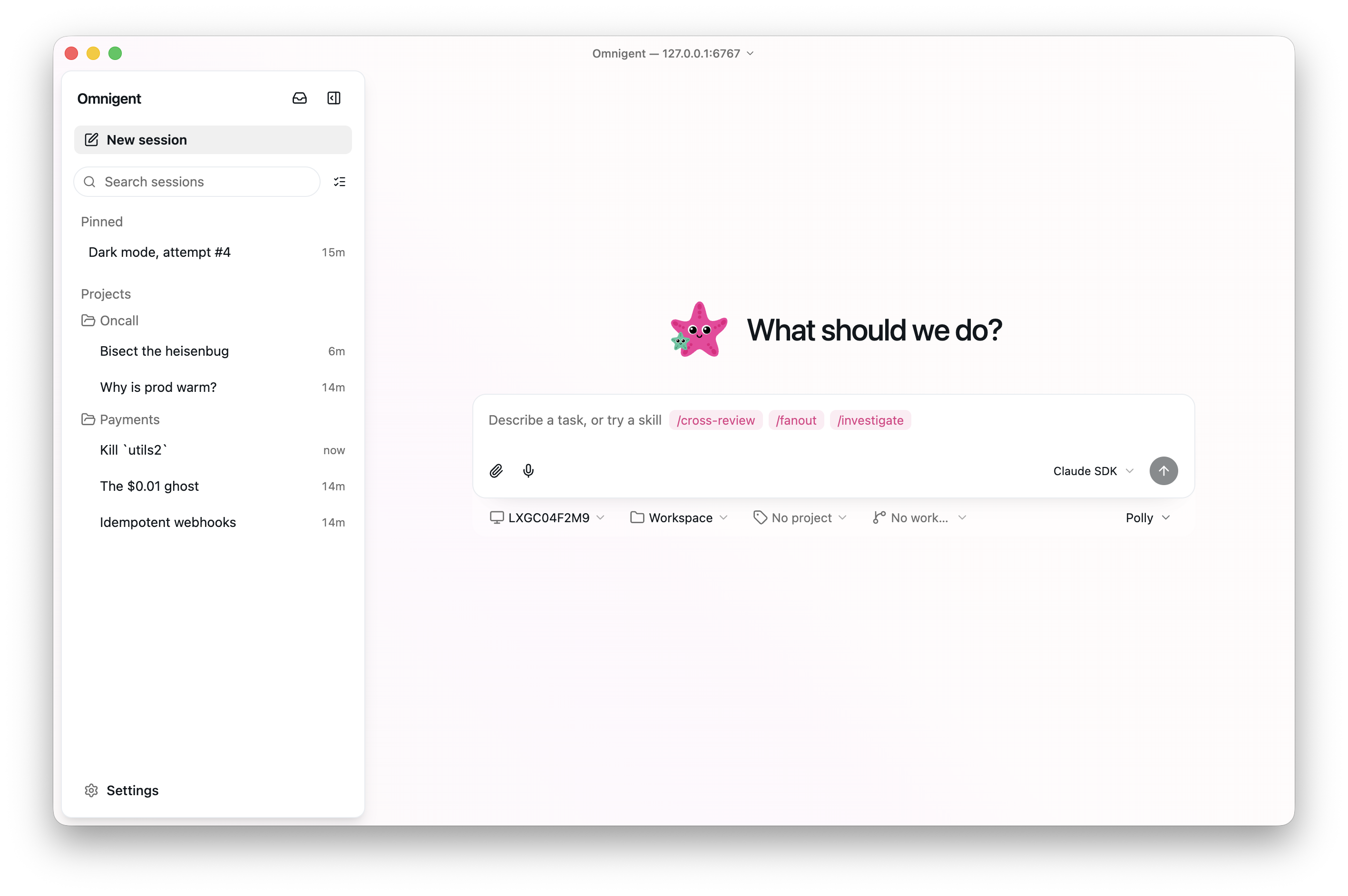
Omnigent is an open-source AI agent framework and meta-harness: orchestrate Claude Code, Codex, Cursor, Pi, and custom agents — swap harnesses without rewriting, enforce policies and sandboxing, and collaborate in real time from any device.

A theoretical reconstruction of the Claude Mythos architecture, built from first principles using the available research literature.
🕷️ An adaptive Web Scraping framework that handles everything from a single request to a full-scale crawl!