
NousResearch/
hermes-agent

The agent that grows with you
245k
Paseo runs a local daemon that manages coding agents and lets you control them from desktop, mobile, web, or the terminal. It supports multiple providers, parallel tasks, voice input, and device pairing, with plugins and an SDK for extending the system.

Builders who want one place to start, monitor, and hand off work between coding agents across devices.
You can coordinate multiple agents from one workspace instead of juggling separate tools and sessions.
Runs Claude Code, Codex, Copilot, OpenCode, and Pi through the same interface.
Works across iOS, Android, desktop, web, and CLI so you can start work in one place and continue in another.
Keeps agents on your own machine with your environment, tools, and credentials.
Lets you create, list, attach to, and send follow-up tasks to agents from the terminal with commands like `paseo run`, `paseo ls`, and `paseo attach`.
Supports TypeScript plugins for themes, workspace panels, commands, settings screens, and provider integrations.
Provides `@getpaseo/client` for building issue integrations, dashboards, and custom orchestration services.
Includes skills such as `/paseo-handoff`, `/paseo-advisor`, and `/paseo-committee` for agent-to-agent coordination.
npm install -g @getpaseo/cli
paseo
docker run -d --name paseo \
  -p 6767:6767 \
  -e PASEO_PASSWORD=change-me \
  -v "$PWD/paseo-home:/home/paseo" \
  -v "$PWD:/workspace" \
  ghcr.io/getpaseo/paseo:latest





One interface for Claude Code, Codex, Copilot, OpenCode, and Pi agents.

Run agents in parallel on your own machines. Ship from your phone or your desk.
Add themes, workspace panels, commands, settings screens, and coding-agent providers with trusted
TypeScript plugins. Install from a local directory or Git repository with paseo plugin add <source>.
See the plugin docs for your Paseo version, or start with the 0.8 beta quickstart. Plugins run with access to your daemon machine and inside connected clients; install only code you trust.
Paseo runs a local server called the daemon that manages your coding agents. Clients like the desktop app, mobile app, web app, and CLI connect to it.
You need at least one agent CLI installed and configured with your credentials:
Download it from paseo.sh/download or the GitHub releases page. Open the app and the daemon starts automatically. Nothing else to install.
To connect from your phone, open Settings → your host → Pair Device.
Install the CLI and start Paseo:
npm install -g @getpaseo/cli
paseo
Paseo starts locally, then asks whether to enable the end-to-end encrypted relay for device pairing. If you decline, connect directly over TCP, Tailscale, or another VPN. This path is useful for servers and remote machines.
For full setup and configuration, see:
Run the Paseo daemon and self-hosted web UI in Docker:
docker run -d --name paseo \
  -p 6767:6767 \
  -e PASEO_PASSWORD=change-me \
  -v "$PWD/paseo-home:/home/paseo" \
  -v "$PWD:/workspace" \
  ghcr.io/getpaseo/paseo:latest
Open http://localhost:6767 after it starts. Extend the base image with the agent CLIs you use, then provide credentials through environment variables or the persistent /home/paseo volume. See the Docker documentation for full setup details.
Everything you can do in the app, you can do from the terminal.
paseo run --provider claude/opus-4.6 "implement user authentication"
paseo run --provider codex/gpt-5.5 --worktree feature-x "implement feature X"

paseo ls                           # list running agents
paseo attach abc123                # stream live output
paseo send abc123 "also add tests" # follow-up task

# run on a remote daemon; --cwd is a path on that host
paseo run --host workstation.local:6767 --cwd /workspace "run the full test suite"
See the full CLI reference for more.
Build issue integrations, dashboards, and orchestration services with @getpaseo/client:
import { createPaseoClient } from "@getpaseo/client";

const client = createPaseoClient({ url: "ws://127.0.0.1:6767/ws" });
await client.connect();

const agent = await client.agents.create({
  config: { provider: "codex/gpt-5.5" },
  cwd: "/Users/me/dev/storefront",
  prompt: "Review the current diff and name the riskiest change.",
});

const result = await agent.waitForFinish();
console.log(result.lastMessage);

await client.close();
See the SDK quickstart, recipes, and API reference.
Skills teach your agent to use Paseo to orchestrate other agents.
npx skills add getpaseo/paseo
Then use them in any agent conversation:
/paseo-handoff — hand off work between agents. I use this to plan with Claude and then handoff to Codex to implement./paseo-advisor — spin up a single agent as an advisor for a second opinion, without delegating the work itself./paseo-committee — form a committee of two contrasting agents to step back, do root cause analysis, and produce a plan.Quick monorepo package map:
packages/server: Paseo daemon (agent process orchestration, WebSocket API, MCP server)packages/app: Expo client (iOS, Android, web)packages/cli: paseo CLI for daemon and agent workflowspackages/desktop: Electron desktop apppackages/relay: Relay transport and encryption used by the daemon and clientspackages/website: Marketing site and documentation (paseo.sh)Common commands:
# run all local dev services
npm run dev

# run individual surfaces
npm run dev:server
npm run dev:app
npm run dev:desktop
npm run dev:website

# build the server stack
npm run build:server

# repo-wide checks
npm run typecheck
Apache-2.0
Sign in to join the discussion.
No comments yet. Be the first to say what this is good for.
The agent that grows with you

Open-source coding agent for your terminal, built in Rust and on a journey of continuous community improvement. Issues and PRs welcome.
A lightweight alternative to OpenClaw that runs in containers for security. Connects to WhatsApp, Telegram, Slack, Discord, Gmail and other messaging apps,, has memory, scheduled jobs, and runs directly on Anthropic's Agents SDK

OpenSquilla — Token-Efficient AI Agent with same budget, higher intelligence density
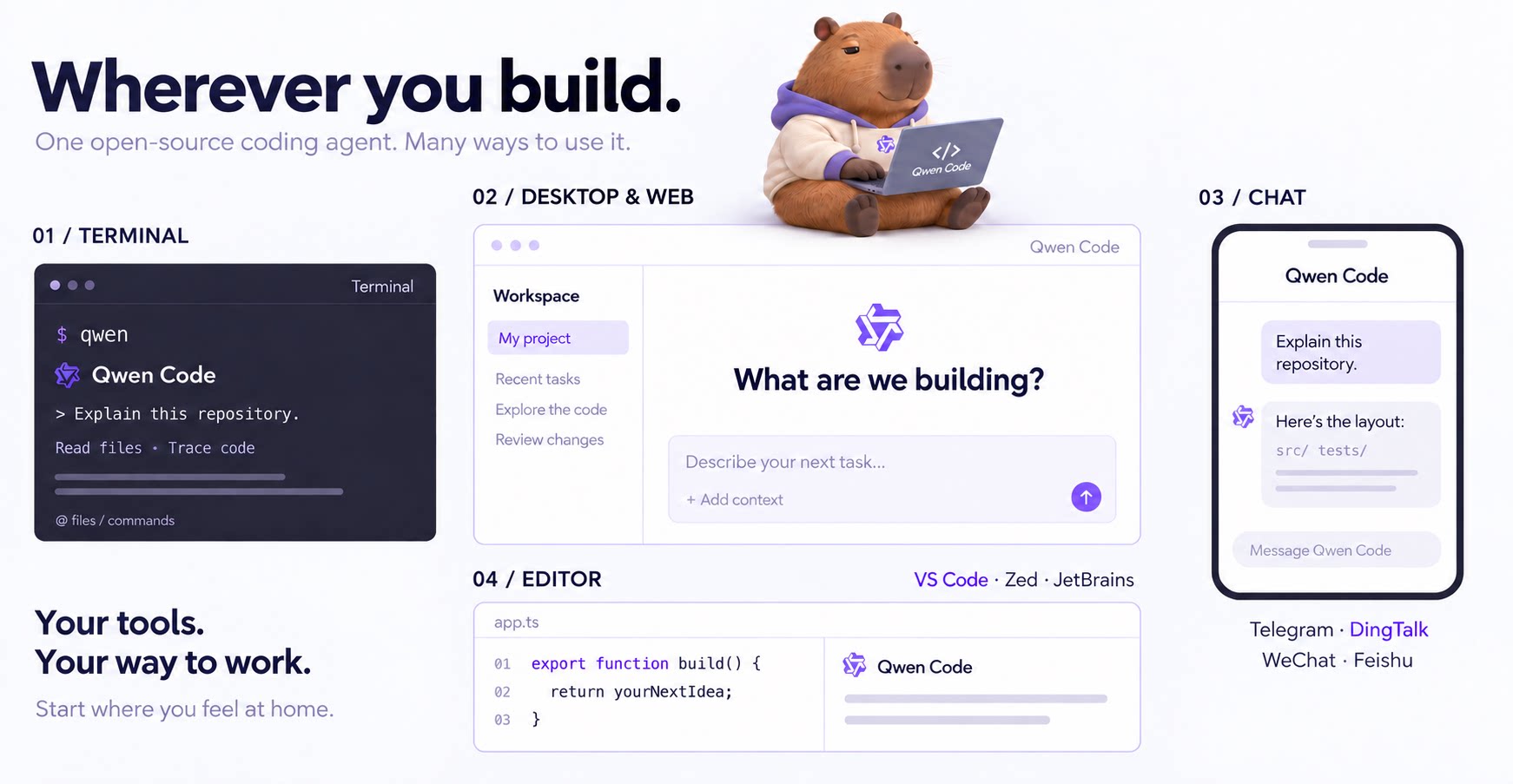
An open-source AI coding agent that lives in your terminal.

Run and supervise teams of coding agents from planning to merge. Any harness (Claude code, codex, +25 more). Desktop, web, mobile, and cloud agents.