
koala73/worldmonitorConnectors
Real-time global intelligence dashboard. AI-powered news aggregation, geopolitical monitoring, and infrastructure tracking in a unified situational awareness interface
86k
This repo provides an MCP server that lets a client talk to Basecamp 3 through OAuth-protected API calls. The FastMCP server in `basecamp_fastmcp.py` exposes tools for browsing projects, managing todos and messages, working with card tables and documents, downloading uploads, and searching across Basecamp.
Builders who want Codex or Cursor to work with Basecamp projects, tasks, messages, and files.
You can manage Basecamp work from your MCP client instead of switching into Basecamp for each read or edit.
Uses a local OAuth flow in `oauth_app.py` and shared token storage so the server can call the Basecamp API on your behalf.
Exposes dozens of MCP tools from `basecamp_fastmcp.py` for projects, todos, messages, comments, documents, uploads, events, webhooks, and search.
Creates local MCP config for Codex, Cursor, and Claude Desktop with `generate_codex_config.py`, `generate_cursor_config.py`, and `generate_claude_desktop_config.py`.
Searches across projects, todos, messages, campfire lines, comments, uploads, and schedules through `search_utils.py`.
Reads and edits card tables, columns, cards, and card steps, including completion and move actions.
Downloads vault uploads and inline attachments so the client can inspect file contents directly when supported.
git clone https://github.com/georgeantonopoulos/Basecamp-MCP-Server.git
cd Basecamp-MCP-Server

uv venv --python 3.12 venv
source venv/bin/activate
uv pip install -r requirements.txt
python setup.py
cp .env.example .env
BASECAMP_CLIENT_ID=your-client-id
BASECAMP_CLIENT_SECRET=your-client-secret
BASECAMP_ACCOUNT_ID=your-account-id
USER_AGENT="Your App Name (your@email.com)"
python oauth_app.py


An MCP server for Basecamp 3. It lets MCP-capable clients such as Codex, Cursor, and Claude Desktop read and manage Basecamp projects through OAuth-authenticated Basecamp API calls.
The main server is basecamp_fastmcp.py. It uses the official mcp.server.fastmcp Python SDK and exposes 79 tools covering projects, todos, message boards, campfires, card tables, inbox forwards, documents, uploads, comments, events, webhooks, and search.
If your system Python is older, use uv; it can create a virtual environment with a newer Python version.
Clone the repository and install dependencies:
git clone https://github.com/georgeantonopoulos/Basecamp-MCP-Server.git
cd Basecamp-MCP-Server

uv venv --python 3.12 venv
source venv/bin/activate
uv pip install -r requirements.txt
Or, if python already points to Python 3.10 or newer:
python setup.py
Create a .env file from the example and fill in your Basecamp OAuth details:
cp .env.example .env
Required values:
BASECAMP_CLIENT_ID=your-client-id
BASECAMP_CLIENT_SECRET=your-client-secret
BASECAMP_ACCOUNT_ID=your-account-id
USER_AGENT="Your App Name (your@email.com)"
Authenticate with Basecamp:
python oauth_app.py
Open http://localhost:8000 and complete the OAuth flow. The token is stored locally in oauth_tokens.json by default.
python generate_codex_config.py
codex mcp get basecamp
Useful options:
python generate_codex_config.py --dry-run
python generate_codex_config.py --legacy
The script writes a basecamp server entry to ~/.codex/config.toml and points it at this checkout's virtual environment and basecamp_fastmcp.py.
python generate_cursor_config.py
Then restart Cursor and check Settings -> MCP. The server should appear as basecamp.
python generate_claude_desktop_config.py
Then fully quit and reopen Claude Desktop. The generated config is written to:
~/Library/Application Support/Claude/claude_desktop_config.json~/AppData/Roaming/Claude/claude_desktop_config.json~/.config/claude-desktop/claude_desktop_config.jsonRun the FastMCP server through stdio and ask for its tool list:
printf '%s\n%s\n%s\n' \
  '{"jsonrpc":"2.0","id":1,"method":"initialize","params":{"protocolVersion":"2025-06-18","capabilities":{},"clientInfo":{"name":"test","version":"1.0"}}}' \
  '{"jsonrpc":"2.0","method":"notifications/initialized","params":{}}' \
  '{"jsonrpc":"2.0","id":2,"method":"tools/list","params":{}}' \
  | python basecamp_fastmcp.py
Run the automated tests:
python -m pytest tests/ -v
The FastMCP server exposes 82 tools.
get_projectsget_projectsearch_basecampglobal_searchget_assignable_people — all people who can have to-dos assigned to them
(GET /reports/todos/assigned.json)get_person_assignments — all active, pending to-dos assigned to one
person across all projects (GET /reports/todos/assigned/{id}.json,
optional group_by: bucket|date). Prefer this over iterating projects
when you need everything assigned to a single person.get_overdue_todos — all overdue to-dos across all projects, grouped by
lateness (GET /reports/todos/overdue.json)get_todolistsget_todolistcreate_todolistupdate_todolisttrash_todolistget_todosget_todocreate_todoupdate_tododelete_todoarchive_todocomplete_todouncomplete_todoreposition_todoget_todolist_groupscreate_todolist_groupreposition_todolist_groupget_message_boardget_messagesget_messageget_message_categoriescreate_messagecreate_draft_messagePass publish: false to create_message to create a draft message instead
of posting it immediately. Agents can also call create_draft_message directly
when the intended operation is specifically to create a draft.
get_campfire_linesget_daily_check_insget_question_answersget_commentscreate_commentget_card_tablesget_card_tableget_columnsget_columncreate_columnupdate_columnmove_columnupdate_column_colorput_column_on_holdremove_column_holdwatch_columnunwatch_columnget_cardsget_cardcreate_cardupdate_cardmove_cardcomplete_carduncomplete_cardget_card_stepscreate_card_stepget_card_stepupdate_card_stepdelete_card_stepcomplete_card_stepuncomplete_card_stepget_inboxget_forwardsget_forwardget_inbox_repliesget_inbox_replytrash_forwardcreate_attachmentget_uploadsget_uploaddownload_upload — download a vault Upload recording (Docs & Files) and
return its bytes as MCP content (ImageContent for image MIME types,
EmbeddedResource / BlobResourceContents otherwise). The MCP host
forwards the blob to the model, so PDFs, images, and documents are read
natively without an out-of-band fetch.download_attachment — download an inline comment/message attachment by its
content_attachments[].download_url and return it as MCP content. Use this
for files embedded into a comment or message body. Inline attachments are
Attachment objects with their own IDs and cannot be resolved through
/uploads/{id} — that endpoint returns 404. For files that are their own
Upload recording in a vault, use download_upload instead.Host compatibility for
download_uploadanddownload_attachment. Both tools return MCP content blocks. The file is only readable by the model if the MCP host forwardsImageContent/EmbeddedResource(BlobResourceContents) on. Status as of June 2026:
- Claude Code (CLI) — fully supported, including
application/pdfand other binary blob resources.- Claude Desktop / claude.ai web — image content blocks work, but non-image
EmbeddedResourceblocks are rejected with"Resources of type 'application/pdf' are not currently supported". The bytes reach the host but never the model. Once the client adds support, these tools become useful in those frontends without server changes.
get_documentsget_documentcreate_documentcreate_draft_documentPass publish: false to create_document to create a draft document instead
of publishing it immediately. Agents can also call create_draft_document
directly when the intended operation is specifically to create a draft.
update_documenttrash_documentget_eventsget_webhookscreate_webhookdelete_webhookbasecamp_fastmcp.py: FastMCP stdio server used by MCP clients.basecamp_client.py: Synchronous Basecamp 3 API client.search_utils.py: Higher-level search helpers across Basecamp resources.oauth_app.py: Local Flask OAuth flow for Basecamp authentication.auth_manager.py: OAuth refresh helper used before API calls.token_storage.py: Local OAuth token storage.generate_codex_config.py: Codex MCP configuration generator.generate_cursor_config.py: Cursor MCP configuration generator.generate_claude_desktop_config.py: Claude Desktop configuration generator.mcp_server_cli.py: Legacy JSON-RPC server kept for compatibility and tests.The recommended path is OAuth 2.0:
.env.python oauth_app.py.By default, OAuth tokens are stored in <project>/oauth_tokens.json. For containers, read-only checkouts, or mounted token volumes, set BASECAMP_MCP_TOKEN_FILE:
export BASECAMP_MCP_TOKEN_FILE=/var/lib/basecamp-mcp/oauth_tokens.json
Both the OAuth app and the MCP server read the same variable. token_storage.py expands ~ and environment variables in this path, creates the parent directory if needed, and attempts to set the token file permissions to 0o600 when writing. Parent directory permissions are still your responsibility.
If tools do not appear in your MCP client:
Confirm the virtual environment exists and has the MCP SDK:
./venv/bin/python -c "import mcp; print('MCP available')"
Confirm .env contains BASECAMP_ACCOUNT_ID.
Re-run the relevant config generator.
Fully quit and restart your MCP client.
If authentication fails:
python oauth_app.py
Then open http://localhost:8000 and complete the Basecamp OAuth flow again.
For Claude Desktop on macOS, MCP logs are usually under:
~/Library/Logs/Claude/
.env or oauth_tokens.json.USER_AGENT that includes contact information, as Basecamp expects API clients to identify themselves.MIT. See LICENSE.
Sign in to join the discussion.
No comments yet. Be the first to say what this is good for.
Real-time global intelligence dashboard. AI-powered news aggregation, geopolitical monitoring, and infrastructure tracking in a unified situational awareness interface
High-performance code intelligence MCP server. Indexes codebases into a persistent knowledge graph — average repo in milliseconds. 158 languages, sub-ms queries, 99% fewer tokens. Single static binary, zero dependencies.
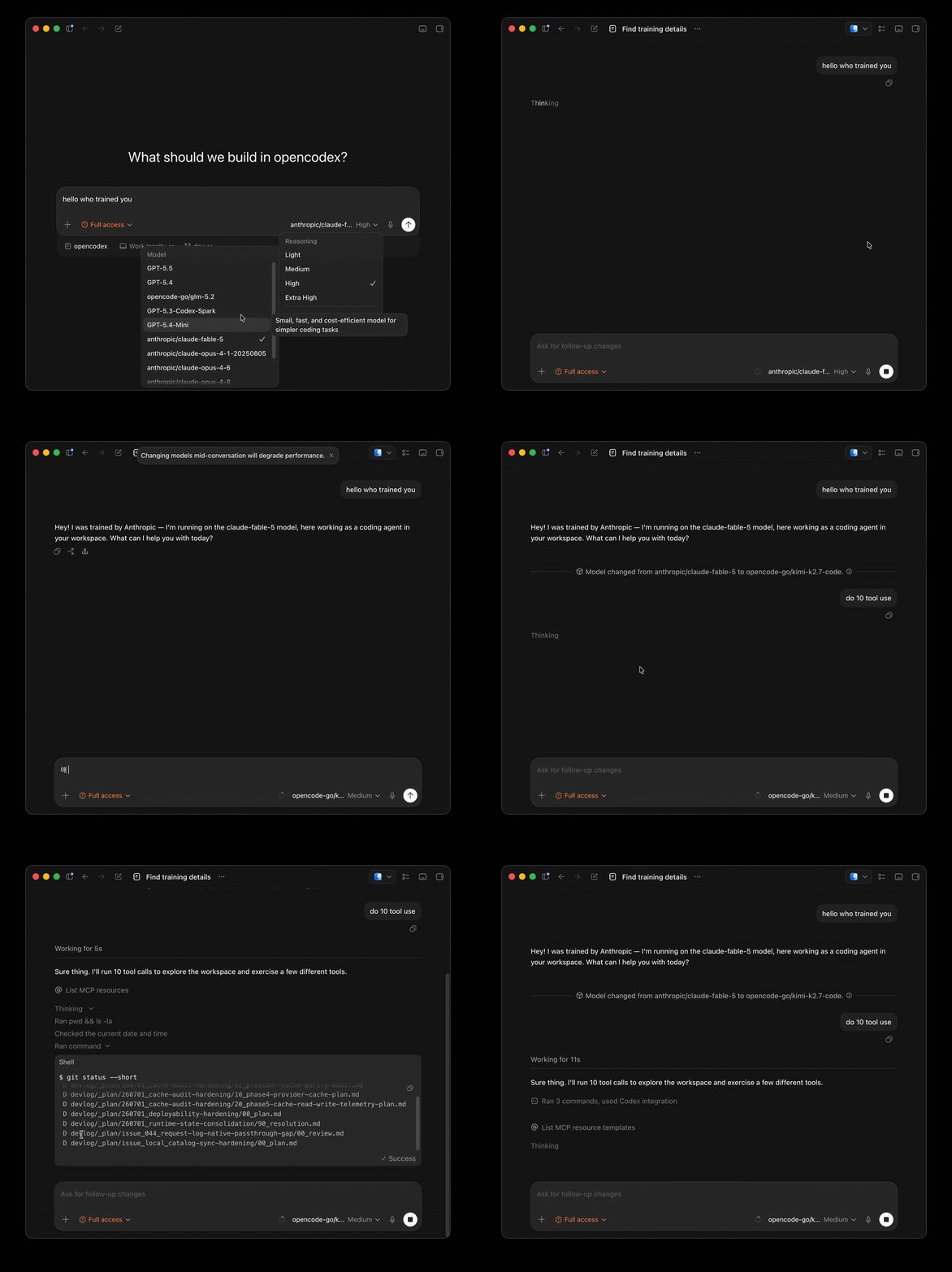
Universal provider proxy for OpenAI Codex & Claude Code — use any LLM (Claude, Gemini, Grok, DeepSeek, Ollama…) with Codex CLI, App, SDK, and Claude Code

Git-native persistent memory for AI coding agents. Implements Google OKF v0.2 with sub-300µs in-memory BM25 search, embedded MCP server, and progressive disclosure. Slashes token bloat by 80% with zero external databases or dependencies. Built in pure Go.

Local-first code intelligence graph for MCP and CLI. Builds a persistent map of your codebase so AI coding tools read only what matters, with benchmarked context reductions on reviews and large-repo workflows.

Stop your AI from making things up — it proposes, deterministic tools decide, every claim checked against ground truth with evidence. Grounded facts and context survive resets. Reverse engineering is the proving ground. MCP server + CLI.