
koala73/worldmonitorConnectors
Real-time global intelligence dashboard. AI-powered news aggregation, geopolitical monitoring, and infrastructure tracking in a unified situational awareness interface
86k
This server plugs an MCP client into Elasticsearch so an agent can list indices, inspect mappings, run searches, execute ES|QL, and check shards. It supports direct stdio connections and a streamable-HTTP endpoint for web and multi-client setups.
Builders who want an MCP client to read and query Elasticsearch data from inside their agent workflow.
You can ask your agent to inspect and query Elasticsearch without building a custom integration.
Provides `list_indices` so an agent can discover available Elasticsearch indices.
Provides `get_mappings` to inspect field mappings for a chosen index.
Provides `search` for Elasticsearch query DSL searches.
Provides `esql` to run ES|QL queries against the cluster.
Provides `get_shards` for shard details on all or selected indices.
Supports stdio for direct client connections and streamable-HTTP for web-based or concurrent use.
Runs as a Docker image with Elasticsearch settings passed through environment variables.
docker run -i --rm \
  -e ES_URL \
  -e ES_API_KEY \
  docker.elastic.co/mcp/elasticsearch \
  stdio
docker run --rm \
  -e ES_URL \
  -e ES_API_KEY \
  -p 8080:8080 \
  docker.elastic.co/mcp/elasticsearch \
  http
uv tool install mcp-proxy
docker ps | grep elasticsearch-mcp-server
curl http://<host>:8080/ping
docker logs <container-id>
[!CAUTION] This MCP server is deprecated and will only receive critical security updates going forward. It has been superseded by the Elastic Agent Builder MCP endpoint, which is available in Elastic 9.2.0+ and Elasticsearch Serverless projects.
The Elasticsearch MCP Server connects your AI agents to Elasticsearch data using the Model Context Protocol (MCP). It enables natural language interactions with your Elasticsearch indices, allowing agents to query, analyze, and retrieve data without custom APIs.
Follow these steps to deploy and configure the Elasticsearch MCP Server container image from AWS Marketplace.
Before you start, ensure you have:
[!NOTE]
These instructions apply to Elasticsearch MCP Server 0.4.0 and later. For versions 0.3.1 and earlier, refer to the README for v0.3.1.
The Elasticsearch MCP Server is provided as a Docker container image available from AWS Marketplace. You can run it using either the stdio protocol (for direct client connections) or the streamable-HTTP protocol (for web-based integrations).
The server supports two protocols:
Note: Server-Sent Events (SSE) is deprecated. Use streamable-HTTP instead.
Use the stdio protocol when your MCP client connects directly to the server process.
Set the following environment variables:
ES_URL: The URL of your Elasticsearch cluster (for example, https://your-cluster.es.amazonaws.com:9200)ES_API_KEY to your Elasticsearch API keyES_USERNAME and ES_PASSWORD to your Elasticsearch credentialsES_SSL_SKIP_VERIFY: Set to true to skip SSL/TLS certificate verification when connecting to Elasticsearch. Only use this for development or testing environments.Start the MCP server in stdio mode:
docker run -i --rm \
  -e ES_URL \
  -e ES_API_KEY \
  docker.elastic.co/mcp/elasticsearch \
  stdio
Add this configuration to your Claude Desktop configuration file:
{
  "mcpServers": {
    "elasticsearch-mcp-server": {
      "command": "docker",
      "args": [
        "run", "-i", "--rm",
        "-e", "ES_URL",
        "-e", "ES_API_KEY",
        "docker.elastic.co/mcp/elasticsearch",
        "stdio"
      ],
      "env": {
        "ES_URL": "<elasticsearch-cluster-url>",
        "ES_API_KEY": "<elasticsearch-API-key>"
      }
    }
  }
}
Replace <elasticsearch-cluster-url> with your Elasticsearch cluster URL and <elasticsearch-API-key> with your API key.
Use the streamable-HTTP protocol for web-based integrations or when you need to support multiple concurrent clients.
Set the same environment variables as the stdio protocol:
ES_URL: The URL of your Elasticsearch clusterES_API_KEY to your Elasticsearch API keyES_USERNAME and ES_PASSWORD to your Elasticsearch credentialsES_SSL_SKIP_VERIFY: Set to true to skip SSL/TLS certificate verificationStart the MCP server in HTTP mode:
docker run --rm \
  -e ES_URL \
  -e ES_API_KEY \
  -p 8080:8080 \
  docker.elastic.co/mcp/elasticsearch \
  http
The streamable-HTTP endpoint is available at http://<host>:8080/mcp. A health check endpoint is available at http://<host>:8080/ping.
If you're using Claude Desktop (free edition) which only supports the stdio protocol, use mcp-proxy to bridge stdio to streamable-HTTP:
Install mcp-proxy:
uv tool install mcp-proxy
For alternative installation options, refer to mcp-proxy/README.md.
Add this configuration to Claude Desktop:
{
  "mcpServers": {
    "elasticsearch-mcp-server": {
      "command": "/<home-directory>/.local/bin/mcp-proxy",
      "args": [
        "--transport=streamablehttp",
        "--header", "Authorization", "ApiKey <elasticsearch-API-key>",
        "http://<mcp-server-host>:<mcp-server-port>/mcp"
      ]
    }
  }
}
Replace <home-directory>, <elasticsearch-API-key>, <mcp-server-host>, and <mcp-server-port> with your values.
After configuring your MCP client, verify the connection works:
If the connection fails, verify:
docker logs <container-id>)Monitor the health and proper function of the Elasticsearch MCP Server using these methods:
Verify the container is running:
docker ps | grep elasticsearch-mcp-server
The container should appear in the list with a status of Up.
If you're using the streamable-HTTP protocol, test the health check endpoint:
curl http://<host>:8080/ping
A successful response returns pong, indicating the server is running and healthy.
View container logs to identify any issues:
docker logs <container-id>
Look for error messages related to:
Test connectivity to your Elasticsearch cluster from the container:
docker exec <container-id> curl -k -u <username>:<password> <ES_URL>
Or with an API key:
docker exec <container-id> curl -k -H "Authorization: ApiKey <api-key>" <ES_URL>
A successful response indicates the container can reach your Elasticsearch cluster.
The Elasticsearch MCP Server handles authentication credentials securely:
ES_URL uses the https:// protocol. Ensure your Elasticsearch cluster has SSL/TLS enabled.The Elasticsearch MCP Server runs as a container in your AWS environment. Consider these AWS service quotas:
To request quota increases, use the AWS Service Quotas console or refer to the AWS General Reference Guide.
Once connected, the MCP server provides these tools to your agent:
list_indices: List all available Elasticsearch indicesget_mappings: Get field mappings for a specific Elasticsearch indexsearch: Perform an Elasticsearch search using query DSLesql: Execute an ES|QL queryget_shards: Get shard information for all or specific indicesYour agent can use these tools to interact with your Elasticsearch data through natural language conversations.
Sign in to join the discussion.
No comments yet. Be the first to say what this is good for.
Real-time global intelligence dashboard. AI-powered news aggregation, geopolitical monitoring, and infrastructure tracking in a unified situational awareness interface
High-performance code intelligence MCP server. Indexes codebases into a persistent knowledge graph — average repo in milliseconds. 158 languages, sub-ms queries, 99% fewer tokens. Single static binary, zero dependencies.
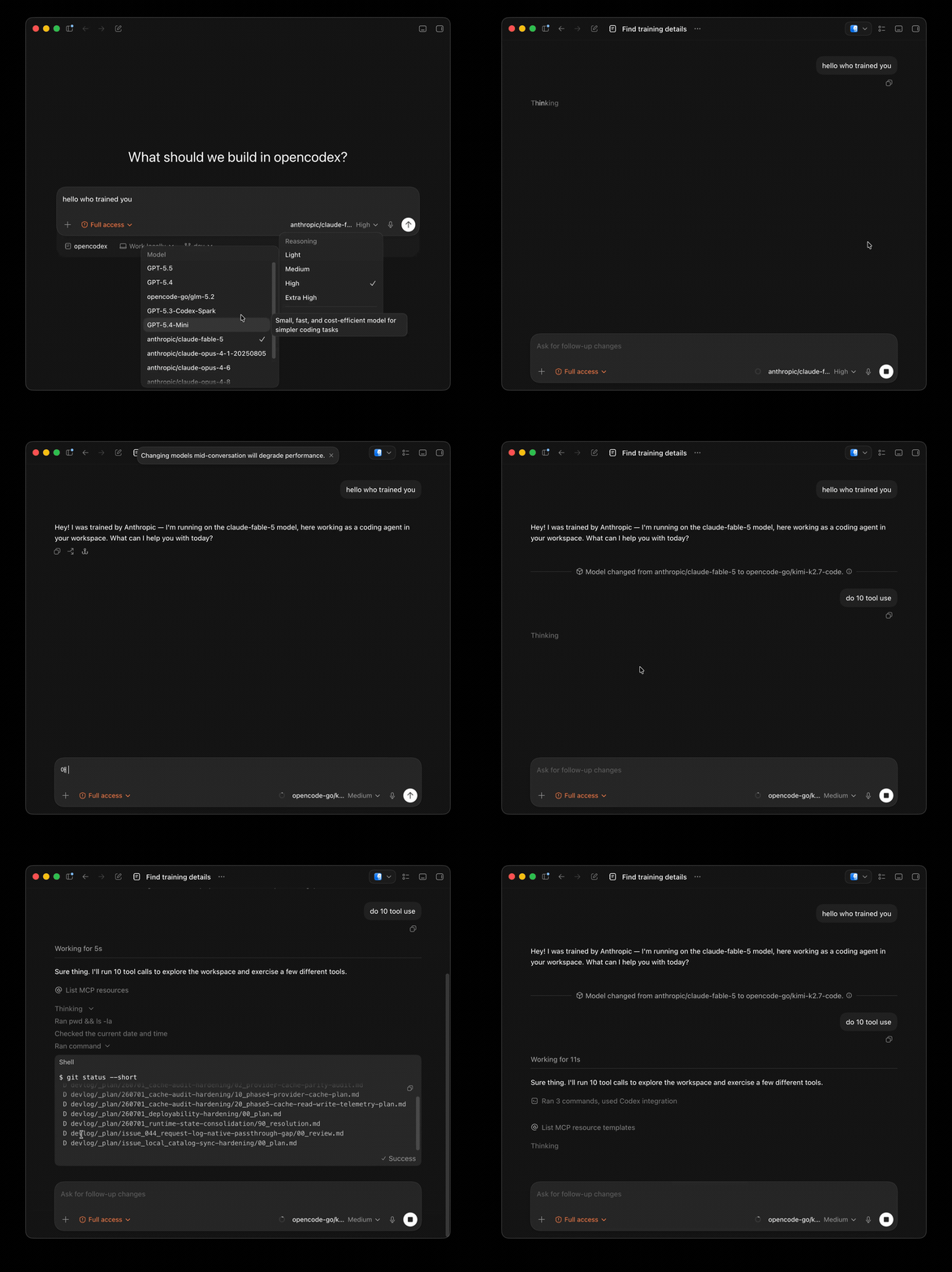
Universal provider proxy for OpenAI Codex & Claude Code — use any LLM (Claude, Gemini, Grok, DeepSeek, Ollama…) with Codex CLI, App, SDK, and Claude Code

Git-native persistent memory for AI coding agents. Implements Google OKF v0.2 with sub-300µs in-memory BM25 search, embedded MCP server, and progressive disclosure. Slashes token bloat by 80% with zero external databases or dependencies. Built in pure Go.

Local-first code intelligence graph for MCP and CLI. Builds a persistent map of your codebase so AI coding tools read only what matters, with benchmarked context reductions on reviews and large-repo workflows.

Stop your AI from making things up — it proposes, deterministic tools decide, every claim checked against ground truth with evidence. Grounded facts and context survive resets. Reverse engineering is the proving ground. MCP server + CLI.