
koala73/worldmonitorConnectors
Real-time global intelligence dashboard. AI-powered news aggregation, geopolitical monitoring, and infrastructure tracking in a unified situational awareness interface
86k
Kept saves chats from ChatGPT, Claude, Gemini, Grok, and Kimi as local Markdown files in `~/.kept/`. The desktop app indexes them for full-text search, topic browsing, and graph views, while the MCP server lets agentic clients work with the vault.
Builders who want their agent to keep a local memory of past chats and make those chats searchable from Claude Code or other MCP clients.
You can search, reopen, and reuse old AI conversations instead of digging through vendor chat histories.
Saves conversations as plain `.md` files with YAML frontmatter under `~/.kept/vault/`.
Uses a Chromium extension to pull conversations from ChatGPT, Claude, Gemini, Grok, and Kimi.
Indexes content in SQLite and CozoDB for full-text search, topics, projects, and graph views.
Exposes tools like `list_vault`, `read_file`, `write_file`, `move_file`, and `grep_vault` for MCP clients.
Keeps the archive in a vault layout you can open directly in Obsidian, VS Code, or any editor.
irm https://kept.work/install.ps1 | iex
curl -fsSL https://kept.work/install.sh | bash
irm https://raw.githubusercontent.com/egroup-labs/kept.work/main/scripts/install.ps1 | iex
curl -fsSL https://raw.githubusercontent.com/egroup-labs/kept.work/main/scripts/install.sh | bash
~/.kept/
  vault/
  index.db
  kg.db/
  config.toml
  token
http://localhost:18241/connect

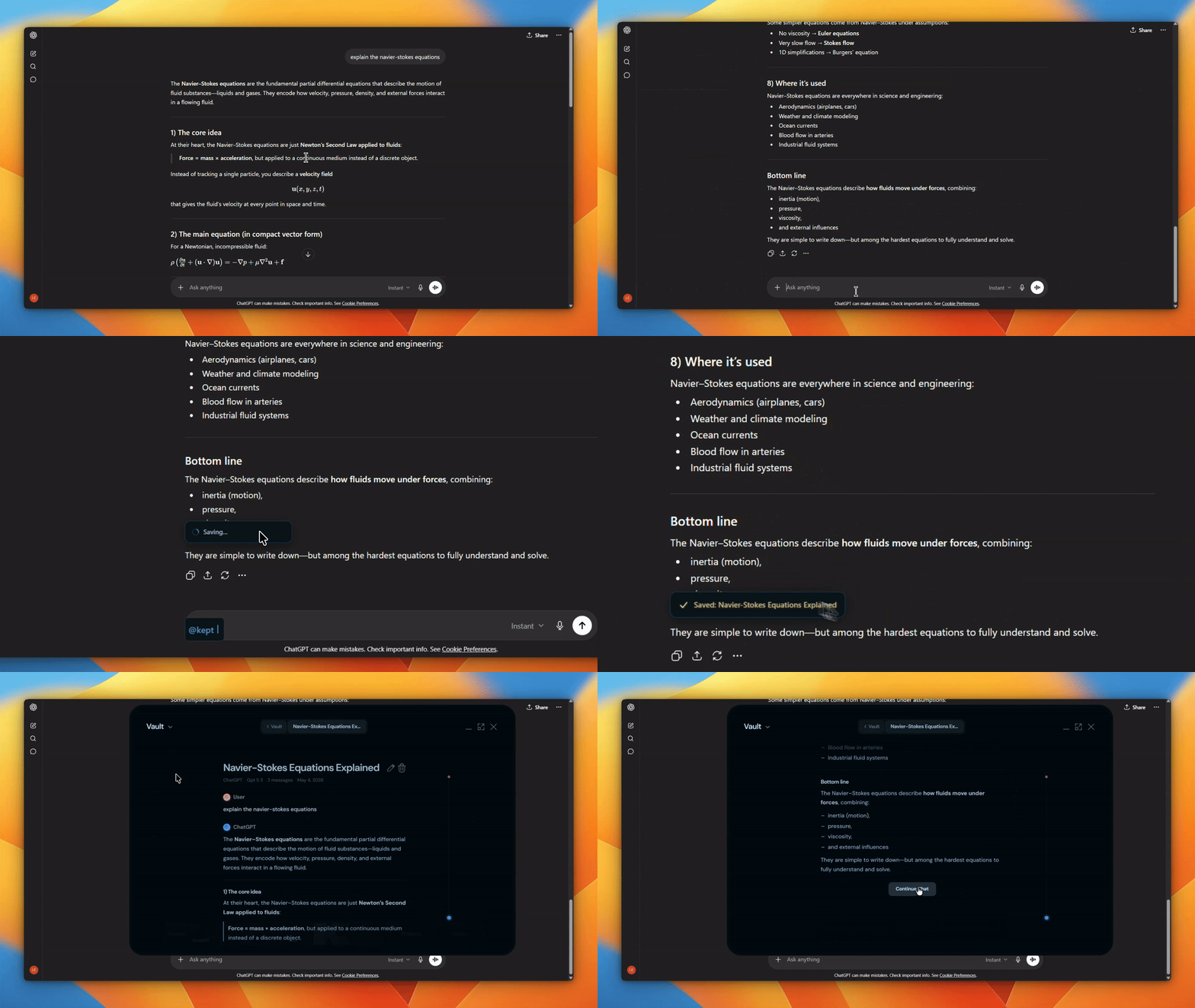
Kept saves your AI conversations as local Markdown files, then gives you a desktop app to search, browse, connect, and reuse them.
It works with ChatGPT, Claude, Gemini, Grok, and Kimi. Your archive lives on your machine under ~/.kept/, with an Obsidian-compatible vault plus local indexes for full-text search, topics, projects, and graph views.
Quick Install | Download | Setup | Build from source | MCP server
AI chats often become working memory: debugging trails, research notes, product decisions, prompts, snippets, and half-finished ideas. Most of that history stays inside vendor UIs.
Kept turns it into files you own.
Chromium browser extension
  -> reads conversations from provider API endpoints using your signed-in session
  -> normalizes messages and supported image assets
  -> sends them to the Kept desktop app on http://localhost:18241

Kept desktop app
  -> writes Markdown files to ~/.kept/vault/
  -> indexes content in SQLite
  -> builds a local knowledge graph in CozoDB
  -> exposes search, graph, project, export, and agent tools

MCP server
  -> lets Claude Code, OpenClaw, and other MCP clients work with the vault
Kept does not scrape rendered chat pages. The extension syncs conversation data from provider API responses and hands the normalized payload to the local app.
| Provider | Sync | Notes |
|---|---|---|
| ChatGPT | Yes | Full conversations, streaming history, branch-aware saves |
| Claude | Yes | Full conversations and streaming history |
| Gemini | Yes | Best effort; Google's API format changes often |
| Grok | Yes | Includes supported image assets |
| Kimi | Yes | Uses the Kimi auth helper included in the extension |
Provider APIs are private and can change without notice. Kept keeps the archive as plain files so your saved conversations stay readable even if an adapter needs an update.
Windows PowerShell:
irm https://kept.work/install.ps1 | iex
macOS and Linux:
curl -fsSL https://kept.work/install.sh | bash
The installer downloads the latest GitHub Release, installs the desktop app, and extracts the Chromium extension to a local folder. Browsers still require you to load the extension manually in Developer Mode.
The same scripts can be run directly from GitHub:
irm https://raw.githubusercontent.com/egroup-labs/kept.work/main/scripts/install.ps1 | iex
curl -fsSL https://raw.githubusercontent.com/egroup-labs/kept.work/main/scripts/install.sh | bash
Desktop builds are published on GitHub Releases.
Current release targets:
.dmg.exe installer.deb and .AppImageThe release also includes the Chromium extension package. Until the Web Store listing is live, install the extension in developer mode.
Use the Quick Install command above, or download the build for your OS from Releases, install it, and launch Kept.
On first launch, Kept creates:
~/.kept/
  vault/
  index.db
  kg.db/
  config.toml
  token
The app also starts a local server on http://localhost:18241. The browser extension uses this local server to send conversations into the vault.
Kept supports Chromium-based browsers: Chrome, Brave, Edge, Vivaldi, Arc, Opera, and Chromium.
extension/ from this repo.chrome://extensions.extension/ directory.With the Kept app running, open this page in the same browser:
http://localhost:18241/connect
That page gives the extension its per-install token. After that, use the extension popup or Kept onboarding flow to sync your providers.
Kept writes conversations as Markdown with YAML frontmatter:
~/.kept/vault/
  chatgpt/
    2026-05-02_optimizing-cuda-kernel.md
  claude/
    2026-05-02_kept-readme-draft.md
  gemini/
  grok/
  kimi/
You can open ~/.kept/vault/ directly in Obsidian, VS Code, or any editor. The files are the source of truth; the search and graph databases can be rebuilt from them.
mcp/ is an MCP server named kept-vault-server. It lets agentic clients list, read, write, search, rename, and delete files in your Kept vault.
Inside Claude Code:
/plugin marketplace add egroup-labs/kept.work
/plugin install kept-vault@kept-plugins
One-line installer for Linux and macOS:
bash <(curl -fsSL https://raw.githubusercontent.com/egroup-labs/kept.work/main/scripts/install-kept-mcp.sh)
PowerShell:
& ([scriptblock]::Create((irm https://raw.githubusercontent.com/egroup-labs/kept.work/main/scripts/install-kept-mcp.ps1)))
Set KEPT_VAULT_PATH if your vault is not at ~/.kept/vault.
Tools exposed by the server:
list_vaultlist_directoryread_filewrite_fileupdate_filedelete_filemove_filegrep_vaultRequirements:
git clone https://github.com/egroup-labs/kept.git
cd kept/app
npm ci
npm run tauri dev
Ubuntu/Debian:
sudo apt install -y \
  build-essential clang libclang-dev pkg-config \
  libgtk-3-dev libwebkit2gtk-4.1-dev libsoup-3.0-dev \
  libpango1.0-dev libcairo2-dev libgdk-pixbuf-2.0-dev libglib2.0-dev
build-essential, clang, and libclang-dev are required for Rust crates that
use bindgen (e.g. zstd-sys pulled in by CozoDB). The rest are the GTK /
WebKitGTK / GLib stack Tauri 2 links against.
Then run:
npm run tauri:dev:linux
You can run the UI against mock data without the Rust app:
cd app
npm ci
npm run dev
Vite serves the UI at http://localhost:1420.
app/                Tauri 2 desktop app
  src/              React frontend
  src-tauri/        Rust backend, Axum server, vault, search, graph, agent tools
extension/          Chromium extension
  platforms/        Provider sync adapters
mcp/                MCP server for the vault
scripts/            App and MCP install scripts
~/.kept/.localhost and must include the bearer token stored at ~/.kept/token.Issues and pull requests are welcome. Conventional commits are preferred:
feat(scope): add ...
fix(scope): repair ...
Useful areas to start:
extension/platforms/ for provider adaptersapp/src-tauri/src/vault.rs for vault writesapp/src-tauri/src/db.rs for search indexingapp/src-tauri/src/kg-gen/ for graph generationmcp/src/ for MCP vault toolsMIT
Sign in to join the discussion.
No comments yet. Be the first to say what this is good for.
Real-time global intelligence dashboard. AI-powered news aggregation, geopolitical monitoring, and infrastructure tracking in a unified situational awareness interface
High-performance code intelligence MCP server. Indexes codebases into a persistent knowledge graph — average repo in milliseconds. 158 languages, sub-ms queries, 99% fewer tokens. Single static binary, zero dependencies.
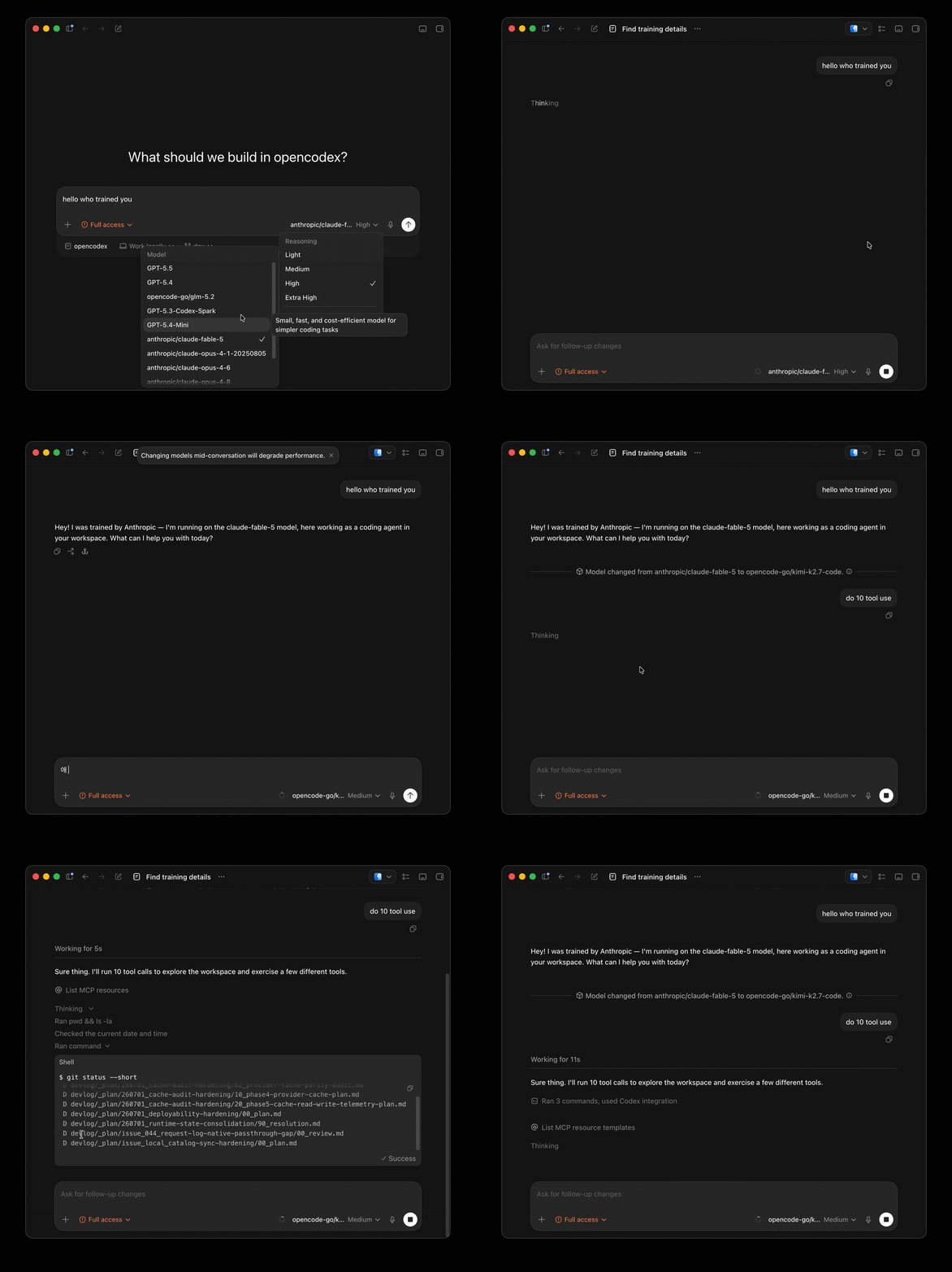
Universal provider proxy for OpenAI Codex & Claude Code — use any LLM (Claude, Gemini, Grok, DeepSeek, Ollama…) with Codex CLI, App, SDK, and Claude Code

Git-native persistent memory for AI coding agents. Implements Google OKF v0.2 with sub-300µs in-memory BM25 search, embedded MCP server, and progressive disclosure. Slashes token bloat by 80% with zero external databases or dependencies. Built in pure Go.

Local-first code intelligence graph for MCP and CLI. Builds a persistent map of your codebase so AI coding tools read only what matters, with benchmarked context reductions on reviews and large-repo workflows.

Stop your AI from making things up — it proposes, deterministic tools decide, every claim checked against ground truth with evidence. Grounded facts and context survive resets. Reverse engineering is the proving ground. MCP server + CLI.