
koala73/worldmonitorConnectors
Real-time global intelligence dashboard. AI-powered news aggregation, geopolitical monitoring, and infrastructure tracking in a unified situational awareness interface
86k
This server connects Things 3 to MCP clients so you can manage tasks in natural language. It exposes tools for todos, projects, areas, tags, lists, search, bulk moves, health checks, and usage stats, with AppleScript handling writes and structured output for reads.
Builders who want their agent to work with Things 3 for task management.
You can ask your agent to manage Things 3 instead of switching apps and retyping tasks by hand.
Create, read, update, delete, and search todos, including partial updates, bulk updates, and item lookup by ID.
List, create, and update projects and areas, including project hierarchies and project headings.
Read Inbox, Today, Upcoming, Anytime, Someday, Logbook, and Trash views from Things 3.
List tags, create tags, add and remove tags on todos, and report tag usage for cleanup.
Move single records or many records under a new parent in one operation.
Run health checks, queue status, server capability checks, usage recommendations, and context stats.
Run the server over HTTP instead of stdio when a client subprocess cannot get the right macOS permissions.
Generate or write MCP client config for Claude Desktop and Claude Code with the `config` command.
mcp-server-things config --client claude-desktop --write
claude mcp add-json things '{"command":"uvx","args":["--python-preference","only-managed","--python","3.12","mcp-server-things"]}'
claude mcp add-json things '{"command":"uvx","args":["--python-preference","only-managed","--python","3.12","mcp-server-things"]}' -s user


A Model Context Protocol (MCP) server that connects Claude and other AI assistants to Things 3 for natural language task management.
Writes go through AppleScript, not the Things URL scheme, which is what enables delete_todo, move_record/bulk_move_records, remove_tags, real IDs returned synchronously, and no Things auth token — the trade-off is a one-time macOS Automation permission prompt on first write. Operationally it also ships built-in doctor diagnostics, config --write client setup, context-optimized response modes for large databases, and 1300+ unit tests.
hald/things-mcp is a solid, lighter URL-scheme-based alternative — several of its ideas (Someday-project filtering, tag usage reporting, .mcpb packaging) are adopted here too. See docs/COMPARISON.md for the detailed matrix.
brew install uv)Option A: One-click .mcpb
Download the latest .mcpb file from the releases page and double-click it to install into Claude Desktop.
The bundle launches the server via uvx, so uv must be installed and on PATH (brew install uv). The generated config pins uv's managed Python (--python-preference only-managed) so a stray Intel/Rosetta Python on your PATH can't break the install; first launch may download a managed CPython.
Option B: config CLI
mcp-server-things config --client claude-desktop --write
Safely adds/updates the things entry in your Claude Desktop config (--force overwrites an existing, different entry instead of refusing).
Option C: Manual JSON
{
  "mcpServers": {
    "things": {
      "command": "uvx",
      "args": ["--python-preference", "only-managed", "--python", "3.12", "mcp-server-things"]
    }
  }
}
claude mcp add-json things '{"command":"uvx","args":["--python-preference","only-managed","--python","3.12","mcp-server-things"]}'
claude mcp add-json things '{"command":"uvx","args":["--python-preference","only-managed","--python","3.12","mcp-server-things"]}' -s user
mcp-server-things config --client claude-code prints these exact commands.
{
  "command": "uvx",
  "args": ["--python-preference", "only-managed", "--python", "3.12", "mcp-server-things"]
}
Run mcp-server-things doctor (or uvx mcp-server-things doctor) to confirm Things 3, permissions, and the database are all reachable.
Then ask your client "What's in my Things inbox?".
uvx mcp-server-thingsfails withBuilding cryptography==.../ maturin / Rust errors? Your default Python is an x86_64 (Intel/Rosetta) build —cryptographyno longer ships macOS x86_64 wheels. Fix: run with an arm64 interpreter, e.g.uvx -p 3.12 mcp-server-things(Homebrew or uv-managed Python), oruv python install 3.12first.mcp-server-things doctorwarns about this.
Upgrading from an existing install? See docs/UPGRADING.md.
python3 -m venv venv
source venv/bin/activate  # On macOS/Linux
pip install mcp-server-things
git clone https://github.com/ebowman/mcp-server-things.git
cd mcp-server-things
python3 -m venv venv
source venv/bin/activate  # On macOS/Linux
pip install -r requirements.txt
pip install -e .
config CLImcp-server-things config --client <claude-desktop|claude-code|generic> [--via uvx|current-python] [--write] [--force]
prints the MCP client configuration for the requested client (or, for
claude-desktop --write, safely merges it into
~/Library/Application Support/Claude/claude_desktop_config.json, backing up
the previous file first and refusing to clobber an existing, different
things entry unless --force is also passed). Run
mcp-server-things config --client claude-desktop --write or
mcp-server-things config --client claude-code instead of hand-editing JSON
or memorizing the claude mcp add-json syntax.
Shortcut for venv/pip installs: mcp-server-things config --client claude-desktop --via current-python targets the currently-running interpreter (sys.executable -m things_mcp) instead of the default uvx mcp-server-things.
Add to your Claude Desktop configuration (~/Library/Application Support/Claude/claude_desktop_config.json):
{
  "mcpServers": {
    "things": {
      "command": "/path/to/your/venv/bin/python",
      "args": ["-m", "things_mcp"],
      "env": {
        "THINGS_MCP_LOG_LEVEL": "INFO",
        "THINGS_MCP_APPLESCRIPT_TIMEOUT": "30"
      }
    }
  }
}
Add to your Claude Desktop configuration (~/Library/Application Support/Claude/claude_desktop_config.json):
{
  "mcpServers": {
    "things": {
      "command": "/path/to/mcp-server-things/venv/bin/python",
      "args": ["-m", "things_mcp"],
      "env": {
        "PYTHONPATH": "/path/to/mcp-server-things/src",
        "THINGS_MCP_LOG_LEVEL": "INFO",
        "THINGS_MCP_APPLESCRIPT_TIMEOUT": "30"
      }
    }
  }
}
Notes:
/path/to/your/venv/bin/python with your virtual environment's Python path/path/to/mcp-server-things with your actual installation path and include the PYTHONPATH Creating tasks with natural language through Claude
add_area, update_area)get_tag_usage) for weekly-review cleanupstructured_content (via FastMCP 3.x) with a consistent {items, count, total, mode, limit, offset} shape ({item: {...}} for single-item lookups like get_todo_by_id), so clients can consume results programmatically without re-parsing textOnce installed, Claude (or other MCP clients) can automatically discover and use all available tools. No additional setup required.
The server uses environment variables for configuration, settable via system environment variables or a .env file (auto-loaded from the current directory, or pointed to with --env-file). The env vars that matter most:
| Variable | Default | Description |
|---|---|---|
THINGS_MCP_LOG_LEVEL | INFO | Logging level: DEBUG, INFO, WARNING, ERROR, CRITICAL |
THINGS_MCP_AI_CAN_CREATE_TAGS | false | Whether the AI can create new tags (false = existing tags only) |
THINGS_MCP_APPLESCRIPT_TIMEOUT | 30.0 | AppleScript execution timeout in seconds (1-300) |
THINGS_MCP_TRANSPORT | stdio | Transport to use: stdio or http |
THINGS_MCP_PORT | 8000 | Port to bind to when THINGS_MCP_TRANSPORT=http |
See .env.example for the full list of options, including validation limits, retry counts, the auth-token file, and THINGS_MCP_HOST.
add_checklist_items, prepend_checklist_items, and replace_checklist_items
(and any other tool built on things:///update, e.g. moving a to-do under a
heading) require a Things URL-scheme auth token. Without one configured,
these tools return success: false with an actionable error instead of
silently doing nothing - Things itself rejects un-authenticated update
requests, but open -g still exits 0, so the failure has to be caught before
the URL is ever opened. things:///add-based tools (add_todo,
add_project, including todo creation with a checklist) do not need a
token.
To configure one:
.things-auth in the project rootthings-auth.txt in the project root~/.things-auth in your home directoryAn empty or whitespace-only token file is treated the same as a missing one
(the loader falls through to the next candidate path). health_check and
get_server_capabilities report the current auth_token_configured state,
and an AUTH_TOKEN_NOT_CONFIGURED error includes a checked_paths field
showing which candidate paths were checked and why each was rejected
(missing / empty / unreadable) - never the token value itself.
By default the server speaks MCP over stdio. It can optionally run an HTTP transport instead, which is the reliable fix when a client's stdio subprocess lacks Automation (TCC) access to Things 3: run the server from a Terminal that has been granted access, then point the client at the HTTP URL instead of launching it as a subprocess (see Troubleshooting for details).
| Variable | Default | Description |
|---|---|---|
THINGS_MCP_TRANSPORT | stdio | Transport to use: stdio or http |
THINGS_MCP_HOST | 127.0.0.1 | Host to bind to when THINGS_MCP_TRANSPORT=http |
THINGS_MCP_PORT | 8000 | Port to bind to when THINGS_MCP_TRANSPORT=http |
THINGS_MCP_TRANSPORT=http THINGS_MCP_PORT=8000 uvx mcp-server-things
Then add it to Claude Code as an HTTP server:
claude mcp add --transport http things http://127.0.0.1:8000/mcp
--transport, --host, and --port CLI flags are also available and take
precedence over the environment variables above.
The server supports several command-line options:
# Start with debug logging
python -m things_mcp --debug

# Use a custom .env file
python -m things_mcp --env-file ~/my-config.env

# Check system health
python -m things_mcp --health-check

# Test AppleScript connectivity
python -m things_mcp --test-applescript

# Show version
python -m things_mcp --version

# Customize timeout and retry settings
python -m things_mcp --timeout 60 --retry-count 5

# Run with HTTP transport instead of stdio
python -m things_mcp --transport http --host 127.0.0.1 --port 8000
You can set environment variables directly in your Claude Desktop configuration:
{
  "mcpServers": {
    "things": {
      "env": {
        "THINGS_MCP_LOG_LEVEL": "DEBUG",
        "THINGS_MCP_AI_CAN_CREATE_TAGS": "true",
        "THINGS_MCP_APPLESCRIPT_TIMEOUT": "60"
      }
    }
  }
}
get_todos(project_uuid?, include_items?) - List todosadd_todo(title, ...) - Create new todoupdate_todo(id, ..., heading?, list_id?, list_title?) - Update existing todo; heading moves it under a heading (requires the Things URL-scheme auth token), list_id/list_title move it to a different project or areabulk_update_todos(todo_ids, ...) - Update multiple todos in one operationget_todo_by_id(todo_id) - Get specific todo. A to-do/heading that is itself untrashed but whose containing project is trashed reports trashed: true plus trashedViaParent: true (Things marks only the trashed container, not its descendants); direct trash keeps trashed: true alone.delete_todo(todo_id) - Delete a to-do or a project (auto-detects the id type; headings/areas/tags cannot be deleted via any public Things 3 API)get_projects(include_items?) - List projectsadd_project(title, ..., todos?) - Create new project; a ##-prefixed line in todos creates a real heading (via the Things URL scheme's json action), with subsequent lines nesting under itupdate_project(id, ...) - Update existing project. Completing a project (completed="true") cascades to its child to-dos (Things marks them completed too), but reopening a project (completed="false") does not cascade back - child to-dos already completed stay completed. This is upstream Things behavior, not a bug here; reopen specific to-dos explicitly (e.g. bulk_update_todos) if needed.get_project_headings(project_id, mode?) - Read a project's heading structure (title, order, open-todo count per heading), in Things' own order. Read-only: headings can only be created at project-creation time (add_project's ## lines) and cannot be renamed/deleted via any public Things 3 API.get_areas(include_items?) - List areasadd_area(title, tags?) - Create new areaupdate_area(id, title?, tags?) - Update existing areaget_today, get_upcoming, get_anytime, get_someday, and get_trash never return headings, and exclude projects by default - pass include_projects=true to also include projects that belong to that list (e.g. a project due today), matching the Things app's list views. get_inbox has no include_projects flag since the Inbox can never contain projects.
get_inbox() - Get Inbox todosget_today(include_projects?) - Get Today's todosget_upcoming(days?, include_projects?) - Get upcoming todos (with optional days filter)get_anytime(include_projects?) - Get Anytime todosget_someday(include_project_tasks?, include_projects?) - Get Someday todos. By default only returns items whose own start state is Someday; pass include_project_tasks=true to also include tasks that live inside Someday projects (marked inheritedSomeday: true). Today/Anytime/Upcoming always exclude tasks that belong to a Someday project, regardless of this flag.get_logbook(limit?, period?, offset?, include_canceled?) - Get completed todos; includes canceled todos by default (include_canceled=true), matching the Things app's own Logbook viewget_trash(include_projects?) - Get trashed todosget_due_in_days(days, include_overdue?, mode?, limit?) - Get todos due within specified days; includes already-overdue todos by default (include_overdue=true)get_activating_in_days(days, mode?, limit?) - Get todos activating within dayssearch_todos(query, status?, offset?) - Basic search; matches incomplete todos by default (status='incomplete'), pass status=None to search all statusessearch_advanced(...) - Advanced search with filters; searches all statuses by default when no status filter is givenget_tags(include_items?) - List tagsget_tag_usage(only_unused?, mode?) - Per-tag open/total/area usage counts, sorted by usage, for cleanup. Caveats: tags sharing an identical title are merged into one row (uuid picks the last match), and area-only tags are counted via area_count/total_count but never affect open_count.create_tag(name) - Create a new tagget_tagged_items(tag) - Get items with specific tagadd_tags(todo_id, tags) - Add tags to a todoremove_tags(todo_id, tags) - Remove tags from a todoget_recent(period, status?, type?) - Get recently created items; returns all statuses and both to-dos and projects by default (headings are never included unless type='heading' is passed explicitly)move_record(record_id, to_parent_uuid) - Move single recordbulk_move_records(record_ids, to_parent_uuid) - Move multiple recordshealth_check() - Check server and Things 3 statusqueue_status() - Check operation queue status and statisticsget_server_capabilities() - Get server features and configurationget_usage_recommendations() - Get usage tips and best practicescontext_stats() - Get context-aware response statisticsRun mcp-server-things doctor first. It's a read-only diagnostic that checks
Things 3 installation, whether it's running, macOS Automation permission,
database readability (Full Disk Access/TCC), uv/uvx availability, the
optional auth token, and environment/version info - printing a PASS/FAIL/WARN
table with a one-line fix hint per row (exits non-zero only if something
actually needs fixing). Use mcp-server-things doctor --json for
machine-readable output, or python -m things_mcp doctor if you're running
from source.
| Operation | Result |
|---|---|
Read tools (get_today, get_inbox, search_todos, ...) | Fail instantly with unable to open database file |
Write tools (add_todo, update_todo, ...) | Work normally |
| URL-scheme features needing the auth token | Also fail (the token is read from the same database) |
Cause: Under Claude Desktop, MCP servers are spawned via
/Applications/Claude.app/Contents/Helpers/disclaimer, which disclaims TCC
(privacy/permissions) responsibility for the process it launches. As a
result, the spawned server does not inherit Claude Desktop's Full Disk
Access grant, even though Claude.app itself has it. The Things 3 SQLite
database lives under the TCC-protected
~/Library/Group Containers/JLMPQHK86H.com.culturedcode.ThingsMac/ThingsData-*/Things Database.thingsdatabase/main.sqlite
(confirmed via things.database.Database().filepath - the same read path
this server uses for every read tool), so any process without Full Disk
Access gets unable to open database file immediately. Granting Full Disk
Access to Claude.app does not fix this, since the disclaimer helper is
what actually launches the server process.
Fix ladder (try in order):
THINGS_MCP_TRANSPORT=http THINGS_MCP_PORT=8000 uvx mcp-server-things
claude mcp add --transport http things http://127.0.0.1:8000/mcp
mcp-remote:
npx mcp-remote http://127.0.0.1:8000/mcp
uvx executable or the venv python in uv's cache) via System Settings ->
Privacy & Security -> Full Disk Access. This works but is fragile - the
grant can silently break when Homebrew/uv updates the binary, and the FDA
picker sometimes greys out these paths, requiring drag-and-drop from
Finder to add them.mcp-server-things doctor to confirm the fix - the "Database
readable" row reports PASS once Full Disk Access (or the HTTP transport
workaround) is in place.This is the same failure mode reported upstream in
hald/things-mcp#62; we've
verified it applies here too since we read the Things database via the same
things.py library and code path.
add_checklist_items, prepend_checklist_items, and replace_checklist_items
need a Things URL-scheme auth token (see "Things URL-scheme auth token" under
Configuration above). mcp-server-things doctor reports this as a WARN on
the "Auth token file" row, naming the affected tools, until a token file is
in place.
# Grant AppleScript permissions to your terminal/IDE
# System Preferences > Security & Privacy > Privacy > Automation
# Enable access for your terminal application to control Things 3
# Verify Things 3 is installed and running
python -m things_mcp.main --health-check

# Check if Things 3 is in Applications folder
ls /Applications/ | grep -i things
# Increase timeout value via environment variable
export THINGS_MCP_APPLESCRIPT_TIMEOUT=60

# Or in your .env file
THINGS_MCP_APPLESCRIPT_TIMEOUT=60
# Enable debug logging
python -m things_mcp.main --debug

# Check logs
tail -f things_mcp.log
# Comprehensive health check
python -m things_mcp.main --health-check

# Test specific components
python -m things_mcp.main --test-applescript
If the server appears to hang before an MCP client can connect (especially on a cold start), the process writes timestamped boot-phase markers to stderr:
things-mcp boot: 2026-07-20T09:00:00.000+00:00 +0.001s process-start
things-mcp boot: 2026-07-20T09:00:00.010+00:00 +0.011s watchdog-armed (25.0s)
things-mcp boot: 2026-07-20T09:00:00.050+00:00 +0.051s things-import-start
things-mcp boot: 2026-07-20T09:00:00.120+00:00 +0.121s things-import-done
A one-shot startup watchdog also runs in the background: if boot doesn't
complete the MCP handshake within the deadline, it dumps every thread's stack
to stderr (Timeout (0:00:25)! followed by a traceback for each thread). On a
healthy, long-running server this fires exactly once, at the deadline, and is
harmless - it's stderr-only and does not affect the MCP stdio protocol (which
only uses stdout).
Relevant environment variables:
# Startup watchdog deadline in seconds. 0 (or any value <= 0) disables it.
THINGS_MCP_BOOT_WATCHDOG_SECS=25

# Timeout for lazily importing the third-party `things` package, in seconds.
# 0 (or any value <= 0) makes the import unbounded (blocking).
THINGS_MCP_THINGS_IMPORT_TIMEOUT_SECS=10
To diagnose a cold-start hang from a client's debug log: find the last
things-mcp boot: marker line - the phase named there is where boot stalled.
If a watchdog stack dump follows, its traceback shows exactly where each
thread was blocked at that moment.
Contributions are welcome! Please follow these guidelines:
Testing: pytest tests/unit runs entirely against mocked AppleScript/things.py
calls and needs no Things 3 install. pytest tests/integration is mostly mock-based
too; its real_things_tools/cleanup_test_todos fixtures, plus the local fixtures in
test_bulk_operations_comprehensive.py, test_search_comprehensive.py, and
test_search_performance.py (like the opt-in tests/live smoke suite) all require a
real, running Things 3 and are gated behind THINGS_MCP_LIVE_TESTS=1 - without it they
skip with a clear reason rather than writing to your live database. Run the live smoke
suite with make test-live (or
THINGS_MCP_LIVE_TESTS=1 pytest tests/live -q); it creates and cleans up its own
throwaway project and never touches pre-existing data. tests/regression is a second,
opt-in live suite (same THINGS_MCP_LIVE_TESTS=1 gate) that drives the real MCP tool
boundary end-to-end - run it with make test-regression. See
docs/TESTING.md for the full testing policy.
This project is licensed under the MIT License - see the LICENSE file for details.
Built for the Things 3 and MCP community.
Sign in to join the discussion.
No comments yet. Be the first to say what this is good for.
Real-time global intelligence dashboard. AI-powered news aggregation, geopolitical monitoring, and infrastructure tracking in a unified situational awareness interface
High-performance code intelligence MCP server. Indexes codebases into a persistent knowledge graph — average repo in milliseconds. 158 languages, sub-ms queries, 99% fewer tokens. Single static binary, zero dependencies.
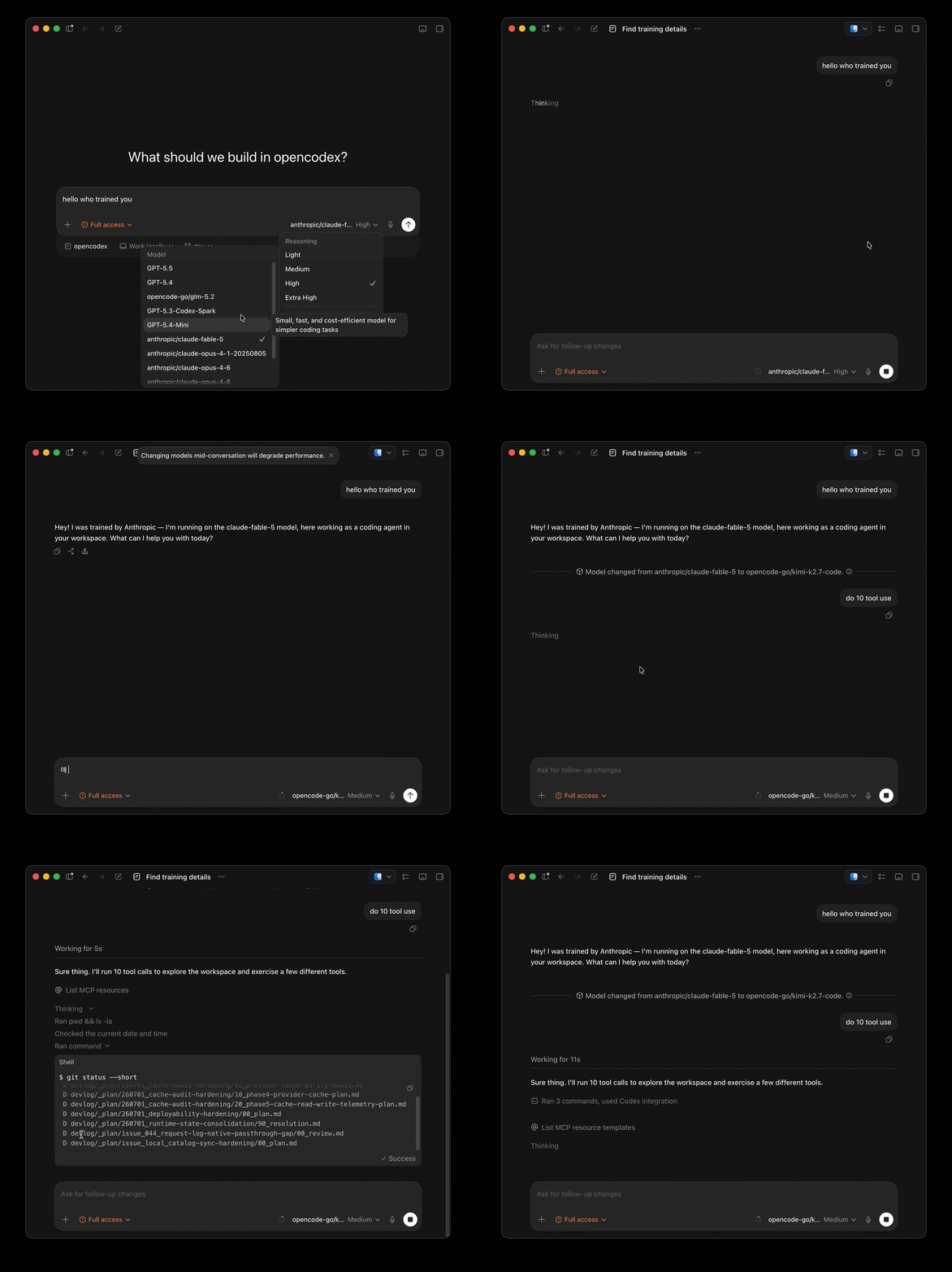
Universal provider proxy for OpenAI Codex & Claude Code — use any LLM (Claude, Gemini, Grok, DeepSeek, Ollama…) with Codex CLI, App, SDK, and Claude Code

Git-native persistent memory for AI coding agents. Implements Google OKF v0.2 with sub-300µs in-memory BM25 search, embedded MCP server, and progressive disclosure. Slashes token bloat by 80% with zero external databases or dependencies. Built in pure Go.

Local-first code intelligence graph for MCP and CLI. Builds a persistent map of your codebase so AI coding tools read only what matters, with benchmarked context reductions on reviews and large-repo workflows.

Stop your AI from making things up — it proposes, deterministic tools decide, every claim checked against ground truth with evidence. Grounded facts and context survive resets. Reverse engineering is the proving ground. MCP server + CLI.