Embody puts your ideas on screen as fast as you can describe them. Operators, connections, parameters, the works. Want to try a different direction? Spin up a new approach in seconds. Compare attempts side by side. Branch off the one that works. The tool keeps up with you, instead of the other way around.
Four Tools, One Idea
Envoy — forward velocity. An embedded MCP server lets Claude Code, Codex, OpenCode, Gemini, Cursor, Windsurf, and GitHub Copilot (via VS Code) talk directly to your live TouchDesigner session. Create operators, wire them up, set parameters, write extensions, debug errors — by saying what you want. No copy-pasting code. No describing your network in chat. Idea → operators in seconds.
Embody — lateral velocity. Tag any operator and Embody externalizes it to files on disk that mirror your network hierarchy. Try a new direction, branch off a good one, restore the state from yesterday — all in seconds. Your externalized files are the source of truth, so every project opens already in flow.
Convoy — outward velocity. Convoy-enabled Embody nodes on a trusted LAN discover, inspect, and control each other — one AI session relaying builds, test runs, saves, screenshots, and restarts to every machine in the room. A small per-user background app keeps each node reachable even while TouchDesigner is closed. Convoy guide
TDXN — the substrate that makes it all possible. TouchDesigner networks exported as human-readable YAML. The format is what lets your AI agent understand what's on the screen, what lets you diff one attempt against another, and what lets a network reconstruct itself from text on the next project open. TDXN is what makes the rest of this possible.
| What | Why it matters |
|---|
| 🤖 | Envoy MCP Server | 68 tools let your AI assistant build, wire, parameterize, and debug live networks. The first time you watch it happen, you stop typing operator names by hand for good. |
| 📄 | TDXN Network Format | Networks become text. Diff two versions, revisit any version, hand an LLM a complete picture of what's on screen — all from a single .tdxn file. |
| 📦 | Automatic Restoration | Externalized files are written on save, so any COMP can be recovered from disk. By default (Export-on-Save) the .toe stays authoritative on open; switch to Roundtrip mode to rebuild TDXN-strategy COMPs from .tdxn on every open. |
| 📤 | Portable Tox Export | Pull any COMP out as a self-contained .tox with external references stripped. Ship a piece of your project anywhere. |
| 🐍 | Project Python Environment | One .venv per project, built against TouchDesigner's own interpreter — Envoy runs from it, your packages import inside TD from it, and AI agents manage it hands-free. Python Environment |
| 🛰️ | Convoy LAN Relay | Convoy-enabled Embody nodes on a trusted LAN discover, inspect, and control each other through Envoy — relay test runs, saves, screenshots, and restarts to other machines from one AI session. Convoy guide |
Quick Start
Requirements: TouchDesigner 2025.33070 or later (Windows / macOS). No Python setup needed — Embody builds a per-project Python environment (.venv) matched to TouchDesigner's own interpreter, and your own packages can live in it too. No special folder structure either: Embody works in any project folder, and if you happen to use git, every change is also a clean diff for free.
1. Install
Download the Embody .tox from /release and drag it into your TouchDesigner project. The Setup Wizard opens and walks you through the choices that matter — how much autonomy Embody gets, what to externalize, whether to enable the AI assistant (Envoy) and for which tool, permissions, whether to join a trusted-LAN Convoy, and where config files live. Nothing changes until the final click, and you can re-run it anytime via the Setup Wizard pulse on the Embody COMP.
Updating Embody: Embody updates itself — pulse Check for Update on the About page (or set Auto-Update to check at startup), and a verified release is downloaded, backed up against, and swapped in place. Your settings and tracked externalizations live on disk and survive the update untouched. See the auto-update guide. Manual alternative: delete the old Embody COMP and drag the new .tox in its place — the new version picks up your on-disk state automatically, no re-scan, no files rewritten.
Provisioning a machine with no one at it (a render node, a media server)? The bootstrap installs Embody into a .toe offline with TouchDesigner's own tools, in one line.
2. Tag and Work
- Tag operators — hover any COMP or DAT and press
lctrl twice to open the tagger (pick a strategy for a COMP, a file format for a DAT)
- Work normally — press
ctrl + shift + u to update all externalizations, or ctrl + alt + u to update only the current COMP. Externalized files are written on save; on open, the .toe stays authoritative by default (Export-on-Save), while Roundtrip mode also reconstructs TDXN-strategy COMPs from disk
Tip: Externalization is opt-in — nothing is written to disk until you tag it. To capture your AI assistant's work automatically, set Auto-Externalize New Ops (Envoy parameter page) and everything it creates through Envoy is tagged and externalized as it's built.
For supported formats, folder configuration, duplicate handling, Manager UI, and more — see the Embody docs.
Envoy MCP Server
Embody includes Envoy, an embedded MCP server that gives AI coding assistants direct access to your live TouchDesigner session.
Setup
- Pick an AI assistant in the Setup Wizard — it opens on first install, or re-run it anytime (the Setup Wizard pulse on the Embody COMP). Prefer parameters? Toggling Envoy Enable (
Envoyenable) does the same thing with your current settings
- Server starts on
127.0.0.1:9870 (configurable via Envoyport; if the port is taken by another instance, Envoy scans forward automatically)
- Auto-configuration — Envoy writes a
.mcp.json (STDIO bridge, so tools are available even before TD is running) at your AI project root. By default that's the git repo root; the wizard's config-location step — or the Aiprojectroot parameter — can point it at the .toe folder or a custom path instead. Projects without a git repo still get config generated in the .toe folder
- Connect — open a Claude Code session (or restart your IDE) at that root — it picks up
.mcp.json automatically
The generated config runs Envoy's bridged STDIO transport (recommended — it can launch and restart TD for you). If you'd rather wire a client by hand, the direct HTTP transport works whenever TD is running:
{
"mcpServers": {
"envoy": {
"type": "http",
"url": "http://127.0.0.1:9870/mcp"
}
}
}
Tools at a Glance
| Tool | What It Does |
|---|
create_op | Create any operator type in any network |
set_parameter | Set values, expressions, or bind modes on any parameter |
connect_ops | Wire operators together |
execute_python | Run arbitrary Python in TD's main thread |
export_network | Export networks to diffable .tdxn YAML |
create_extension | Scaffold a full extension (COMP + DAT + wiring) |
get_op_errors | Inspect errors on any operator and its children |
...and 56 more. See the full tools reference.
When Envoy starts, it always generates an AGENTS.md file in your project root with TD development patterns and project-specific guidance. It also writes a client-specific config for whichever assistant you select in the Aiclient parameter (CLAUDE.md + .claude/ for Claude Code, opencode.json + .claude/ for OpenCode, Cursor/Windsurf rules, Copilot instructions, GEMINI.md for Gemini; Codex and OpenCode read AGENTS.md directly). For OpenCode and local-model setups, see the Local Models & Open Clients guide.
TDXN Network Format
TDXN (TouchDesigner eXternal Network) is the file format that makes the rest of Embody possible. It exports an entire operator network — operators, connections, parameters, layout, annotations, DAT content — as a single human-readable YAML file. Your AI agent can read it. You can read it. Any text tool can diff it. The network can rebuild itself from it.
This is the substrate. Every other capability — AI-driven building, version control, automatic restoration — builds on top of it.
- Entire project:
ctrl + shift + e
- Current COMP:
ctrl + alt + e
- Via Envoy:
export_network / import_network MCP tools
See the full TDXN specification for format details, import process, and round-trip guarantees.
Keyboard Shortcuts
| Shortcut | Action |
|---|
lctrl + lctrl | Tag or manage the operator under the cursor |
ctrl + shift + u | Update all externalizations |
ctrl + alt + u | Update only the current COMP |
ctrl + shift + r | Refresh tracking state |
ctrl + shift + o | Open the Manager UI |
ctrl + shift + c | Copy the selected COMP to the clipboard as a portable TDXN envelope |
ctrl + shift + e | Export entire project to .tdxn file |
ctrl + alt + e | Export current COMP to .tdxn file |
These are the defaults — every shortcut is editable on the Embody COMP's Shortcuts parameter page (type a combo, or pulse Record and press the keys; empty disables it). See Keyboard Shortcuts.
Where externalized files go
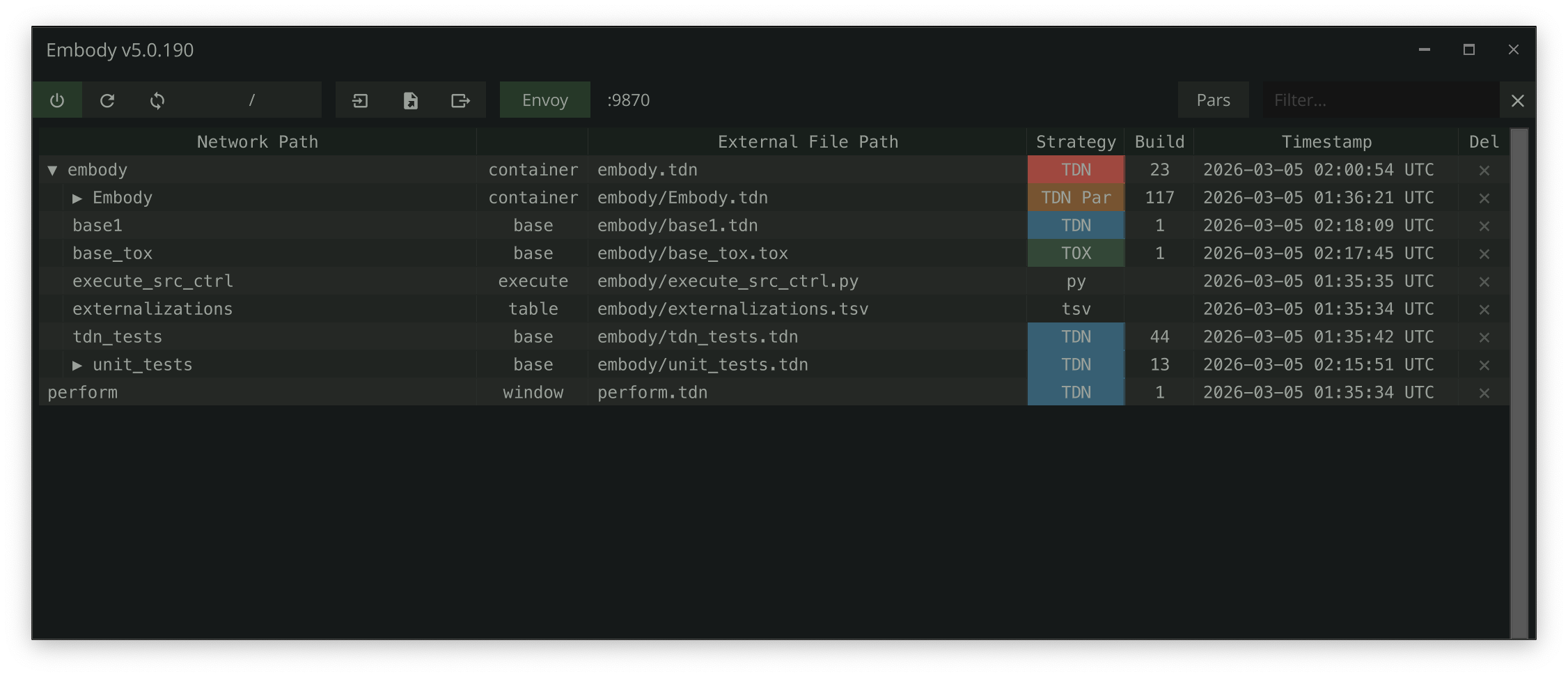
Embody writes externalized files relative to your .toe location, mirroring your network hierarchy — no special folder structure required:
my-project/              ← project folder (optionally a git repo)
├── my-project.toe       ← your TouchDesigner project
├── base1/               ← externalized operators
│   ├── base2.tox        ← COMP (TOX strategy)
│   ├── base3.tdxn        ← COMP (TDXN strategy — diffable YAML)
│   └── text1.py         ← DAT
└── ...
Logging
Embody provides a multi-destination logging system:
- File logging (default):
dev/logs/<project_name>_YYMMDD.log, auto-rotates at 10 MB
- FIFO DAT: Recent entries visible in the TD network editor
- Textport: Enable the
Print parameter to echo logs
- Ring buffer: Last 200 entries via the Envoy
get_logs MCP tool
op.Embody.Log('Something happened', 'INFO')
op.Embody.Warn('Check this out')
op.Embody.Error('Something broke')
Testing
Embody includes 148 test suites (4,650 tests) covering core externalization, MCP tools, TDXN format, the Envoy server/bridge, launch/config generation, install/uninstall paths, self-update, release hooks, the status readout, and palette catalogs. Tests run inside TouchDesigner using a custom test runner with sandbox isolation. Destructive whole-project suites are segregated and run only via the save-gated RunDestructiveTests.
op.unit_tests.RunTests()                              # All tests (non-blocking)
op.unit_tests.RunTests(suite_name='test_path_utils')   # Single suite
op.unit_tests.RunTestsSync()                           # All in one frame (blocks TD)
Via Envoy MCP: use the run_tests tool. See the full testing docs for coverage details and how to write new tests.
Troubleshooting
- Timeline Paused: Embody requires the timeline to be running. An error appears if paused.
- Clone/Replicant Operators: Cannot be externalized. Embody warns if you try to tag them.
- Engine COMPs: Engine, time, and annotate COMPs are not supported for externalization.
For more, see Troubleshooting.
Version History
Every release is documented in the full changelog. Highlights:
- 6.2.42 —
ExportReleaseToe: ship the whole project as one locked .toe with Embody removed, preview first
- 6.2.41 — the MCP SDK moves to 2.2.0; existing venvs upgrade themselves on the next start
- 6.2.40 — the TDXN tag, the
strategy column, the files on disk and the git diff driver all say TDXN; nine strategy reads that had silently stopped matching are fixed
- 6.2.13 — vector custom parameter defaults survive the round trip (issue #96); six definition fields, three authored flags, and TDXN format 2.1
- 6.2.8 — the TDXN rename completes across docs, skills, and embody.tools (
/tdn/ → /tdxn/ with permanent redirects)
- 6.2.5 — TDXN review fixes: snapshot exports never touch tracked files, and dirty detection covers everything an export writes
- 6.2.0 — three namespace tiers; the promoted surface drops from 214 members to 43 (issue #94 — breaking for undocumented names)
- 6.1.5 — every AI client gets the MCP config it actually reads, from one registry; edit protection rides inside generated files
- 6.1.2 — the format becomes TDXN (TouchDesigner eXternal Network); existing
.tdn files work unchanged, with an opt-in migration pulse
- 6.0.201–6.0.280 — the Convoy hardening arc: macOS enablement, a self-updating daemon, fleet-wide Embody updates, and a self-updater that can no longer be latched by a stuck download
- 6.0.171 — Convoy ships end to end: nodes on a trusted LAN discover, relay work to, and control each other
- 6.0.162 — MCP SDK 2.0 port with self-upgrading venvs
- 6.0.145 — self-update ships: manifest-gated, verified, backup + rollback
Contributors
Originally derived from External Tox Saver by Tim Franklin. Refactored entirely by Dylan Roscover, with inspiration and guidance from Elburz Sorkhabi, Matthew Ragan and Wieland Hilker.
Want to help? Start with CONTRIBUTING.md — this repo works differently from a typical Python project (TouchDesigner writes many of the files), and that page explains what is safe to change and how to run the tests.
Credits
Embody stands on other people's work, and this section names it. Ideas move
between the TouchDesigner MCP projects in both directions; where Embody took
one, it is credited here and in the code where it landed.
- External Tox Saver by Tim Franklin -- Embody began in 2020 as a refactor of it.
- TDMCP by Derivative (their experimental MCP server, a private repository at the time of writing, used with permission) -- undoable MCP mutations (one undo step per batch), the
get_docs design (version-exact offline help first, the wiki API second), sequence-block growth on parameter writes, the transport-security hardening prompt, and treating a code-review rule as a query. Landed from v6.0.87 (2026-07-04) on.
- TDMCPSkills by Derivative (private at the time of writing, used with permission) -- the
pop-networks skill is adapted from td-pop-family.
- touchdesigner-mcp by 8beeeaaat -- the first widely used TouchDesigner MCP server (2025). Envoy's earliest tool vocabulary (
get_td_classes, get_td_class_details, get_td_info, get_module_help, exec_node_method, execute_python) follows the names that project established.
- td-mcp-rs by asyade -- a Rust-daemon take on the same problem (2026). Its OS-dialog dismissal, per-call instance addressing, stable error codes with fix hints, any-family capture through an OP Viewer TOP, shader lint on DAT writes, and offline installation into a project file are ideas Embody adopted and built (see the roadmap).
If Embody carries an idea of yours and this list misses it, open an issue and it will be added.
Trademarks and Affiliation
Embody is an independent open-source project. It is not affiliated with, endorsed by, or sponsored by Derivative. TouchDesigner is a trademark of Derivative.
License
MIT License