
koala73/worldmonitorConnectors
Real-time global intelligence dashboard. AI-powered news aggregation, geopolitical monitoring, and infrastructure tracking in a unified situational awareness interface
86k
Hayhooks packages Haystack pipelines and agents behind REST routes, MCP tools, and related integration endpoints. You deploy a pipeline or wrapper, then call it through HTTP, MCP clients, or supported chat frontends like Chainlit and Open WebUI.
Builders who want to wrap Haystack pipelines as tools, APIs, and chat backends for agent workflows.
You can ship a Haystack pipeline as a callable endpoint instead of building the serving layer yourself.
Turns deployed Haystack pipelines and agents into HTTP endpoints with minimal wrapper code.
Serves pipelines and agents as MCP tools so clients like Cursor can call them.
Exposes agents through the A2A protocol so other agents can discover and delegate work to them.
Provides chat completion endpoints with streaming support for compatible clients.
Can run a Chainlit chat front end alongside the API with pipeline selection and custom widgets.
Adds OpenTelemetry tracing for deploy, run, and undeploy actions, with a `/dashboard` view.
# Install Hayhooks
pip install hayhooks
hayhooks run
hayhooks pipeline deploy-files -n my_agent ./my_agent_dir
curl -X POST http://localhost:1416/my_agent/run \
  -H 'Content-Type: application/json' \
-d '{"question": "What can you do?"}'curl -X POST http://localhost:1416/chat/completions \
-H 'Content-Type: application/json' \
-d '{
"model": "my_agent",
"messages": [{"role": "user", "content": "What can you do?"}]
}'Hayhooks makes it easy to deploy and serve Haystack Pipelines and Agents.
With Hayhooks, you can:
pip install "hayhooks[a2a]"), so other agents can discover them through auto-generated agent cards and delegate tasks to them via hayhooks a2a run.pip install "hayhooks[chainlit]" and hayhooks run --with-chainlit -- zero-configuration frontend with streaming, pipeline selection, and custom UI widgets.pip install "hayhooks[tracing]") for deploy/run/undeploy visibility across REST and MCP, with a /dashboard UI via hayhooks run --with-tracing-dashboard (backed by a local live trace buffer).



📚 For detailed guides, examples, and API reference, check out our comprehensive documentation.
# Install Hayhooks
pip install hayhooks
hayhooks run
Create a minimal agent wrapper with streaming chat support and a simple HTTP POST API:
from typing import AsyncGenerator
from haystack.components.agents import Agent
from haystack.dataclasses import ChatMessage
from haystack.tools import Tool
from haystack.components.generators.chat import OpenAIChatGenerator
from hayhooks import BasePipelineWrapper, async_streaming_generator
# Define a Haystack Tool that provides weather information for a given location.
def weather_function(location):
return f"The weather in {location} is sunny."
weather_tool = Tool(
name="weather_tool",
description="Provides weather information for a given location.",
parameters={
"type": "object",
"properties": {"location": {"type": "string"}},
"required": ["location"],
},
function=weather_function,
)
class PipelineWrapper(BasePipelineWrapper):
def setup(self) -> None:
self.agent = Agent(
chat_generator=OpenAIChatGenerator(model="gpt-4o-mini"),
system_prompt="You're a helpful agent",
tools=[weather_tool],
)
# This will create a POST /my_agent/run endpoint
# `question` will be the input argument and will be auto-validated by a Pydantic model
async def run_api_async(self, question: str) -> str:
result = await self.agent.run_async(messages=[ChatMessage.from_user(question)])
return result["last_message"].text
# This will create an OpenAI-compatible /chat/completions endpoint
async def run_chat_completion_async(
self, model: str, messages: list[dict], body: dict
) -> AsyncGenerator[str, None]:
chat_messages = [
ChatMessage.from_openai_dict_format(message) for message in messages
]
return async_streaming_generator(
pipeline=self.agent,
pipeline_run_args={
"messages": chat_messages,
},
)
Save as my_agent_dir/pipeline_wrapper.py.
hayhooks pipeline deploy-files -n my_agent ./my_agent_dir
Call the HTTP POST API (/my_agent/run):
curl -X POST http://localhost:1416/my_agent/run \
-H 'Content-Type: application/json' \
-d '{"question": "What can you do?"}'
Call the OpenAI-compatible chat completion API (streaming enabled):
curl -X POST http://localhost:1416/chat/completions \
  -H 'Content-Type: application/json' \
  -d '{
    "model": "my_agent",
    "messages": [{"role": "user", "content": "What can you do?"}]
  }'
Or chat with it in the embedded Chainlit UI (hayhooks run --with-chainlit) or integrate it with Open WebUI!
Hayhooks is actively maintained by the deepset team.
Sign in to join the discussion.
No comments yet. Be the first to say what this is good for.
Real-time global intelligence dashboard. AI-powered news aggregation, geopolitical monitoring, and infrastructure tracking in a unified situational awareness interface
High-performance code intelligence MCP server. Indexes codebases into a persistent knowledge graph — average repo in milliseconds. 158 languages, sub-ms queries, 99% fewer tokens. Single static binary, zero dependencies.
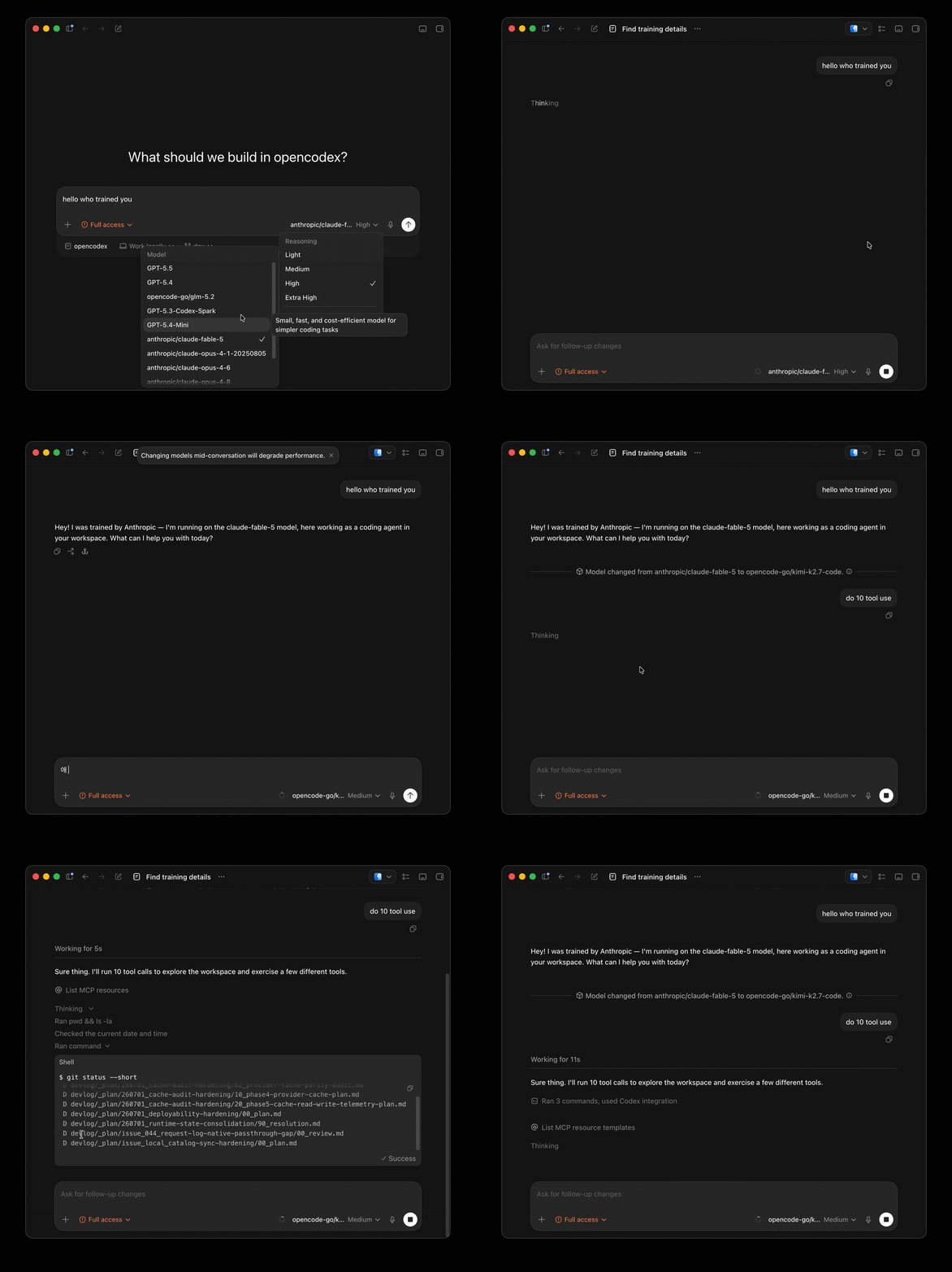
Universal provider proxy for OpenAI Codex & Claude Code — use any LLM (Claude, Gemini, Grok, DeepSeek, Ollama…) with Codex CLI, App, SDK, and Claude Code

Git-native persistent memory for AI coding agents. Implements Google OKF v0.2 with sub-300µs in-memory BM25 search, embedded MCP server, and progressive disclosure. Slashes token bloat by 80% with zero external databases or dependencies. Built in pure Go.

Local-first code intelligence graph for MCP and CLI. Builds a persistent map of your codebase so AI coding tools read only what matters, with benchmarked context reductions on reviews and large-repo workflows.

Stop your AI from making things up — it proposes, deterministic tools decide, every claim checked against ground truth with evidence. Grounded facts and context survive resets. Reverse engineering is the proving ground. MCP server + CLI.