

koala73/worldmonitorConnectors
Real-time global intelligence dashboard. AI-powered news aggregation, geopolitical monitoring, and infrastructure tracking in a unified situational awareness interface
86k
Daymon plugs Claude into local memory, scheduling, workers, and file watching so tasks can keep running after you close the chat. It auto-configures Claude Desktop and Claude Code, then uses a local SQLite store and background processes to run tasks on your machine.
Builders who use Claude Code or Claude Desktop and want background automation with local memory.
You can give Claude persistent context and let it keep working on scheduled or file-based tasks without re-explaining everything.
Stores facts, preferences, and project details in a local memory store with search and forget tools.
Lets Claude create recurring, one-time, or on-demand tasks and track their history and progress.
Creates named worker profiles with system prompts for roles like researcher, reviewer, writer, or ops.
Watches folders and triggers actions when files change or appear.
Shows finished task results back in your active Claude Code chat, with quiet hours and per-task controls.
Keeps data in SQLite on your machine with no cloud account or API keys.
brew install daymonio/daymon/daymon
# .deb (Ubuntu/Debian)
sudo dpkg -i daymon_*.deb

# AppImage (any distro)
chmod +x Daymon-*.AppImage && ./Daymon-*.AppImage
git clone https://github.com/daymonio/daymon.git
cd daymon
npm install
npm run dev      # Development mode
npm run build    # Production build



Open source autopilot for Claude.
Scheduled tasks, persistent memory, background automation. No API keys. No cloud. Runs on your Mac, Windows, or Linux machine.
Daymon is not affiliated with, endorsed by, or sponsored by Anthropic.
Sleep. Daymon doesn't. It runs Claude tasks on schedule, remembers context across conversations, watches files for changes, and works in the background — all while you sleep, commute, or focus on other things.
No API keys. No token costs. No cloud. Just your existing Claude subscription, finally working 24/7.
brew install daymonio/daymon/daymon
Download the latest .dmg from GitHub Releases.
Download the latest .exe installer from GitHub Releases.
Download the .deb or .AppImage from GitHub Releases.
# .deb (Ubuntu/Debian)
sudo dpkg -i daymon_*.deb

# AppImage (any distro)
chmod +x Daymon-*.AppImage && ./Daymon-*.AppImage
git clone https://github.com/daymonio/daymon.git
cd daymon
npm install
npm run dev      # Development mode
npm run build    # Production build
Install Daymon and open it. That's it — Daymon auto-configures Claude Desktop on first launch.
Open Claude Desktop and try:
"Remember that I prefer TypeScript over JavaScript"
"Every weekday at 9am, check HackerNews for AI news and summarize the top 5 stories"
"Watch my Downloads folder and organize new files into subfolders by type"
Install Daymon and open it. Daymon auto-configures Claude Code on first launch (if ~/.claude.json exists).
Then try:
"Remember this project uses PostgreSQL 16 and runs on port 5432"
"Schedule a daily code review of this repo every morning at 8am"
Daymon is a desktop app for macOS, Windows, and Linux that lives in your menu bar (system tray on Windows). It gives Claude persistent memory, scheduled tasks, workers, and file watchers — all running locally on your machine.
Your Claude subscription only works when you do. Daymon puts it to work 24/7.
Scheduled Tasks — "Every weekday at 9am, check HackerNews for AI news." Just tell Claude what you want. Daymon handles the scheduling.
Persistent Memory — "Remember I'm fundraising Series A." Say it once, it sticks forever. Knowledge graph with semantic search, no API keys.
Workers — Named agent personalities with system prompts. Assign a Researcher, Chief of Staff, or Code Reviewer to any task. 9 templates included.
Self-Improving Tasks — Tasks get smarter every time they run. Daymon learns what works and skips the guesswork on future runs — faster results, no configuration needed.
Auto-Nudge — When a background task finishes, Daymon shows results in your active Claude Code chat automatically. Per-task control: always, failures only, or never. Quiet hours keep nudges out of your way.
Session Continuity — Tasks resume where they left off. "Compare today's results to yesterday's" just works.
File Watchers — "When a new file appears in Downloads, organize it." Daymon watches folders and acts automatically.
100% Local — No cloud. No account. Your data is a SQLite file you can inspect anytime.
Workers are named agent profiles with system prompts. Each worker defines a personality, values, and anti-patterns that shape how tasks execute.
| Template | Description |
|---|---|
| Chief of Staff | Proactive business ops — triages, anticipates needs, proposes actions |
| Researcher | Deep research with strong opinions — synthesis over summarization |
| Code Reviewer | Catches what linters miss — leads with blockers, no bikeshedding |
| Writer | Sharp writing — cuts fluff, clarity over everything |
| Email Assistant | 3-tier triage, drafts replies, never sends |
| Tech Trend Analyst | Tech-only trends + tweet drafts with real takes |
| Competitor Tracker | Reports signal, not noise — silence is a valid report |
| DevOps | Reliability over novelty — boring infrastructure that works |
| Data Analyst | Analysis that drives decisions, not dashboards |
Create workers in the Daymon UI or via Claude: "Create a worker called 'My Analyst' with this system prompt..."
| Tool | Description |
|---|---|
daymon_remember | Store a fact, preference, or project detail |
daymon_recall | Search memories by keyword |
daymon_forget | Delete a memory |
daymon_memory_list | List all stored memories |
| Tool | Description |
|---|---|
daymon_schedule | Create a task (recurring, one-time, or on-demand) |
daymon_list_tasks | Show all tasks |
daymon_run_task | Manually trigger a task |
daymon_pause_task | Pause a task |
daymon_resume_task | Resume a paused task |
daymon_delete_task | Delete a task |
daymon_task_history | Show past runs |
daymon_task_progress | Check running task progress |
daymon_reset_session | Clear session for a task |
| Tool | Description |
|---|---|
daymon_create_worker | Create a worker with name and system prompt |
daymon_list_workers | List all workers |
daymon_update_worker | Update a worker |
daymon_delete_worker | Delete a worker |
| Tool | Description |
|---|---|
daymon_watch | Watch a folder for changes |
daymon_unwatch | Stop watching |
daymon_list_watches | List active watches |
| Tool | Description |
|---|---|
daymon_get_setting | Get a setting value |
daymon_set_setting | Update a setting (quiet hours, etc.) |
npm run dev          # Start dev mode
npm run build        # Full build (main + renderer + MCP)
npm test             # Run test suite
npm run typecheck    # TypeScript type checking
npm run build:mac    # Build + package macOS DMG
npm run build:linux  # Build + package Linux AppImage + deb
daymon/
├── src/
│   ├── main/           # Desktop app (menu bar / tray)
│   ├── sidecar/        # Standalone Node.js server (cron, watchers, task execution)
│   ├── mcp/            # MCP server (stdio)
│   │   └── tools/      # Memory, scheduler, worker, watcher, settings tools
│   ├── renderer/       # React + Tailwind UI
│   └── shared/         # Shared logic (DB queries, task runner, auto-nudge)
├── docs/               # Landing page (daymon.io)
└── resources/          # App icons
Tech stack: React 18, Tailwind CSS 4, TypeScript, Vite 7, better-sqlite3, node-cron, zod, MCP SDK, HuggingFace Transformers (local embeddings), Vitest
MIT License. See LICENSE for details.
Sign in to join the discussion.
No comments yet. Be the first to say what this is good for.
Real-time global intelligence dashboard. AI-powered news aggregation, geopolitical monitoring, and infrastructure tracking in a unified situational awareness interface
High-performance code intelligence MCP server. Indexes codebases into a persistent knowledge graph — average repo in milliseconds. 158 languages, sub-ms queries, 99% fewer tokens. Single static binary, zero dependencies.
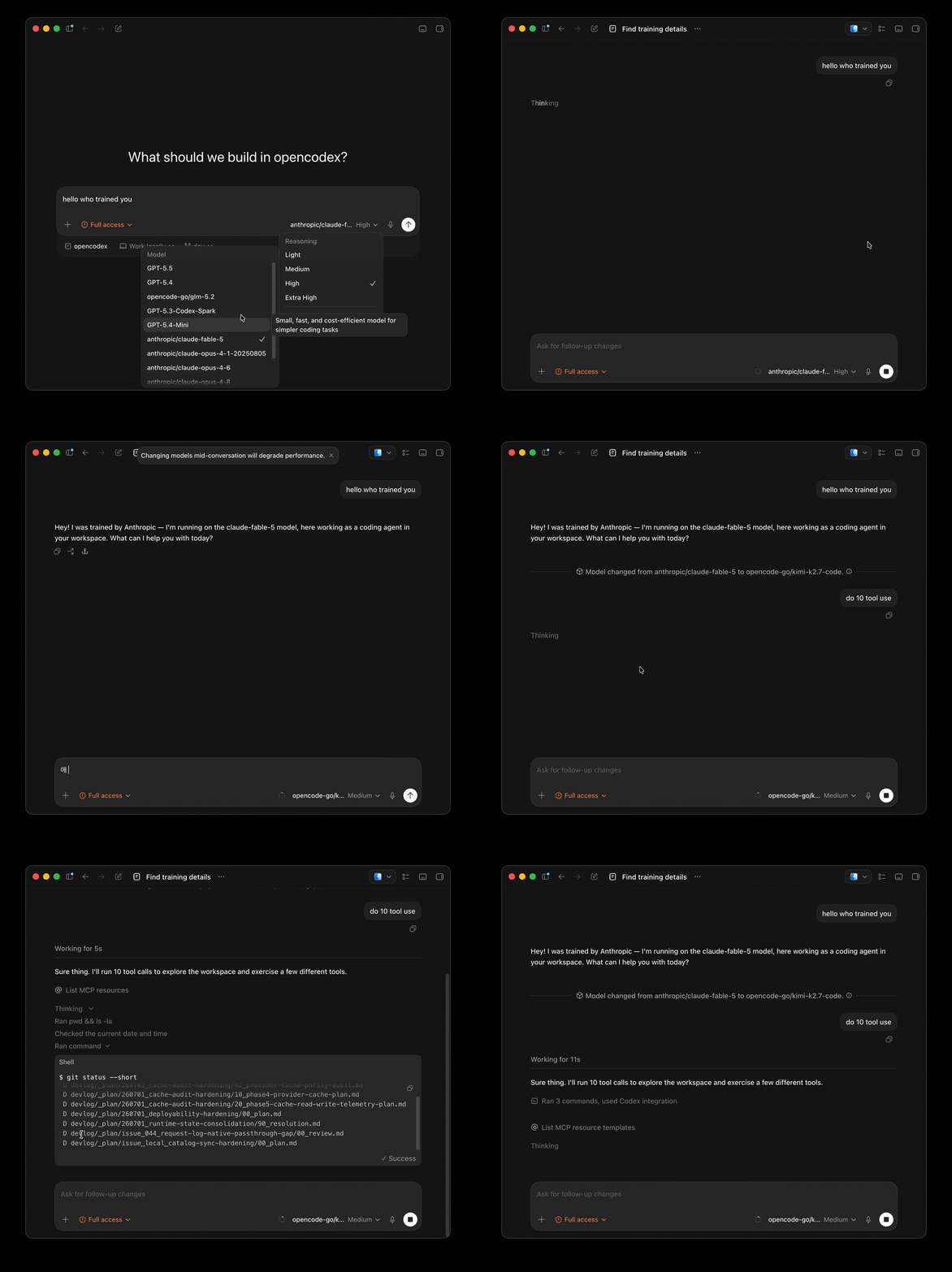
Universal provider proxy for OpenAI Codex & Claude Code — use any LLM (Claude, Gemini, Grok, DeepSeek, Ollama…) with Codex CLI, App, SDK, and Claude Code

Git-native persistent memory for AI coding agents. Implements Google OKF v0.2 with sub-300µs in-memory BM25 search, embedded MCP server, and progressive disclosure. Slashes token bloat by 80% with zero external databases or dependencies. Built in pure Go.

Local-first code intelligence graph for MCP and CLI. Builds a persistent map of your codebase so AI coding tools read only what matters, with benchmarked context reductions on reviews and large-repo workflows.

Stop your AI from making things up — it proposes, deterministic tools decide, every claim checked against ground truth with evidence. Grounded facts and context survive resets. Reverse engineering is the proving ground. MCP server + CLI.