
koala73/worldmonitorConnectors
Real-time global intelligence dashboard. AI-powered news aggregation, geopolitical monitoring, and infrastructure tracking in a unified situational awareness interface
86k
This server gives an agent a compact way to work with Cloudflare’s API without loading the full OpenAPI spec into context. It offers `docs`, `search`, and `execute` tools so the agent can find the right endpoint and then make the API call.
Builders who want their agent to create, inspect, and change Cloudflare resources through MCP.
You can manage Cloudflare services from your agent without pasting large API specs into context.
The `docs` tool searches Cloudflare developer documentation.
The `search` tool runs JavaScript against `spec.paths` to locate the right API route.
The `execute` tool runs JavaScript that calls `cloudflare.request()` with the chosen endpoint.
By default it uses code mode for low context cost; `?codemode=false` switches to one tool per endpoint.
It detects Cloudflare GraphQL Analytics API requests and sends them through the same execution flow.
https://mcp.cloudflare.com/mcp?codemode=false
Agent                         MCP Server
  │                               │
  ├──search({code: "..."})───────►│ Execute code against spec.json
  │◄──[matching endpoints]────────│
  │                               │
  ├──execute({code: "..."})──────►│ Execute code against Cloudflare API
│◄──[API response]──────────────│A token-efficient MCP server for the entire Cloudflare API. 2500 endpoints in 1k tokens, powered by Code Mode.
| Approach | Tools | Token cost | Context used (200K) |
|---|---|---|---|
| Raw OpenAPI spec in prompt | — | ~2,000,000 | 977% |
| Native MCP (full schemas) | 2,594 | 1,170,523 | 585% |
| Native MCP (minimal — required params only) | 2,594 | 244,047 | 122% |
| Code mode | 3 | ~1,100 | 0.5% |
MCP URL: https://mcp.cloudflare.com/mcp
Just connect to the MCP server URL - you'll be redirected to Cloudflare to authorize and select permissions.
{
  "mcpServers": {
    "cloudflare-api": {
      "type": "http",
      "url": "https://mcp.cloudflare.com/mcp"
    }
  }
}
For CI/CD, automation, or if you prefer managing tokens yourself.
Create a Cloudflare API token with the permissions you need. Both user tokens and account tokens are supported. For account tokens, include the Account Resources : Read permission so the server can auto-detect your account ID.
Note: API tokens with Client IP Address Filtering enabled are not currently supported.
| Setting | Value |
|---|---|
| MCP URL | https://mcp.cloudflare.com/mcp |
| Bearer Token | Your Cloudflare API Token |
If your MCP client already uses code mode, or you're composing this server with another server that uses code mode, you can disable it with the ?codemode=false query parameter. This registers an individual tool for each of the ~2,500 Cloudflare API endpoints instead of the code mode API tools. The docs tool remains available in both modes.
https://mcp.cloudflare.com/mcp?codemode=false
{
  "mcpServers": {
    "cloudflare-api": {
      "type": "http",
      "url": "https://mcp.cloudflare.com/mcp?codemode=false"
    }
  }
}
When code mode is disabled:
get_workers_scripts, post_d1_database)account_id are auto-resolved when possible (single account)Note: Disabling code mode significantly increases the token cost (~244k tokens vs ~1k tokens). Only disable it when necessary for composition with other code mode systems.
The Cloudflare OpenAPI spec is 2 million tokens. Even with native MCP tools using minimal schemas, it's still ~244k tokens. Traditional MCP servers that expose every endpoint as a tool leak this entire context to the main agent.
This server solves the problem by using code execution in a Code Mode pattern - the spec lives on the server, and only the result of the code execution is returned to the agent.
Agent writes code to search the spec and execute API calls. It can also search Cloudflare's developer documentation directly.
| Tool | Description |
|---|---|
docs | Search Cloudflare developer documentation |
search | Write JavaScript to query spec.paths and find endpoints |
execute | Write JavaScript to call cloudflare.request() with the discovered endpoints |
Agent                         MCP Server
  │                               │
  ├──search({code: "..."})───────►│ Execute code against spec.json
  │◄──[matching endpoints]────────│
  │                               │
  ├──execute({code: "..."})──────►│ Execute code against Cloudflare API
  │◄──[API response]──────────────│
Workers, KV, R2, D1, Pages, DNS, Firewall, Load Balancers, Stream, Images, AI Gateway, Vectorize, Access, Gateway, and more. See the full Cloudflare API schemas.
Once configured, just ask your agent to do things with Cloudflare:
The agent will search for the right endpoints and execute the API calls. Here's what happens behind the scenes:
// 1. Search for endpoints
search({
  code: `async () => {
    const results = [];
    for (const [path, methods] of Object.entries(spec.paths)) {
      for (const [method, op] of Object.entries(methods)) {
        if (op.tags?.some(t => t.toLowerCase() === 'workers')) {
          results.push({ method: method.toUpperCase(), path, summary: op.summary });
        }
      }
    }
    return results;
  }`,
});

// 2. Execute API call (user token - account_id required)
execute({
  code: `async () => {
    const response = await cloudflare.request({
      method: "GET",
      path: \`/accounts/\${accountId}/workers/scripts\`
    });
    return response.result;
  }`,
  account_id: "your-account-id",
});

// 2. Execute API call (account token - account_id auto-detected)
execute({
  code: `async () => {
    const response = await cloudflare.request({
      method: "GET",
      path: \`/accounts/\${accountId}/workers/scripts\`
    });
    return response.result;
  }`,
});
The server automatically detects and handles Cloudflare's GraphQL Analytics API endpoints. GraphQL queries work seamlessly through the same execute tool:
execute({
  code: `async () => {
    const response = await cloudflare.request({
      method: "POST",
      path: "/client/v4/graphql",
      body: {
        query: \`query {
          viewer {
            zones(filter: { zoneTag: "your-zone-id" }) {
              httpRequests1dGroups(limit: 7, orderBy: [date_ASC]) {
                dimensions {
                  date
                }
                sum {
                  requests
                  bytes
                  cachedBytes
                }
              }
            }
          }
        }\`,
        variables: {}
      }
    });
    return response.result;
  }`,
  account_id: "your-account-id",
});
Code execution uses Cloudflare's Dynamic Worker Loader API to run generated code in isolated Workers, following the Code Mode pattern.
Read the Code Mode SDK docs for more info.
Sign in to join the discussion.
No comments yet. Be the first to say what this is good for.
Real-time global intelligence dashboard. AI-powered news aggregation, geopolitical monitoring, and infrastructure tracking in a unified situational awareness interface
High-performance code intelligence MCP server. Indexes codebases into a persistent knowledge graph — average repo in milliseconds. 158 languages, sub-ms queries, 99% fewer tokens. Single static binary, zero dependencies.
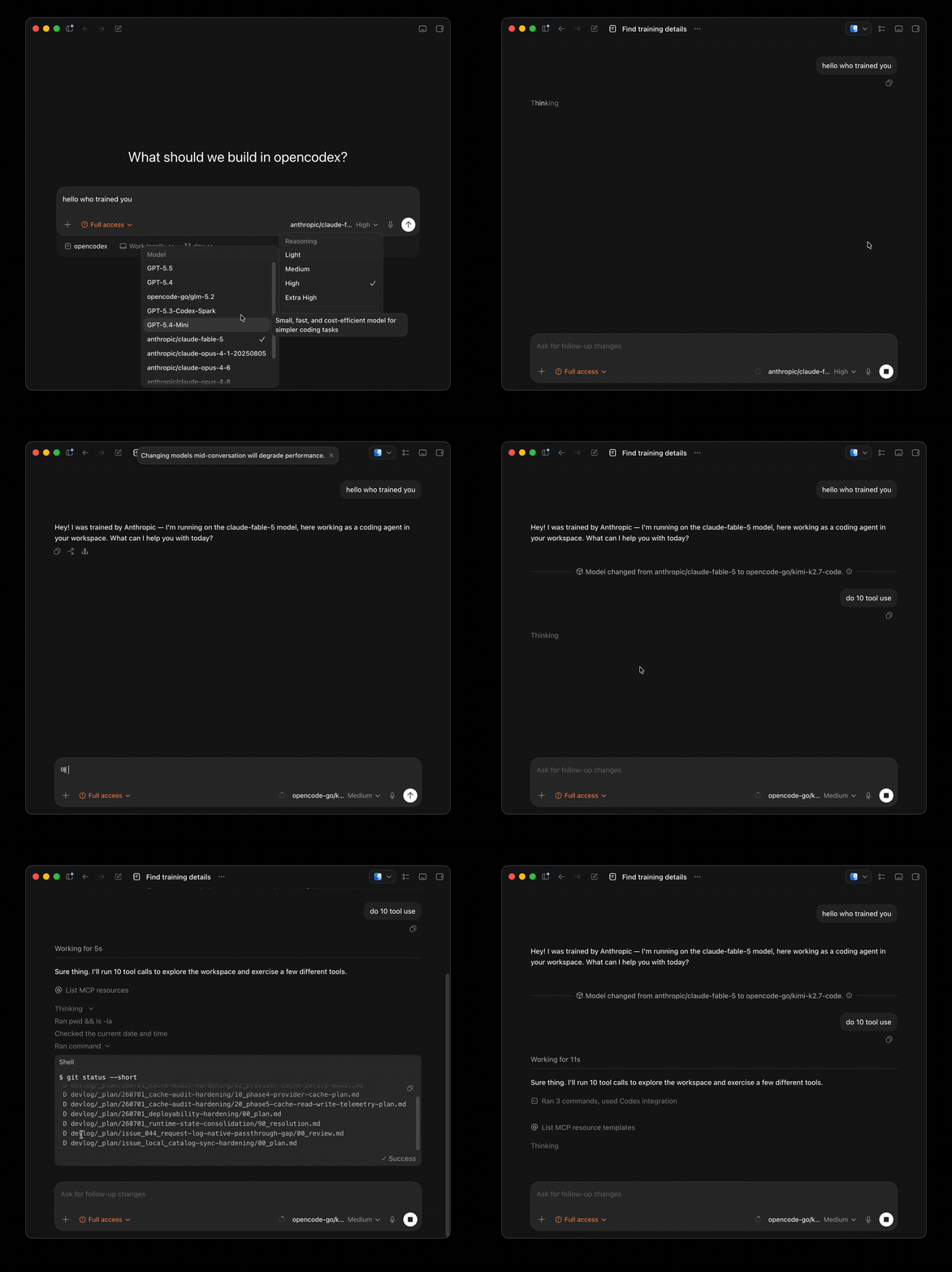
Universal provider proxy for OpenAI Codex & Claude Code — use any LLM (Claude, Gemini, Grok, DeepSeek, Ollama…) with Codex CLI, App, SDK, and Claude Code

Git-native persistent memory for AI coding agents. Implements Google OKF v0.2 with sub-300µs in-memory BM25 search, embedded MCP server, and progressive disclosure. Slashes token bloat by 80% with zero external databases or dependencies. Built in pure Go.

Local-first code intelligence graph for MCP and CLI. Builds a persistent map of your codebase so AI coding tools read only what matters, with benchmarked context reductions on reviews and large-repo workflows.

Stop your AI from making things up — it proposes, deterministic tools decide, every claim checked against ground truth with evidence. Grounded facts and context survive resets. Reverse engineering is the proving ground. MCP server + CLI.