
koala73/worldmonitorConnectors
Real-time global intelligence dashboard. AI-powered news aggregation, geopolitical monitoring, and infrastructure tracking in a unified situational awareness interface
86k
Cortex gives agent hosts a local memory layer for decisions, fixes, project context, and retrieval-backed recall. It works as a stdio MCP server, with optional Claude Code hooks for automatic capture and session-start recall, while other hosts call the same tools directly.
Builders who want their local agent to keep project memory between sessions without sending data to a hosted service.
You can pick up work with remembered context instead of re-explaining the same decisions and fixes.
Stores project memory in a local SQLite database by default, or PostgreSQL with pgvector if you opt in.
Exposes the same memory tools on Claude Code, Codex, Gemini CLI, Cursor, Windsurf, and other stdio MCP hosts.
Adds session start, post-tool capture, checkpoint, and recall hooks when used as a Claude Code plugin.
Combines vector similarity, full-text search, trigram match, heat, and recency before reranking results.
Supports novelty checks, provenance grading, superseding corrections, consolidation, and decay-based forgetting.
Includes reproducible benchmarks and ablation runs for retrieval quality across memory datasets.
claude plugin marketplace add cdeust/Cortex
claude plugin install hypermnesia-mcp
claude plugin uninstall cortex
claude plugin install hypermnesia-mcp
claude plugin uninstall cortex-viz@cortex-plugins
claude plugin marketplace update cortex-plugins
claude plugin install hypermnesia-mcp-viz@cortex-plugins






Memory for AI coding agents that you can hold accountable.
Keep decisions, fixes and project context between sessions, and inspect what was retrieved.
Runs locally by default. No account, no API key, no server to manage.
Sovereign is what it is today. Everything runs on your machine: a local SQLite file by default, or PostgreSQL + pgvector if you prefer. No LLM in the retrieval loop, and nothing leaves localhost unless you configure an integration that does. Your project's memory is a file you own and can delete.
Cross-platform is how it is built. One stdio MCP server and the same 52 tools on Claude Code, in the Claude Desktop bundle, under Claude Cowork, and on every local stdio MCP host listed in the table below. What differs per host is stated there, not discovered after install.
Eco-responsible is what we are aiming at. Work that never reaches a datacenter is work nobody has to power, and an agent that finds the right context first time re-reads fewer files. We hold that intent to the Green Software Foundation's SCI method, and we publish no CO₂ or energy figure, because we have not measured one. What we do and do not claim ↓
36 neuroscience mechanisms · 52 memory tools · 9 lifecycle hooks · a self-curating per-project wiki — all local, all open-source, MIT.
Claude Code — add the marketplace and install the plugin:
claude plugin marketplace add cdeust/Cortex
claude plugin install hypermnesia-mcp
Claude Desktop — download hypermnesia-mcp.mcpb from
Releases and open it, or use
Settings → Extensions. The bundle carries the tools but no hooks; the MCPB format has none.
Claude Cowork is detected automatically (CLAUDE_ENVIRONMENT=cowork) and uses the local
SQLite store. No PostgreSQL required.
Any other stdio MCP host (Codex, Gemini CLI, Cursor, Windsurf, VS Code) launches the same server and gets the same tools. The per-host matrix and launch commands are in Every other MCP host below. Codex has a native package: docs/codex-plugin.md. WSL, TLS client certificates and corporate proxies are covered in docs/deployment-scenarios.md.
The first use creates a local SQLite store under ~/.claude/methodology/. Models are downloaded
once when needed and then run offline. The embedding and reranking model files are both fetched
on first use. Optional integrations, remote PostgreSQL, and OTLP telemetry use the network only
when explicitly configured. PRIVACY.md lists the exact scope.
An existing PostgreSQL install is never silently downgraded: the installer detects a
configured DATABASE_URL, a prior backend marker, or a reachable local cortex database and
keeps it across updates.
The plugin was renamed hypermnesia-mcp in v4.15.0, after a community-directory collision
with an unrelated cortex plugin. Memories, configuration and storage paths are untouched.
claude plugin uninstall cortex
claude plugin install hypermnesia-mcp
The visualization companion, hypermnesia-mcp-viz, was renamed the same way:
claude plugin uninstall cortex-viz@cortex-plugins
claude plugin marketplace update cortex-plugins
claude plugin install hypermnesia-mcp-viz@cortex-plugins
The retained cortex-viz@cortex-plugins entry is a frozen shim that only prints this notice
and exposes no server or tools.
Allowlists, hooks, skills and agents must migrate both composed tool names:
mcp__plugin_cortex-viz_cortex-viz__open_visualization becomes
mcp__plugin_hypermnesia-mcp-viz_hypermnesia-mcp-viz__open_visualization, and
mcp__plugin_cortex-viz_cortex-viz__get_methodology_graph becomes
mcp__plugin_hypermnesia-mcp-viz_hypermnesia-mcp-viz__get_methodology_graph.
Across sessions, agents need to remember decisions, bring prior fixes back when a similar problem returns, and show you which sources support a memory so you can correct it. Cortex keeps that context available while making its status visible.
Cortex does this with local quality checks: what is written, whether its references resolve, what happens when a decision changes, and what can fade over time.
A write passes a local novelty check (the implementation calls it a predictive-coding gate) against what is already stored. Novel content is written; a near-duplicate is merged into the memory it restates rather than filed beside it.
// Illustrative project decision:
remember({ content: "Keep session state in Redis so TTL expiry is handled consistently." })
// → { stored: true, action: "stored" }
Deliberate writes are never rejected for being unsurprising. Unattended capture is, which is what keeps automatic capture from burying the memories you meant to keep.
Every memory is graded at write time, locally, with no network call. The grade is not a confidence score: it is whether the claims carry references that resolve on this machine.
// → provenance: { grade: "unverifiable",
//                 reason: "dead_refs: deps/numpy/_core/_multiarray_umath.cpython-313-darwin.so",
//                 hint: "1 of 9 checkable reference(s) could not be resolved" }
That memory named a file that no longer existed, so it was stored and labelled unverifiable
instead of being silently presented as verified. Rewritten against paths that resolve, the same
memory grades verified. A recalled memory tells you which kind it is; a verified grade still
means that the references resolve locally, not that the claim has been independently proven true.
Corrections supersede rather than overwrite. The new memory records what it replaces, the old one is demoted in recall, and the chain stays readable.
remember({ content: "...", supersedes_id: 4360411 })
// → { action: "superseded", memory_id: 4360412, superseded_id: 4360411 }
Memories carry heat that decays unless replay reinforces them, and episodic traces can consolidate into semantic ones. A specific debugging session may compress to the principle it taught; the commands can fade while the lesson survives. This lifecycle is designed to keep the store useful as it grows, though it is not a promise of a fixed size or guaranteed semantic compression.
Here is an illustrative workflow: decisions, prior fixes, and source checks becoming useful again.
Monday. An hour debugging a webhook handler ends in a race condition: TTL expiry firing between the auth check and the permission lookup. You agree on a fix, implement it, close the session.
Thursday. In another session, a user reports intermittent logouts. Cortex surfaces relevant prior analysis, the Redis decision, and the TTL lesson when their content matches the new work.
Three weeks later. The sessions can consolidate into a pattern about authentication and TTL-based caches; some details may fade while the principle remains useful.
In Claude Code that is automatic: nine lifecycle hooks inject context at session start, recall
per prompt, capture as you work, checkpoint before compaction, and run a per-project wiki that
curates itself. In any other stdio MCP host you call the same 52 tools yourself, or 55 when
the optional ai-architect-mcp-codebase and ai-architect-mcp-spec integrations are present.
Measured against a published benchmark, retrieval only. No LLM reader in the loop: the question is whether the right memory surfaces, not whether a model can write a good answer from it.
LongMemEval: 500 human-curated questions buried in about 40 sessions of history.
| v4.14.1 (historical) | v4.20.0 (current release) | |
|---|---|---|
| Recall@10 | 98.2% | 97.8% |
| MRR | 0.9167 | 0.905 |
Both are single runs: n=500, clean database, consolidation disabled, retrieval only.
v4.14.1, 2026-07-14: artifact JSON; code SHA. This is the run the ablation campaign in Verification was built around.
v4.20.0, 2026-09-09: artifact JSON and its
manifest; code SHA,
dirty=false. A single run of the LongMemEval-S leg alone (benchmarks/reproduce.sh --only longmemeval --no-ablation) in an isolated ephemeral PostgreSQL container, reranker loaded, consolidation
disabled. Against v4.14.1 the change is 0.4 points of Recall@10 and 0.012 of MRR. The run's own
floor check reports Recall@10 within the 0.005 tolerance of the July floor (0.982) and MRR
0.0093 below its floor (0.914), which the script treats as non-blocking by design;
docs/agent-guidance.md records that main no longer clears those
floors and that the release gate is --no-regression against origin/main. The same tree has
no LoCoMo or BEAM figure yet.
Reproduce with benchmarks/reproduce.sh, which runs in an isolated ephemeral container, never
against a live store.
Recall@10 is the share of questions whose answer-bearing session appears in the first ten retrieved sessions. MRR (mean reciprocal rank) rewards finding that session near the top. These numbers describe retrieval only; they do not measure whether an LLM writes a correct answer.
Retrieval fuses five signals through weighted reciprocal-rank fusion, then reranks with a cross-encoder: vector similarity, full-text search, trigram match, heat and recency. LoCoMo and BEAM results, the ablations and the floor gates are in benchmarks/.
SQLite by default. PostgreSQL is one configuration field, worth it for very large stores or a database shared across a team.
bash <plugin-dir>/scripts/install-plugin.sh --postgres
| SQLite (default) | PostgreSQL 15+ | |
|---|---|---|
| Setup | none | pgvector, pg_trgm |
| All 52 tools | yes | yes |
| Retrieval contract | identical | identical |
| Fusion | in-process | server-side PL/pgSQL |
| ANN index | none | pgvector HNSW |
| Cross-agent team decisions, preemptive context, pipeline heat bumps | no-op | active |
Three hook enrichments are PostgreSQL-only and degrade to silent no-ops on SQLite. Session banners, auto-recall, auto-capture, checkpoints and every memory tool work on both.
The server is host-agnostic. Any host that can launch a stdio process gets the full tool surface on the default SQLite store. What is not portable are the nine lifecycle hooks, which are Claude Code plugin machinery; the server never imports or requires them at startup.
| Capability | Claude Code plugin | Local stdio hosts (Gemini CLI, Codex CLI, ChatGPT desktop, Cursor, Windsurf, VS Code, Agents SDK) | ChatGPT web |
|---|---|---|---|
All 52 memory tools (remember, recall, wiki, navigation, consolidation, triggers, rules) | ✅ | ✅ | ❌ no remote HTTPS endpoint is shipped |
| SQLite default store / PostgreSQL opt-in | ✅ | ✅ | ❌ would need a remote deployment and a per-user storage and auth model |
| Auto-capture of significant tool output | ✅ PostToolUse hook | ❌ store explicitly with remember | ❌ |
| Session-start context injection | ✅ SessionStart hook | ❌ call recall yourself | ❌ |
| Per-prompt auto-recall | ✅ | ❌ | ❌ |
| Compaction checkpoints | ✅ | ❌ | ❌ |
| Autonomous wiki cycle | ✅ | ❌ run consolidate / curate_wiki manually | ❌ |
Cognitive profiling (query_methodology) | ✅ | ⚠️ profiles are mined from Claude Code session logs under ~/.claude/; without them the profile is empty | ❌ |
On Claude Code memory is ambient: hooks capture and inject automatically. On every other host memory is tool-driven: the agent stores and retrieves when instructed, and nothing happens between prompts.
The launch command on every host is the PyPI package. The [sqlite] extra enables
sqlite-vec vector search; without it the store still works, with vector search disabled.
uvx --from "hypermnesia-mcp[sqlite]" hypermnesia-mcp
Gemini CLI ships as an extension (gemini-extension.json is in this repository):
gemini extensions install https://github.com/cdeust/Cortex
Codex and ChatGPT desktop have a native plugin with a 10-tool lean surface. Pre-install
the package once so the plugin's first uvx handshake reuses the local uv cache instead of
spending its startup budget downloading a Python environment:
uv tool install "hypermnesia-mcp[sqlite]"
codex plugin marketplace add cdeust/Cortex
codex plugin add hypermnesia-mcp-codex@cortex-codex-plugins
The direct fallback registers the executable without the plugin:
codex mcp add cortex --env CORTEX_MEMORY_STORE_BACKEND=sqlite -- hypermnesia-mcp
The host boundary, the measured startup ceiling and the public-directory requirements Cortex deliberately does not claim are in docs/codex-plugin.md.
Cortex runs a standing efficiency programme, gated by the same evidence rule as the retrieval work: no unsourced efficiency claim ships. Waste is treated as a defect with a reproduction, not as a virtue to advertise.
benchmarks/energy/ implements the Green Software Foundation SCI
specification: operational emissions
O = E × I, embodied allocation M = TE × TS × RS, reported per functional
unit. For the embedding path the functional unit is 1000 model input tokens,
counted from the tokenizer's own attention_mask — never estimated from
characters.
Read benchmarks/energy/README.md before quoting anything from it. Its own
first paragraph is the important one: the automated fixtures exercise arithmetic
and failure paths, they do not measure device energy and do not establish an
energy improvement. Further, by design:
--carbon-intensity (gCO2eq/kWh) and
--embodied (gCO2eq/s, an already allocated rate) are mandatory operator
inputs, validated before any model import. The harness records the values and
their units; it does not vouch for their provenance. You supply the region,
observation period, lifecycle assessment and reservation assumptions.raw_system_energy_j is the sensor's combined
CPU+GPU+ANE estimate. It is neither wall-plug energy nor a complete device SCI
score: memory, storage, screen, power-supply losses, model warm-up and token
counting are all excluded.results.json,
a MANIFEST.json of commit and source hashes, and the exact analyzed
powermetrics.txt snapshot.No energy results are committed to this repository. That is deliberate: a figure measured on one operator's machine, region and duty cycle is not a property of the software, and publishing it as one would be the drift this programme exists to prevent.
Efficiency work lands as ordinary reviewed PRs. Two workstreams are merged:
| Workstream | Change | PR |
|---|---|---|
| CI / build | run pytest once, on the coverage leg, instead of twice | #475 |
| build runtime images only on Docker changes + a weekly validation | #476 | |
| cache pinned dependency and actionlint downloads | #477 | |
| sdist under 5 MB, with a byte-identical wheel | #478 | |
| measured job timeouts; cancel superseded PR runs | #479 | |
| bound the local Docker build context | #481 | |
| stop exporting an unreadable layer cache on every PR run | #506 | |
| Runtime | defer unused pipeline hook imports | #482 |
| route PostToolUse hooks by the tool names they handle | #483 | |
| audit and clean orphan plugin dependencies | #484 | |
| rotate telemetry and detached-worker logs | #485 | |
| persist hook cascade cadence; cool down misses | #486 | |
| pinned CPU-only Torch on Linux — no CUDA payload pulled | #487 |
The hook work is the load-bearing one, because hooks run on every tool event.
Deferring the handler/store stack keeps hook boot at ~0.05 s against
~0.6 s for the full registry import (measured 2026-07-28; the constant is
cited in mcp_server/hooks/auto_recall.py at its call sites, per the
no-invented-constants rule).
The largest efficiency term in an LLM-assisted workflow is not this server's own
CPU — it is the tokens a model must process because the right context was not
found the first time. That makes retrieval quality an energy property, and it is
why the benchmark tables above and this section are the same programme:
response_budget.py bounds a payload and keeps ids so truncation stays
resumable, the reranker degrades to first-stage scores rather than fetching a
model, and CORTEX_RERANKER_OFFLINE=1 refuses the download outright.
This paragraph is a design rationale, not a measurement. Cortex publishes no token-savings or CO2 figure for end-to-end agent sessions, because it has not measured one.
The v4.14.1 figures above are backed by a per-mechanism ablation campaign — full n, single-seed, with code SHAs, dirty flags, manifests, and per-row JSON preserved; the v4.20.0 figures are a single measurement without one:
docs/benchmarks/e1-v3-results.md. Per-mechanism deltas at the calibrated equilibrium + category-specialization analysis.docs/benchmarks/e1-v3-locomo-results.md (pre-fix) and docs/benchmarks/e1-v3-locomo-results-post-fix.md (post plasticity result-shape fix). Two-baseline design (NO_CONSOLIDATION / WITH_CONSOLIDATION).The full per-mechanism evidence lives in the thermodynamic paper (§6.3); the BEAM decay dose-response (§6.4) documents a re-scoped negative result after a dirty-store confound was caught and traced. Thermodynamic Memory vs. Flat-Importance Stores (PDF, 34 pages) · Stage-Aware Context Assembly (PDF, 39 pages).
The mechanisms above are implemented as 36 system mechanisms spanning encoding, consolidation, retrieval and forgetting. Each is cited to published work and exposed as a live system vital. The bibliography is the check: its entry count is what the references badge reports, and a gate fails the build if the two disagree.
Clean Architecture, concentric layers: server → handlers → core ← shared, and
infrastructure → shared. Core is pure and testable without mocks.
docs/agent-guidance.md is the map;
docs/mcp-tools.md is the tool reference.
Runs 100% locally — MCP over stdio, the storage backend (SQLite file or PostgreSQL on localhost) never leaves your machine (the optional hypermnesia-mcp-viz companion binds its server to 127.0.0.1). No data leaves your machine. SafeSkill scan: 94/100 (code 97, content 88 — docs/safeskill-report.json).
Cortex is local-first: your memories, conversations, and profiles stay on your machine — stored in a local SQLite database (~/.claude/methodology/memory.db) by default, or in a PostgreSQL database you control. Cortex sends no memories, content, or telemetry to the author, Anthropic, or any third party. The only outbound network activity is a one-time download of open-source embedding/reranking models from Hugging Face (model files only), plus any integrations you explicitly configure. Full policy: PRIVACY.md.
pytest                                # full suite; assets/badge-tests.svg carries the current count
ruff check . && ruff format --check . # lint and format, both enforced in CI
python scripts/check_doc_claims.py    # advertised counts must match the repo
python scripts/check_craftsmanship.py # file and method caps, layer whitelist, sourced constants
CONTRIBUTING.md describes the gates a change has to clear. GOVERNANCE.md says who decides and what happens if the maintainer stops. docs/ROADMAP.md says where the project is going, and docs/ASSURANCE-CASE.md states the security argument and its limits. CHANGELOG.md is the complete release history.
MIT — see LICENSE.
This software is the independent work of Clément Deust. It was developed outside any employment relationship and is not affiliated with, endorsed by, or owned by any past or present employer. It is part of the ai-architect ecosystem (zetetic-team-subagents, ai-architect-mcp-codebase, ai-architect-mcp-spec).
The neuroscience and information-retrieval algorithms encoded in this software are derived
from published academic work cited in
docs/papers/bibliography.md and inline in the source via
# source: annotations (Friston on predictive coding, Anderson & Lebiere on rate-distortion
forgetting, Nader et al. on retrieval-induced lability, McClelland et al. on consolidation,
and others). The MIT license covers this implementation; it does not assert ownership over
the underlying mechanisms, which remain attributable to their original authors and
publications.
The paper PDFs on main are the canonical artefacts (arXiv IDs forthcoming, endorsement in
progress):
@software{cortex2026,
  title={Cortex: Persistent Memory for Claude Code},
  author={Deust, Clement},
  year={2026},
  url={https://github.com/cdeust/Cortex}
}

@unpublished{deust2026thermodynamic,
  title={Thermodynamic Memory vs. Flat-Importance Stores:
         Why Long-Term Retrieval Collapses Without Decay},
  author={Deust, Clement},
  year={2026},
  note={arXiv ID forthcoming, endorsement in progress},
  url={https://github.com/cdeust/Cortex/blob/main/docs/arxiv-thermodynamic/main.pdf}
}

@unpublished{deust2026context,
  title={Stage-Aware Context Assembly for Long-Context Memory Retrieval},
  author={Deust, Clement},
  year={2026},
  note={arXiv ID forthcoming, endorsement in progress},
  url={https://github.com/cdeust/Cortex/blob/main/docs/arxiv-context-assembly/main.pdf}
}
Sign in to join the discussion.
No comments yet. Be the first to say what this is good for.
Real-time global intelligence dashboard. AI-powered news aggregation, geopolitical monitoring, and infrastructure tracking in a unified situational awareness interface
High-performance code intelligence MCP server. Indexes codebases into a persistent knowledge graph — average repo in milliseconds. 158 languages, sub-ms queries, 99% fewer tokens. Single static binary, zero dependencies.
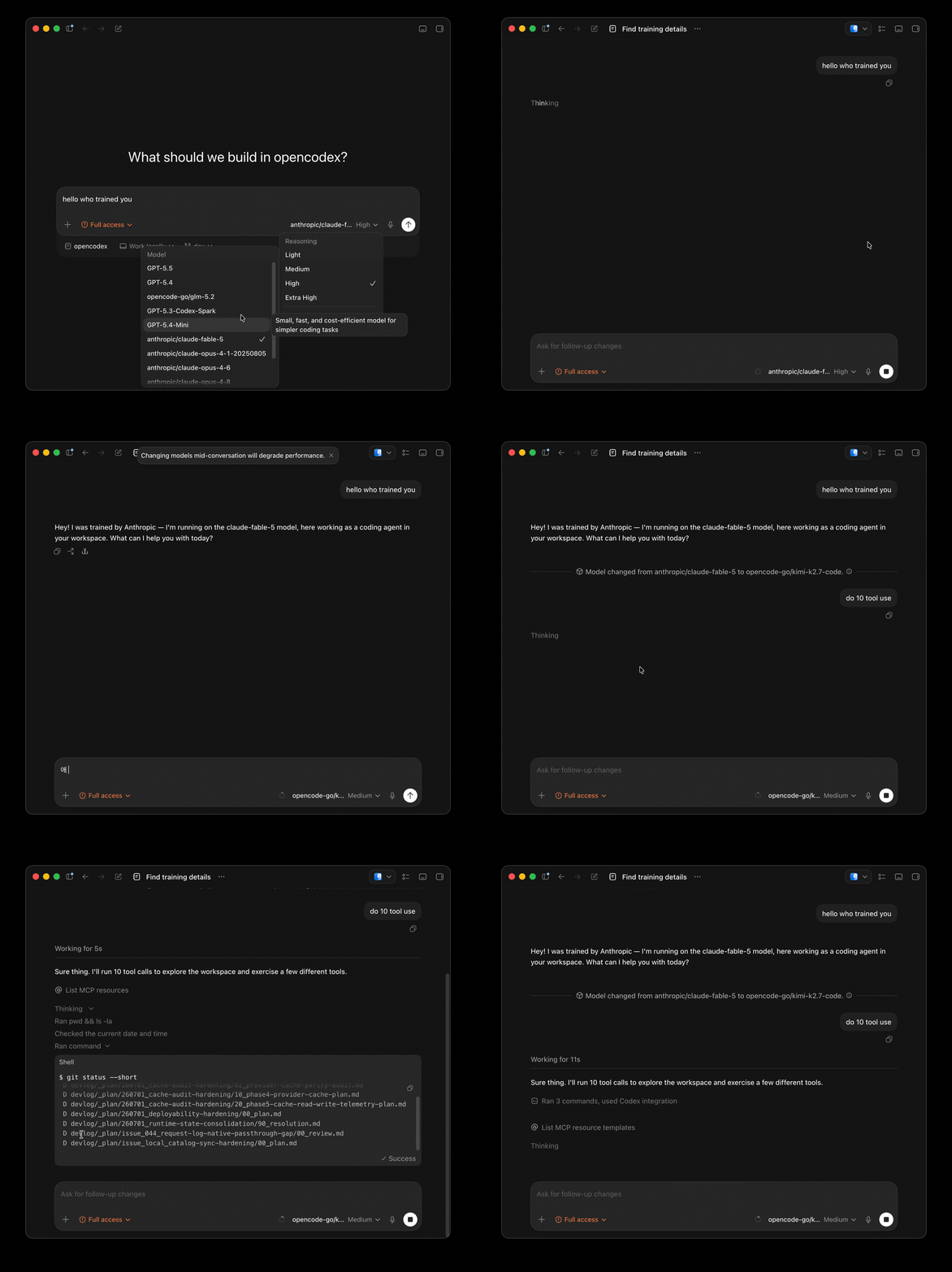
Universal provider proxy for OpenAI Codex & Claude Code — use any LLM (Claude, Gemini, Grok, DeepSeek, Ollama…) with Codex CLI, App, SDK, and Claude Code

Git-native persistent memory for AI coding agents. Implements Google OKF v0.2 with sub-300µs in-memory BM25 search, embedded MCP server, and progressive disclosure. Slashes token bloat by 80% with zero external databases or dependencies. Built in pure Go.

Local-first code intelligence graph for MCP and CLI. Builds a persistent map of your codebase so AI coding tools read only what matters, with benchmarked context reductions on reviews and large-repo workflows.

Stop your AI from making things up — it proposes, deterministic tools decide, every claim checked against ground truth with evidence. Grounded facts and context survive resets. Reverse engineering is the proving ground. MCP server + CLI.