
koala73/worldmonitorConnectors
Real-time global intelligence dashboard. AI-powered news aggregation, geopolitical monitoring, and infrastructure tracking in a unified situational awareness interface
86k
ida-mcp-rs exposes IDA Pro as an MCP server so an agent can open binaries, list functions, disassemble code, decompile, search strings, and run scripts. It supports stdio and HTTP transport, workspace mode for multiple databases, and optional debugger and Lumina tools behind flags.
Builders who want their agent to analyze binaries inside IDA Pro instead of copying data by hand.
You can let your agent inspect and analyze binaries through IDA Pro from the same chat or terminal workflow.
Open IDB files or raw blobs, list functions, read strings, inspect xrefs, and decompile addresses.
Run multiple databases at once and route each tool call with a `database_id`.
Serve MCP over stdio or HTTP/SSE, including pooled worker mode for multi-client use.
Run inline Python or a `.py` file inside the open database and capture stdout and stderr.
Expose launch, attach, module, and stop tools when `--enable-debugger` is set on supported builds.
Query or apply IDA Lumina metadata when `--allow-lumina` is enabled.
Limit the MCP surface with `--toolsets`, `--tools`, `--exclude-tools`, and `--read-only`.
brew install blacktop/tap/ida-mcp # Latest (IDA 9.4)
brew install blacktop/tap/ida-mcp@9.3    # IDA 9.3/9.3sp1
brew install blacktop/tap/ida-mcp@9.2    # IDA 9.2
scoop bucket add blacktop https://github.com/blacktop/scoop-bucket
scoop install blacktop/ida-mcp
nix shell github:blacktop/nur#ida-mcp \
  --extra-experimental-features 'nix-command flakes'
claude mcp add ida -- ida-mcp
claude mcp add ida -e DYLD_LIBRARY_PATH='/path/to/IDA.app/Contents/MacOS' -- ida-mcp
Headless IDA Pro MCP server for AI-powered reverse engineering.




macOS / Linux (via Homebrew)
brew install blacktop/tap/ida-mcp # Latest (IDA 9.4)
macOS (Apple Silicon), older IDA releases (via versioned Homebrew casks)
brew install blacktop/tap/ida-mcp@9.3    # IDA 9.3/9.3sp1
brew install blacktop/tap/ida-mcp@9.2    # IDA 9.2
Windows (via Scoop)
scoop bucket add blacktop https://github.com/blacktop/scoop-bucket
scoop install blacktop/ida-mcp
Windows note: See the Windows platform setup section below for DLL discovery options.
macOS / Linux (via Nix)
nix shell github:blacktop/nur#ida-mcp \
  --extra-experimental-features 'nix-command flakes'
Direct download — grab the archive for your platform from GitHub Releases.
Build from source
See docs/BUILDING.md.
ida-mcp versions mirror IDA Pro versions (
v9.4.xfor IDA 9.4,v9.3.xfor IDA 9.3, andv9.2.xfor IDA 9.2). A version mismatch is detected at startup with a clear error message. Scoop and NUR publish the latest version. For older IDA versions, use the matching GitHub Release or, on Apple Silicon, the versioned Homebrew cask.
Standard IDA installations in /Applications work automatically:
claude mcp add ida -- ida-mcp
If you see Library not loaded: @rpath/libida.dylib, set DYLD_LIBRARY_PATH to your IDA path:
claude mcp add ida -e DYLD_LIBRARY_PATH='/path/to/IDA.app/Contents/MacOS' -- ida-mcp
Supported paths (auto-detected):
/Applications/IDA Professional 9.4.app/Contents/MacOS/Applications/IDA Home 9.4.app/Contents/MacOS/Applications/IDA Essential 9.4.app/Contents/MacOSThe IDA installer defaults to ~/ida-pro-9.4 — the launcher script auto-detects this:
claude mcp add ida -- ida-mcp
For non-default install locations, set IDADIR:
claude mcp add ida -e IDADIR='/path/to/ida' -- ida-mcp
Resolution order: $IDADIR → ~/ida-pro-9.4 → /opt/ida-pro-9.4 and other RUNPATH fallbacks.
Option A — Install ida-mcp.exe into your IDA directory (simplest, no env setup needed):
# Copy the binary next to ida.dll / idalib.dll
copy ida-mcp.exe "C:\Program Files\IDA Professional 9.4\"
claude mcp add ida -- "C:\Program Files\IDA Professional 9.4\ida-mcp.exe"
Option B — Install via Scoop (auto-detects IDA and sets IDADIR):
scoop bucket add blacktop https://github.com/blacktop/scoop-bucket
scoop install blacktop/ida-mcp
claude mcp add ida -- ida-mcp
Option C — Set IDADIR manually:
$idaDir = "C:\Program Files\IDA Professional 9.4"
[Environment]::SetEnvironmentVariable("IDADIR", $idaDir, "User")
$userPath = [Environment]::GetEnvironmentVariable("Path", "User")
$pathEntries = @($userPath -split ";" | Where-Object { $_ })
if (-not ($pathEntries -contains $idaDir)) {
  [Environment]::SetEnvironmentVariable(
    "Path", (@($pathEntries + $idaDir) -join ";"), "User"
  )
}
# Then restart your terminal
claude mcp add ida -- ida-mcp
Windows requires ida.dll and idalib.dll to be discoverable before ida-mcp starts. Placing ida-mcp.exe in the IDA directory is the easiest approach. Otherwise, set IDADIR for build/install discovery and add the same IDA directory to PATH for runtime DLL loading.
Common IDA paths:
C:\Program Files\IDA Professional 9.4C:\Program Files\IDA Pro 9.4C:\Program Files\IDA Home 9.4The binary links against IDA's libraries at runtime. Standard installation paths are auto-detected via baked RPATHs. For non-standard paths:
| Platform | Library | Fallback Configuration |
|---|---|---|
| macOS | libida.dylib | DYLD_LIBRARY_PATH |
| Linux | libida.so | IDADIR (launcher reads it) or LD_LIBRARY_PATH |
| Windows | ida.dll | Place exe in IDA dir, or set IDADIR and add IDA dir to PATH |
claude mcp add ida -- ida-mcp
codex mcp add ida -- ida-mcp
gemini mcp add ida -- ida-mcp
Add to .cursor/mcp.json:
{
  "mcpServers": {
    "ida": { "command": "ida-mcp" }
  }
}
Once configured, you can analyze binaries through your AI agent:
# Open a binary (returns quickly — analysis runs separately)
open_idb(path: "~/samples/malware")

# Keep the generated database away from a read-only input directory
open_idb(path: "/System/example", idb_out: "~/ida-work/example.i64")

# These work immediately, no analysis needed
list_functions(limit: 20)
disasm_by_name(name: "main", count: 20)
strings(limit: 10)

# For xrefs/decompile on large binaries, run analysis in background
analyze_funcs(background: true)   # returns task_id
task_status(task_id: "analyze-<random>") # poll progress (ID from the analyze_funcs response)

# Decompile (requires Hex-Rays + completed analysis)
decompile(address: "0x100000f00")

# Discover more tools
tool_catalog(query: "find callers")
Raw inputs still use IDA's normal loader by default and save to <input>.i64.
idb_out selects another database location, which is useful for read-only input
directories. An existing output is reused only when IDA's recorded input
SHA-256 matches the current file; rebuild: true can overwrite only a database
whose hash or recorded input path proves that it belongs to the input.
For headerless blobs, the same open_idb tool accepts typed loader hints:
open_idb(
  path: "~/firmware/boot.bin",
  idb_out: "~/ida-work/boot.i64",
  processor: "arm:ARMv7-M",
  bitness: 32,
  base_address: "0x08000000",
  entry_point: "0x08000101"
)
Processor families with multiple modes require an explicit IDA processor
variant; ambiguous bare names such as arm or metapc are rejected. These
target fields apply only while creating a raw-input database and never alter an
existing .i64/.idb. For 32-bit ARM targets, an odd entry_point is treated
as a Thumb pointer: ida-mcp clears bit 0 for the code address and records the
Thumb state before creating the entry instruction.
The default remains one implicit IDA database, so existing agent prompts and
tool calls do not need a handle. For headless workflows that deliberately keep
several databases open, start with --workspace:
ida-mcp --workspace --workspace-max-workers 4
ida-mcp --workspace serve-http --bind 127.0.0.1:8765 --stateless
In workspace mode, each open_idb/open_dsc allocates and returns a
database_id. Every database-scoped call must send that ID; runtime tools such
as tool_catalog reject it. close_idb(database_id: ...) invalidates only the
selected handle. Idle handles are reaped after 30 minutes by default; use
--workspace-idle-timeout-secs 0 to disable that database TTL.
list_databases recovers handles: it returns every routed database_id with
its database path and lifecycle state (open, busy, or no_worker), so an
agent that lost a response — or reconnected over stateless HTTP — can re-address
an open database instead of stranding it until the TTL expires. It is read-only
and, like every workspace tool, is absent unless the server runs --workspace.
Workspace routing and legacy pooled HTTP share one internal registry. The legacy session behavior below is preserved, but there is no second independent session-to-worker lease map.
serve-http keeps the existing single in-process IDA worker by default. For
stateful multi-client HTTP/SSE usage, set --max-workers above 1 to route
sessions through child ida-mcp worker processes:
ida-mcp serve-http --bind 127.0.0.1:8765 --max-workers 4 --min-workers 1
Without --max-workers N, HTTP sessions still share one IDA context; a second
client opening another binary waits behind the first and then gets the normal
A database is already open error. Pooled startup logs include
Starting pooled HTTP router and MCP pooled HTTP server listening.
Each opened HTTP session leases one child worker until close_idb, HTTP
DELETE, session timeout, or server shutdown. close_idb releases the lease
immediately, but the child process may stay alive idle for reuse until
--worker-idle-timeout-secs elapses. If all workers are leased, new
open_idb/open_dsc calls fail with Worker pool exhausted so clients can
retry later. Pooled mode requires stateful HTTP sessions; --max-workers > 1
is rejected with --stateless.
Debugger tools are absent from the default schema. On supported builds, add
--enable-debugger to expose debug_status, debug_launch, debug_attach,
debug_modules, and debug_stop. debug_open_module additionally requires
--workspace, because it opens the selected runtime image in a new database
without replacing the database that owns the live debug session:
debug_status()
debug_launch(database_id: "…", path: "/absolute/path/to/program")
debug_modules(database_id: "…")
debug_open_module(
  database_id: "…",
  module: "/usr/lib/libobjc.A.dylib",
  idb_out: "~/ida-work/libobjc.i64"
)
debug_stop(database_id: "…", action: "auto")
debug_open_module opens standalone binaries and dlopen'd plugins directly.
On macOS, it also resolves system libraries such as
/usr/lib/libobjc.A.dylib through the target architecture's host dyld shared
cache and loads the selected image through IDA 9.4's in-process DSC service;
it does not extract a temporary dylib or invoke idat.
debug_open_module.idb_out is always required. Runtime modules often live in
read-only system directories, and silently writing an IDB next to them is not a
valid headless workflow. The response includes a checked runtime slide; the new
database remains at its on-disk preferred addresses.
In workspace mode, a successfully launched or attached debug session pins its
database against the idle TTL until debug_stop succeeds or close_idb
releases the database.
Known limitation — a target that exits on its own keeps its pin. IDA's
process state is a cached value that only refreshes when a call drains the
pending debug event, so a debuggee killed outside ida-mcp is not observable in
the background. Its database stays pinned (and exempt from the idle TTL) until
debug_stop, close_idb, or worker loss clears it. Both debug_stop and
close_idb handle an already-exited target correctly.
Known limitation — worker loss does not stop the debuggee. If the worker
process hosting a live debug session is killed, crashes, or ida-mcp retires it
after a wedged debugger call, that process may never run its own teardown, so
IDA's debug-server helper can be reparented instead of terminated and the
target may keep running. When an in-flight tool call detects or causes that
retirement, ida-mcp returns a Debugger session lost error saying the target
may still be alive, clears the handle's debug pin, and never claims the
debuggee ended. A leased worker can also die while no request is in flight to
carry an error; list_databases may briefly report no_worker before the
reaper removes that terminal handle, even when healthy idle eviction is
disabled. Cleaning up a stray helper or debuggee is currently manual.
The first enabled platform is macOS on Apple Silicon. ida-mcp selects IDA's
signed loopback helper from the opened database's target architecture:
mac_server_arm for ARM64 and mac_server for x86/x86_64. macOS may require
IDA's supported “Take Control” authorization once per login; tools report
user_action_required when it is missing. ida-mcp never asks for root, disables
SIP, edits authorizationdb, or re-signs binaries. Linux and Windows remain
fail-closed rather than being advertised optimistically: IDA's ARM Linux
backend is remote-only and remote configuration is not exposed, while the SDK
does not provide a Windows-on-ARM user debugger. Their native ARM64 harnesses
pass by proving the debugger surface remains unavailable; x86 Linux and Windows
still require a positive local-backend oracle before advertisement.
MCP 2026-07-28 uses the sessionless server/discover lifecycle. It is
supported over stdio and the default single-worker HTTP mode, including
multi-round elicitation and the io.modelcontextprotocol/tasks extension for
background open_dsc calls. Pooled HTTP (--max-workers > 1) deliberately
advertises protocol versions only through 2025-11-25: its worker lease is
session-affine, and MCP 2026 has no session identifier to preserve that routing
across requests. MCP 2026 requests to pooled HTTP fail with an unsupported
protocol-version error instead of risking dispatch to a different IDA worker.
If an SSE-capable client exits without sending close_idb or HTTP DELETE,
pooled mode closes the session after its standalone SSE stream disconnects and
the --worker-disconnect-grace-secs reconnect grace elapses.
POST-only clients do not always leave a stream for the server to observe, so
their orphaned sessions are reclaimed by --session-keep-alive-secs (default
1800 seconds). Lower it if you need faster pool reclaim for POST-only clients.
dyld_shared_cache analysisopen_dsc opens a single module from Apple's dyld_shared_cache. With IDA 9.4, ida-mcp opens the DSC header directly and loads images through IDA's native dscu service. Older IDA builds fall back to the legacy idat background flow when a generated .i64 is needed.
# Open a module from the DSC
open_dsc(path: "/path/to/dyld_shared_cache_arm64e", arch: "arm64e",
         module: "/usr/lib/libobjc.A.dylib")

# If a legacy background task was started, poll until done
task_status(task_id: "dsc-<random>")  # ID from the open_dsc response

# Load additional frameworks for cross-module references
open_dsc(path: "/path/to/dyld_shared_cache_arm64e", arch: "arm64e",
         module: "/usr/lib/libobjc.A.dylib",
         frameworks: ["/System/Library/Frameworks/Foundation.framework/Foundation"])

# Incrementally load another DSC dylib into an already-open database
dsc_add_dylib(module: "/usr/lib/libSystem.B.dylib")

# Incrementally load a DSC data/GOT/stub region by address
dsc_add_region(address: "0x180116000")

# After dsc_add_dylib/dsc_add_region, confirm analysis readiness
analysis_status()
Requirements:
dscu loadingidat must be available via $IDADIR or standard install pathsrun_script executes Python code in the open database via IDA's IDAPython engine. stdout and stderr are captured.
# Inline script
run_script(code: "import idautils\nfor f in idautils.Functions():\n    print(hex(f))")

# Run a .py file from disk
run_script(file: "/path/to/analysis_script.py")

# With timeout (default 120s, max 600s)
run_script(code: "import ida_bytes; print(ida_bytes.get_bytes(0x1000, 16).hex())",
           timeout_secs: 30)
All ida_* modules, idc, and idautils are available. See the IDAPython API reference.
ida-mcp disables IDA's automatic Lumina lookup by default, so starting the
server or opening a database does not automatically contact
lumina.hex-rays.com. The setting is applied only inside ida-mcp's isolated
IDA user profile and does not change the normal IDA GUI profile. On Windows,
ida-mcp also uses a process-local registry mapping because IDA stores its
settings in the Windows registry instead of under IDAUSR. Startup fails
closed if the private profile cannot be established.
To allow IDA to use the configured Lumina servers, opt in for that process:
ida-mcp --allow-lumina
The equivalent environment setting is IDA_MCP_ALLOW_LUMINA=true.
With that opt-in enabled, two metadata tools are available:
lumina_lookup queries one function and reports the available metadata
without changing the database.lumina_apply pulls and applies metadata using IDA's upgrade policy.
force: true may replace existing names, types, or comments.lumina_apply is excluded by --read-only; lumina_lookup remains available
because it does not modify the database.
ida-mcp exposes the same 75 baseline tools by default (~12k tokens of
tools/list payload). Six debugger tools exist behind the explicit gates above,
so installing the new release does not enlarge existing clients' schema.
Clients with dynamic tool discovery defer that cost; clients that preload
schemas include it in every session. Filter the surface to only what you need:
| Flag | Env var | Effect |
|---|---|---|
--toolsets=cat1,cat2 | IDA_MCP_TOOLSETS | Replaces "all tools" with the union of selected categories |
--tools=t1,t2 | IDA_MCP_TOOLS | Adds individual tools (additive to --toolsets) |
--exclude-tools=t1,t2 | IDA_MCP_EXCLUDE_TOOLS | Subtracts from the include set; always wins |
--read-only | IDA_MCP_READ_ONLY | Strips mutating/arbitrary-code tools (run_script, patch*, rename, set_comments, lumina_apply, type/stack edits, dsc_add_*, analyze_funcs, and debugger process control); keeps lifecycle/discovery |
No flags = all 75 baseline tools (default). Categories: core, functions,
disassembly, decompile, xrefs, control_flow, memory, search,
metadata, types, editing, scripting; debug appears only when its
startup/platform gate is active (run tool_catalog to enumerate). Flags
override env vars; unknown names are rejected at startup.
ida-mcp --toolsets=core,functions,disassembly,decompile,xrefs
ida-mcp --toolsets=core,functions,disassembly,decompile --read-only
ida-mcp --toolsets=core,functions --tools=decompile,callees,callers --read-only
mcpServers.jsonMost installed MCP configs run ida-mcp directly without a subcommand. The env vars apply on that path too:
{
  "mcpServers": {
    "ida-mcp": {
      "command": "ida-mcp",
      "env": {
        "IDA_MCP_TOOLSETS": "core,functions,disassembly,decompile,xrefs",
        "IDA_MCP_READ_ONLY": "true"
      }
    }
  }
}
Run just measure-tools to see the per-tool char/token breakdown. Filtering doesn't change the numbers reported there (it acts at the protocol boundary), but the difference shows up in your client's context view (/context in Claude Code, equivalents elsewhere).
MIT Copyright (c) 2026 blacktop
Sign in to join the discussion.
No comments yet. Be the first to say what this is good for.
Real-time global intelligence dashboard. AI-powered news aggregation, geopolitical monitoring, and infrastructure tracking in a unified situational awareness interface
High-performance code intelligence MCP server. Indexes codebases into a persistent knowledge graph — average repo in milliseconds. 158 languages, sub-ms queries, 99% fewer tokens. Single static binary, zero dependencies.
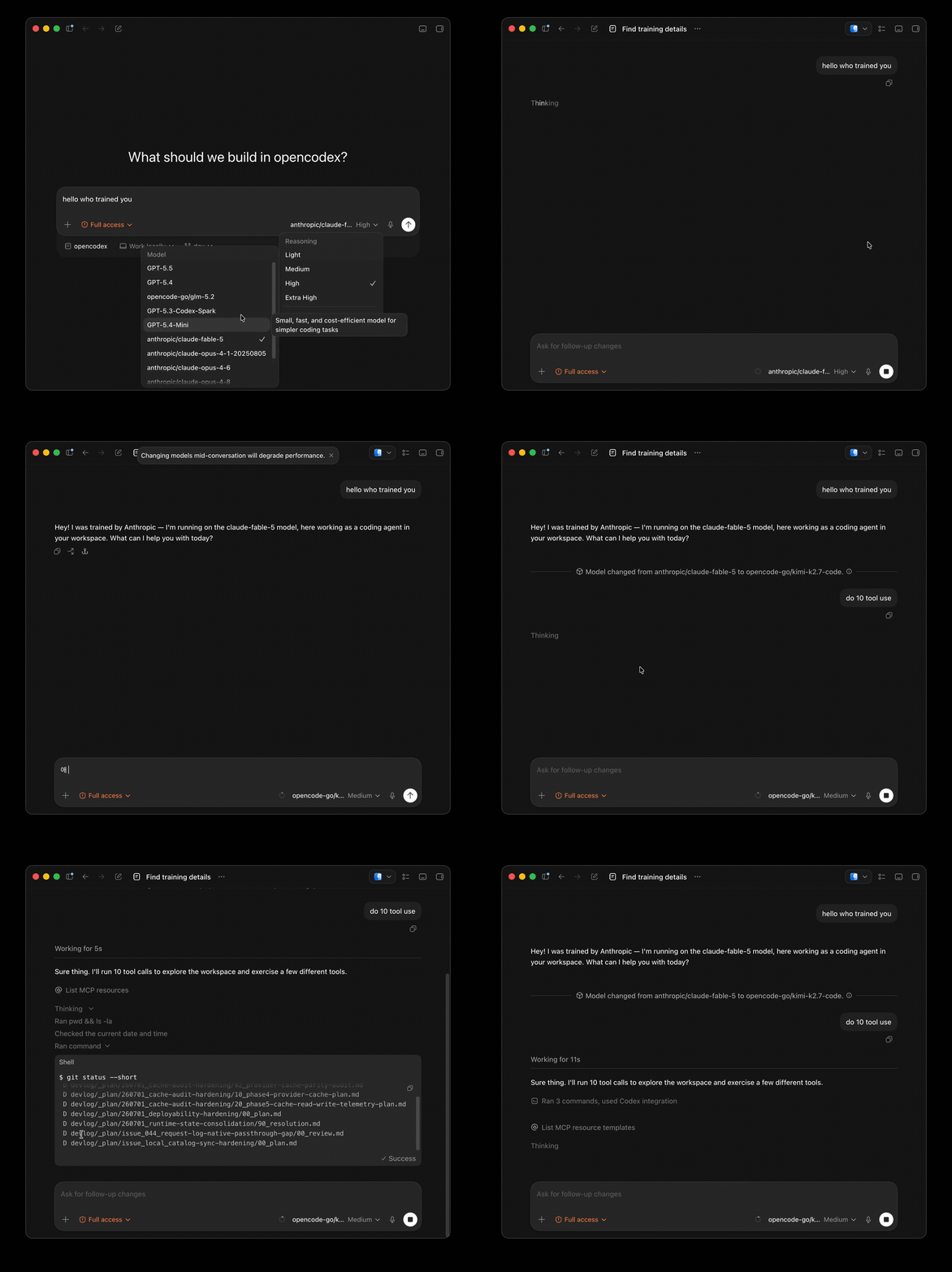
Universal provider proxy for OpenAI Codex & Claude Code — use any LLM (Claude, Gemini, Grok, DeepSeek, Ollama…) with Codex CLI, App, SDK, and Claude Code

Git-native persistent memory for AI coding agents. Implements Google OKF v0.2 with sub-300µs in-memory BM25 search, embedded MCP server, and progressive disclosure. Slashes token bloat by 80% with zero external databases or dependencies. Built in pure Go.

Local-first code intelligence graph for MCP and CLI. Builds a persistent map of your codebase so AI coding tools read only what matters, with benchmarked context reductions on reviews and large-repo workflows.

Stop your AI from making things up — it proposes, deterministic tools decide, every claim checked against ground truth with evidence. Grounded facts and context survive resets. Reverse engineering is the proving ground. MCP server + CLI.