

koala73/worldmonitorConnectors
Real-time global intelligence dashboard. AI-powered news aggregation, geopolitical monitoring, and infrastructure tracking in a unified situational awareness interface
86k
Airstore turns integrations into folders and files that an agent can read with normal filesystem tools. It also provides MCP tools as executables, so the agent can search data and act on connected services from the mounted workspace.
Builders who want their agent to work with connected data through files and command-line tools.
You can give your agent scoped access to live data without re-explaining context or wiring each app by hand.
Create folders of files from natural language queries or structured filters, such as invoices, open PRs, or high-priority issues.
Connect services like GitHub, Gmail, Google Drive, Linear, Notion, Slack, and web sources.
Expose tools such as GitHub, Wikipedia, and filesystem actions as command-line binaries under the mounted tree.
Share integrations and source views across a team.
Run the stack on your own infrastructure with your own MCP servers and config file.
curl -fsSL https://get.airstore.ai | sh
airstore login
airstore mount ~/airstore
ls ~/airstore/gmail/invoices/
# stripe-invoice-jan-28.eml
# aws-invoice-jan-25.eml
# digitalocean-jan-22.eml
cat ~/airstore/gmail/invoices/stripe-invoice-jan-28.eml

From: billing@stripe.com
Subject: Your invoice from Stripe
Date: Jan 28, 2025

Amount: $249.00
Status: Paid
cd ~/airstore
claude
The filesystem for AI agents

Website · Docs · Demo Video · Discord
Airstore adds any source of data into a virtual filesystem. Connect Gmail, GitHub, Linear — then describe what you need in plain English. Results appear as files that Claude Code can read.
⭐ If this is useful, give us a star
Claude Code already knows how to read files, search directories, and work with file contents. By turning your integrations into files, Claude can use the same tools it uses for code, for your data.
Source views also let you scope exactly what Claude can access. Instead of granting access to your entire inbox, create a view with just "invoices from last week" — or use structured filters for precise control.
Go to app.airstore.ai and create an account.
In the dashboard, go to Settings → Integrations and connect a service (GitHub, Gmail, Drive, and more.).
Click New Folder and describe what you want in natural language, or use structured filters:
curl -fsSL https://get.airstore.ai | sh
airstore login
airstore mount ~/airstore
Your source views are now available as local directories:
ls ~/airstore/gmail/invoices/
# stripe-invoice-jan-28.eml
# aws-invoice-jan-25.eml
# digitalocean-jan-22.eml
cat ~/airstore/gmail/invoices/stripe-invoice-jan-28.eml

From: billing@stripe.com
Subject: Your invoice from Stripe
Date: Jan 28, 2025

Amount: $249.00
Status: Paid
cd ~/airstore
claude
Ask Claude to work with your data:
~/airstore/
├── linear/
│   └── design-issues/     # Source view
├── github/
│   └── open-prs/          # Source view
├── gmail/
│   └── invoices/          # Source view
└── tools/
    ├── github             # MCP tool executable
    ├── linear             # MCP tool executable
    └── gmail              # MCP tool executable
Source views contain data from your integrations, materialized as files. They sync automatically in the background, or manually on demand.
Tools are MCP servers exposed as executables that let you take actions:
~/airstore/tools/github create-issue --repo=acme/api --title="Bug fix needed"
Tools output JSON and can be piped together with standard Unix tools:
~/airstore/tools/wikipedia search "albert" | grep -i 'einstein'
The install script handles everything:
curl -fsSL https://get.airstore.ai | sh
This automatically:
Verify the installation:
airstore --version
| Platform | Status |
|---|---|
| macOS (Apple Silicon) | Supported |
| macOS (Intel) | Supported |
| Linux (x86_64) | Supported |
| Linux (ARM64) | Supported |
| Windows | Coming soon |
For development or self-hosted deployments, you can run Airstore entirely on your own infrastructure with your own MCP servers.
FUSE (required):
# macOS
brew install fuse-t

# Ubuntu/Debian
sudo apt install fuse3
Node.js (for npx-based MCP servers):
# macOS
brew install node

# Ubuntu/Debian
sudo apt install nodejs npm
Create a config.local.yaml file:
mode: local

gateway:
  grpc:
    port: 1993
  http:
    host: 127.0.0.1
    port: 1994

tools:
  mcp:
    filesystem:
      command: npx
      args: ["-y", "@modelcontextprotocol/server-filesystem", "/tmp", "/Users"]

    memory:
      command: npx
      args: ["-y", "@modelcontextprotocol/server-memory"]

    wikipedia:
      command: npx
      args: ["-y", "@modelcontextprotocol/server-wikipedia"]

    github:
      command: npx
      args: ["-y", "@modelcontextprotocol/server-github"]
      env:
        GITHUB_TOKEN: "${GITHUB_TOKEN}"
airstore mount ~/airstore --config config.local.yaml
Your tools are now available:
ls ~/airstore/tools/
# filesystem  memory  wikipedia  github

# Search Wikipedia
~/airstore/tools/wikipedia search "artificial intelligence"

# List files
~/airstore/tools/filesystem list_directory /tmp

# Get help for any tool
~/airstore/tools/filesystem --help
git clone https://github.com/beam-cloud/airstore
cd airstore
make build
./bin/cli mount ~/airstore --config config.local.yaml
Full documentation at docs.airstore.ai:
PRs welcome! See CONTRIBUTING.md for guidelines.
Join our Discord to discuss ideas and get help.
AGPL 3.0 License - see LICENSE for details.
Sign in to join the discussion.
No comments yet. Be the first to say what this is good for.
Real-time global intelligence dashboard. AI-powered news aggregation, geopolitical monitoring, and infrastructure tracking in a unified situational awareness interface
High-performance code intelligence MCP server. Indexes codebases into a persistent knowledge graph — average repo in milliseconds. 158 languages, sub-ms queries, 99% fewer tokens. Single static binary, zero dependencies.
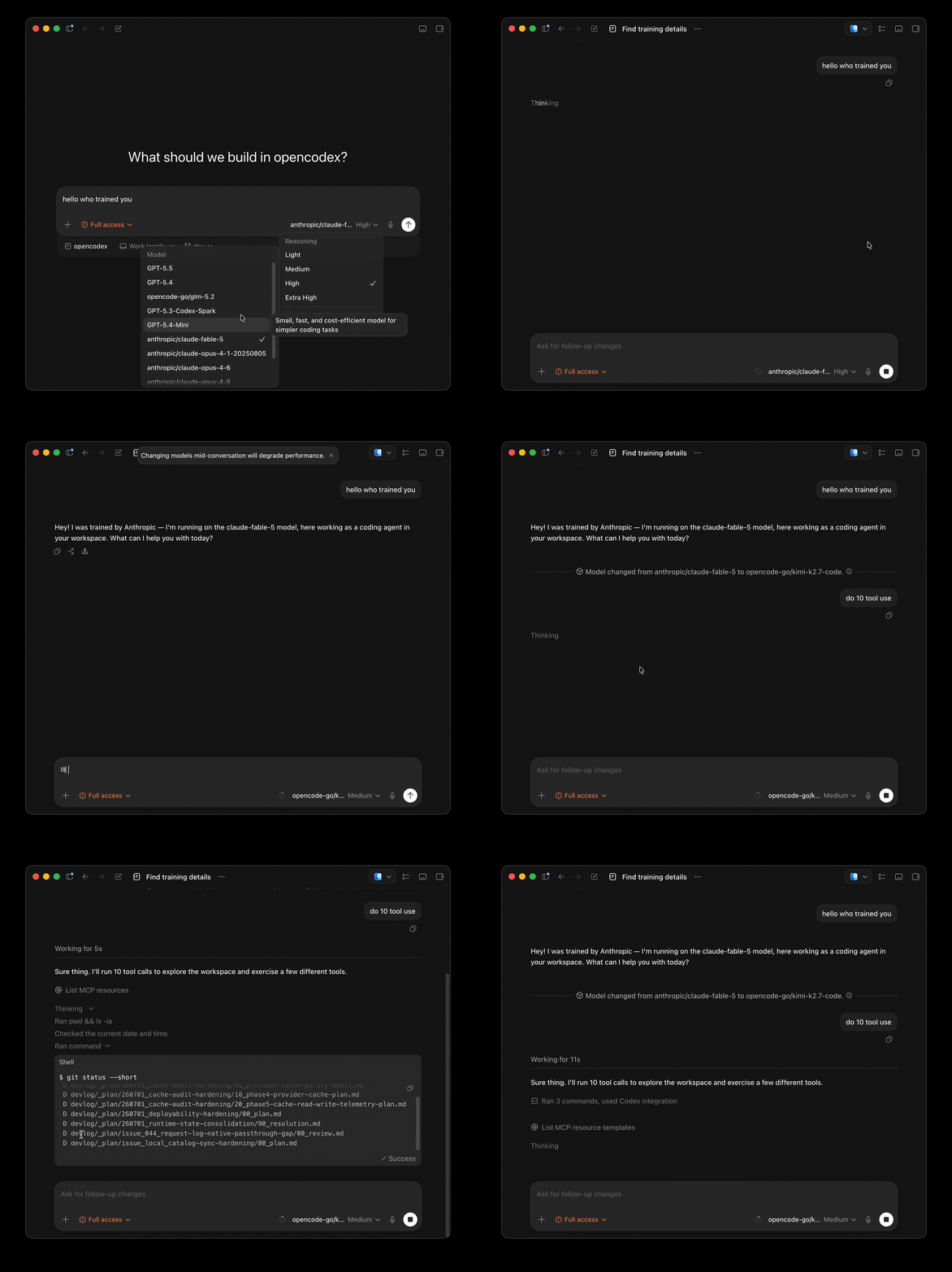
Universal provider proxy for OpenAI Codex & Claude Code — use any LLM (Claude, Gemini, Grok, DeepSeek, Ollama…) with Codex CLI, App, SDK, and Claude Code

Git-native persistent memory for AI coding agents. Implements Google OKF v0.2 with sub-300µs in-memory BM25 search, embedded MCP server, and progressive disclosure. Slashes token bloat by 80% with zero external databases or dependencies. Built in pure Go.

Local-first code intelligence graph for MCP and CLI. Builds a persistent map of your codebase so AI coding tools read only what matters, with benchmarked context reductions on reviews and large-repo workflows.

Stop your AI from making things up — it proposes, deterministic tools decide, every claim checked against ground truth with evidence. Grounded facts and context survive resets. Reverse engineering is the proving ground. MCP server + CLI.