
koala73/worldmonitorConnectors
Real-time global intelligence dashboard. AI-powered news aggregation, geopolitical monitoring, and infrastructure tracking in a unified situational awareness interface
86k
This project connects an agent to a remote Mac through MCP and screen sharing. The server turns desktop actions into tools the agent can call, including screenshots, keyboard input, mouse control, drag and drop, and app launch. It is packaged for Docker and configured through environment variables rather than per-request connection settings.
Builders who want an agent to control a remote Mac from Claude Desktop or another MCP client.
You can let your agent use a remote macOS desktop without adding a separate app on the target machine.
`remote_macos_get_screen` returns a screenshot of the remote desktop for agent vision and navigation.
`remote_macos_send_keys` sends keystrokes to the remote Mac.
`remote_macos_mouse_move`, `remote_macos_mouse_click`, `remote_macos_mouse_double_click`, `remote_macos_mouse_scroll`, and `remote_macos_mouse_drag_n_drop` handle pointer actions with coordinate scali
`remote_macos_open_application` opens or activates an app and returns its PID.
The repo provides a Docker image and a Claude Desktop config example for running the server.
# Clone the repository
git clone https://github.com/yourusername/mcp-remote-macos-use.git
cd mcp-remote-macos-use
# Build the Docker image
docker build -t mcp-remote-macos-use .
docker buildx create --use
docker buildx build --platform linux/amd64,linux/arm64 -t buryhuang/mcp-remote-macos-use:latest --push .
docker buildx imagetools inspect buryhuang/mcp-remote-macos-use:latest
The first open-source MCP server that enables AI to fully control remote macOS systems.
A direct alternative to OpenAI Operator, optimized specifically for autonomous AI agents with complete desktop capabilities, requiring no additional software installation.


Showcases
Research Twitter and Post Twitter(https://www.youtube.com/watch?v=--QHz2jcvcs)
Use CapCut to create short highlight video(https://www.youtube.com/watch?v=RKAqiNoU8ec)
AI Recruiter: Automated candidate information collection, qualifying applications and sending screening sessions using Mail App
AI Marketing Intern: LinkedIn engagement - automated following, liking, and commenting with relevant users
AI Marketing Intern: Twitter engagement - automated following, liking, and commenting with relevant users
We welcome contributions!
The macOS native ecosystem remains unmatched in user experience today and will continue to be the gold standard for years to come. This is where human capabilities truly thrive, and now your AI can operate in this environment with the same fluency.
{
  "mcpServers": {
    "remote-macos-use": {
      "command": "docker",
      "args": [
        "run",
        "-i",
        "-e",
        "MACOS_USERNAME=your_macos_username",
        "-e",
        "MACOS_PASSWORD=your_macos_password",
        "-e",
        "MACOS_HOST=your_macos_hostname_or_ip",
        "--rm",
        "buryhuang/mcp-remote-macos-use:latest"
      ]
    }
  }
}
This server now includes WebRTC support through LiveKit integration, enabling:
To use WebRTC features, you'll need to:
# Clone the repository
git clone https://github.com/yourusername/mcp-remote-macos-use.git
cd mcp-remote-macos-use
# Build the Docker image
docker build -t mcp-remote-macos-use .
To publish the Docker image for multiple platforms, you can use the docker buildx command. Follow these steps:
Create a new builder instance (if you haven't already):
docker buildx create --use
Build and push the image for multiple platforms:
docker buildx build --platform linux/amd64,linux/arm64 -t buryhuang/mcp-remote-macos-use:latest --push .
Verify the image is available for the specified platforms:
docker buildx imagetools inspect buryhuang/mcp-remote-macos-use:latest
The server provides Remote MacOs functionality through MCP tools.
The server provides the following tools for remote macOS control:
Connect to a remote macOS machine and get a screenshot of the remote desktop. Uses environment variables for connection details.
Send keyboard input to a remote macOS machine. Uses environment variables for connection details.
Move the mouse cursor to specified coordinates on a remote macOS machine, with automatic coordinate scaling. Uses environment variables for connection details.
Perform a mouse click at specified coordinates on a remote macOS machine, with automatic coordinate scaling. Uses environment variables for connection details.
Perform a mouse double-click at specified coordinates on a remote macOS machine, with automatic coordinate scaling. Uses environment variables for connection details.
Perform a mouse scroll at specified coordinates on a remote macOS machine, with automatic coordinate scaling. Uses environment variables for connection details.
Opens/activates an application and returns its PID for further interactions.
Perform a mouse drag operation from start point and drop to end point on a remote macOS machine, with automatic coordinate scaling.
All tools use the environment variables configured during setup instead of requiring connection parameters.
https://support.apple.com/guide/remote-desktop/encrypt-network-data-apdfe8e386b/mac https://cafbit.com/post/apple_remote_desktop_quirks/
We only support protocol 30, which uses the Diffie-Hellman key agreement protocol with a 512-bit prime. This protocol is used by macOS 11 to macOS 12 when communicating with OS X 10.11 or earlier clients.
Here's the information converted to a markdown table:
| macOS version running Remote Desktop | macOS client version | Authentication | Control and Observe | Copy items or install package | All other tasks | Protocol Version |
|---|---|---|---|---|---|---|
| macOS 13 | macOS 13 | 2048-bit RSA host keys | 2048-bit RSA host keys | 2048-bit RSA host keys to authenticate, then 128-bit AES | 2048-bit RSA host keys | 36 |
| macOS 13 | macOS 10.12 | Secure Remote Password (SRP) protocol for local only. Diffie-Hellman (DH) if bound to LDAP or macOS server is version 10.11 or earlier | SRP or DH,128-bit AES | SRP or DH to authenticate, then 128-bit AES | 2048-bit RSA host keys | 35 |
| macOS 11 to macOS 12 | macOS 10.12 to macOS 13 | Secure Remote Password (SRP) protocol for local only, Diffie-Hellman if bound to LDAP | SRP or DH 1024-bit, 128-bit AES | 2048-bit RSA host keys macOS 13 to macOS 10.13 | 2048-bit RSA host keys macOS 10.13 or later | 33 |
| macOS 11 to macOS 12 | OS X 10.11 or earlier | DH 1024-bit | DH 1024-bit, 128-bit AES | Diffie-Hellman Key agreement protocol with a 512-bit prime | Diffie-Hellman Key agreement protocol with a 512-bit prime | 30 |
Always use secure, authenticated connections when accessing remote remote MacOs machines. This tool should only be used with servers you trust and have permission to access.
See the LICENSE file for details.
Sign in to join the discussion.
No comments yet. Be the first to say what this is good for.
Real-time global intelligence dashboard. AI-powered news aggregation, geopolitical monitoring, and infrastructure tracking in a unified situational awareness interface
High-performance code intelligence MCP server. Indexes codebases into a persistent knowledge graph — average repo in milliseconds. 158 languages, sub-ms queries, 99% fewer tokens. Single static binary, zero dependencies.
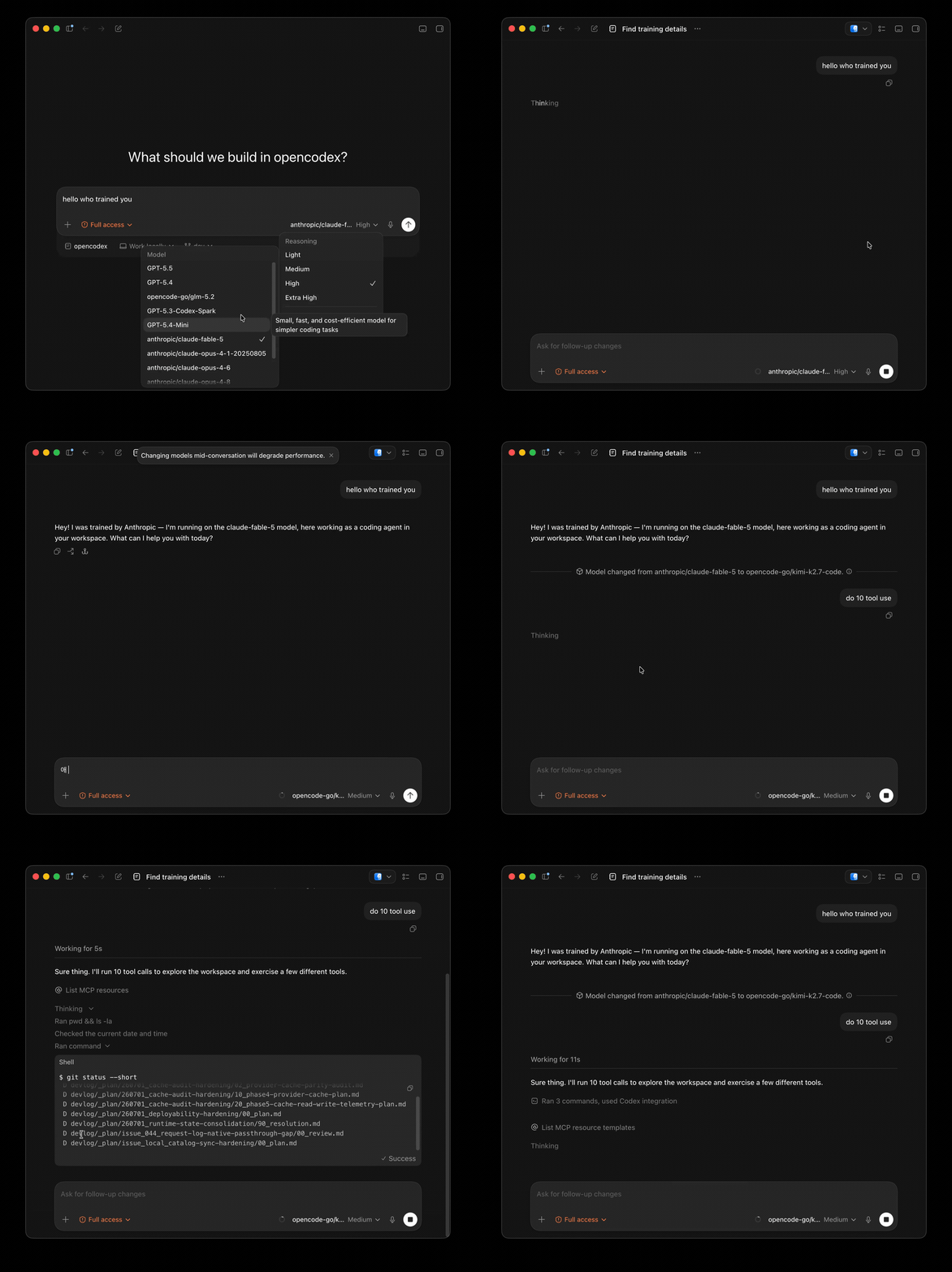
Universal provider proxy for OpenAI Codex & Claude Code — use any LLM (Claude, Gemini, Grok, DeepSeek, Ollama…) with Codex CLI, App, SDK, and Claude Code

Git-native persistent memory for AI coding agents. Implements Google OKF v0.2 with sub-300µs in-memory BM25 search, embedded MCP server, and progressive disclosure. Slashes token bloat by 80% with zero external databases or dependencies. Built in pure Go.

Local-first code intelligence graph for MCP and CLI. Builds a persistent map of your codebase so AI coding tools read only what matters, with benchmarked context reductions on reviews and large-repo workflows.

Stop your AI from making things up — it proposes, deterministic tools decide, every claim checked against ground truth with evidence. Grounded facts and context survive resets. Reverse engineering is the proving ground. MCP server + CLI.