
koala73/worldmonitorConnectors
Real-time global intelligence dashboard. AI-powered news aggregation, geopolitical monitoring, and infrastructure tracking in a unified situational awareness interface
86k
This server connects an AI client to Atlassian Cloud through MCP, with OAuth 2.1 or API token auth. Once connected, the client can search, summarize, create, and update work in Jira, Confluence, Jira Service Management, Bitbucket, Compass, Loom, and related Atlassian data.
Builders who want their AI tools to work with Jira, Confluence, Bitbucket, and related Atlassian data without switching tabs.
You can ask your agent to find, summarize, create, and update Atlassian work while staying in the same workflow.
Connects external AI clients to Atlassian Cloud with OAuth 2.1 or API tokens and respects existing permissions.
Exposes tools for Jira, Confluence, Jira Service Management, Bitbucket Cloud, Compass, Loom, and Atlassian platform data.
Ships manifests for Claude Code, Cursor, Gemini, Agent Plugins, and MCP Registry so clients can install it in their own format.
Includes reusable skills in `skills/` for workflows like triage issue, capture tasks from meeting notes, generate status report, and spec to backlog.
Shows primary tools first and lets the client discover the rest as needed, so the agent context stays smaller.
Supports service-style setups with personal API tokens or service account keys, including Jira Service Management use cases.
Set up Atlassian Rovo MCP for this agent using the official setup guide at
https://support.atlassian.com/atlassian-rovo-mcp-server/docs/getting-started-with-the-atlassian-remote-mcp-server/
and the MCP server URL https://mcp.atlassian.com/v2/mcp. Then start the Atlassian MCP
authentication flow so I can sign in.

The official Model Context Protocol (MCP) server for Atlassian: a cloud-hosted bridge that gives your AI tools secure, real-time access to Jira, Confluence, Jira Service Management, Bitbucket, Compass, Loom, and the wider Atlassian platform — powered by your Teamwork Graph.










Getting started · Supported tools · Security & admin · Community
The official Atlassian Rovo MCP Server is a cloud-based bridge between your Atlassian Cloud site and compatible external tools. Once configured, it enables those tools to interact with Jira, Confluence, Jira Service Management, Bitbucket, Compass, Loom, and Atlassian platform data (Projects, Goals, Teams, Focus, Talent, and the Teamwork Graph) in real time. Authentication uses OAuth 2.1 or API tokens, so every action respects the user's existing access controls.
With the Atlassian Rovo MCP Server, you can:
Connect once, then describe what you want — no tab switching and no copy-pasting. Your AI selects and runs the right actions.
It's built for developers, content creators, and project teams who work in IDEs or AI tools and want to use Atlassian data without constantly switching context.
[!IMPORTANT] v2 is now the recommended version. New setups should use
https://mcp.atlassian.com/v2/mcp, which exposes more tools and more products. Existing v1 connections automatically start to expose and use v2 tools; incompatible clients may need to clear cached client IDs or.well-knowncredentials to keep authenticating. For setup steps, see Getting started with the Atlassian Rovo MCP Server.
Pick your AI client below to install the official Atlassian Rovo MCP Server. Each button uses your client's native install link, so you don't need to edit any JSON config by hand.
 Add to Cursor Reference issues and log work in your codebase. |
 Add to VS Code Search and create Jira issues via GitHub Copilot. |
 Add to ChatGPT Search, summarize, and create right from ChatGPT. |
 Add to Claude Bring Jira and Confluence into Claude workflows. |
Most AI coding agents can install, authenticate, and configure the server themselves. Copy and paste this prompt into your agent:
Set up Atlassian Rovo MCP for this agent using the official setup guide at
https://support.atlassian.com/atlassian-rovo-mcp-server/docs/getting-started-with-the-atlassian-remote-mcp-server/
and the MCP server URL https://mcp.atlassian.com/v2/mcp. Then start the Atlassian MCP
authentication flow so I can sign in.
Or add the server manually with your client's own command:
| Client | Command or configuration |
|---|---|
| Claude Code | claude mcp add --transport http atlassian https://mcp.atlassian.com/v2/mcp, then run /mcp in a session to authenticate |
| Codex | codex mcp add atlassian --url https://mcp.atlassian.com/v2/mcp |
| Claude Desktop | Settings → Extensions → Browse extensions → Plugins, then search for Atlassian |
| Codex Desktop | Plugins or Connectors, then install Atlassian Rovo |
| VS Code / GitHub Copilot | Extensions view → search @mcp Atlassian → Install |
| Cursor | Atlassian plugin for Cursor with MCP → Add to Cursor |
| Windsurf | Cascade → MCP servers → Add Server → Add custom server, with serverUrl set to https://mcp.atlassian.com/v2/mcp |
| Any other MCP client | Use the server URL https://mcp.atlassian.com/v2/mcp |
The Atlassian Rovo MCP Server works with a growing list of MCP-compatible clients:
| Client | Setup reference |
|---|---|
| OpenAI ChatGPT | Connectors / MCP guide |
| OpenAI Codex (CLI and Desktop) | Codex MCP docs |
| Claude (Claude.ai, Desktop, and Code) | Claude MCP docs |
| Cursor | Atlassian on the Cursor marketplace |
| Visual Studio Code (GitHub Copilot) | VS Code MCP docs |
| GitHub Copilot CLI | About Copilot CLI |
| Google Gemini CLI | Gemini CLI MCP docs |
| Windsurf | Windsurf MCP docs |
| Docker | Docker MCP Catalog and Toolkit |
| Kiro and other Agent Plugins clients | Kiro Powers documentation |
| Amazon Quick Suite | MCP integration guide |
The Atlassian Rovo MCP Server also supports any local MCP-compatible client that can run on localhost and connect to the server via the mcp-remote proxy. This enables custom or third-party integrations that follow the MCP specification.
[!TIP] For the current, canonical list of supported clients and step-by-step setup, see Getting started with the Atlassian Rovo MCP Server. You can also refer to your client's own MCP documentation or built-in assistant.
This repository publishes the same MCP server and skills in several package formats so clients can use their native discovery and installation flows:
| Format | Manifest and configuration | Shared components |
|---|---|---|
| Agent Plugins v1 | plugin.json and mcp.json | skills/ |
| Claude Code plugin | .claude-plugin/plugin.json and .claude-plugin/marketplace.json | .mcp.json and skills/ |
| Cursor plugin | .cursor-plugin/plugin.json | .mcp.json and skills/ |
| Gemini extension | gemini-extension.json | MCP server configuration embedded in the manifest |
| MCP Registry | server.json | Remote server metadata |
The skills in skills/ target the /v2/mcp endpoint and are what every packaged plugin
installs. The previous generation is archived in skills/v1/ for anyone still on a v1
endpoint; it is not installed by any plugin and is set up manually. See
skills/README.md for the differences.
Both mcp.json and .mcp.json are intentional. Agent Plugins requires the root mcp.json filename and its portable transport vocabulary; existing clients continue to use .mcp.json and their native configuration vocabulary. Keep their endpoint settings aligned when changing either file.
The root package can be imported by clients that implement Agent Plugins, including Kiro Powers. Client-specific manifests remain available and are not replaced by the portable package.
Tools are organized by product and intent (read, write, search, delete, or manage). Organization admins grant or revoke access at the permission-group level, and each tool inherits the access of its parent group.
| Product | Permission groups | OAuth 2.1 | API token |
|---|---|---|---|
| Jira | read_jira · write_jira · search_jira | ✅ | ✅ |
| Jira (admin-enabled) | delete_jira · manage_jira | ✅ | ✅ |
| Confluence | read_confluence · write_confluence · search_confluence | ✅ | ✅ |
| Bitbucket Cloud | read_bitbucket · write_bitbucket | ✅ | ✅ |
| Jira Service Management | read_jsm · write_jsm | — | ✅ (only) |
| Atlassian platform | read_teamwork_graph · write_teamwork_graph · search_atlassian | ✅ | ✅ |
| Loom | read_loom · write_loom | ✅ | ✅ |
| Goals | read_goals · write_goals | ✅ | ✅ |
| Projects | read_projects · write_projects | ✅ | ✅ |
| Teams | read_teams · write_teams | ✅ | ✅ |
| Focus | read_focus · write_focus | ✅ | ✅ |
| Talent | read_talent · write_talent | ✅ | ✅ |
| Compass | read_compass · write_compass | ✅ (only) | — |
Product-specific conditions:
delete_jira and manage_jira are disabled by default and must be enabled by an admin before they can be used.[!NOTE] For the complete, current tool reference, including the required scope for each permission group, see Supported tools.
Rather than sending every tool definition to the AI client at connection time, the Atlassian Rovo MCP Server exposes a small set of the most-used tools and lets the client discover the rest on demand. Tools marked Primary are visible directly to agents.
This has two benefits:
If you're using an MCP gateway, or otherwise need every tool available up front rather than using the discovery and execute methods, use the tools=all override to expose all tools as a paginated flat tool list:
https://mcp.atlassian.com/v2/mcp?tools=all
Check that your environment meets these requirements before you set up the server.
The requirements depend on how you connect:
If your organization admin has disabled authentication via API token, MCP clients can't connect with a token and need to use OAuth 2.1 instead.
mcp-remote)The server enforces several security controls:
For a deeper overview of the security model and admin controls, see:
A supported client connects to the server endpoint. The recommended endpoint for all clients is:
https://mcp.atlassian.com/v2/mcp
The v1 endpoints (https://mcp.atlassian.com/v1/mcp/authv2 and https://mcp.atlassian.com/v1/mcp) remain supported, and existing v1 connections automatically start to expose and use v2 tools.
Depending on your setup, a secure browser-based OAuth 2.1 flow is triggered, or API token authentication is used.
Once authorized, the client streams contextual data and receives real-time responses from your connected Atlassian products.
[!WARNING] After 30 June 2026, the legacy Server-Sent Events endpoint (
https://mcp.atlassian.com/v1/sse) will no longer be supported. Update any custom clients configured to use/sseso they point to/mcp— preferablyhttps://mcp.atlassian.com/v2/mcp.
[!NOTE] Clients that can't complete authentication after the move to v2 tools may need to clear cached client IDs or
.well-knowncredentials.
Access is granted only to data that the user already has permission to view in Atlassian Cloud. All actions respect existing project or space-level roles. OAuth and API token authentication both honor configured scopes and Atlassian permissions.
API token authentication is available for headless, service-style, or non-interactive client setups (for example, backend systems or automations). It is also required for Jira Service Management tools.
Two mechanisms are supported:
| Mechanism | Header |
|---|---|
| Personal API token (Basic auth) | Authorization: Basic <base64(email:api_token)> |
| Service account API key (Bearer token) | Authorization: Bearer <api_key> |
Sign in to join the discussion.
No comments yet. Be the first to say what this is good for.
Real-time global intelligence dashboard. AI-powered news aggregation, geopolitical monitoring, and infrastructure tracking in a unified situational awareness interface
High-performance code intelligence MCP server. Indexes codebases into a persistent knowledge graph — average repo in milliseconds. 158 languages, sub-ms queries, 99% fewer tokens. Single static binary, zero dependencies.
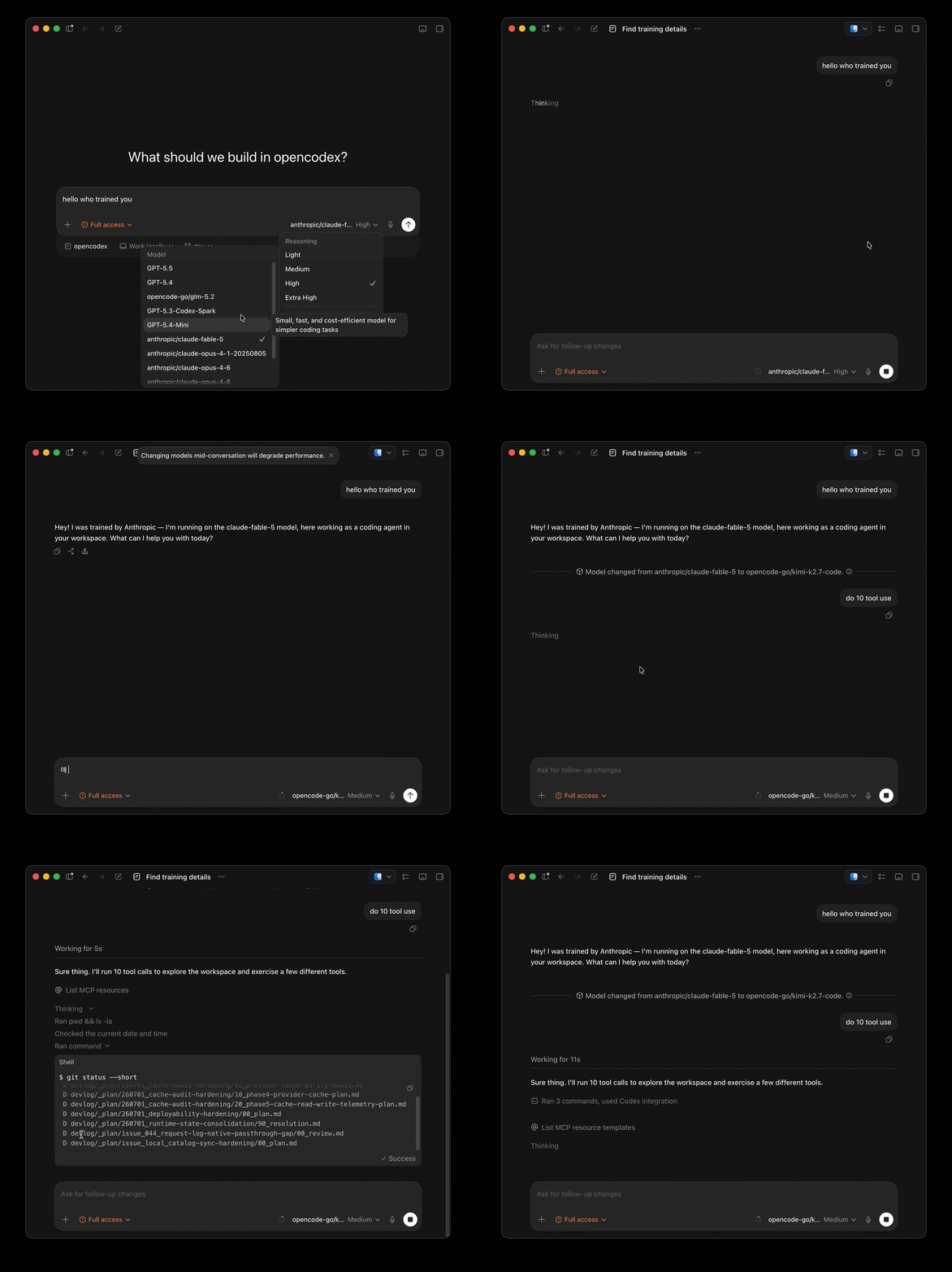
Universal provider proxy for OpenAI Codex & Claude Code — use any LLM (Claude, Gemini, Grok, DeepSeek, Ollama…) with Codex CLI, App, SDK, and Claude Code

Git-native persistent memory for AI coding agents. Implements Google OKF v0.2 with sub-300µs in-memory BM25 search, embedded MCP server, and progressive disclosure. Slashes token bloat by 80% with zero external databases or dependencies. Built in pure Go.

Local-first code intelligence graph for MCP and CLI. Builds a persistent map of your codebase so AI coding tools read only what matters, with benchmarked context reductions on reviews and large-repo workflows.

Stop your AI from making things up — it proposes, deterministic tools decide, every claim checked against ground truth with evidence. Grounded facts and context survive resets. Reverse engineering is the proving ground. MCP server + CLI.