









NousResearch/
hermes-agent

The agent that grows with you
245k
GPT Researcher is a Python research agent that turns a question into a plan, collects evidence from web and local sources, and produces a cited report. It uses planner, execution, and publisher steps, and can also connect to MCP servers and run multi-agent research flows.
Builders who want Claude Code, Codex, or Cursor to produce sourced research reports from web and local data.
You can turn a research question into a cited report instead of manually collecting and summarizing sources.
Creates research questions, then uses crawler agents to gather information for each one before combining the results.
Supports web search and local files such as PDF, text, CSV, Excel, Markdown, PowerPoint, and Word documents.
Can pull data from MCP servers such as GitHub and other custom tools alongside web search.
Includes LangGraph and AG2-based multi-agent setups for deeper research runs.
Writes research reports and can export them to formats like PDF, Word, and Markdown.
Includes packaged support files for Claude, Codex, and Cursor users.
npx skills add assafelovic/gpt-researcher
git clone https://github.com/assafelovic/gpt-researcher.git
cd gpt-researcher
export OPENAI_API_KEY={Your OpenAI API Key here}
export TAVILY_API_KEY={Your Tavily API Key here}# export LANGCHAIN_TRACING_V2=true
# export LANGCHAIN_API_KEY={Your LangChain API Key here}export OPENAI_BASE_URL={Your custom API base URL here}pip install -r requirements.txt python -m uvicorn main:app --reload
GPT Researcher the first open deep research agent designed for both web and local research on any given task.
The agent produces detailed, factual, and unbiased research reports with citations. GPT Researcher provides a full suite of customization options to create tailor made and domain specific research agents. Inspired by the recent Plan-and-Solve and RAG papers, GPT Researcher addresses misinformation, speed, determinism, and reliability by offering stable performance and increased speed through parallelized agent work.
Our mission is to empower individuals and organizations with accurate, unbiased, and factual information through AI.
Extend Claude's deep research capabilities by installing GPT Researcher as a Claude Skill:
npx skills add assafelovic/gpt-researcher
Once installed, Claude can leverage GPT Researcher's deep research capabilities directly within your conversations.
The core idea is to utilize 'planner' and 'execution' agents. The planner generates research questions, while the execution agents gather relevant information. The publisher then aggregates all findings into a comprehensive report.
Steps:
See the Documentation for:
Install Python 3.11 or later. Guide.
Clone the project and navigate to the directory:
git clone https://github.com/assafelovic/gpt-researcher.git
cd gpt-researcher
Set up API keys by exporting them or storing them in a .env file.
export OPENAI_API_KEY={Your OpenAI API Key here}
export TAVILY_API_KEY={Your Tavily API Key here}
(Optional) For enhanced tracing and observability, you can also set:
# export LANGCHAIN_TRACING_V2=true
# export LANGCHAIN_API_KEY={Your LangChain API Key here}
For custom OpenAI-compatible APIs (e.g., local models, other providers), you can also set:
export OPENAI_BASE_URL={Your custom API base URL here}
Install dependencies and start the server:
pip install -r requirements.txt
python -m uvicorn main:app --reload
Visit http://localhost:8000 to start.
For other setups (e.g., Poetry or virtual environments), check the Getting Started page.
pip install gpt-researcher
...
from gpt_researcher import GPTResearcher

query = "why is Nvidia stock going up?"
researcher = GPTResearcher(query=query)
# Conduct research on the given query
research_result = await researcher.conduct_research()
# Write the report
report = await researcher.write_report()
...
For more examples and configurations, please refer to the PIP documentation page.
GPT Researcher supports MCP integration to connect with specialized data sources like GitHub repositories, databases, and custom APIs. This enables research from data sources alongside web search.
export RETRIEVER=tavily,mcp # Enable hybrid web + MCP research
from gpt_researcher import GPTResearcher
import asyncio
import os

async def mcp_research_example():
    # Enable MCP with web search
    os.environ["RETRIEVER"] = "tavily,mcp"

    researcher = GPTResearcher(
        query="What are the top open source web research agents?",
        mcp_configs=[
            {
                "name": "github",
                "command": "npx",
                "args": ["-y", "@modelcontextprotocol/server-github"],
                "env": {"GITHUB_TOKEN": os.getenv("GITHUB_TOKEN")}
            }
        ]
    )

    research_result = await researcher.conduct_research()
    report = await researcher.write_report()
    return report
For comprehensive MCP documentation and advanced examples, visit the MCP Integration Guide.
GPT Researcher can automatically generate and embed AI-created illustrations in your research reports using Google's Gemini models (Nano Banana).
# Enable in your .env file
IMAGE_GENERATION_ENABLED=true
GOOGLE_API_KEY=your_google_api_key
IMAGE_GENERATION_MODEL=models/gemini-2.5-flash-image
When enabled, the system will:
Images are generated with dark-mode styling that matches the GPT Researcher UI, featuring professional infographic aesthetics with teal accents.
Learn more about Image Generation in our documentation.
GPT Researcher now includes Deep Research - an advanced recursive research workflow that explores topics with agentic depth and breadth. This feature employs a tree-like exploration pattern, diving deeper into subtopics while maintaining a comprehensive view of the research subject.
o3-mini on "high" reasoning effort)Learn more about Deep Research in our documentation.
Step 1 - Install Docker
Step 2 - Clone the '.env.example' file, add your API Keys to the cloned file and save the file as '.env'
Step 3 - Within the docker-compose file comment out services that you don't want to run with Docker.
docker-compose up --build
If that doesn't work, try running it without the dash:
docker compose up --build
Step 4 - By default, if you haven't uncommented anything in your docker-compose file, this flow will start 2 processes:
Visit localhost:3000 on any browser and enjoy researching!
You can instruct the GPT Researcher to run research tasks based on your local documents. Currently supported file formats are: PDF, plain text, CSV, Excel, Markdown, PowerPoint, and Word documents.
Step 1: Add the env variable DOC_PATH pointing to the folder where your documents are located.
export DOC_PATH="./my-docs"
Step 2:
report_source argument as "local" when you instantiate the GPTResearcher class code sample here.We've moved our MCP server to a dedicated repository: gptr-mcp.
The GPT Researcher MCP Server enables AI applications like Claude to conduct deep research. While LLM apps can access web search tools with MCP, GPT Researcher MCP delivers deeper, more reliable research results.
Features:
For detailed installation and usage instructions, please visit the official repository.
As AI evolves from prompt engineering and RAG to multi-agent systems, we're excited to introduce multi-agent assistants built with LangGraph and AG2.
By using multi-agent frameworks, the research process can be significantly improved in depth and quality by leveraging multiple agents with specialized skills. Inspired by the recent STORM paper, this project showcases how a team of AI agents can work together to conduct research on a given topic, from planning to publication.
An average run generates a 5-6 page research report in multiple formats such as PDF, Docx and Markdown.
Check it out here or head over to our documentation for LangGraph and AG2 for more information.
GPT Researcher supports LangSmith for enhanced tracing and observability, making it easier to debug and optimize complex multi-agent workflows.
To enable tracing:
export LANGCHAIN_TRACING_V2=true
export LANGCHAIN_API_KEY=your_api_key
export LANGCHAIN_PROJECT="gpt-researcher"
GPT Researcher also supports Monocle, an OpenTelemetry-based tracer for agentic applications. It records each run end-to-end: LLM calls, agent steps, and tool invocations, with their inputs, outputs, timings, and token counts.
Monocle is an opt-in extra and is off by default. Install it, then add the following to your .env file:
pip install "gpt-researcher[monocle]"
MONOCLE_TRACING=true
MONOCLE_EXPORTERS=file          # file, console, okahu, s3, blob, gcs (default: file)
OKAHU_API_KEY=okh_xxxxxxxx      # required only for the `okahu` exporter
Each run writes one trace file to .monocle/; open it in the Monocle VS Code extension. Connect to Okahu to analyze traces across runs (via the okahu exporter).
GPT-Researcher now features an enhanced frontend to improve the user experience and streamline the research process. The frontend offers:
Two deployment options are available:
For detailed setup instructions and more information about the frontend features, please visit our documentation page.
We highly welcome contributions! Please check out contributing if you're interested.
Please check out our roadmap page and reach out to us via our Discord community if you're interested in joining our mission.
This project, GPT Researcher, is an experimental application and is provided "as-is" without any warranty, express or implied. We are sharing codes for academic purposes under the Apache 2 license. Nothing herein is academic advice, and NOT a recommendation to use in academic or research papers.
Our view on unbiased research claims:
Sign in to join the discussion.
No comments yet. Be the first to say what this is good for.
The agent that grows with you

Open-source coding agent for your terminal, built in Rust and on a journey of continuous community improvement. Issues and PRs welcome.
A lightweight alternative to OpenClaw that runs in containers for security. Connects to WhatsApp, Telegram, Slack, Discord, Gmail and other messaging apps,, has memory, scheduled jobs, and runs directly on Anthropic's Agents SDK

OpenSquilla — Token-Efficient AI Agent with same budget, higher intelligence density
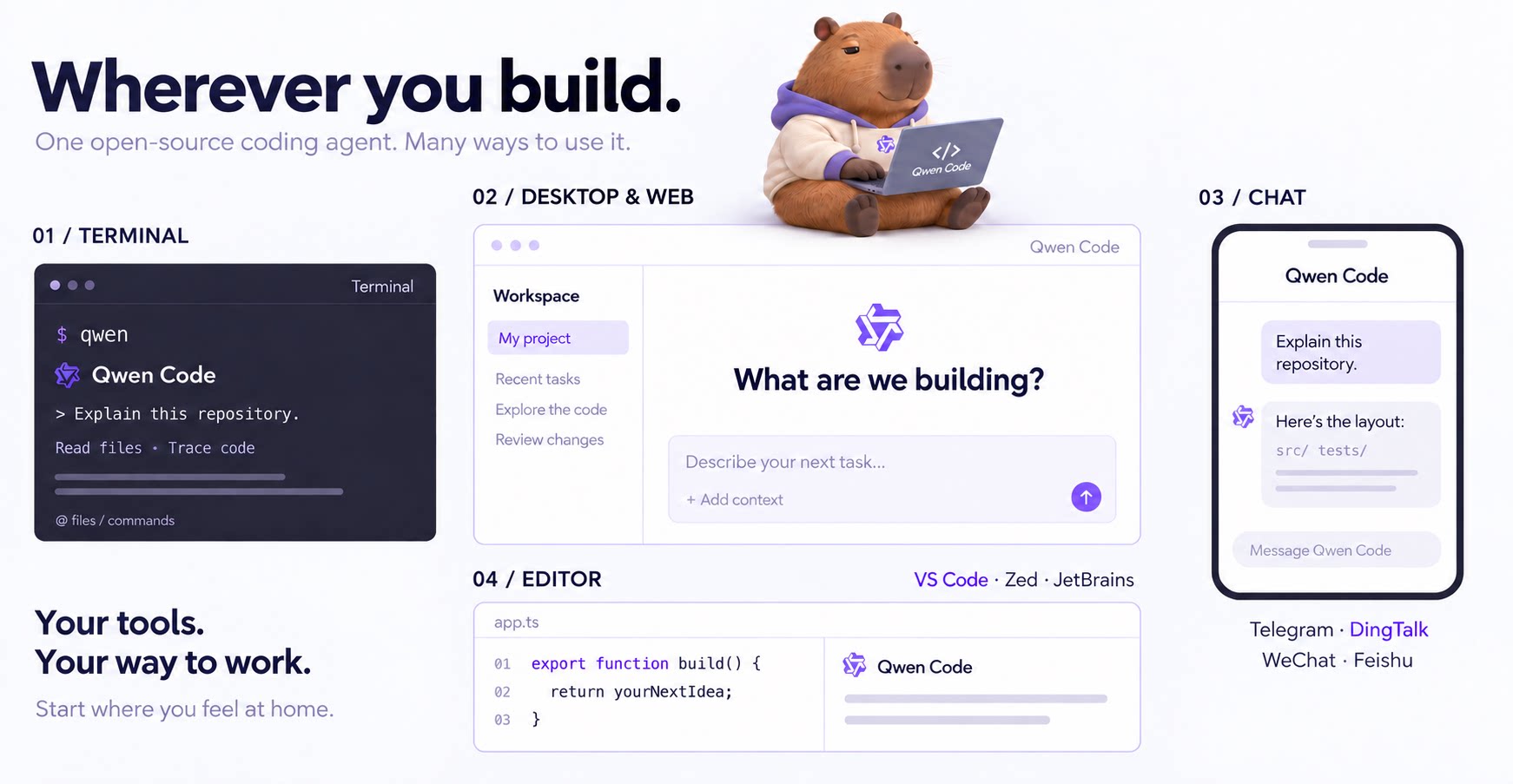
An open-source AI coding agent that lives in your terminal.

Run and supervise teams of coding agents from planning to merge. Any harness (Claude code, codex, +25 more). Desktop, web, mobile, and cloud agents.