
koala73/worldmonitorConnectors
Real-time global intelligence dashboard. AI-powered news aggregation, geopolitical monitoring, and infrastructure tracking in a unified situational awareness interface
86k
This repository exposes Kaggle dataset search, download, and EDA prompt generation through MCP. An agent can call the server to find datasets, fetch them locally, and ask for a starting analysis prompt without leaving the chat.
Builders who want their agent to search Kaggle datasets, download them, and draft EDA prompts.
You can move from dataset search to local files and a starter analysis prompt inside one agent session.
Searches Kaggle by keyword and returns up to 10 dataset results as JSON.
Fetches a Kaggle dataset by `owner/dataset-slug` reference and saves it locally.
Creates a prompt for basic Python exploratory analysis, including loading, missing-value checks, plots, and summary stats.
Reads Kaggle API credentials from environment variables or the standard `kaggle.json` location.
Works locally over stdio, in Docker, or through Smithery.
git clone <repository-url>
cd kaggle-mcp
python -m venv .venv
source .venv/bin/activate  # Windows: .venv\Scripts\activate
uv sync
pip install -r requirements.txt
A Model Context Protocol (MCP) server that exposes Kaggle dataset search, download, and EDA prompt generation to MCP clients such as Claude Desktop.
kaggle.json file.search_kaggle_datasets(query: str)Searches Kaggle for datasets matching query and returns up to 10 results as JSON.
Returned fields include:
reftitlesubtitledownload_countlast_updatedusability_ratingdownload_kaggle_dataset(dataset_ref: str, download_path: str | None = None)Downloads and unzips a Kaggle dataset.
dataset_ref: Kaggle dataset reference in owner/dataset-slug format, for example kaggle/titanic.download_path: Optional local output path. If omitted, files are saved to ./datasets/<dataset_slug>/.generate_eda_notebook(dataset_ref: str)Creates a prompt for generating basic Python EDA code for the provided Kaggle dataset reference. The prompt asks for data loading, missing-value checks, visualizations, and summary statistics.
Create a Kaggle API token from your Kaggle account settings:
kaggle.json.Use either environment variables or the standard Kaggle config file.
Create a .env file in the project root:
KAGGLE_USERNAME=your_kaggle_username
KAGGLE_KEY=your_kaggle_api_key
kaggle.jsonPlace kaggle.json in the standard Kaggle location:
~/.kaggle/kaggle.jsonC:\Users\<Your User Name>\.kaggle\kaggle.jsonOn macOS/Linux, make sure the file is not world-readable:
chmod 600 ~/.kaggle/kaggle.json
git clone <repository-url>
cd kaggle-mcp
Create and activate a virtual environment:
python -m venv .venv
source .venv/bin/activate  # Windows: .venv\Scripts\activate
Install dependencies with one of the following methods.
uv sync
pip install -r requirements.txt
With uv:
uv run kaggle-mcp
Or run the server module directly:
python src/server.py
The server communicates over MCP stdio and is intended to be launched by an MCP client.
Open Claude Desktop settings, then go to Developer > Edit Config and add this server to claude_desktop_config.json.
If installed in the project environment:
{
  "mcpServers": {
    "kaggle-mcp": {
      "command": "uv",
      "args": ["run", "kaggle-mcp"],
      "cwd": "/absolute/path/to/kaggle-mcp",
      "env": {
        "KAGGLE_USERNAME": "your_kaggle_username",
        "KAGGLE_KEY": "your_kaggle_api_key"
      }
    }
  }
}
If using kaggle.json, you can omit the env block.
Build the image:
docker build -t kaggle-mcp .
Run with credentials from .env:
docker run --rm -i --env-file .env kaggle-mcp
This repository includes smithery.yaml. Smithery starts the server over stdio and passes these configuration values as environment variables:
kaggleUsername -> KAGGLE_USERNAMEkaggleKey -> KAGGLE_KEYsearch_kaggle_datasets.user/heart-disease-dataset.user/heart-disease-dataset."user/heart-disease-dataset.".
├── Dockerfile
├── README.md
├── pyproject.toml
├── requirements.txt
├── smithery.yaml
├── src/
│ ├── __init__.py
│ └── server.py
└── uv.lock
Downloaded datasets are saved under datasets/ by default. This directory is created at runtime when downloads are requested.
Sign in to join the discussion.
No comments yet. Be the first to say what this is good for.
Real-time global intelligence dashboard. AI-powered news aggregation, geopolitical monitoring, and infrastructure tracking in a unified situational awareness interface
High-performance code intelligence MCP server. Indexes codebases into a persistent knowledge graph — average repo in milliseconds. 158 languages, sub-ms queries, 99% fewer tokens. Single static binary, zero dependencies.
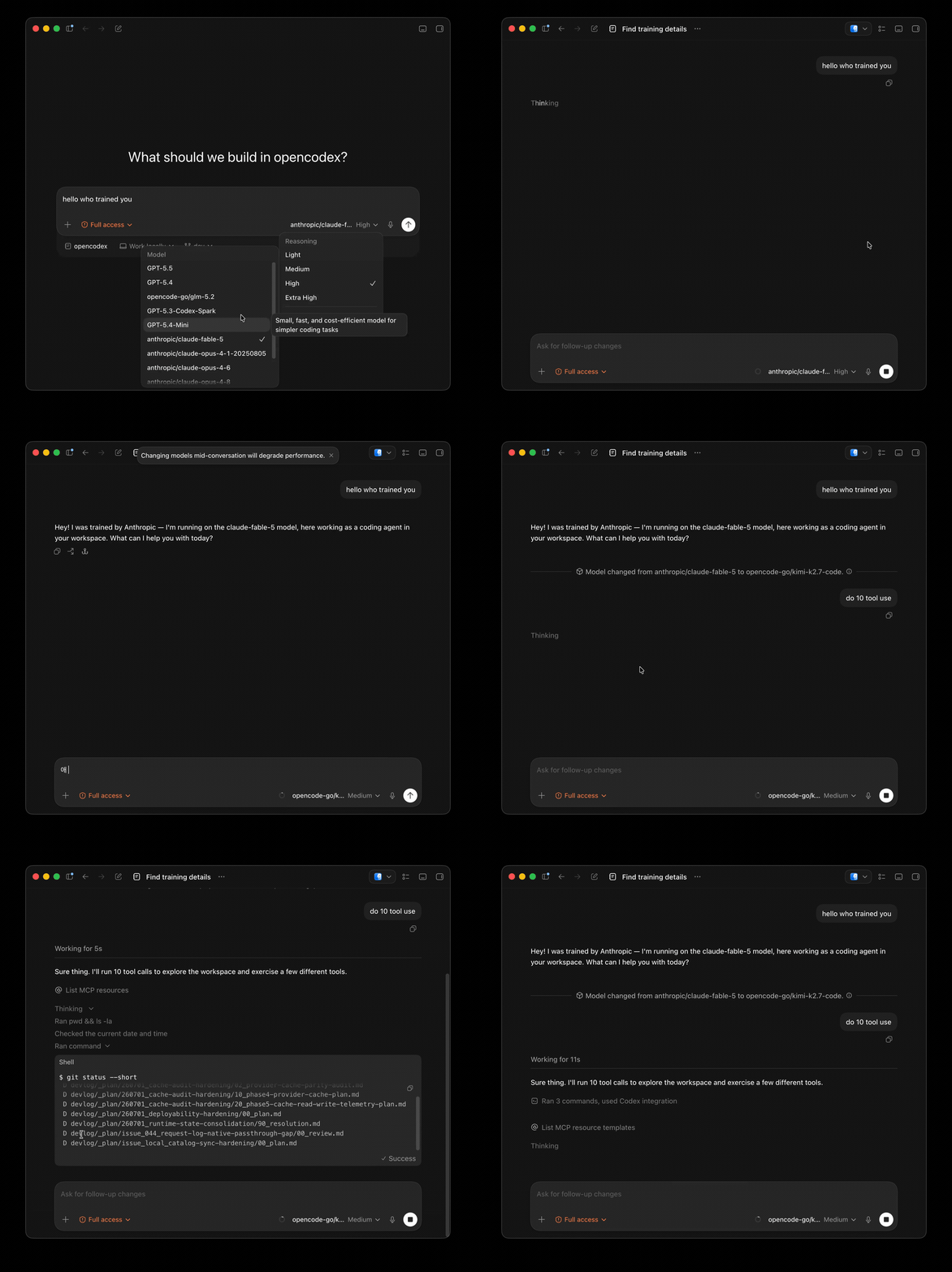
Universal provider proxy for OpenAI Codex & Claude Code — use any LLM (Claude, Gemini, Grok, DeepSeek, Ollama…) with Codex CLI, App, SDK, and Claude Code

Git-native persistent memory for AI coding agents. Implements Google OKF v0.2 with sub-300µs in-memory BM25 search, embedded MCP server, and progressive disclosure. Slashes token bloat by 80% with zero external databases or dependencies. Built in pure Go.

Local-first code intelligence graph for MCP and CLI. Builds a persistent map of your codebase so AI coding tools read only what matters, with benchmarked context reductions on reviews and large-repo workflows.

Stop your AI from making things up — it proposes, deterministic tools decide, every claim checked against ground truth with evidence. Grounded facts and context survive resets. Reverse engineering is the proving ground. MCP server + CLI.