
koala73/worldmonitorConnectors
Real-time global intelligence dashboard. AI-powered news aggregation, geopolitical monitoring, and infrastructure tracking in a unified situational awareness interface
86k
APISIX MCP is a bridge between MCP-compatible AI clients and the APISIX Admin API. It exposes tools for reading and managing routes, services, upstreams, SSL certificates, plugins, secrets, consumers, and credentials.
Builders who want Claude, Cursor, Copilot, or another MCP client to manage APISIX.
You can manage APISIX resources from natural language instead of switching to the Admin API by hand.
Provides `get_resource`, `delete_resource`, and `send_request_to_gateway` for common APISIX operations.
Includes tools to create, update, and delete routes, services, upstreams, SSL certificates, protobuf definitions, and stream routes.
Lets you list plugin names, inspect plugin info and schemas, and manage plugin configs, global rules, and metadata.
Supports secrets, consumers, consumer credentials, and consumer groups through MCP tools.
Shows how to wire the server into MCP client settings with environment variables for APISIX host, ports, prefix, and admin key.
npx -y @smithery/cli install @api7/apisix-mcp --client claude
git clone https://github.com/api7/apisix-mcp.git
cd apisix-mcp
pnpm install
pnpm build
APISIX Model Context Protocol (MCP) server is used to bridge large language models (LLMs) with the APISIX Admin API. It aims to enable natural language-based interaction for viewing and managing resources in APISIX through MCP-compatible AI clients.
https://github.com/user-attachments/assets/081e878c-225e-4ff8-a9c5-5813f4784cfe
get_resource: Retrieve resources by type (routes, services, upstreams, etc.)delete_resource: Remove resources by IDsend_request_to_gateway: Send a request or multiple requests to the APISIX gatewaycreate_route/update_route/delete_route: Manage routescreate_service/update_service/delete_service: Manage servicescreate_upstream/update_upstream/delete_upstream: Manage upstreamcreate_ssl/update_ssl/delete_ssl: Manage SSL certificatescreate_or_update_proto: Manage protobuf definitionscreate_or_update_stream_route: Manage stream routesget_all_plugin_names: Get all available plugin namesget_plugin_info/get_plugins_by_type/get_plugin_schema: Retrieve plugins configurationcreate_plugin_config/update_plugin_config: Manage plugin configurationscreate_global_rule/update_global_rule: Manage plugin global rulesget_plugin_metadata/create_or_update_plugin_metadata/delete_plugin_metadata: Manage plugin metadataget_secret_by_id/create_secret/update_secret: Manage secretscreate_or_update_consumer/delete_consumer: Manage consumersget_credential/create_or_update_credential/delete_credential/: Manage consumer credentialscreate_consumer_group/delete_consumer_group: Manage consumer groupsFollow the APISIX Getting Started guide to set up and run APISIX.
To install APISIX Model Context Protocol Server for Claude Desktop automatically via Smithery:
npx -y @smithery/cli install @api7/apisix-mcp --client claude
Configure your AI client (Cursor, Claude, Copilot, etc.) with following settings:
{
  "mcpServers": {
    "apisix-mcp": {
      "command": "npx",
      "args": [
        "-y",
        "apisix-mcp"
      ],
      "env": {
        "APISIX_SERVER_HOST": "your-apisix-server-host",
        "APISIX_SERVER_PORT": "your-apisix-server-port",
        "APISIX_ADMIN_API_PORT": "your-apisix-admin-api-port",
        "APISIX_ADMIN_API_PREFIX": "your-apisix-admin-api-prefix",
        "APISIX_ADMIN_KEY": "your-apisix-api-key"
      }
    }
  }
}
First clone the apisix-mcp repository:
git clone https://github.com/api7/apisix-mcp.git
cd apisix-mcp
Install the dependencies and build the project:
pnpm install
pnpm build
Configure your AI client (Cursor, Claude, Copilot, etc.) with following settings:
{
  "mcpServers": {
    "apisix-mcp": {
      "command": "node",
      "args": [
        "your-apisix-mcp-path/dist/index.js"
      ],
      "env": {
        "APISIX_SERVER_HOST": "your-apisix-server-host",
        "APISIX_SERVER_PORT": "your-apisix-server-port",
        "APISIX_ADMIN_API_PORT": "your-apisix-admin-api-port",
        "APISIX_ADMIN_API_PREFIX": "your-apisix-admin-api-prefix",
        "APISIX_ADMIN_KEY": "your-apisix-api-key"
      }
    }
  }
}
| Variable | Description | Default Value |
|---|---|---|
APISIX_SERVER_HOST | Host that have access to your APISIX server | http://127.0.0.1 |
APISIX_SERVER_PORT | APISIX server port | 9080 |
APISIX_ADMIN_API_PORT | Admin API port | 9180 |
APISIX_ADMIN_API_PREFIX | Admin API prefix | /apisix/admin |
APISIX_ADMIN_KEY | Admin API authentication key | edd1c9f034335f136f87ad84b625c8f1 |
To view or modify Admin API configurations in APISIX, refer to the Admin API documentation.
Example: Search Server and Tools
    import anthropic
    import mcp_marketplace as mcpm

    result_q = mcpm.search(query="apisix mcp", mode="list", page_id=0, count_per_page=100, config_name="deepnlp") # search server by category choose various endpoint
    result_id = mcpm.search(id="api7/apisix-mcp", mode="list", page_id=0, count_per_page=100, config_name="deepnlp")      # search server by id choose various endpoint
    tools = mcpm.list_tools(id="api7/apisix-mcp", config_name="deepnlp_tool")

    # Call Claude to Choose Tools Function Calls
    client = anthropic.Anthropic()
    response = client.messages.create(model="claude-3-7-sonnet-20250219", max_tokens=1024, tools=tools, messages=[])
Sign in to join the discussion.
No comments yet. Be the first to say what this is good for.
Real-time global intelligence dashboard. AI-powered news aggregation, geopolitical monitoring, and infrastructure tracking in a unified situational awareness interface
High-performance code intelligence MCP server. Indexes codebases into a persistent knowledge graph — average repo in milliseconds. 158 languages, sub-ms queries, 99% fewer tokens. Single static binary, zero dependencies.
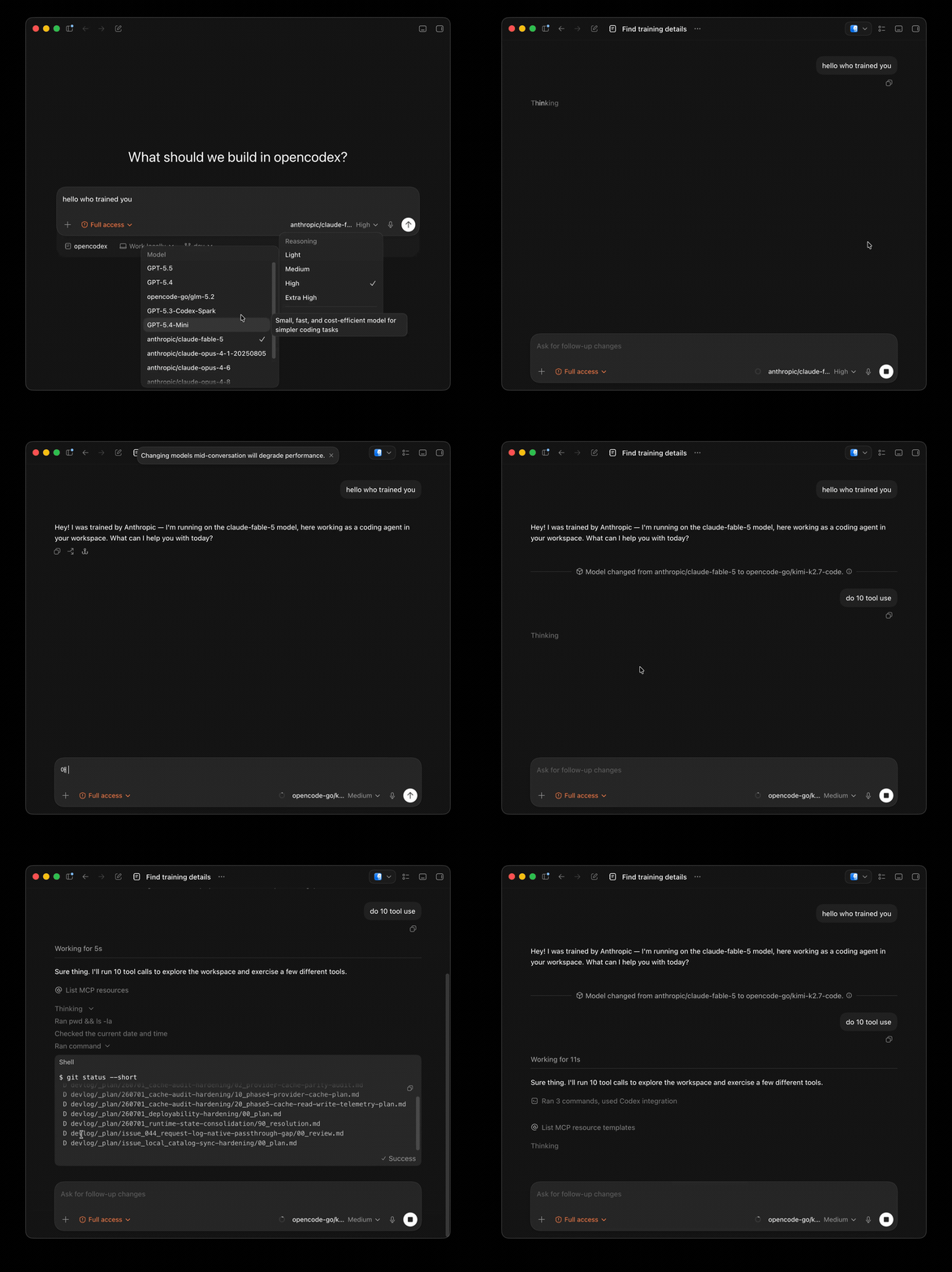
Universal provider proxy for OpenAI Codex & Claude Code — use any LLM (Claude, Gemini, Grok, DeepSeek, Ollama…) with Codex CLI, App, SDK, and Claude Code

Git-native persistent memory for AI coding agents. Implements Google OKF v0.2 with sub-300µs in-memory BM25 search, embedded MCP server, and progressive disclosure. Slashes token bloat by 80% with zero external databases or dependencies. Built in pure Go.

Local-first code intelligence graph for MCP and CLI. Builds a persistent map of your codebase so AI coding tools read only what matters, with benchmarked context reductions on reviews and large-repo workflows.

Stop your AI from making things up — it proposes, deterministic tools decide, every claim checked against ground truth with evidence. Grounded facts and context survive resets. Reverse engineering is the proving ground. MCP server + CLI.