
koala73/worldmonitorConnectors
Real-time global intelligence dashboard. AI-powered news aggregation, geopolitical monitoring, and infrastructure tracking in a unified situational awareness interface
86k
AnySearch connects an agent to live web search, domain-specific search, parallel queries, and full-page extraction. It works as a remote MCP server, so you add it to a supported client and call the tools from inside the agent.
Builders who want their agent to look up current web information and pull page content without leaving the chat.
You can give your agent live search and page extraction inside the same workflow.
Run open-ended natural-language search queries.
Search structured domains like finance, academic, security, legal, and code.
Send 1–5 independent queries in one call and get results in parallel.
Fetch a full web page and return the content as Markdown.
Use the server without an API key, with lower rate limits.
claude mcp add --transport http anysearch https://api.anysearch.com/mcp --scope user --header "Authorization: Bearer <your_api_key>" --header "X-Anysearch-Client: mcp/1.0.0"
claude mcp get anysearch
claude mcp list
English | 简体中文
Unified real-time search MCP server supporting general web search, vertical domain search, parallel batch search, and full-page URL content extraction.
An API key is optional but recommended. Without a key, all features still work via anonymous access with lower rate limits.
The agent can register the user and obtain an API key in a single call — no verification code, no manual signup. Ask the user for a real email address: it becomes the account username.
curl -s -X POST "https://api.anysearch.com/v1/auth/email/register" \
  -H "Content-Type: application/json" \
  -d '{"email": "you@example.com"}'
Success response (code: 0) returns the account info and a one-time plaintext API key:
{
  "code": 0,
  "message": "success",
  "data": {
    "username": "you@example.com",
    "email": "you@example.com",
    "login_url": "https://www.anysearch.com/login",
    "api_key": {
      "id": "key_xxxxxxxx",
      "key": "as_sk_xxxxxxxxxxxxxxxxxxxxxxxxxxxxxx",
      "key_prefix": "as_sk_xxxxxx...",
      "name": "default",
      "rate_limit": 100,
      "quota_limit": 0,
      "expires_at": null,
      "created_at": "2026-06-23T10:23:00Z"
    }
  }
}
On success the agent MUST:
data.api_key.key into the MCP server config as the Authorization: Bearer <key> value (and/or set ANYSEARCH_API_KEY) — it is shown only once (it can also be retrieved later from the dashboard).login_url.Error handling (always code: -1 on error; branch on the message string):
| message | what to do |
|---|---|
Invalid email address. | ask the user to re-enter the email |
email_already_registered | email is taken — tell the user to sign in at login_url; do not retry |
contains Rate limited | read retry seconds from message (e.g. "Rate limited, retry after 300 seconds."), wait, then retry |
starts with Key creation failed. | account created but key failed — extract the email and URL from the message ("Key creation failed. Your account <email> was created; sign in at <url>.") and tell the user to sign in there to create a key manually |
Internal server error. | retry later or fall back to anonymous |
The email must be real and reachable.
Alternatively, visit https://anysearch.com/console/api-keys to create a free API key.
| Priority | Source |
|---|---|
| 1 (highest) | --api_key CLI flag / Authorization header |
| 2 | Environment variable ANYSEARCH_API_KEY |
| 3 | .env file (ANYSEARCH_API_KEY=<key>) |
| 4 | Anonymous access (lower rate limits) |
| Scenario | Behavior |
|---|---|
| No key | Proceed with anonymous access (lower rate limits) |
| Has key | Sent via Authorization: Bearer <key> header, higher rate limits |
| Key exhausted, auto-registered key returned | Agent should ask user for confirmation, then persist the new key |
| Key exhausted, no new key | Inform user and suggest configuring a new API key |
The production endpoint is:
https://api.anysearch.com/mcp
It natively uses Streamable HTTP. Current OpenCode, Claude Code, Cursor, VS Code, Windsurf, and Cline releases can connect to it directly; no SSE or stdio proxy is needed. The configurations below follow each client's current official documentation.
The API key is optional. In clients that support custom headers, the examples use the recommended authenticated setup. To use anonymous access, remove only the Authorization entry and keep X-Anysearch-Client.
Official docs: MCP servers and configuration locations.
Use ~/.config/opencode/opencode.json for a global configuration or opencode.json in the project root. On Windows, the global path is %USERPROFILE%\.config\opencode\opencode.json.
{
  "$schema": "https://opencode.ai/config.json",
  "mcp": {
    "anysearch": {
      "type": "remote",
      "url": "https://api.anysearch.com/mcp",
      "enabled": true,
      "oauth": false,
      "headers": {
        "Authorization": "Bearer {env:ANYSEARCH_API_KEY}",
        "X-Anysearch-Client": "mcp/1.0.0"
      }
    }
  }
}
OpenCode uses {env:NAME} for environment-variable substitution. "oauth": false prevents an unnecessary OAuth discovery flow for this API-key-authenticated server.
Official docs: Connect Claude Code to tools via MCP.
For a private, user-wide installation, run:
claude mcp add --transport http anysearch https://api.anysearch.com/mcp --scope user --header "Authorization: Bearer <your_api_key>" --header "X-Anysearch-Client: mcp/1.0.0"
The user scope stores the server in ~/.claude.json and makes it available across all projects on the machine. For anonymous access, omit the Authorization --header option.
For a shareable project configuration, create .mcp.json in the project root:
{
  "mcpServers": {
    "anysearch": {
      "type": "http",
      "url": "https://api.anysearch.com/mcp",
      "headers": {
        "Authorization": "Bearer ${ANYSEARCH_API_KEY}",
        "X-Anysearch-Client": "mcp/1.0.0"
      }
    }
  }
}
Claude Code expands ${VAR} and ${VAR:-default} in .mcp.json, including inside url and headers. Set ANYSEARCH_API_KEY before starting Claude Code. Project-scoped servers require approval when first opened interactively.
Verify the connection with:
claude mcp get anysearch
claude mcp list
Inside Claude Code, /mcp shows the server status and available tools.
Official docs: Model Context Protocol.
Use .cursor/mcp.json for a project or ~/.cursor/mcp.json globally:
{
  "mcpServers": {
    "anysearch": {
      "url": "https://api.anysearch.com/mcp",
      "headers": {
        "Authorization": "Bearer ${env:ANYSEARCH_API_KEY}",
        "X-Anysearch-Client": "mcp/1.0.0"
      }
    }
  }
}
Cursor automatically recognizes the remote HTTP endpoint and supports ${env:NAME} interpolation in url and headers.
Official docs: MCP configuration reference.
Run MCP: Open User Configuration for a user-wide server, or create .vscode/mcp.json in a workspace. This example uses a password input so the key is prompted for and stored securely instead of being committed:
{
  "inputs": [
    {
      "type": "promptString",
      "id": "anysearch-api-key",
      "description": "AnySearch API key",
      "password": true
    }
  ],
  "servers": {
    "anysearch": {
      "type": "http",
      "url": "https://api.anysearch.com/mcp",
      "headers": {
        "Authorization": "Bearer ${input:anysearch-api-key}",
        "X-Anysearch-Client": "mcp/1.0.0"
      }
    }
  }
}
For anonymous access, remove the Authorization entry and the entire inputs array.
Official docs: Cascade MCP integration.
Open Settings > Tools > Windsurf Settings > Add Server, or edit ~/.codeium/mcp_config.json via View Raw Config:
{
  "mcpServers": {
    "anysearch": {
      "serverUrl": "https://api.anysearch.com/mcp",
      "headers": {
        "Authorization": "Bearer ${env:ANYSEARCH_API_KEY}",
        "X-Anysearch-Client": "mcp/1.0.0"
      }
    }
  }
}
Windsurf supports environment-variable interpolation in serverUrl, url, and headers. Refresh the MCP server list after saving.
Official docs: MCP.
In the Cline panel, open MCP Servers > Configure > Configure MCP Servers, or add a hosted endpoint from the Remote Servers tab. Use the explicit streamableHttp type; omitting it falls back to legacy SSE behavior.
{
  "mcpServers": {
    "anysearch": {
      "type": "streamableHttp",
      "url": "https://api.anysearch.com/mcp",
      "headers": {
        "Authorization": "Bearer <your_api_key>",
        "X-Anysearch-Client": "mcp/1.0.0"
      },
      "disabled": false,
      "autoApprove": []
    }
  }
}
For Cline CLI, the config file is ~/.cline/mcp.json; cline mcp opens the interactive MCP wizard.
| Client | Official connection | Configuration location | Direct Streamable HTTP? |
|---|---|---|---|
| OpenCode | Remote MCP config | ~/.config/opencode/opencode.json or project opencode.json | Yes |
| Claude Code | Remote HTTP MCP | User ~/.claude.json or project .mcp.json | Yes |
| Cursor | Remote MCP config | .cursor/mcp.json or ~/.cursor/mcp.json | Yes |
| VS Code | HTTP MCP config | User MCP config or .vscode/mcp.json | Yes |
| Windsurf | Remote HTTP MCP | ~/.codeium/mcp_config.json | Yes |
| Cline | Remote Streamable HTTP | Cline MCP settings or ~/.cline/mcp.json | Yes |
searchExecute a search query — general or vertical domain.
| Parameter | Type | Required | Description |
|---|---|---|---|
query | string | Yes | Natural language search query. ONE intent per call |
domain | string | No | Vertical domain (e.g. finance, academic, security). Must come from get_sub_domains enum |
sub_domain | string | No | Sub-domain routing key (e.g. finance.us_stock). Must come from get_sub_domains output |
sub_domain_params | object | No | Structured params from get_sub_domains params column. NEVER invent values |
max_results | integer | No | 1–10, default 10 |
get_sub_domainsQuery the vertical domain directory. Required before any search that uses a domain — returns valid sub_domains and their parameter schemas.
| Parameter | Type | Required | Description |
|---|---|---|---|
domain | string | One of | Single domain to query |
domains | string[] | One of | Batch up to 5 domains (preferred — covers more ground) |
Returns a Markdown table: sub_domain | description | params
batch_searchExecute 1–5 independent search queries in parallel. Single failure does not block others.
| Parameter | Type | Required | Description |
|---|---|---|---|
queries | object[] | Yes | 1–5 query objects, each with same fields as search |
extractFetch full page content from a URL and return as Markdown. Truncated at 50,000 characters. HTML pages only.
| Parameter | Type | Required | Description |
|---|---|---|---|
url | string | Yes | Target URL (http:// or https://) |
Sign in to join the discussion.
No comments yet. Be the first to say what this is good for.
Real-time global intelligence dashboard. AI-powered news aggregation, geopolitical monitoring, and infrastructure tracking in a unified situational awareness interface
High-performance code intelligence MCP server. Indexes codebases into a persistent knowledge graph — average repo in milliseconds. 158 languages, sub-ms queries, 99% fewer tokens. Single static binary, zero dependencies.
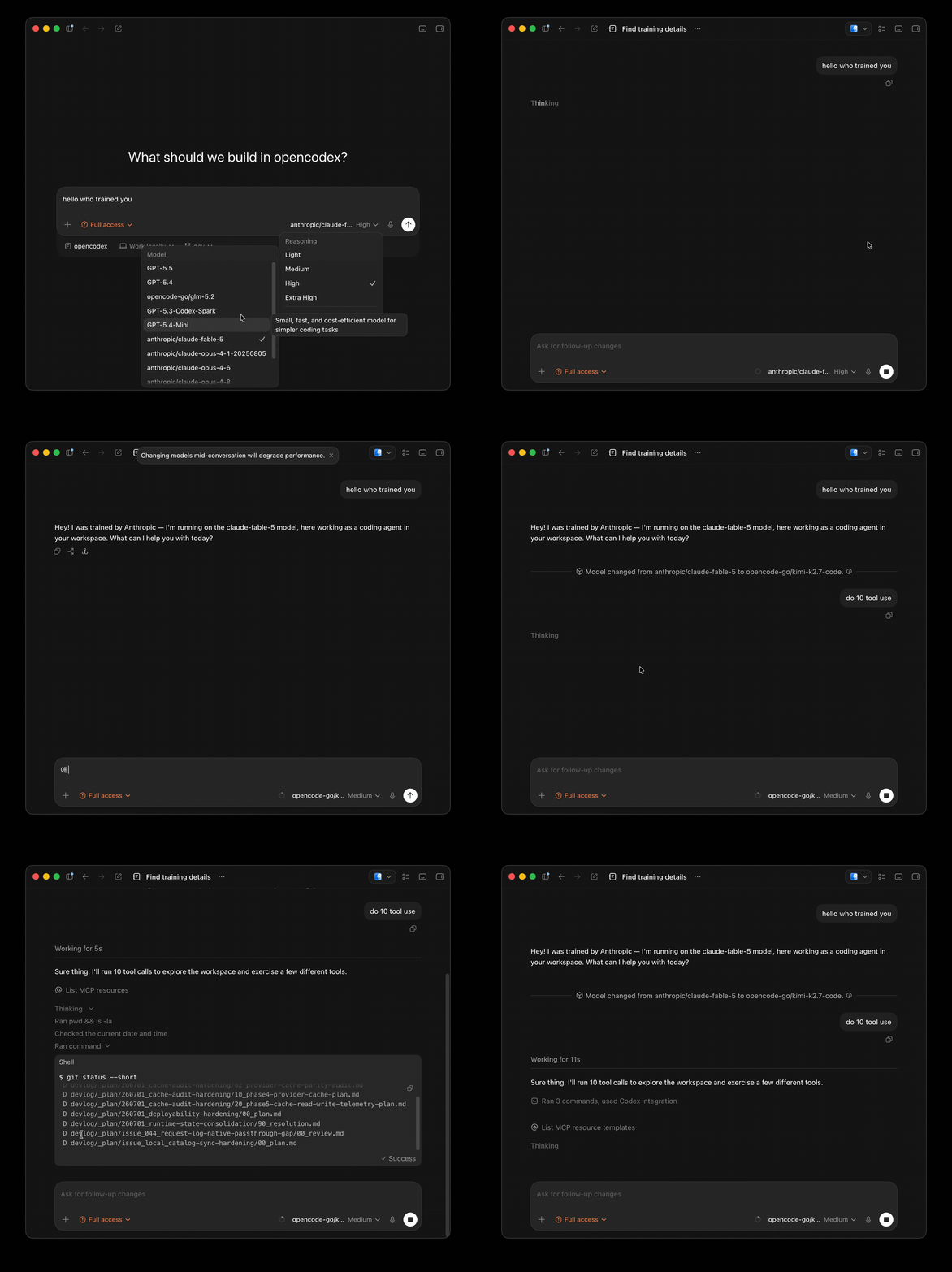
Universal provider proxy for OpenAI Codex & Claude Code — use any LLM (Claude, Gemini, Grok, DeepSeek, Ollama…) with Codex CLI, App, SDK, and Claude Code

Git-native persistent memory for AI coding agents. Implements Google OKF v0.2 with sub-300µs in-memory BM25 search, embedded MCP server, and progressive disclosure. Slashes token bloat by 80% with zero external databases or dependencies. Built in pure Go.

Local-first code intelligence graph for MCP and CLI. Builds a persistent map of your codebase so AI coding tools read only what matters, with benchmarked context reductions on reviews and large-repo workflows.

Stop your AI from making things up — it proposes, deterministic tools decide, every claim checked against ground truth with evidence. Grounded facts and context survive resets. Reverse engineering is the proving ground. MCP server + CLI.