
koala73/worldmonitorConnectors
Real-time global intelligence dashboard. AI-powered news aggregation, geopolitical monitoring, and infrastructure tracking in a unified situational awareness interface
86k
This project has two parts: a crawler that turns a site into Markdown, and an MCP server that makes that Markdown searchable. The server loads files from `./storage/`, chunks them by headings, embeds them, and answers document queries through tools for MCP clients like Cursor.
Builders who want their agent to search crawled docs and wikis from Cursor or another MCP client.
You can turn a documentation site into searchable context for your agent instead of copying pages by hand.
Crawls from a starting URL with depth, include/exclude patterns, content-type filters, and optional HTML cleaning before Markdown output.
Writes crawled content into a single Markdown file in `./storage/` by default, ready for later search.
Parses Markdown into chunks based on headings so the server can search smaller sections instead of whole files.
Creates embeddings with `sentence-transformers` and stores them in `storage/document_chunks_cache.pkl` for faster restarts.
Exposes `list_documents`, `get_document_headings`, and `search_documentation` through `fastmcp`.
Runs as an MCP server over stdio so Cursor can call it directly from its agent workflow.
git clone https://github.com/alizdavoodi/MCPDocSearch.git
cd MCPDocSearch
uv sync
uv run python crawl.py https://docs.example.com
uv run python crawl.py https://docs.another.site --output ./storage/custom_name.md --max-depth 2 --keyword "API" --keyword "Reference" --exclude-pattern "*blog*"
uv run python crawl.py --help
uv run python crawl.py https://pulsar.apache.org/docs/4.0.x/admin-api-overview/ -v --include-pattern "*admin-api*" --max-depth 2
This project provides a toolset to crawl websites, generate Markdown documentation, and make that documentation searchable via a Model Context Protocol (MCP) server, designed for integration with tools like Cursor.
crawler_cli):
crawl4ai../storage/ by default.mcp_server):
./storage/ directory.sentence-transformers (multi-qa-mpnet-base-dot-v1).storage/document_chunks_cache.pkl) to store processed chunks and embeddings.
.md files in ./storage/ haven't changed, the server loads directly from the cache, resulting in much faster startup times..md file in ./storage/ is modified, added, or removed since the cache was last created.fastmcp for clients like Cursor:
list_documents: Lists available crawled documents.get_document_headings: Retrieves the heading structure for a document.search_documentation: Performs semantic search over document chunks using vector similarity.stdio transport for use within Cursor.crawler_cli tool to crawl a website and generate a .md file in ./storage/.mcp_server (typically managed by an MCP client like Cursor)..md files in ./storage/.list_documents, search_documentation, etc.) to query the crawled content.This project uses uv for dependency management and execution.
Install uv: Follow the instructions on the uv website.
Clone the repository:
git clone https://github.com/alizdavoodi/MCPDocSearch.git
cd MCPDocSearch
Install dependencies:
uv sync
This command creates a virtual environment (usually .venv) and installs all dependencies listed in pyproject.toml.
Run the crawler using the crawl.py script or directly via uv run.
Basic Example:
uv run python crawl.py https://docs.example.com
This will crawl https://docs.example.com with default settings and save the output to ./storage/docs.example.com.md.
Example with Options:
uv run python crawl.py https://docs.another.site --output ./storage/custom_name.md --max-depth 2 --keyword "API" --keyword "Reference" --exclude-pattern "*blog*"
View all options:
uv run python crawl.py --help
Key options include:
--output/-o: Specify output file path.--max-depth/-d: Set crawl depth (must be between 1 and 5).--include-pattern/--exclude-pattern: Filter URLs to crawl.--keyword/-k: Keywords for relevance scoring during crawl.--remove-links/--keep-links: Control HTML cleaning.--cache-mode: Control crawl4ai caching (DEFAULT, BYPASS, FORCE_REFRESH).--wait-for: Wait for a specific time (seconds) or CSS selector before capturing content (e.g., 5 or 'css:.content'). Useful for pages with delayed loading.--js-code: Execute custom JavaScript on the page before capturing content.--page-load-timeout: Set the maximum time (seconds) to wait for a page to load.--wait-for-js-render/--no-wait-for-js-render: Enable a specific script to better handle JavaScript-heavy Single Page Applications (SPAs) by scrolling and clicking potential "load more" buttons. Automatically sets a default wait time if --wait-for is not specified.Sometimes, you might want to crawl only a specific subsection of a documentation site. This often requires some trial and error with --include-pattern and --max-depth.
--include-pattern: Restricts the crawler to only follow links whose URLs match the given pattern(s). Use wildcards (*) for flexibility.--max-depth: Controls how many "clicks" away from the starting URL the crawler will go. A depth of 1 means it only crawls pages directly linked from the start URL. A depth of 2 means it crawls those pages and pages linked from them (if they also match include patterns), and so on.Example: Crawling only the Pulsar Admin API section
Suppose you want only the content under https://pulsar.apache.org/docs/4.0.x/admin-api-*.
https://pulsar.apache.org/docs/4.0.x/admin-api-overview/.admin-api: --include-pattern "*admin-api*".2 and increase if needed.-v to see which URLs are being visited or skipped, which helps debug the patterns and depth.uv run python crawl.py https://pulsar.apache.org/docs/4.0.x/admin-api-overview/ -v --include-pattern "*admin-api*" --max-depth 2
Check the output file (./storage/pulsar.apache.org.md by default in this case). If pages are missing, try increasing --max-depth to 3. If too many unrelated pages are included, make the --include-pattern more specific or add --exclude-pattern rules.
The MCP server is designed to be run by an MCP client like Cursor via the stdio transport. The command to run the server is:
python -m mcp_server.main
However, it needs to be run from the project's root directory (MCPDocSearch) so that Python can find the mcp_server module.
The MCP server generates embeddings locally the first time it runs or whenever the source Markdown files in ./storage/ change. This process involves loading a machine learning model and processing all the text chunks.
To use this server with Cursor, create a .cursor/mcp.json file in the root of this project (MCPDocSearch/.cursor/mcp.json) with the following content:
{
  "mcpServers": {
    "doc-query-server": {
      "command": "uv",
      "args": [
        "--directory",
        // IMPORTANT: Replace with the ABSOLUTE path to this project directory on your machine
        "/path/to/your/MCPDocSearch",
        "run",
        "python",
        "-m",
        "mcp_server.main"
      ],
      "env": {}
    }
  }
}
Explanation:
"doc-query-server": A name for the server within Cursor."command": "uv": Specifies uv as the command runner."args":
"--directory", "/path/to/your/MCPDocSearch": Crucially, tells uv to change its working directory to your project root before running the command. Replace /path/to/your/MCPDocSearch with the actual absolute path on your system."run", "python", "-m", "mcp_server.main": The command uv will execute within the correct directory and virtual environment.After saving this file and restarting Cursor, the "doc-query-server" should become available in Cursor's MCP settings and usable by the Agent (e.g., @doc-query-server search documentation for "how to install").
For Claude for Desktop, you can use this official documentation to set up the MCP server
Key libraries used:
crawl4ai: Core web crawling functionality.fastmcp: MCP server implementation.sentence-transformers: Generating text embeddings.torch: Required by sentence-transformers.typer: Building the crawler CLI.uv: Project and environment management.beautifulsoup4 (via crawl4ai): HTML parsing.rich: Enhanced terminal output.The project follows this basic flow:
crawler_cli: You run this tool, providing a starting URL and options.crawl4ai): The tool uses crawl4ai to fetch web pages, following links based on configured rules (depth, patterns).crawler_cli/markdown.py): Optionally, HTML content is cleaned (removing navigation, links) using BeautifulSoup.crawl4ai): Cleaned HTML is converted to Markdown../storage/): The generated Markdown content is saved to a file in the ./storage/ directory.mcp_server Startup: When the MCP server starts (usually via Cursor's config), it runs mcp_server/data_loader.py..pkl). If valid, it loads chunks and embeddings from the cache. Otherwise, it reads .md files from ./storage/.sentence-transformers and stored in memory (and saved to cache).mcp_server/mcp_tools.py): The server exposes tools (list_documents, search_documentation, etc.) via fastmcp.search_documentation uses the pre-computed embeddings to find relevant chunks based on semantic similarity to the query.This project is licensed under the MIT License - see the LICENSE file for details.
Contributions are welcome! Please feel free to open an issue or submit a pull request.
pickle module to cache processed data (storage/document_chunks_cache.pkl). Unpickling data from untrusted sources can be insecure. Ensure that the ./storage/ directory is only writable by trusted users/processes.Sign in to join the discussion.
No comments yet. Be the first to say what this is good for.
Real-time global intelligence dashboard. AI-powered news aggregation, geopolitical monitoring, and infrastructure tracking in a unified situational awareness interface
High-performance code intelligence MCP server. Indexes codebases into a persistent knowledge graph — average repo in milliseconds. 158 languages, sub-ms queries, 99% fewer tokens. Single static binary, zero dependencies.
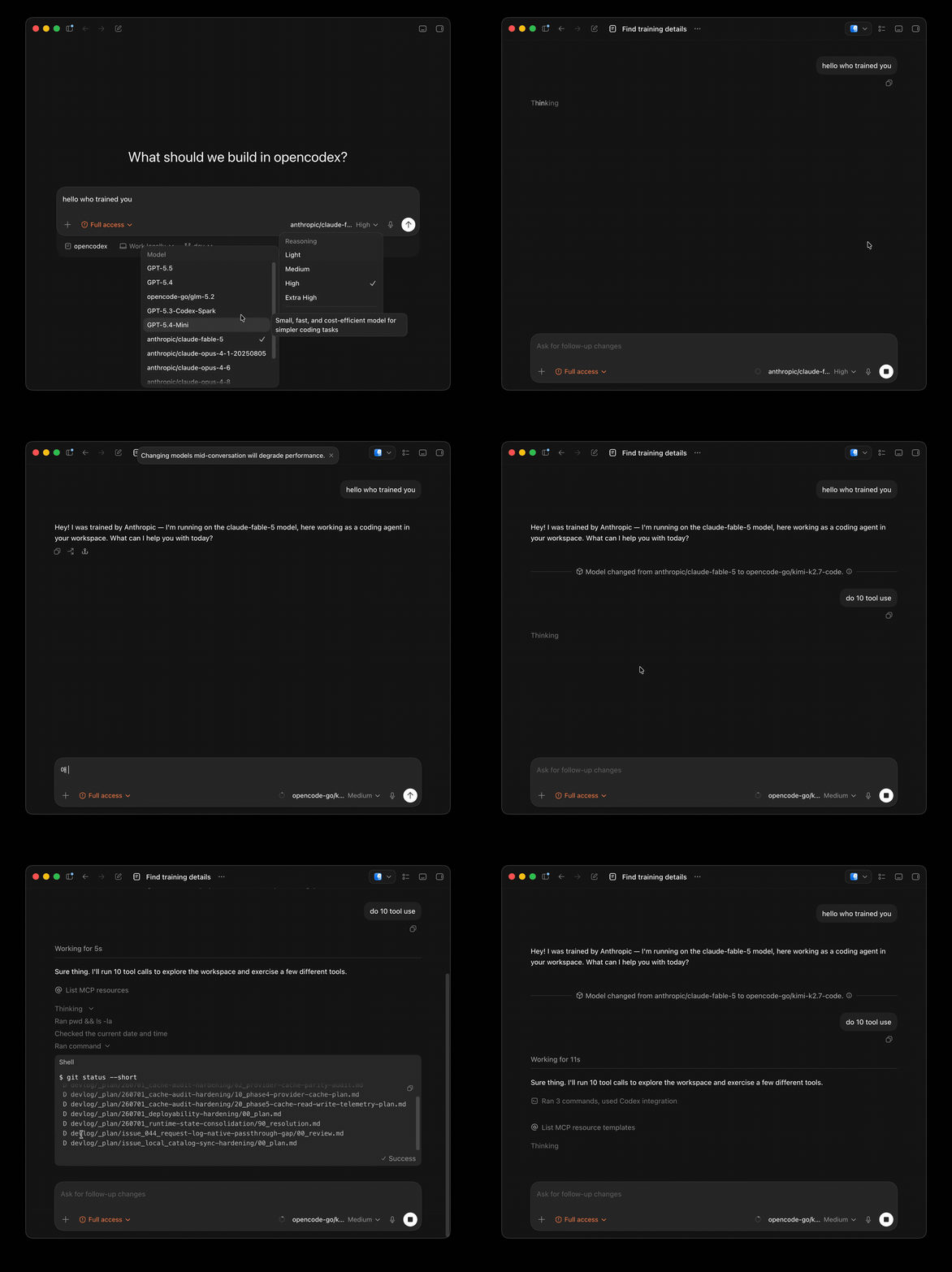
Universal provider proxy for OpenAI Codex & Claude Code — use any LLM (Claude, Gemini, Grok, DeepSeek, Ollama…) with Codex CLI, App, SDK, and Claude Code

Git-native persistent memory for AI coding agents. Implements Google OKF v0.2 with sub-300µs in-memory BM25 search, embedded MCP server, and progressive disclosure. Slashes token bloat by 80% with zero external databases or dependencies. Built in pure Go.

Local-first code intelligence graph for MCP and CLI. Builds a persistent map of your codebase so AI coding tools read only what matters, with benchmarked context reductions on reviews and large-repo workflows.

Stop your AI from making things up — it proposes, deterministic tools decide, every claim checked against ground truth with evidence. Grounded facts and context survive resets. Reverse engineering is the proving ground. MCP server + CLI.