High-performance code intelligence MCP server. Indexes codebases into a persistent knowledge graph — average repo in milliseconds. 158 languages, sub-ms queries, 99% fewer tokens. Single static binary, zero dependencies.
Agent gateway for MCP and A2A traffic
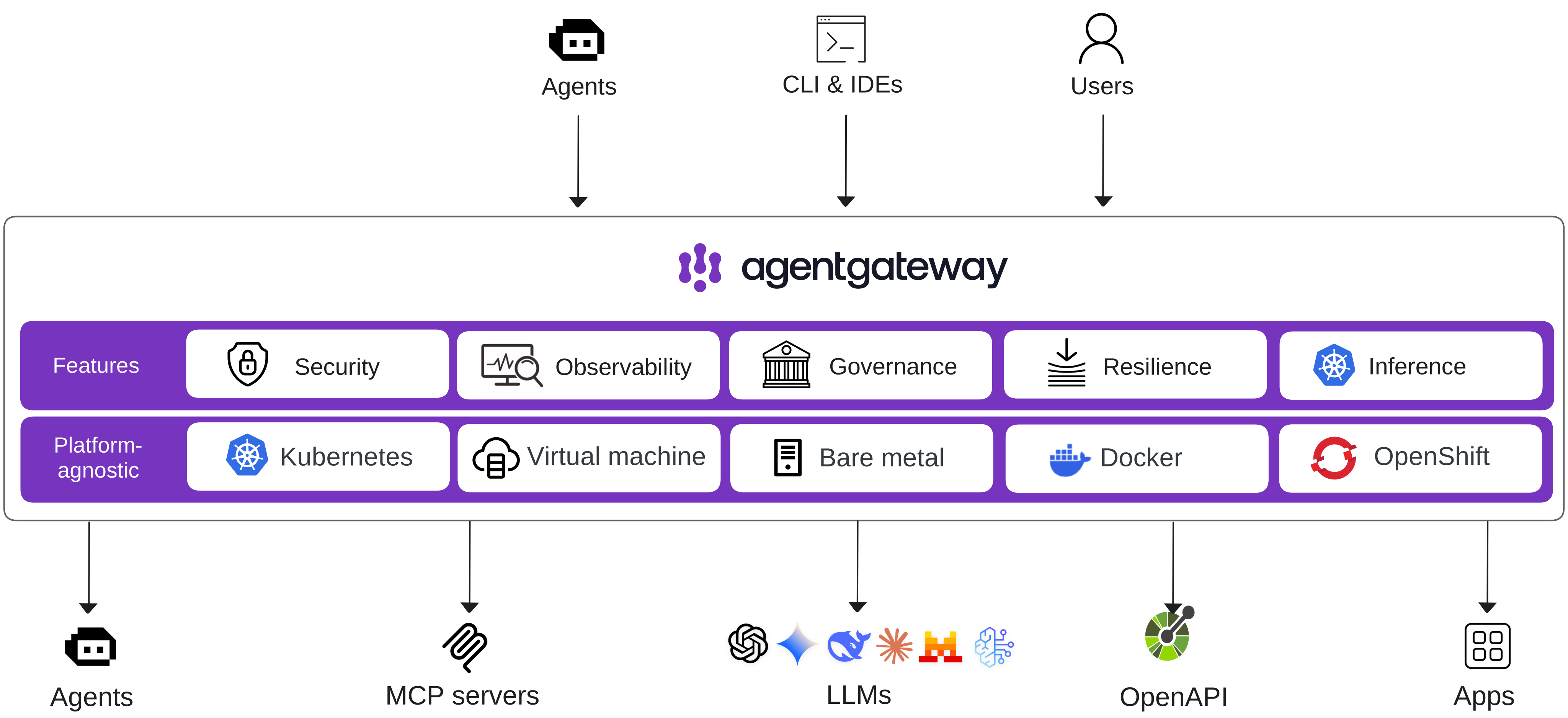
Agentgateway sits between your agents and the services they use. It routes MCP, A2A, and LLM traffic while adding auth, policy checks, guardrails, load balancing, failover, and observability.
Builders who want a single proxy layer for agent traffic across tools, models, and environments.
You can connect agents to tools and models through one managed gateway instead of custom wiring for every integration.
What it does
MCP gateway
Connects LLMs to tools and data sources through MCP with stdio, HTTP, SSE, and streamable HTTP transports, plus OpenAPI and OAuth support.
A2A gateway
Handles agent-to-agent communication with capability discovery, modality negotiation, and task collaboration.
LLM routing
Routes requests to providers like OpenAI, Anthropic, Gemini, and Bedrock through one OpenAI-compatible API with budgets, spend controls, load balancing, and failover.
Inference routing
Routes to self-hosted models using Kubernetes Inference Gateway signals such as GPU use, KV cache, LoRA adapters, and queue depth.
Guardrails and policy
Adds content filtering, JWT, API key, OAuth, RBAC, CEL policy, and rate limiting around agent traffic.
Observability
Exports OpenTelemetry metrics, logs, and traces for agent and tool calls.
README
Agentgateway is an open source proxy built on AI-native protocols (MCP & A2A) that provides drop-in security, observability, and governance for agent-to-LLM, agent-to-tool, and agent-to-agent communication across any framework and environment.
Intro to Agentgateway Video
Key Features
-
LLM Gateway
Route traffic to major LLM providers (OpenAI, Anthropic, Gemini, Bedrock, and more) through a unified OpenAI-compatible API with budget and spend controls, prompt enrichment, load balancing, and failover. -
MCP Gateway
Connect LLMs to tools and external data sources via MCP with tool federation, stdio/HTTP/SSE/Streamable HTTP transports, OpenAPI integration, and OAuth authentication. -
A2A Gateway
Enable secure agent-to-agent communication using A2A, with capability discovery, modality negotiation, and task collaboration. -
Inference Routing
Intelligent routing to self-hosted models using Kubernetes Inference Gateway extensions, with decisions based on GPU utilization, KV cache, LoRA adapters, and queue depth. -
Guardrails
Multi-layered content filtering with regex, OpenAI moderation, AWS Bedrock Guardrails, Google Model Armor, and custom webhooks. -
Security & Observability
Auth (JWT, API keys, OAuth), fine-grained RBAC with CEL policy engine, rate limiting, TLS, and OpenTelemetry metrics/logs/tracing.
Getting Started
- Standalone Quickstart — Get started with agentgateway in minutes.
- Kubernetes Quickstart — Deploy on Kubernetes using the built-in controller and Gateway API.
Documentation
Depending on your deployment environment, check out the following docs:
- agentgateway.dev/docs: For deployments without the full Kubernetes controller, driven by flat yaml config.
- agentgateway.dev/docs/kubernetes/latest: For Kubernetes-based deployments using the built-in Kubernetes controller and Gateway API support.
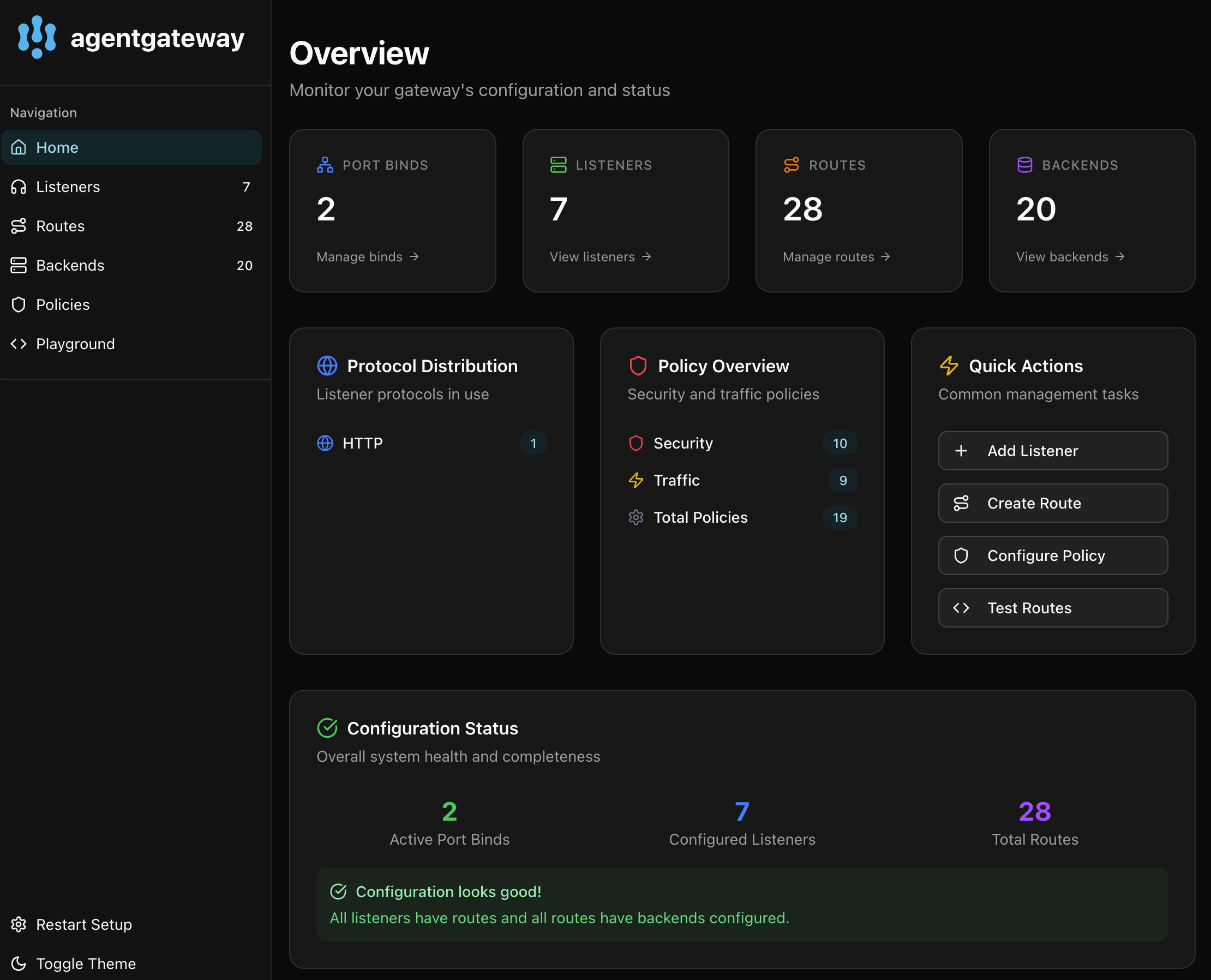
Agentgateway has a built-in UI for you to explore agentgateway connecting agent-to-agent or agent-to-tool:
Sponsors
|
|
Thank you to our sponsors for helping to fund the development of agentgateway!
Contributing
For instructions on how to contribute to the agentgateway project, see the CONTRIBUTION.md file.
Community Meetings
To join a community meeting, add the agentgateway calendar to your Google account. Then, you can find event details on the calendar.
Recordings of the community meetings will be published on our google drive.
Roadmap
agentgateway is currently in active development. If you'd like a feature that's missing, open an issue in our GitHub repo.
Contributors
Thanks to all contributors who are helping to make agentgateway better.
Agentgateway is a Linux Foundation project.
Files in the repo
- .cargo
- .githooks
- .github
- api
- architecture
- catalog
- common
- controller
- crates
- design
- examples
- fuzz
- img
- manifests
- schema
- tools
- ui
- .clippy.toml
- .devcontainer.json
- .dockerignore
- .gitattributes
- .gitignore
- buf.gen.yaml
- buf.yaml
- Cargo.lock
- Cargo.toml
- CHARTER.md
- CODE_OF_CONDUCT.md
- CODEOWNERS
- CONTRIBUTION.md
- deny.toml
- DEVELOPMENT.md
- Dockerfile
- Dockerfile.s390x
- Dockerfile.windows
- go.mod
- go.sum
- LICENSE
- Makefile
- modern.yaml
- osv-scanner.toml
- README.md
- rust-toolchain.toml
- rustfmt.toml
- SECURITY.md
- Tiltfile
Discussion (0)
Ask about usage, or say what you built with itSign in to join the discussion.
No comments yet. Be the first to say what this is good for.
More connectors

Universal provider proxy for OpenAI Codex & Claude Code — use any LLM (Claude, Gemini, Grok, DeepSeek, Ollama…) with Codex CLI, App, SDK, and Claude Code
Git-native persistent memory for AI coding agents. Implements Google OKF v0.2 with sub-300µs in-memory BM25 search, embedded MCP server, and progressive disclosure. Slashes token bloat by 80% with zero external databases or dependencies. Built in pure Go.
Local-first code intelligence graph for MCP and CLI. Builds a persistent map of your codebase so AI coding tools read only what matters, with benchmarked context reductions on reviews and large-repo workflows.
Stop your AI from making things up — it proposes, deterministic tools decide, every claim checked against ground truth with evidence. Grounded facts and context survive resets. Reverse engineering is the proving ground. MCP server + CLI.
20 MB lightweight cross-platform database client for 90+ databases, including MySQL, PostgreSQL, SQLite, Redis, MongoDB, DuckDB, SQL Server, and Dameng. Built-in AI, MCP Server, CLI, desktop and Docker. | 轻量级跨平台数据库管理工具,支持 MySQL、PostgreSQL、SQLite、Redis、MongoDB、达梦等 90+ 数据库,提供桌面端、Docker、CLI、内置 AI 助手和 MCP Server。