
NousResearch/
hermes-agent

The agent that grows with you
245k
Claude Swarm turns one complex Claude Code task into a dependency graph, assigns subtasks to parallel agents, and then reviews the combined result. It uses a Rich terminal UI to show progress, file conflicts, cost, retries, and session replay.
Builders who use Claude Code and want repeatable multi-agent task execution.
You can split a hard task into parallel agent work, review it, and replay the session instead of managing each step by hand.
Uses a planning step to break a request into a dependency graph of subtasks.
Runs independent subtasks at the same time and waits on dependent tasks.
Locks files so agents do not edit the same file at once.
Stops remaining work when the configured dollar limit is reached.
Runs an Opus review over the combined outputs before finishing.
Stores swarm events and lets you replay a past run from the CLI.
Shows live agent progress, tool use, costs, and conflicts in the terminal.
Loads custom agent topologies from `swarm.yaml` or `.claude/swarm.yaml`.
You: "Refactor auth module from Express middleware to Next.js API routes"

Claude Swarm:
  Phase 1:   Opus 4.6 decomposes task into dependency graph
  Phase 2:   Parallel agents execute subtasks with live dashboard
  Phase 2.5: Opus 4.6 Quality Gate reviews all agent outputs
  Phase 3:   Results summary with costs and session replay



Multi-agent orchestration for Claude Code — decompose complex tasks into parallel subtasks, coordinate agents in real-time, and visualize everything in a rich terminal UI.
Built with the Claude Agent SDK for the Claude Code Hackathon (Feb 10-16, 2026).
You: "Refactor auth module from Express middleware to Next.js API routes"

Claude Swarm:
  Phase 1:   Opus 4.6 decomposes task into dependency graph
  Phase 2:   Parallel agents execute subtasks with live dashboard
  Phase 2.5: Opus 4.6 Quality Gate reviews all agent outputs
  Phase 3:   Results summary with costs and session replay
htop-style dashboard showing agent progress, tool usage, costs, and file conflicts in real-time# See it in action instantly (no API key needed!)
pip install claude-swarm
claude-swarm --demo
# Or install from source
git clone https://github.com/affaan-m/claude-swarm
cd claude-swarm
pip install -e .
# Set your API key for real usage
export ANTHROPIC_API_KEY="sk-ant-..."
# Run a swarm
claude-swarm "Refactor auth module from Express middleware to Next.js API routes"
# Dry run (shows plan without executing)
claude-swarm --dry-run "Add user authentication with JWT"
# Custom budget, agents, and retries
claude-swarm --budget 3.0 --max-agents 6 --retry 2 "Build a REST API for user management"
# Disable quality gate for faster execution
claude-swarm --no-quality-gate "Quick fix: update README"
┌───────────────────────────────────────────────┐
│              Claude Swarm CLI                  │
│                                                │
│  Phase 1: Decompose                            │
│  ┌─────────────────────────────────────────┐   │
│  │  Opus 4.6 Task Decomposer              │   │
│  │  "Add auth" -> [create routes,          │   │
│  │   add middleware, write tests, review]   │   │
│  └──────────────┬──────────────────────────┘   │
│                 │ dependency graph              │
│  Phase 2: Execute                              │
│  ┌──────────────▼──────────────────────────┐   │
│  │       Swarm Orchestrator                │   │
│  │                                         │   │
│  │  Wave 1: ┌────────┐ ┌────────┐         │   │
│  │          │ Agent 1 │ │ Agent 2 │  (parallel)│
│  │          │ coder   │ │ coder   │         │  │
│  │          └────┬────┘ └────┬────┘         │  │
│  │  Wave 2:      └─────┬─────┘              │  │
│  │               ┌─────▼─────┐              │  │
│  │               │  Agent 3  │  (depends)   │  │
│  │               │  tester   │              │  │
│  │               └─────┬─────┘              │  │
│  │  Wave 3:      ┌─────▼─────┐              │  │
│  │               │  Agent 4  │  (depends)   │  │
│  │               │  reviewer │              │  │
│  │               └───────────┘              │  │
│  │                                          │  │
│  │  File Locks: {auth.ts -> Agent 1}       │  │
│  │  Budget: $0.23 / $5.00                  │  │
│  │  Retries: task-2 (attempt 2/3)          │  │
│  └──────────────────────────────────────────┘  │
│                                                │
│  Phase 2.5: Quality Gate                       │
│  ┌──────────────────────────────────────────┐  │
│  │  Opus 4.6 reviews combined agent output  │  │
│  │  Score: 8/10 | Verdict: PASS            │  │
│  └──────────────────────────────────────────┘  │
│                                                │
│  Phase 3: Results                              │
│  ┌──────────────────────────────────────────┐  │
│  │  4/4 tasks completed | $0.45 | 32s      │  │
│  │  Session: swarm-a1b2c3d4                 │  │
│  └──────────────────────────────────────────┘  │
└────────────────────────────────────────────────┘
| Feature | Description |
|---|---|
| Dependency-aware scheduling | Tasks only start when their dependencies complete |
| File conflict detection | Pessimistic file locking prevents agents from editing the same file simultaneously |
| Budget enforcement | Hard cost limit — cancels remaining tasks when budget is exceeded |
| Cost tracking | Real-time per-agent and total cost monitoring |
| Opus Quality Gate | Phase 2.5 — Opus 4.6 reviews all agent outputs for correctness and consistency |
| Smart model selection | Opus 4.6 for planning + quality review, Haiku for worker agents (3x cheaper) |
| Task retry | Failed tasks are automatically retried with configurable attempt limits |
| Demo mode | --demo flag shows animated TUI without API key (great for presentations) |
| Session recording | Every swarm execution recorded as JSONL events |
| Session replay | claude-swarm replay <id> to review what each agent did |
| YAML config | Declarative swarm topologies via swarm.yaml |
| Progress visualization | Live htop-style dashboard with Rich |
# Main command
claude-swarm [OPTIONS] TASK

Options:
  -d, --cwd TEXT            Working directory (default: .)
  -n, --max-agents INTEGER  Max concurrent agents (default: 4)
  -m, --model TEXT          Decomposition model (default: opus)
  -b, --budget FLOAT        Max budget in USD (default: 5.0)
  -r, --retry INTEGER       Max retries for failed tasks (default: 1)
  -c, --config PATH         Path to swarm.yaml
  --demo                    Run demo simulation (no API key needed)
  --dry-run                 Show plan without executing
  --quality-gate/--no-quality-gate  Enable/disable Opus quality review (default: on)
  --no-ui                   Disable rich terminal UI
  -v, --version             Show version

# Subcommands
claude-swarm sessions              # List past sessions
claude-swarm replay <session-id>   # Replay a session's events
Create swarm.yaml in your project root to define custom agent types:
swarm:
  name: full-stack-review
  max_concurrent: 4
  budget_usd: 5.0
  model: opus

agents:
  security-reviewer:
    description: Reviews code for OWASP vulnerabilities
    model: opus
    tools: [Read, Grep, Glob]
    prompt: |
      Analyze the code for SQL injection, XSS, CSRF...

  tester:
    description: Writes and runs tests
    model: haiku
    tools: [Read, Write, Edit, Bash]
    prompt: |
      Write comprehensive tests. Ensure 80% coverage...

connections:
  - from: coder
    to: security-reviewer
  - from: coder
    to: tester
  - from: [security-reviewer, tester]
    to: reviewer
Claude Swarm auto-detects swarm.yaml or .claude/swarm.yaml in your project.
Claude Swarm demonstrates strategic model selection with two critical Opus 4.6 touchpoints:
Opus 4.6 handles the hardest reasoning task — analyzing your codebase, understanding the architecture, identifying dependencies between subtasks, and producing a parallelizable execution plan. This requires deep understanding of code relationships and optimal task splitting.
Haiku handles the parallelizable work — each agent follows focused instructions from the plan. Using Haiku here is 3x cheaper while maintaining 90% of Sonnet's capability for focused tasks.
After all agents complete, Opus 4.6 reviews the combined output. It checks for integration issues between agents' work, missed edge cases, security concerns, and whether the original task was fully addressed. This catches problems that individual agents can't see.
This mirrors real engineering team structure: a senior architect designs the plan, junior engineers execute in parallel, and the senior reviews the combined result.
anyio for structured async concurrency# Clone and install
git clone https://github.com/affaan-m/claude-swarm
cd claude-swarm
pip install -e ".[dev]"
# Run tests (44 passing)
pytest tests/ -v
# Lint
ruff check src/ tests/
src/claude_swarm/
  cli.py           CLI entry point (Click group + subcommands)
  types.py         Core dataclasses (SwarmTask, SwarmPlan, etc.)
  decomposer.py    Opus 4.6 task decomposition
  orchestrator.py  Parallel execution with file locks, budget, retries
  quality_gate.py  Opus 4.6 quality review of agent outputs
  demo.py          Demo simulation with animated TUI
  config.py        YAML swarm topology configuration
  session.py       JSONL event recording and replay
  ui.py            Rich terminal dashboard
MIT — Affaan Mustafa
Sign in to join the discussion.
No comments yet. Be the first to say what this is good for.
The agent that grows with you

Open-source coding agent for your terminal, built in Rust and on a journey of continuous community improvement. Issues and PRs welcome.
A lightweight alternative to OpenClaw that runs in containers for security. Connects to WhatsApp, Telegram, Slack, Discord, Gmail and other messaging apps,, has memory, scheduled jobs, and runs directly on Anthropic's Agents SDK

OpenSquilla — Token-Efficient AI Agent with same budget, higher intelligence density
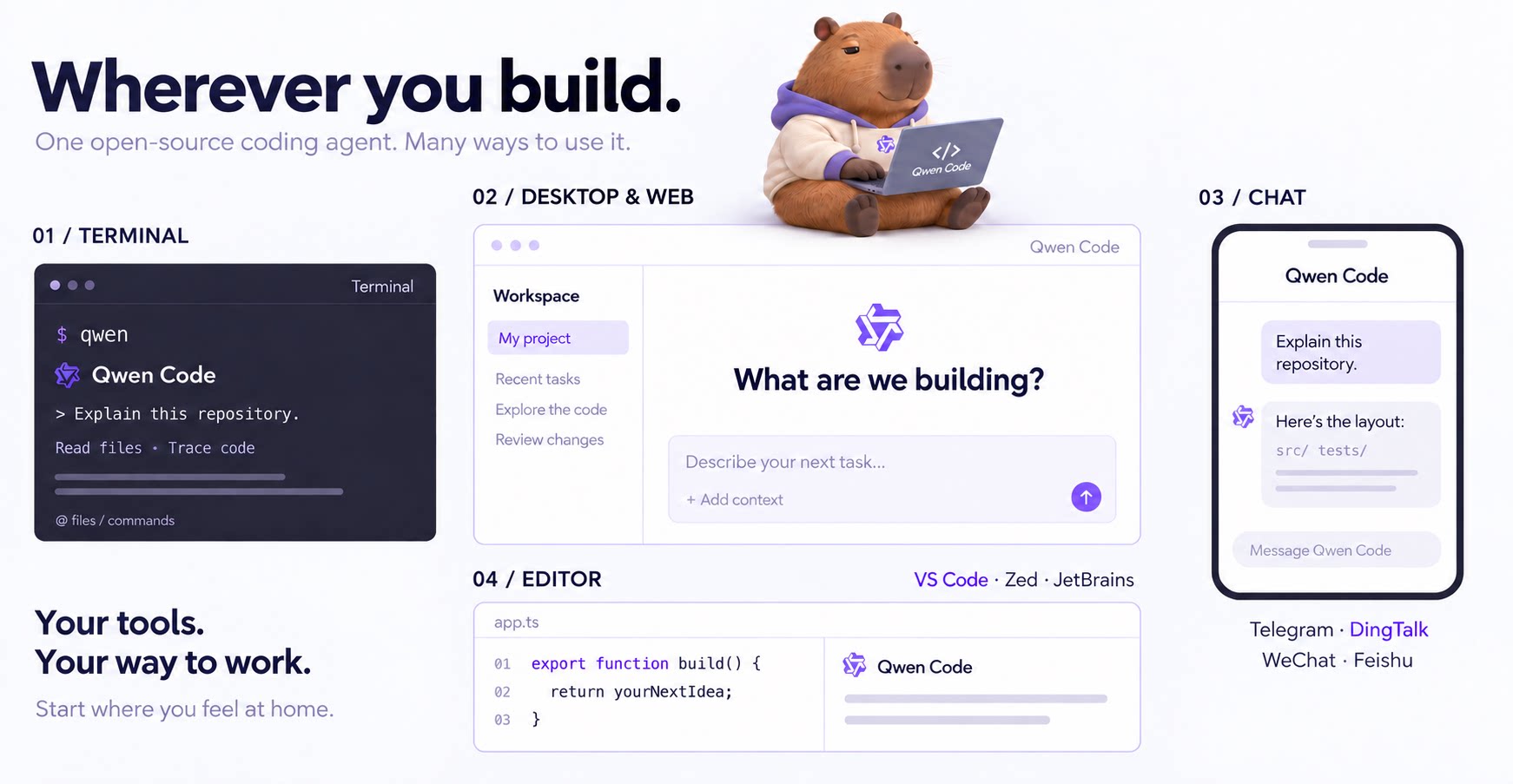
An open-source AI coding agent that lives in your terminal.

Run and supervise teams of coding agents from planning to merge. Any harness (Claude code, codex, +25 more). Desktop, web, mobile, and cloud agents.