
koala73/worldmonitorConnectors
Real-time global intelligence dashboard. AI-powered news aggregation, geopolitical monitoring, and infrastructure tracking in a unified situational awareness interface
86k
GhostDesk exposes a full desktop through MCP so an agent can inspect the screen and drive input like a person. It works through the same tool surface on Linux, macOS, and Windows, with a Docker-based sandbox on Linux and native binaries on the other two.
Builders who want their agent to operate browsers, native apps, and internal tools from one prompt.
You can automate UI-only tasks without writing selectors or API glue.
`screen_shot` returns a full desktop image, or a cropped region, so the agent can inspect what is on screen.
Tools like `mouse_click`, `mouse_drag`, `key_type`, and `key_press` let the agent interact with the desktop directly.
`clipboard_get` and `clipboard_set` let the agent move text quickly instead of typing long passages.
`app_list`, `app_launch`, `app_running`, and `app_status` let the agent start approved apps and check their windows and logs.
The server speaks Streamable HTTP MCP at `/mcp`, so any compatible client can connect.
The Docker path provides a disposable virtual desktop with browser access through noVNC.
TLS plus bearer-token auth can be enabled for safer access on a networked machine.
docker run -d --name ghostdesk-demo \
  --shm-size 2g \
  -p 3000:3000 \
  -p 6080:6080 \
  ghcr.io/yv17labs/ghostdesk:latest
docker stop ghostdesk-demo && docker rm ghostdesk-demo
cargo install --path apps/ghostdesk --locked
NESTRS_ENV_PREFIX=GHOSTDESK GHOSTDESK_IDLE__TIMEOUT_SECS=0 ghostdesk
cargo install --path apps/ghostdesk --locked
$env:NESTRS_ENV_PREFIX = "GHOSTDESK"
$env:GHOSTDESK_IDLE__TIMEOUT_SECS = "0"
ghostdesk





Give your AI agent eyes, hands, and a full desktop.
An MCP server that lets LLM agents see the screen, move the mouse, type on the keyboard, launch apps, and run shell commands — in a sandboxed virtual desktop, or on the one in front of you.
If a human can do it on a desktop, your agent can too.
Your browser does not support the video tag.
GhostDesk demo — from a single prompt ("open the browser, go to Google News, and tell me the latest headlines in the Technology section"), the agent launches Firefox, navigates to Google News, switches to the Technology section, and reports the latest stories back.
One binary, one MCP endpoint, three desktops. The tool surface is the same
everywhere — an agent calls mouse_click and app_launch without knowing
which desktop it is on.
| Linux | macOS | Windows | |
|---|---|---|---|
| How it runs | the Docker container, in one command | a native binary | a native binary |
| The desktop it drives | a virtual one, shipped inside the image | the Mac in front of you | the PC in front of you |
| Sandboxed | yes — disposable, one per agent | no | no |
| Driven through | zwlr_virtual_pointer_v1, Sway IPC, grim | Quartz Event Services, Accessibility, screencapture | SendInput, GDI, EnumWindows |
Linux is the server. The container is the deployment this README shows unless it says otherwise, and the only one of the three with a sandbox around it. macOS and Windows run the very same server against a real desk — no container, and therefore no isolation. Jump to macOS or Windows, or read what differs between the three.
One command, plain HTTP, no password. Fine for kicking the tires on a laptop you trust — not fit for anything beyond that. Ready to harden it? Jump to Secure local run.
docker run -d --name ghostdesk-demo \
  --shm-size 2g \
  -p 3000:3000 \
  -p 6080:6080 \
  ghcr.io/yv17labs/ghostdesk:latest
The latest image ships with Firefox, the foot terminal, mousepad
(text editor), galculator, and passwordless sudo for the agent user —
enough to demo a browsing + note-taking workflow out of the box. Need a
different app set? Build your own on top of base — see Custom
image.
The container boots in the dev posture: plain HTTP on both ports, every auth gate disarmed on purpose. You'll see warnings in the logs reminding you of that — they go away once you follow the secured path below.
GhostDesk speaks MCP over the Streamable
HTTP transport — any MCP-compatible client can drive it. Point your client at
http://localhost:3000/mcp:
Claude Desktop / Claude Code
{
  "mcpServers": {
    "ghostdesk": {
      "type": "http",
      "url": "http://localhost:3000/mcp"
    }
  }
}
SpecterChat — the chat client we build for this, open source:
YV17labs/SpecterChat. Most chat UIs
drop the image an MCP tool returns — they render it or they forward it to the
model, rarely both — and a screen_shot() the model never sees is the whole
product missing. SpecterChat displays it inline and sends it back as base64.
It talks to any OpenAI-compatible endpoint (llama.cpp, vLLM, Ollama, LM
Studio), so it pairs with the local stacks below; macOS, Linux and Windows
builds are on its releases page.
Any other MCP-compatible client — same URL, no headers, no auth. That's the whole demo posture.
Open http://localhost:6080/ in your browser to see the virtual desktop in
real time. No password prompt — the dev posture skips it.
| Service | URL |
|---|---|
| MCP server | http://localhost:3000/mcp |
| noVNC (browser) | http://localhost:6080/ |
| Health probes | http://localhost:3000/health/{live,ready,startup} |
The probes are what the container's HEALTHCHECK reads, and they answer about
the desktop rather than about the processes: ready goes down when the
compositor stops answering the window seam, live when the connection behind
the virtual pointer and keyboard is gone — a state in which every tool still
replies and none of them does anything.
Give your agent a first prompt to confirm the wiring is right:
"Take a screenshot of the desktop, list the installed applications, then open Firefox and go to wikipedia.org."
You should see Firefox launch in the noVNC tab, the URL bar fill in, and the page load — all under your agent's control.
docker stop ghostdesk-demo && docker rm ghostdesk-demo
The demo run creates no named volume, so this leaves nothing behind.
Fourteen tools, named verb_noun, and this is the whole surface — no hidden
endpoint, no second protocol. Defaults are in parentheses, ? marks an
optional parameter, and every coordinate is a pixel offset in the last
screen_shot(): the moment the screen changes, coordinates computed from the
previous capture are stale.
| Tool | Parameters | Returns |
|---|---|---|
screen_shot | region? — {x, y, width, height}, cropped at native resolution · format "webp" | "png" (webp) · stabilize bool (true) — wait up to 5 s for the screen to settle · quality 1–100 (50, WebP only; raise it for fine fonts or design surfaces) | one image block — {"type": "image", "data": "<base64>", "mimeType": "image/webp"} |
The seven input tools answer with the same verdict, and screen_changed is the
field worth branching on: false means the act landed on nothing. It is a
signal, not an error — the answer is a fresh capture, never a retry at the same
coordinates.
{"action": "Clicked left at (612, 335)", "screen_changed": true, "reaction_time_ms": 180}
| Tool | Parameters |
|---|---|
mouse_move | x int · y int |
mouse_click | x · y · button "left" | "middle" | "right" (left) |
mouse_double_click | x · y · button (left) |
mouse_drag | from_x · from_y · to_x · to_y · button (left) |
mouse_scroll | x · y · direction "up" | "down" | "left" | "right" (down) · amount 1–5 wheel notches (3) |
key_type | text string — Unicode, newlines and tabs, layout-independent |
key_press | keys string — one chord, + between tokens. Modifiers: ctrl/control, alt/option, shift, super/meta/win/cmd/command. Named keys: return/enter, escape/esc, backspace, delete, tab, space, home/end, pageup/pagedown, left/right/up/down, f1–f12 |
Past a sentence or two, clipboard_set(text) plus the paste chord beats
key_type: it is instant, and immune to autocomplete and to the app's own key
handlers.
| Tool | Parameters | Returns |
|---|---|---|
clipboard_get | — | the clipboard as text — an empty string when it is empty or holds something that is not text |
clipboard_set | text string | Clipboard set (N characters) |
| Tool | Parameters | Returns |
|---|---|---|
app_list | — | result[], one entry per installed app: name, exec. This is the launch whitelist, and exec is the exact string app_launch takes |
app_running | — | result[], one entry per real client window: app, title, pid, focused |
app_launch | command string — an exec from app_list, arguments not accepted · wait_for_window bool (true) | pid, log_file, action, plus window and window_wait_ms once a window appeared — and the settled screen as an image block, so no follow-up screen_shot() is needed |
app_status | pid int — one returned by app_launch · lines int (50) | pid, running, log_file, tail — the tail of the captured stdout/stderr |
app_list is a whitelist rather than a hint: app_launch refuses anything
outside it, arguments included, whatever name the model sends.
A call is ordinary MCP over Streamable HTTP — POST /mcp, whose Accept
header has to name both application/json and text/event-stream or the
endpoint answers 406.
// the params of a tools/call request
{"name": "mouse_click", "arguments": {"x": 612, "y": 335}}
The result carries its payload twice — once in structuredContent, once as a
text block holding the same JSON, which is what a client older than structured
output reads. screen_shot is the exception and answers with an image block.
Two headers are GhostDesk's own: Authorization: Bearer …, required once a
cert is mounted (Secure local run), and
GhostDesk-Model-Space, for models that emit normalised coordinates (Model
requirements).
Your inference stack must cover four capabilities — all four are mandatory:
Points 3 and 4 are where most stacks fall short, and both halves have an answer here: SpecterChat on the client side, and the llama.cpp forks below on the inference side.
GhostDesk-Model-Space headerBy default no header is needed: Claude and the other major frontier LLMs work
out of the box. Qwen3.x need the client to send GhostDesk-Model-Space: 1000 on every MCP request.
Example MCP client config:
{
  "mcpServers": {
    "ghostdesk": {
      "url": "http://localhost:3000/mcp",
      "headers": {
        "GhostDesk-Model-Space": "1000"
      }
    }
  }
}
Three backends are tested here. Two are llama.cpp forks we maintain, both kept current with upstream, both adding the WebP decoding upstream still lacks — the day it lands there, they are archived and this points at upstream directly. The third is upstream mlx-vlm, on Apple Silicon.
feature/webp. Start here. WebP decoding and nothing else on top
of upstream, so it stays close to master and inherits its backend work. It is
the faster of the two on Metal and on CUDA — on an Apple Silicon Mac or an
NVIDIA card, this is the one to run.feature/turboquant-webp. The same WebP support plus the
turbo-quant KV cache (--cache-type-v turbo3). Still maintained and still
tracking upstream, but turbo quant is no longer where the interest is, and
this is no longer the first recommendation.Run whatever local model you like — nothing in GhostDesk is pinned to one. The one behind my own runs is Qwen3.6-35B-A3B: 35B parameters with only 3B active per token, and on desktop control that ratio is the whole point — the agent decides where to click on every step, so tokens per second is what you feel.
One tested invocation per backend. They do not take the same flags, so each gets its own rather than one command with a switch — and the model in them is an example, not a requirement: swap in whatever you run.
llama-cpp-webp — --image-min-tokens 1024 is the one that matters for
desktop control: it floors how much of the token budget a screenshot gets, and
a screenshot the model reads at too coarse a scale is where off-target clicks
come from.
build/bin/llama-server \
  --model ~/Models/Qwen3.6-35B-A3B-Q4_K_M.gguf \
  --mmproj ~/Models/Qwen3.6-35B-A3B-mmproj-F16.gguf \
  --alias 'Qwen3.6-35B-A3B-Q4_K_M' \
  --host 127.0.0.1 --port 8080 \
  --ctx-size 131072 \
  --cache-type-k q8_0 --cache-type-v q8_0 \
  --flash-attn on \
  --image-min-tokens 1024 \
  --reasoning on --reasoning-format deepseek --reasoning-preserve \
  --jinja
llama-cpp-turboquant-webp — the KV cache goes to --cache-type-v turbo3,
and --cache-reuse 256 keeps the prefix across turns, which a desktop session
hits constantly: the conversation grows by one screenshot and one tool result
at a time. --spec-type draft-mtp turns on the model's own
multi-token-prediction draft head, so speculative decoding needs no second
model loaded beside it.
build/bin/llama-server \
  --model ~/Models/Qwen3.6-35B-A3B-Q4_K_M.gguf \
  --mmproj ~/Models/Qwen3.6-35B-A3B-mmproj-F16.gguf \
  --alias 'Qwen3.6-35B-A3B-Q4_K_M' \
  --host 127.0.0.1 --port 8080 \
  --ctx-size 131072 \
  --cache-type-k q8_0 --cache-type-v turbo3 \
  --flash-attn on \
  --spec-type draft-mtp --spec-draft-n-max 3 \
  --reasoning on --reasoning-format deepseek \
  --jinja --cache-reuse 256
mlx-vlm — the flags are the same three ideas under other names:
--kv-bits 8 --kv-quant-scheme uniform quantises the KV cache,
--enable-thinking turns reasoning on, and --draft-kind mtp is the
multi-token-prediction draft head. That last one is the difference that costs
something: here the head is a second set of weights on disk (--draft-model),
not a switch on the model already loaded.
.venv/bin/mlx_vlm.server \
  --model ~/Models/Qwen3.6-35B-A3B-MLX-4bit \
  --host 127.0.0.1 --port 8080 \
  --kv-bits 8 --kv-quant-scheme uniform \
  --enable-thinking \
  --draft-model ~/Models/Qwen3.6-35B-A3B-MLX-mtp --draft-kind mtp
Each of the three exposes an OpenAI-compatible endpoint on
http://127.0.0.1:8080; point your MCP host's inference backend at it —
SpecterChat's endpoint field takes that URL as is — and remember the
GhostDesk-Model-Space: 1000 header for the Qwen family.
Browser automation tools (Playwright, Puppeteer, Selenium…) were built for human test engineers driving a browser with selectors. They do one thing, and they do it well — inside the browser.
GhostDesk is built from the other end: for AI agents, driving everything a desktop runs. Browsers, native apps, IDEs, terminals, office suites, legacy software, internal tools. If it renders pixels on screen, your agent can see it and use it — in one conversation, across many applications, without a line of glue code.
You don't write selectors. You write a prompt:
"Open the CRM, export last month's leads as CSV, open LibreOffice Calc, build a pivot table, screenshot the chart, and email it to the team."
The agent opens the browser, logs in, downloads the file, switches to LibreOffice, processes the data, captures the result, composes the email, sends it. One prompt, multiple apps, fully autonomous — no glue code, no per-site scraper, no brittle selector chain.
That is what agents using a desktop looks like.
Desktop control needs to be fast — an agent that takes twelve seconds to decide where to click is unusable. The local path is first-class here, and it is three concrete things rather than a promise: screenshots ship as WebP so a capture costs a small payload, the coordinate space a model emits is one header away, and the two llama.cpp forks below carry the WebP decoding upstream still lacks. No API bill, and no screenshot of your desktop leaving your network.
Frontier models (Claude, GPT-4o, Gemini) work too and remain the smoothest path — but they are not the bar. See Model requirements for the supported stacks and the one coordinate-space setting that matters.
GhostDesk drives a desktop and exposes it as an MCP server. The three ways to run it are the three columns at the top of this page — the container, a macOS binary, a Windows binary — and the tool surface is identical in all of them. The container is what the rest of this README shows unless it says otherwise.
The agent perceives the screen by calling screen_shot(), which captures the
full desktop at native resolution and returns it as WebP (or PNG). An optional
region= argument can crop to a sub-rectangle when the agent explicitly wants
to narrow its focus.
This works with any application — web apps, native apps, legacy software, Canvas, WebGL.
GhostDesk is a single compiled binary. It links libc and nothing else — no
interpreter, no virtual environment, no package tree to harden at build time.
The tool host mounts itself on the HTTP transport, each domain is a service
resolved by type, and the whole dependency graph is verified at boot — a
missing binding is a startup error, never a runtime surprise. The endpoint is
closed by default: a guard has to bind before /mcp answers anything at
all.
The operating system sits behind five traits — input, screen, windows, clipboard, application catalogue — and each OS is one directory implementing those five, under crates/platform/src. Nothing above that boundary names a desktop, which is what made the second one possible at all, and the third one routine.
On Linux the compositor is driven from pure Rust: GhostDesk speaks
zwlr_virtual_pointer_v1 and zwp_virtual_keyboard_v1 directly over the
Wayland socket, with an XKB keymap it generates on the fly — which is why text
entry produces identical output on a French AZERTY host and a US QWERTY one. On
macOS the same five contracts are answered by Quartz Event Services, the
Accessibility API, screencapture and the pasteboard. On Windows they are
answered by SendInput, EnumWindows, GDI, the Win32 clipboard and the Start
Menu — all in process, because Windows is the one of the three that ships no
capture or clipboard tool to shell out to.
The Quick start above drops every gate so you can kick the tires in thirty seconds. The moment you want to expose this to anything beyond your own laptop — another machine on your LAN, a devcontainer port-forward on an untrusted network, a teammate's browser — flip to the secured posture: real TLS + bearer-token auth on MCP + password prompt on noVNC.
GhostDesk couples TLS and auth: mount a cert and you get wss:// +
bearer-token on MCP + a single-password prompt on noVNC (see
Security → Auth ≡ TLS).
mkcert issues a browser-trusted cert
for localhost in two commands:
# Issue a locally-trusted cert (first time only — installs a local CA in your trust store)
mkcert -install
mkdir -p tls
mkcert -cert-file tls/server.crt -key-file tls/server.key localhost 127.0.0.1 ::1

# Generate the MCP and VNC secrets
export GHOSTDESK_AUTH__TOKEN=$(openssl rand -hex 32)
export GHOSTDESK_VNC_PASSWORD=$(openssl rand -hex 16)
Pick a container name that matches the agent's role — sales-agent,
research-agent, accounting-agent… Below we use my-agent as a placeholder;
replace it everywhere in the command.
# Run the container — cert mounted, TLS + auth enabled everywhere
docker run -d --name ghostdesk-my-agent \
  --restart unless-stopped \
  --cap-add SYS_ADMIN \
  --shm-size 2g \
  -p 3000:3000 \
  -p 6080:6080 \
  -v ghostdesk-my-agent-home:/home/agent \
  -v "$PWD/tls/server.crt:/etc/ghostdesk/tls/server.crt:ro" \
  -v "$PWD/tls/server.key:/etc/ghostdesk/tls/server.key:ro" \
  -e GHOSTDESK_AUTH__TOKEN \
  -e GHOSTDESK_VNC_PASSWORD \
  -e TZ=America/New_York \
  -e LANG=en_US.UTF-8 \
  ghcr.io/yv17labs/ghostdesk:latest

echo "MCP token:    $GHOSTDESK_AUTH__TOKEN"
echo "VNC password: $GHOSTDESK_VNC_PASSWORD"
Once the container is up, update your MCP client config — same shape as the
demo, now over https:// with a bearer token:
Claude Desktop / Claude Code
{
  "mcpServers": {
    "ghostdesk": {
      "type": "http",
      "url": "https://localhost:3000/mcp",
      "headers": {
        "Authorization": "Bearer <paste $GHOSTDESK_AUTH__TOKEN here>"
      }
    }
  }
}
Any other MCP-compatible client — same URL, plus an Authorization: Bearer <token> header in whatever form your client accepts.
Then open https://localhost:6080/ in your browser — the mkcert CA installed
by mkcert -install is already in your trust store, so the browser accepts the
cert with no warning. noVNC will prompt for $GHOSTDESK_VNC_PASSWORD.
Going to production? Swap the
mkcertleaf for a real cert, source both secrets from your secret manager, and front port 6080 with an identity-aware proxy — SECURITY.md has the full contract.
--cap-add SYS_ADMIN— Required by Electron apps (VS Code, Slack, etc.) and other applications that need Linux user namespaces to run their sandbox. Safe to remove if you don't need them.
The named volume persists the agent's home directory across restarts — browser passwords, bookmarks, cookies, downloads, and desktop preferences are all preserved. On the first run, Docker automatically seeds the volume with the default configuration from the image.
One agent is one container. Two of them share nothing — not the filesystem, not the desktop, not the clipboard — so a second agent is a second port pair, a second volume and a second name. What differs between two of them is the system prompt you give the model, the applications in the image (Custom image), and the networks you attach the container to.
# docker-compose.y
Sign in to join the discussion.
No comments yet. Be the first to say what this is good for.
Real-time global intelligence dashboard. AI-powered news aggregation, geopolitical monitoring, and infrastructure tracking in a unified situational awareness interface
High-performance code intelligence MCP server. Indexes codebases into a persistent knowledge graph — average repo in milliseconds. 158 languages, sub-ms queries, 99% fewer tokens. Single static binary, zero dependencies.
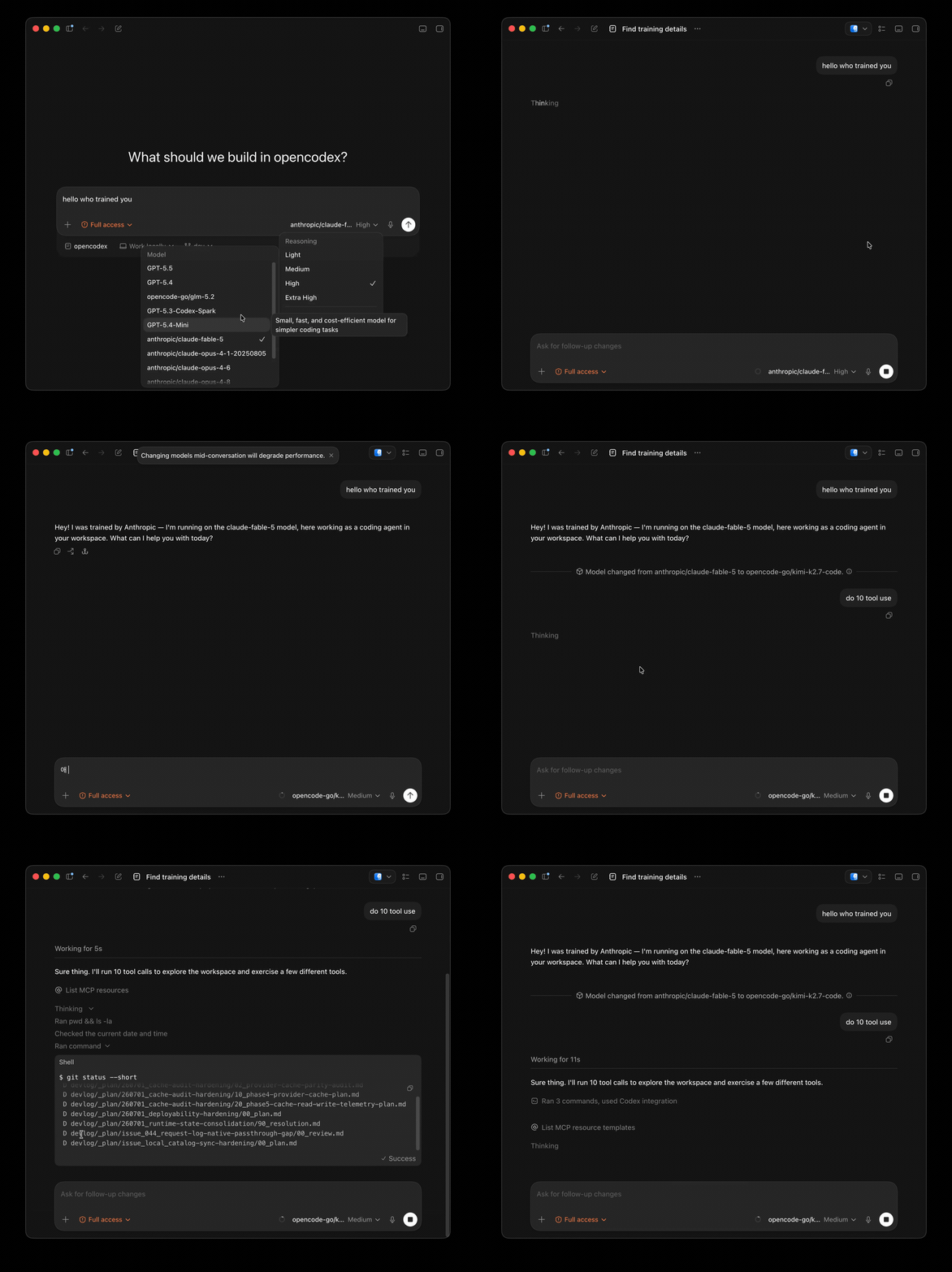
Universal provider proxy for OpenAI Codex & Claude Code — use any LLM (Claude, Gemini, Grok, DeepSeek, Ollama…) with Codex CLI, App, SDK, and Claude Code

Git-native persistent memory for AI coding agents. Implements Google OKF v0.2 with sub-300µs in-memory BM25 search, embedded MCP server, and progressive disclosure. Slashes token bloat by 80% with zero external databases or dependencies. Built in pure Go.

Local-first code intelligence graph for MCP and CLI. Builds a persistent map of your codebase so AI coding tools read only what matters, with benchmarked context reductions on reviews and large-repo workflows.

Stop your AI from making things up — it proposes, deterministic tools decide, every claim checked against ground truth with evidence. Grounded facts and context survive resets. Reverse engineering is the proving ground. MCP server + CLI.