
NousResearch/
hermes-agent

The agent that grows with you
245k
This repo packages a leader-worker agent system that keeps deep learning experiments moving in a loop: plan, execute, monitor, and reflect. The agent reads project briefs, edits code, launches runs, watches progress with low cost, and stores memory across cycles.
Builders who want Claude Code or Codex to run long experiment loops on their projects and keep track of results over time.
You can let an agent run training, monitor progress, and pick the next experiment while you stay focused on the research direction.
A leader agent plans each cycle and hands work to idea, code, and writing agents.
Ledger and journal files store hypotheses, results, dead ends, and durable insights across cycles.
Training is watched with process and log checks instead of repeated LLM calls.
Local, SSH, and Slurm execution modes let the controller stay separate from the training host.
The installer sets up slash commands for Claude Code and local skills for Codex.
Tools like code search, tree listing, file reads, paper lookup, and arXiv search support experiment work.
Optional gates, stagnation signals, and cycle caps help avoid runaway loops.
export ANTHROPIC_API_KEY="sk-ant-xxxxx"
# Add to ~/.bashrc or ~/.zshrc to make it permanent
mkdir ~/my-first-experiment
cd ~/my-first-experiment
/auto-experiment --project ~/my-first-experiment --gpu 0
python -m core.loop \
  --project ~/my-first-experiment \
  --gpu 0 \
  --max-cycles 5    # Stop after 5 cycles (remove for unlimited)
# In Claude Code:
/experiment-status --project ~/my-first-experiment

# Or check GPU usage:
/gpu-monitor
DeepResearcher/my-first-experiment/Dashboard.md
DeepResearcher/my-first-experiment/Daily/YYYY-MM-DD.md

An AI agent that autonomously runs your deep learning experiments 24/7 while you sleep.








2026-06-03 — Domestic LLM API presets
Run the agent on a Chinese LLM API instead of a Claude/Codex subscription by
setting agent.provider to a one-word preset — deepseek, qwen (dashscope),
kimi (moonshot), or glm (zhipu). The preset auto-fills the OpenAI-compatible
base_url and the default key env (DEEPSEEK_API_KEY / DASHSCOPE_API_KEY /
MOONSHOT_API_KEY / ZHIPUAI_API_KEY); you just set model to that vendor's model
id. base_url / api_key_env stay overridable for self-hosted or proxied endpoints.
This is a thin alias over the existing OpenAI-compatible path — no new dependency.
(core/agents.py)
agent:
  provider: "deepseek"      # or qwen / kimi / glm
  model: "deepseek-chat"    # vendor's model id
2026-06-02 — Slurm execution backend + truthful experiment outcomes
execution.mode: "slurm" so the agent can
drive experiments on a Slurm cluster. The controller stays local; training is
submitted to the login node with sbatch --parsable over a single transient
SSH call that exits immediately — no process is ever left running on the
login node. sacct is the sole liveness authority (Slurm enforces --time),
GPU status is read from the partition's squeue occupancy, and two bounds
inside the liveness check (consecutive-unknown grace + a --time-derived
wall-clock backstop) guarantee the monitor loop terminates even if the cluster
goes unreachable — without ever reaping a job sacct still reports as queued
or running. File and repo-reading ops reuse the SSH path (the login node shares
the NFS workspace). (core/execution.py)final_status(), so a FAILED /
TIMEOUT / CANCELLED run is no longer silently recorded as completed. The
outcome flows into state.json, the experiment ledger, and the REFLECT
context, so the agent reasons over what actually happened. On Slurm the state
comes from sacct; pid-only backends (local/ssh) report it as
indeterminate and keep prior behavior. (core/monitor.py, core/loop.py)local/ssh behavior is unchanged. (+21 unit tests, no
cluster required.)2026-06-01 — v2.0 (major update)
This release gives the agent (a) a persistent, queryable memory of its own experiments, (b) explicit progress/quality/safety signals derived from that memory, and (c) much stronger code- and literature-reading tools. Every change is additive and backward-compatible — existing projects keep working unchanged, the new gate and rate limit are opt-in, and the whole suite is unit-tested without a GPU or network (60 → 99 tests).
New: autonomy layer
workspace/experiments.jsonl. Crash-safe, zero token cost, and fed back into planning so the agent remembers what it already tried. (core/ledger.py)ledger.metric_key), instead of only a binary repeat-counter.DEAD_ENDS.md (failed approaches — do not retry) and INSIGHTS.md (durable observations). Never compacted; rotated to dated backups when large, so history is never silently dropped. (core/journal.py)core/safety.py, core/ledger.py)agent.max_cycles_per_hour cap protects budget when the agent is stuck in a loop.New: agent tools
search_code (regex grep across the workspace), list_tree (recursive, depth-limited repo map), and read_file line ranges so large files are no longer blindly truncated. Symlink-safe (never escapes the workspace).get_paper (paper details + reference/citation snowballing) and search_arxiv (freshest preprints), alongside the existing Semantic Scholar search.Config: new optional sections ledger:, stagnation:, journal:, safety:, gates:, and agent.max_cycles_per_hour — all default to current behavior. See config.yaml.
2026-04-22
2026-04-21
2026-04-19
2026-04-18
claude_cli and codex_cli provider modes with fail-fast provider validation and more defensive CLI subprocess handling.2026-04-09
2026-04-08
If you only want the shortest path to a working experiment loop, do this:
PROJECT_BRIEF.md/auto-experiment --project /path/to/project --gpu 0/experiment-status or optional Obsidian/local text notesPrefer AI-guided setup? Open AI_GUIDE.md in Claude / ChatGPT / Codex and let the assistant walk you through it.
| Requirement | Required | Notes |
|---|---|---|
| Python 3.10+ | Yes | Runtime |
| 1+ NVIDIA GPU | Yes | For training |
| API key | Yes | Anthropic-compatible or OpenAI-compatible endpoint |
PROJECT_BRIEF.md | Yes | Main control file |
Project config.yaml | Optional | Only if you want to override defaults |
| Obsidian vault | Optional | If absent, notes fall back to local text files |
The smallest project you can launch looks like this:
my-first-experiment/
├── PROJECT_BRIEF.md
└── workspace/                  # auto-created
Minimal PROJECT_BRIEF.md:
# Goal
Train a ResNet-50 on CIFAR-100 to reach 80%+ accuracy.

# Codebase
Create the training code from scratch in PyTorch.

# What to Try
- Start with a basic ResNet-50 baseline.
- If accuracy < 75%, improve optimization and schedule.
- If accuracy is 75-80%, try augmentation.
- If accuracy > 80%, stop and report.

# Constraints
- Use GPU 0 only
- Max 100 epochs per run
That is enough to start. Everything else is optional refinement.
This project is for people who already know what experiment they want to run, but do not want to babysit the loop:
It is not trying to replace the researcher. It is trying to take over the repetitive experiment-ops layer.
You control the research direction through three files:
PROJECT_BRIEF.md: stable goal, constraints, allowed search spaceHUMAN_DIRECTIVE.md: temporary redirect for the next cycleworkspace/MEMORY_LOG.md: rolling memory of results and decisionsCommon control patterns:
# Keep the search narrow
- Only tune augmentation.
- Do not change the backbone.
- Keep training budget fixed.
# Make the agent stop exploring a weak direction
- If gain stays below 0.3 points for 3 runs, stop this branch.
- Return to the last trusted baseline and try a different idea.
# Force result verification
- If a result looks unusually strong, rerun with the same seed and one new seed.
- Do not claim improvement until both reproduce.
You should never have to guess what the agent is doing.
/experiment-status shows current goal, best result, cycle count, running status, and recent decisions/progress-report generates a structured summary/obsidian-sync refreshes persistent notes manuallyworkspace/progress_tracking/ stores local text notes when no Obsidian vault is configuredIf you want a dashboard outside the terminal:
obsidian:
  enabled: true
  vault_path: "~/Documents/MyObsidianVault"   # Optional
  auto_append_daily: true
If vault_path is empty, the same information is saved locally:
workspace/progress_tracking/Dashboard.txt
workspace/progress_tracking/Daily/YYYY-MM-DD.txt
Our hope is simple: science stays pure, and the human stays in the loop.
We built this framework for one reason — to take the repetitive, mechanical parts of running deep learning experiments off the researcher's plate (launching jobs, watching GPUs, parsing logs, sweeping hyperparameters) so that more of your time can go into the part that actually matters: thinking.
If you're here because you want to spend less time babysitting training runs and more time reading, reasoning, and chasing your own ideas — welcome. That's exactly who we built this for.
A gentle thought we'd love every user to share with us:
The agent is happy to run the experiments. But please let the ideas, the interpretation, and the scientific judgment remain yours. We don't see automation and academic integrity as being in tension — quite the opposite. The hours this tool gives back are meant to be reinvested in deeper thinking, not in skipping it.
So we'd kindly ask that this project not be used to fabricate results, to generate "research" with no human in the loop, or to shortcut the parts of science that depend on a human actually understanding what they're doing. That isn't the future we want to help build — and we don't think it's the one most of you want either.
Science should stay pure. The agent can run the experiments — but the ideas, the interpretation, and the responsibility belong to the human.
学术应当保持纯粹。 Agent 可以替你跑实验,但 idea、判断与责任,请留给人来承担。我们真心希望每一位使用者都能 human in the loop 地去思考,把这个工具省下来的时间,投入到真正属于你自己的研究方向里。
科学は純粋であるべきです。 Agent は実験を走らせることができますが、アイデア・解釈・責任は、どうか人間の手に残してください。
과학은 순수해야 합니다. Agent는 실험을 대신 실행해 줄 수 있지만, 아이디어와 해석, 그리고 책임은 부디 사람의 몫으로 남겨주세요.
We trust the people who pick up this tool to take that seriously — and we built it because we believe most of you already do. Thank you for being one of them. 💛
You design the experiment. The agent handles the repetitive loop.
Deep Researcher Agent:
You sleep 8 hours     → Agent runs 3 experiment cycles
You go on vacation    → Agent explores 50+ hyperparameter configs
You write your paper  → Agent already has the results table ready
Not benchmarks. Real results from months of 24/7 autonomous operation across research projects.
| Metric | Result |
|---|---|
| Autonomous experiment cycles completed | 500+ |
| Best single-project improvement | 52% over baseline (across 200+ auto-run experiments) |
| Concurrent projects managed | 4 projects across 4 GPU servers |
| Longest continuous autonomous operation | 30+ days without human intervention |
| Average LLM cost per 24h cycle | ~$0.08 |
The #1 concern with running LLM agents 24/7: cost.
Most agent frameworks call the LLM every few minutes to "check progress". That's $50+/day.
Experiment Agent sleeps during training — zero API calls. It only wakes the LLM when training finishes.
                    LLM Active              Zero Cost              LLM Active
                  ┌────────────┐    ┌─────────────────────┐    ┌────────────┐
                  │   THINK    │    │   TRAIN & MONITOR    │    │  REFLECT   │
                  │ (5-10 min) │    │   (hours/days)       │    │ (5-10 min) │
                  │            │    │                      │    │            │
                  │ • Analyze  │    │ • kill -0 $PID       │    │ • Parse    │
                  │ • Plan     │    │ • nvidia-smi         │    │   logs     │
                  │ • Code     │    │ • tail log           │    │ • Compare  │
                  │            │    │                      │    │ • Decide   │
                  │  ~$0.05    │    │      $0.00           │    │  ~$0.03    │
                  └────────────┘    └─────────────────────┘    └────────────┘
24-hour cycle with 8 hours of training: ~$0.08 in LLM calls.
┌──────────────────────────────────────────────────────┐
│  ┌──────────┐    ┌──────────┐    ┌──────────┐       │
│  │  THINK   │───→│ EXECUTE  │───→│ REFLECT  │──┐    │
│  │          │    │          │    │          │  │    │
│  │ Analyze  │    │ Dry-run  │    │ Evaluate │  │    │
│  │ Plan     │    │ Launch   │    │ Compare  │  │    │
│  │ Decide   │    │ Monitor  │    │ Update   │  │    │
│  └──────────┘    └──────────┘    └──────────┘  │    │
│       ↑                                         │    │
│       └─────────────────────────────────────────┘    │
│                    ↻ 24/7 Loop                       │
└──────────────────────────────────────────────────────┘
Only ONE worker runs at a time. Others idle at zero cost.
              ┌───────────────┐
              │    Leader     │  Persistent conversation
              │   (Planner)   │  within each cycle
              └───┬───┬───┬───┘
                  │   │   │
          ┌───────┘   │   └───────┐
          ↓           ↓           ↓
    ┌──────────┐ ┌──────────┐ ┌──────────┐
    │   Idea   │ │   Code   │ │ Writing  │
    │  Agent   │ │  Agent   │ │  Agent   │
    │ (4 tools)│ │ (5 tools)│ │ (3 tools)│
    └──────────┘ └──────────┘ └──────────┘
┌─────────────────────────────────────────┐
│ Tier 1: PROJECT_BRIEF.md               │
│ • Frozen project reference              │
│ • Max 3,000 chars                       │
├─────────────────────────────────────────┤
│ Tier 2: MEMORY_LOG.md                   │
│ • Key Results (auto-compact at 1,200ch) │
│ • Recent Decisions (rolling last 15)    │
│ • Max 2,000 chars                       │
├─────────────────────────────────────────┤
│ Total: ~5K chars / ~1,500 tokens        │
│ SAME whether running 1 day or 6 months  │
└─────────────────────────────────────────┘
| # | Strategy | Savings |
|---|---|---|
| 1 | Zero-LLM monitoring during training | 90%+ of runtime is free |
| 2 | Two-Tier memory with auto-compaction | Fixed context window |
| 3 | Leader conversation persists within cycle | Brief sent once per cycle |
| 4 | Anthropic prompt caching | System/tools cached |
| 5 | Per-agent minimal tool sets (3-5 tools) | Less schema overhead |
| 6 | Slim system prompts | Fewer input tokens |
| 7 | State trimmed before sending | No bloat |
| 8 | Single worker at a time | No parallel LLM costs |
Complete beginner? Follow every step below. You'll go from zero to a running experiment agent in ~10 minutes.
Prefer AI-guided setup? Open
AI_GUIDE.mdin Claude Code, ChatGPT, or Codex — the AI will walk you through everything interactively.
| Requirement | Why | How to Check |
|---|---|---|
| Python 3.10+ | Runtime | python3 --version |
| Claude Code | The AI backbone | claude --version |
| 1+ NVIDIA GPU | For training | nvidia-smi |
| Anthropic API key | LLM calls | echo $ANTHROPIC_API_KEY |
Don't have an API key? Get one at console.anthropic.com and set it:
export ANTHROPIC_API_KEY="sk-ant-xxxxx"
# Add to ~/.bashrc or ~/.zshrc to make it permanent
# Clone the repo
git clone https://github.com/Xiangyue-Zhang/auto-deep-researcher-24x7.git
cd auto-deep-researcher-24x7

# Install Python dependencies
pip install -r requirements.txt

# Install 8 Claude slash commands and 8 Codex local skills
python install.py

# Verify everything works
python -m core.loop --check
You should see:
  Deep Researcher Agent — Installer
  ========================================

    ✓ Claude /auto-experiment
    ✓ Claude /experiment-status
    ✓ Claude /gpu-monitor
    ✓ Claude /daily-papers
    ✓ Claude /paper-analyze
    ✓ Claude /conf-search
    ✓ Claude /progress-report
    ✓ Claude /obsidian-sync
    ✓ Codex $auto-experiment
    ...

  Done! 8 Claude commands and 8 Codex skills installed.
Let's say you want to train a ResNet on CIFAR-100. Create a project folder with a PROJECT_BRIEF.md:
mkdir ~/my-first-experiment
cd ~/my-first-experiment
Now write the brief — this is the most important file. It tells the agent what you want:
cat > PROJECT_BRIEF.md << 'EOF'
# Goal
Train a ResNet-50 on CIFAR-100 to reach 80%+ test accuracy.

# Codebase
The agent should create the training code from scratch using PyTorch.
- Use torchvision for the dataset (auto-download)
- Save checkpoints to ./checkpoints/
- Log metrics to ./logs/

# What to Try
- Start with a basic ResNet-50, lr=0.1, SGD, 100 epochs
- If accuracy < 75%, try cosine annealing + warmup
- If accuracy 75-80%, try adding mixup or cutout augmentation
- If accuracy > 80%, the goal is reached

# Constraints
- Use GPU 0 only
- Max 100 epochs per run
- Batch size 128

# Current Status
No experiments run yet. Starting from scratch.
EOF
Tips for writing a good brief:
Option A: Through Claude Code (recommended)
Open Claude Code and type:
/auto-experiment --project ~/my-first-experiment --gpu 0
Option B: Through Python directly
python -m core.loop \
  --project ~/my-first-experiment \
  --gpu 0 \
  --max-cycles 5    # Stop after 5 cycles (remove for unlimited)
The agent will now do everything automatically. Here's what each cycle looks like:
=== Cycle 1 ===

[THINK] Reading PROJECT_BRIEF.md...
        Goal: ResNet-50 on CIFAR-100, target 80%+
        No previous experiments. Starting with baseline.
        Plan: Basic ResNet-50, lr=0.1, SGD with momentum, 100 epochs.

[EXECUTE] Creating train.py...
          Creating config.yaml...
          Running dry-run (2 steps)... ✓ No errors
          Launching training: nohup python train.py --config config.yaml
          PID: 12345, Log: logs/exp001.log

[MONITOR] Training in progress... (zero LLM cost)
          15:00 — PID alive, GPU 98%, Epoch 12/100, loss=2.34
          15:15 — PID alive, GPU 97%, Epoch 25/100, loss=1.87
          15:30 — PID alive, GPU 98%, Epoch 38/100, loss=1.54
          ...
          17:45 — PID alive, GPU 97%, Epoch 100/100, loss=0.82
          18:00 — PID terminated. Training complete.

[REFLECT] Parsing logs... test accuracy = 76.3%
          Result: 76.3% — below 80% target
          Brief says: "If < 75%, try cosine annealing"
          76.3% > 75%, so try augmentation instead.
          Decision: Add mixup augmentation, keep lr=0.1 + cosine
          Milestone logged: "Exp001: ResNet-50 baseline, 76.3%"

=== Cycle 2 ===

[THINK] Best so far: 76.3% (Exp001)
        Plan: Add mixup (alpha=0.2) + cosine annealing schedule
        ...
While the agent is running, you can check on it:
# In Claude Code:
/experiment-status --project ~/my-first-experiment

# Or check GPU usage:
/gpu-monitor
You'll see something like:
# Experiment Status — my-first-experiment

## Goal
ResNet-50 on CIFAR-100 → 80%+ accuracy

## Progress
- Cycles completed: 3
- Current best: 79.1% (Exp003: ResNet-50 + mixup + cosine)
- Status: TRAINING (PID 12389, GPU 0, running 1.5h)

## Key Results
[04-07 15:00] Exp001: ResNet-50 baseline, 76.3%
[04-07 18:30] Exp002: + cosine annealing, 77.8%
[04-07 22:00] Exp003: + mixup α=0.2, 79.1%   ← best

## Current Training
Epoch 67/100 | loss: 0.71 | acc: 79.4%
Enable progress export in your project config.yaml:
obsidian:
  enabled: true
  vault_path: "~/Documents/MyObsidianVault"   # Optional
  project_subdir: "DeepResearcher/{project_name}"
  auto_append_daily: true
If vault_path is set, the agent writes:
DeepResearcher/my-first-experiment/Dashboard.md
DeepResearcher/my-first-experiment/Daily/YYYY-MM-DD.md
If vault_path is empty, it falls back to project-local files:
workspace/progress_tracking/Dashboard.txt
workspace/progress_tracking/Daily/YYYY-MM-DD.txt
Manual refresh:
/obsidian-sync --project
Sign in to join the discussion.
No comments yet. Be the first to say what this is good for.
The agent that grows with you

Open-source coding agent for your terminal, built in Rust and on a journey of continuous community improvement. Issues and PRs welcome.
A lightweight alternative to OpenClaw that runs in containers for security. Connects to WhatsApp, Telegram, Slack, Discord, Gmail and other messaging apps,, has memory, scheduled jobs, and runs directly on Anthropic's Agents SDK

OpenSquilla — Token-Efficient AI Agent with same budget, higher intelligence density
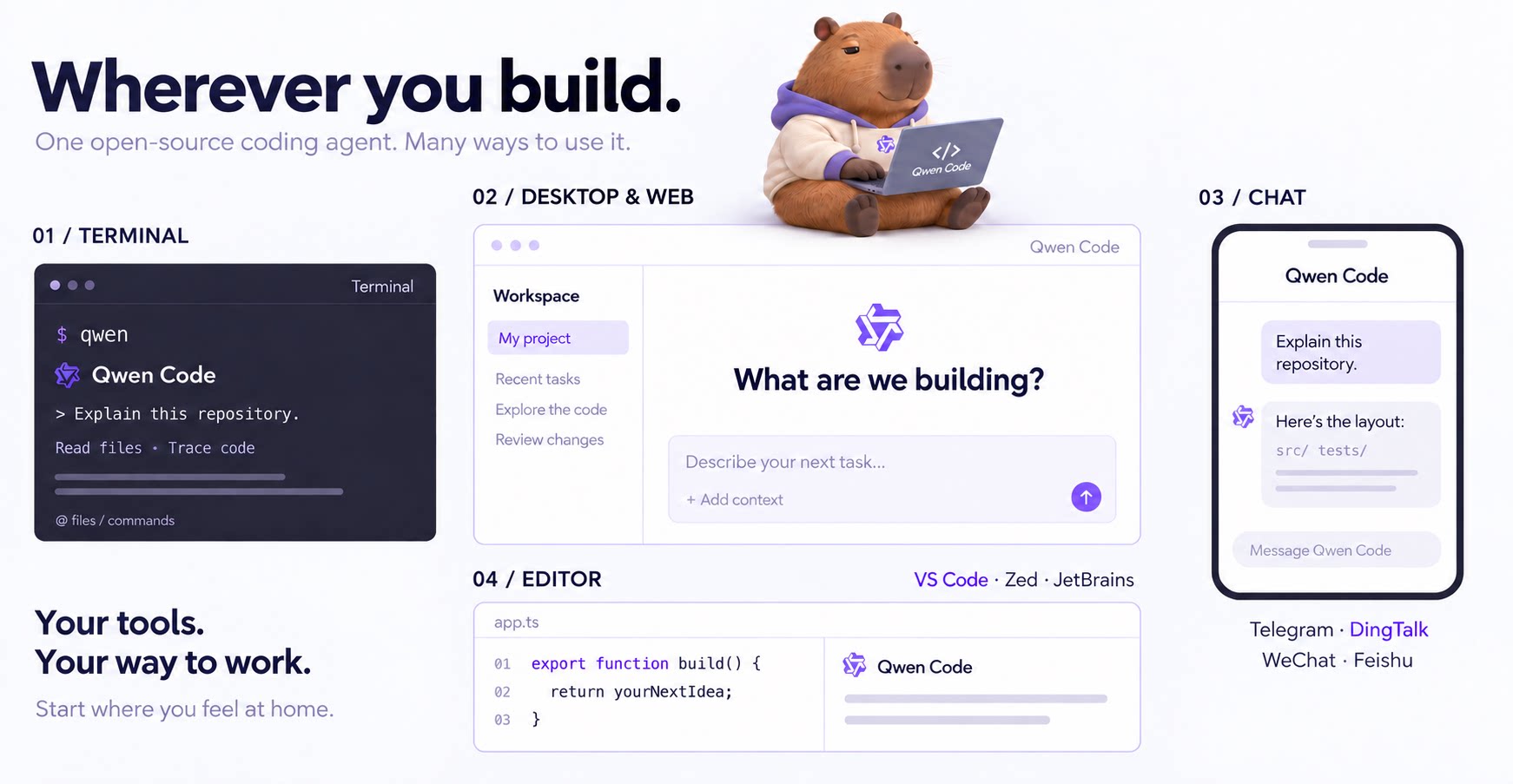
An open-source AI coding agent that lives in your terminal.

Run and supervise teams of coding agents from planning to merge. Any harness (Claude code, codex, +25 more). Desktop, web, mobile, and cloud agents.