
koala73/worldmonitorConnectors
Real-time global intelligence dashboard. AI-powered news aggregation, geopolitical monitoring, and infrastructure tracking in a unified situational awareness interface
86k
UE5-MCP describes a Model Control Protocol setup for moving agent work between Blender and Unreal Engine 5. It focuses on scene generation, asset management, level import, lighting transfer, and Blueprint-based scene changes. The repo is documentation-heavy and points to workflow, commands, configuration, and architecture notes instead of a finished package. The README also says the project was not taken forward, so the value here is the integration design and docs.
Builders who want an agent to help move assets, scenes, and level work between Blender and Unreal Engine 5.
You can use agent-assisted workflows for scene creation, asset transfer, and UE5 level setup instead of doing each step by hand.
Covers text-to-scene and image-to-scene workflows in Blender, plus scene composition and material handling.
Describes automated scene import, level conversion, material and lighting transfer, optimization, and Blueprint scene manipulation.
Explains AI-assisted generation and modification of 3D models, textures, and materials, with transfer workflows between Blender and UE5.
Includes guidance for Blueprint scripting help, performance profiling, and automated debugging in UE5.
Provides separate docs for commands, configuration, automation, architecture, and troubleshooting.
git clone https://github.com/your-repo/UE5-MCP.git
pip install -r requirements.txt
UPDATE: unfortunately we didnt move forward with the project due to time constraints. Feel free to use the docs.
UE5-MCP (Model Control Protocol) is designed to integrate AI-driven automation into Blender and Unreal Engine 5 (UE5) workflows. This project builds upon BlenderMCP to provide an end-to-end pipeline for AI-driven game level creation, enhancing level design, asset management, and gameplay programming.
dependencies.md)git clone https://github.com/your-repo/UE5-MCP.git
pip install -r requirements.txt
configurations.md)workflow.md)ai_integration.md for available AI-powered automation featuresFor detailed commands and parameters, refer to commands.md.
See CONTRIBUTING.md for contributing guidelines and best practices.
Refer to LICENSE.md for licensing details.
If you encounter issues, check troubleshooting.md or submit an issue on GitHub.
Vedant Gosavi Aditya Mhambrey Charles Green
Sign in to join the discussion.
No comments yet. Be the first to say what this is good for.
Real-time global intelligence dashboard. AI-powered news aggregation, geopolitical monitoring, and infrastructure tracking in a unified situational awareness interface
High-performance code intelligence MCP server. Indexes codebases into a persistent knowledge graph — average repo in milliseconds. 158 languages, sub-ms queries, 99% fewer tokens. Single static binary, zero dependencies.
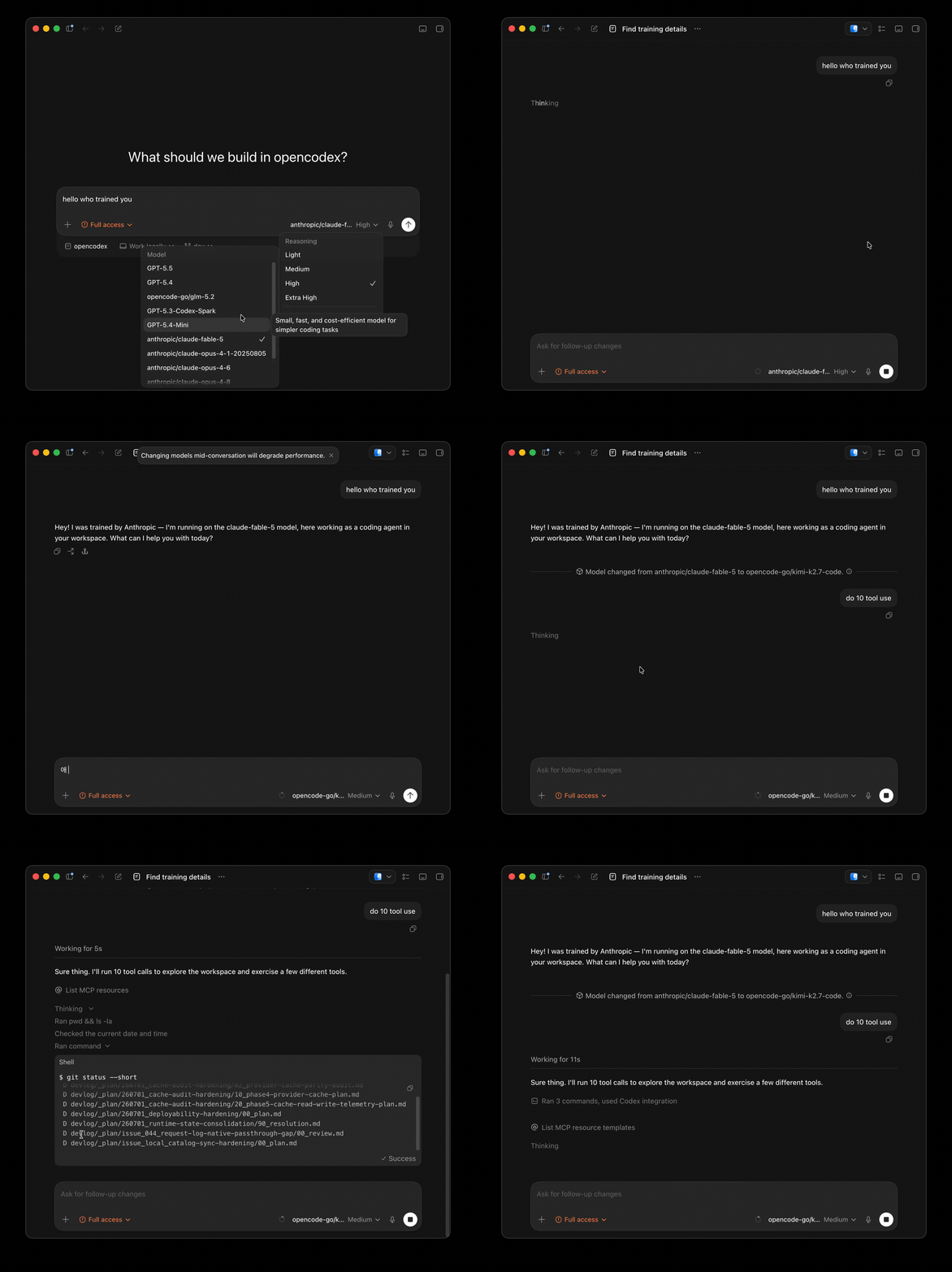
Universal provider proxy for OpenAI Codex & Claude Code — use any LLM (Claude, Gemini, Grok, DeepSeek, Ollama…) with Codex CLI, App, SDK, and Claude Code

Git-native persistent memory for AI coding agents. Implements Google OKF v0.2 with sub-300µs in-memory BM25 search, embedded MCP server, and progressive disclosure. Slashes token bloat by 80% with zero external databases or dependencies. Built in pure Go.

Local-first code intelligence graph for MCP and CLI. Builds a persistent map of your codebase so AI coding tools read only what matters, with benchmarked context reductions on reviews and large-repo workflows.

Stop your AI from making things up — it proposes, deterministic tools decide, every claim checked against ground truth with evidence. Grounded facts and context survive resets. Reverse engineering is the proving ground. MCP server + CLI.