
koala73/worldmonitorConnectors
Real-time global intelligence dashboard. AI-powered news aggregation, geopolitical monitoring, and infrastructure tracking in a unified situational awareness interface
86k
This repo provides a Model Context Protocol server that lets an agent inspect database schemas and run SQL through Legion Query Runner. It supports multiple databases, exposes tools like `execute_query`, `find_table`, and `list_databases`, and can be run from `uvx`, pip, or a Python entrypoint.
Builders who want their agent to query PostgreSQL, MySQL, SQL Server, SQLite, and other databases.
You can ask an agent to find tables, inspect schemas, and run SQL without wiring each database client by hand.
Connects to several databases at once and lets tools choose a database by `db_id`.
Exposes database schemas as MCP resources so the agent can inspect tables and columns.
Provides `execute_query` and `execute_query_json` for running SQL and returning results.
Includes `list_databases`, `find_table`, `get_database_info`, and table description helpers.
Offers prompts like `sql_query`, `explain_query`, `optimize_query`, and `select_database`.
Runs as a standalone MCP server, with FastAPI integration mentioned in the README, and supports env vars or CLI flags.
pip install database-mcp
A server that helps people access and query data in databases using the Legion Query Runner with integration of the Model Context Protocol (MCP) Python SDK.
This tool is provided by Legion AI. To use the full-fledged and fully powered AI data analytics tool, please visit the site. Email us if there is one database you want us to support.
Database MCP stands out from other database access solutions for several compelling reasons:
Whether you're building AI agents that need database access or simply want a unified interface to multiple databases, Database MCP provides a streamlined solution that dramatically reduces development time and complexity.
| Database | DB_TYPE code |
|---|---|
| PostgreSQL | pg |
| Redshift | redshift |
| CockroachDB | cockroach |
| MySQL | mysql |
| RDS MySQL | rds_mysql |
| Microsoft SQL Server | mssql |
| Big Query | bigquery |
| Oracle DB | oracle |
| SQLite | sqlite |
We use Legion Query Runner library as connectors. You can find more info on their api doc.
The Model Context Protocol (MCP) is a specification for maintaining context in AI applications. This server uses the MCP Python SDK to:
For single database configuration:
For multi-database configuration:
The configuration format varies by database type. See the API documentation for database-specific configuration details.
When using uv, no specific installation is needed. We will use uvx to directly run database-mcp.
UV Configuration Example (Single Database):
REPLACE DB_TYPE and DB_CONFIG with your connection info.
{
    "mcpServers": {
      "database-mcp": {
        "command": "uvx",
        "args": [
          "database-mcp"
        ],
        "env": {
          "DB_TYPE": "pg",
          "DB_CONFIG": "{\"host\":\"localhost\",\"port\":5432,\"user\":\"user\",\"password\":\"pw\",\"dbname\":\"dbname\"}"
        },
        "disabled": true,
        "autoApprove": []
      }
    }
}
UV Configuration Example (Multiple Databases):
{
    "mcpServers": {
      "database-mcp": {
        "command": "uvx",
        "args": [
          "database-mcp"
        ],
        "env": {
          "DB_CONFIGS": "[{\"id\":\"pg_main\",\"db_type\":\"pg\",\"configuration\":{\"host\":\"localhost\",\"port\":5432,\"user\":\"user\",\"password\":\"pw\",\"dbname\":\"postgres\"},\"description\":\"PostgreSQL Database\"},{\"id\":\"mysql_data\",\"db_type\":\"mysql\",\"configuration\":{\"host\":\"localhost\",\"port\":3306,\"user\":\"root\",\"password\":\"pass\",\"database\":\"mysql\"},\"description\":\"MySQL Database\"}]"
        },
        "disabled": true,
        "autoApprove": []
      }
    }
}
Install via pip:
pip install database-mcp
PIP Configuration Example (Single Database):
{
  "mcpServers": {
    "database": {
      "command": "python",
      "args": [
        "-m", "database_mcp",
        "--repository", "path/to/git/repo"
      ],
      "env": {
        "DB_TYPE": "pg",
        "DB_CONFIG": "{\"host\":\"localhost\",\"port\":5432,\"user\":\"user\",\"password\":\"pw\",\"dbname\":\"dbname\"}"
      }
    }
  }
}
python mcp_server.py
export DB_TYPE="pg"  # or mysql, postgresql, etc.
export DB_CONFIG='{"host":"localhost","port":5432,"user":"username","password":"password","dbname":"database_name"}'
uv run src/database_mcp/mcp_server.py
export DB_CONFIGS='[{"id":"pg_main","db_type":"pg","configuration":{"host":"localhost","port":5432,"user":"username","password":"password","dbname":"database_name"},"description":"PostgreSQL Database"},{"id":"mysql_users","db_type":"mysql","configuration":{"host":"localhost","port":3306,"user":"root","password":"pass","database":"mysql"},"description":"MySQL Database"}]'
uv run src/database_mcp/mcp_server.py
If you don't specify an ID, the system will generate one automatically based on the database type and description:
export DB_CONFIGS='[{"db_type":"pg","configuration":{"host":"localhost","port":5432,"user":"username","password":"password","dbname":"database_name"},"description":"PostgreSQL Database"},{"db_type":"mysql","configuration":{"host":"localhost","port":3306,"user":"root","password":"pass","database":"mysql"},"description":"MySQL Database"}]'
# IDs will be generated as something like "pg_postgres_0" and "my_mysqldb_1"
uv run src/database_mcp/mcp_server.py
python mcp_server.py --db-type pg --db-config '{"host":"localhost","port":5432,"user":"username","password":"password","dbname":"database_name"}'
python mcp_server.py --db-configs '[{"id":"pg_main","db_type":"pg","configuration":{"host":"localhost","port":5432,"user":"username","password":"password","dbname":"database_name"},"description":"PostgreSQL Database"},{"id":"mysql_users","db_type":"mysql","configuration":{"host":"localhost","port":3306,"user":"root","password":"pass","database":"mysql"},"description":"MySQL Database"}]'
Note that you can specify custom IDs for each database using the id field, or let the system generate them based on database type and description.
When connecting to multiple databases, you need to specify which database to use for each query:
list_databases tool to see available databases with their IDsget_database_info to view schema details of databasesfind_table to locate a table across all databasesdb_id parameter to tools like execute_query, get_table_columns, etc.Database connections are managed internally as a dictionary of DbConfig objects, with each database having a unique ID. Schema information is represented as a list of table objects, where each table contains its name and column information.
The select_database prompt guides users through the database selection process.
Database schemas are represented as a list of table objects, with each table containing information about its columns:
[
  {
    "name": "users",
    "columns": [
      {"name": "id", "type": "integer"},
      {"name": "username", "type": "varchar"},
      {"name": "email", "type": "varchar"}
    ]
  },
  {
    "name": "orders",
    "columns": [
      {"name": "id", "type": "integer"},
      {"name": "user_id", "type": "integer"},
      {"name": "product_id", "type": "integer"},
      {"name": "quantity", "type": "integer"}
    ]
  }
]
This representation makes it easy to programmatically access table and column information while keeping a clean hierarchical structure.
| Resource | Description |
|---|---|
resource://schema/{database_id} | Get the schemas for one or all configured databases |
| Tool | Description |
|---|---|
execute_query | Execute a SQL query and return results as a markdown table |
execute_query_json | Execute a SQL query and return results as JSON |
get_table_columns | Get column names for a specific table |
get_table_types | Get column types for a specific table |
get_query_history | Get the recent query history |
list_databases | List all available database connections |
get_database_info | Get detailed information about a database including schema |
find_table | Find which database contains a specific table |
describe_table | Get detailed description of a table including column names and types |
get_table_sample | Get a sample of data from a table |
All database-specific tools (like execute_query, get_table_columns, etc.) require a db_id parameter to specify which database to use.
| Prompt | Description |
|---|---|
sql_query | Create an SQL query against the database |
explain_query | Explain what a SQL query does |
optimize_query | Optimize a SQL query for better performance |
select_database | Help user select which database to use |
run this to start the inspector
npx @modelcontextprotocol/inspector uv run src/database_mcp/mcp_server.py
then in the command input field, set something like
run src/database_mcp/mcp_server.py --db-type pg --db-config '{"host":"localhost","port":5432,"user":"username","password":"password","dbname":"database_name"}'
uv pip install -e ".[dev]"
pytest
# Clean up build artifacts
rm -rf dist/ build/
# Remove any .egg-info directories if they exist
find . -name "*.egg-info" -type d -exec rm -rf {} + 2>/dev/null || true
# Build the package
uv run python -m build
# Upload to PyPI
uv run python -m twine upload dist/*
This repository is licensed under GPL
Sign in to join the discussion.
No comments yet. Be the first to say what this is good for.
Real-time global intelligence dashboard. AI-powered news aggregation, geopolitical monitoring, and infrastructure tracking in a unified situational awareness interface
High-performance code intelligence MCP server. Indexes codebases into a persistent knowledge graph — average repo in milliseconds. 158 languages, sub-ms queries, 99% fewer tokens. Single static binary, zero dependencies.
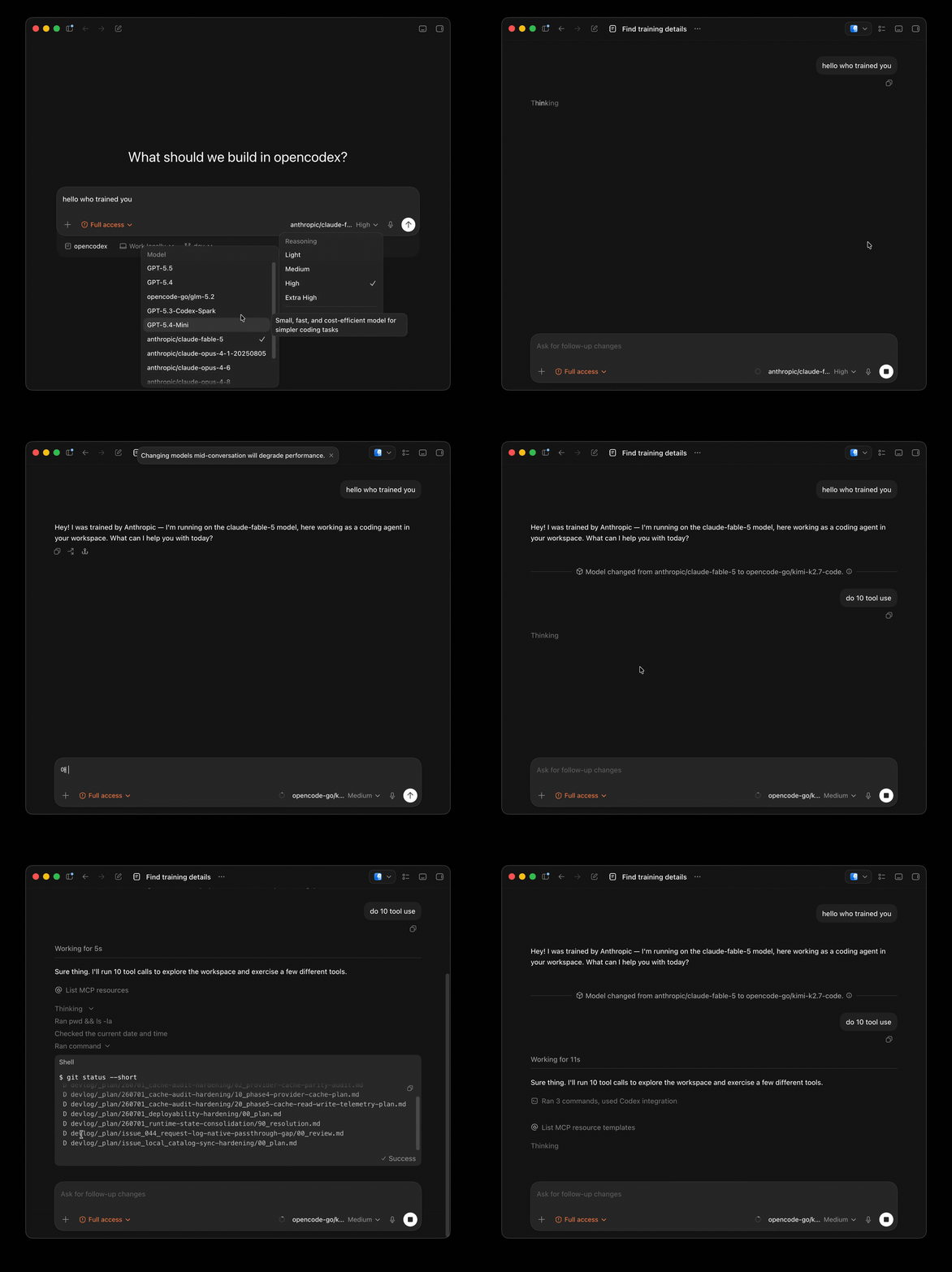
Universal provider proxy for OpenAI Codex & Claude Code — use any LLM (Claude, Gemini, Grok, DeepSeek, Ollama…) with Codex CLI, App, SDK, and Claude Code

Git-native persistent memory for AI coding agents. Implements Google OKF v0.2 with sub-300µs in-memory BM25 search, embedded MCP server, and progressive disclosure. Slashes token bloat by 80% with zero external databases or dependencies. Built in pure Go.

Local-first code intelligence graph for MCP and CLI. Builds a persistent map of your codebase so AI coding tools read only what matters, with benchmarked context reductions on reviews and large-repo workflows.

Stop your AI from making things up — it proposes, deterministic tools decide, every claim checked against ground truth with evidence. Grounded facts and context survive resets. Reverse engineering is the proving ground. MCP server + CLI.