Real-time global intelligence dashboard. AI-powered news aggregation, geopolitical monitoring, and infrastructure tracking in a unified situational awareness interface
MCP memory server for Cursor, Claude, and Windsurf
MCP Memory is a Cloudflare-based MCP server that gives clients a shared memory layer across conversations. It stores text in D1, embeds it with Workers AI, and searches it with Vectorize so agents can pull back relevant context later.
Builders who want their MCP client to remember preferences, behaviors, and notes across sessions.
You can carry useful context from one conversation to the next instead of re-explaining it.
What it does
Persistent user memory
Stores user preferences, behaviors, and other text notes across conversations.
Vector search retrieval
Uses embeddings and Cloudflare Vectorize to find related memories by meaning, not exact words.
Cloudflare-backed storage
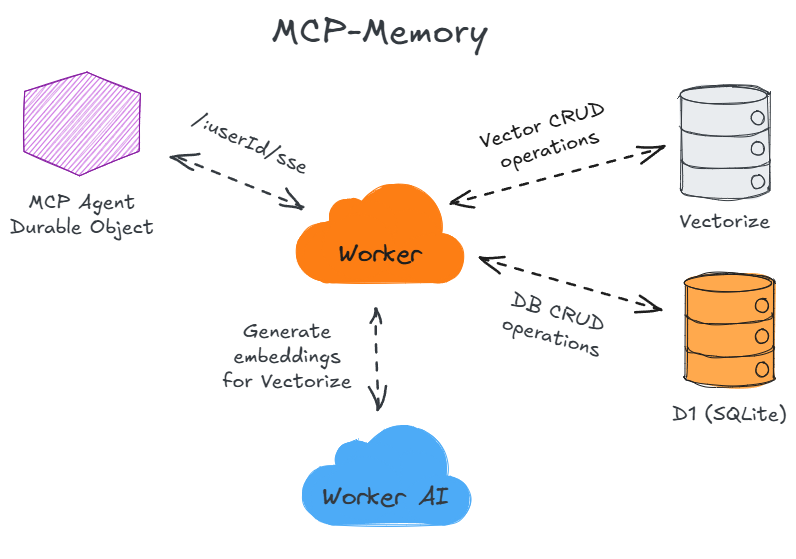
Combines D1 for original text, Vectorize for similarity search, Durable Objects for coordination, and Workers AI for embeddings.
Multi-client MCP support
Works with MCP clients such as Cursor, Claude, Windsurf, and similar tools.
Rate limiting and isolation
Includes per-user memory isolation and rate limiting in `wrangler.jsonc`.
How to get it
- 1Install dependencies
npm install
- 2Create a Vectorize index
npx wrangler vectorize create mcp-memory-vectorize --dimensions 1024 --metric cosine
- 3Install Wrangler
npm run dev
- 4Deploy the worker
npm run deploy
README
MCP Memory
MCP Memory is a MCP Server that gives MCP Clients (Cursor, Claude, Windsurf and more) the ability to remember information about users (preferences, behaviors) across conversations. It uses vector search technology to find relevant memories based on meaning, not just keywords. It's built with Cloudflare Workers, D1, Vectorize (RAG), Durable Objects, Workers AI and Agents.
📺 Video
🚀 Try It Out
https://memory.mcpgenerator.com/
🛠️ How to Deploy Your Own MCP Memory
Option 1: One-Click Deploy Your Own MCP Memory to Cloudflare
In Create Vectorize section choose:
- Dimensions: 1024
- Metric: cosine
Click button "Create and Deploy"
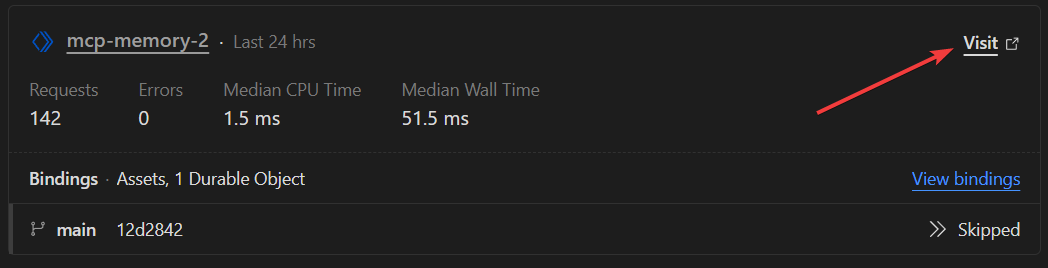
In Cloudflare dashboard, go to "Workers & Pages" and click on Visit
Option 2: Use this template
- Click the "Use this template" button at the top of this repository
- Clone your new repository
- Follow the setup instructions below
Option 3: Create with CloudFlare CLI
npm create cloudflare@latest --git https://github.com/puliczek/mcp-memory
🔧 Setup (Only Option 2 & 3)
- Install dependencies:
npm install
- Create a Vectorize index:
npx wrangler vectorize create mcp-memory-vectorize --dimensions 1024 --metric cosine
- Install Wrangler:
npm run dev
- Deploy the worker:
npm run deploy
🧠 How It Works

-
Storing Memories:
- Your text is processed by Cloudflare Workers AI using the open-source
@cf/baai/bge-m3model to generate embeddings - The text and its vector embedding are stored in two places:
- Cloudflare Vectorize: Stores the vector embeddings for similarity search
- Cloudflare D1: Stores the original text and metadata for persistence
- A Durable Object (MyMCP) manages the state and ensures consistency
- The Agents framework handles the MCP protocol communication
- Your text is processed by Cloudflare Workers AI using the open-source
-
Retrieving Memories:
- Your query is converted to a vector using Workers AI with the same
@cf/baai/bge-m3model - Vectorize performs similarity search to find relevant memories
- Results are ranked by similarity score
- The D1 database provides the original text for matched vectors
- The Durable Object coordinates the retrieval process
- Your query is converted to a vector using Workers AI with the same
This architecture enables:
- Fast vector similarity search through Vectorize
- Persistent storage with D1
- Stateful operations via Durable Objects
- Standardized AI interactions through Workers AI
- Protocol compliance via the Agents framework
The system finds conceptually related information even when the exact words don't match.
🔒 Security
MCP Memory implements several security measures to protect user data:
- Each user's memories are stored in isolated namespaces within Vectorize for data separation
- Built-in rate limiting prevents abuse (100 req/min - you can change it in wrangler.jsonc)
- Authentication is based on userId only
- While this is sufficient for basic protection due to rate limiting
- Additional authentication layers (like API keys or OAuth) can be easily added if needed
- All data is stored in Cloudflare's secure infrastructure
- All communications are secured with industry-standard TLS encryption (automatically provided by Cloudflare's SSL/TLS certification)
💰 Cost Information - FREE for Most Users
MCP Memory is free to use for normal usage levels:
- Free tier allows 1,000 memories with ~28,000 queries per month
- Uses Cloudflare's free quota for Workers, Vectorize, Worker AI and D1 database
For more details on Cloudflare pricing, see:
❓ FAQ
-
Can I use memory.mcpgenerator.com to store my memories?
- Yes, you can use memory.mcpgenerator.com to store and retrieve your memories
- The service is free
- Your memories are securely stored and accessible only to you
- I cannot guarantee that the service will always be available
-
Can I host it?
- Yes, you can host your own instance of MCP Memory for free on Cloudflare
- You'll need a Cloudflare account and the following services:
- Workers
- Vectorize
- D1 Database
- Workers AI
-
Can I run it locally?
- Yes, you can run MCP Memory locally for development
- Use
wrangler devto run the worker locally - You'll need to set up local development credentials for Cloudflare services
- Note that some features like vector search or workers AI requires a connection to Cloudflare's services
-
Can I use different hosting?
- No, MCP Memory is specifically designed for Cloudflare's infrastructure
-
Why did you build it?
- I wanted an open-source solution
- Control over my own data was important to me
-
Can I use it for more than one person?
- Yes, MCP Memory can be integrated into your app to serve all your users
- Each user gets their own isolated memory space
-
Can I use it to store things other than memories?
- Yes, MCP Memory can store any type of text-based information
- Some practical examples:
- Knowledge Base: Store technical documentation, procedures, and troubleshooting guides
- User Behaviors: Track how users interact with features and common usage patterns
- Project Notes: decisions and project updates
- The vector search will help find related items regardless of content type
🤝 Show your support
Files in the repo
- src
- static
- .gitignore
- arch.png
- biome.json
- package-lock.json
- package.json
- README.md
- tsconfig.json
- video.png
- visit.png
- worker-configuration.d.ts
- wrangler.jsonc
Discussion (0)
Ask about usage, or say what you built with itSign in to join the discussion.
No comments yet. Be the first to say what this is good for.
More connectors
High-performance code intelligence MCP server. Indexes codebases into a persistent knowledge graph — average repo in milliseconds. 158 languages, sub-ms queries, 99% fewer tokens. Single static binary, zero dependencies.
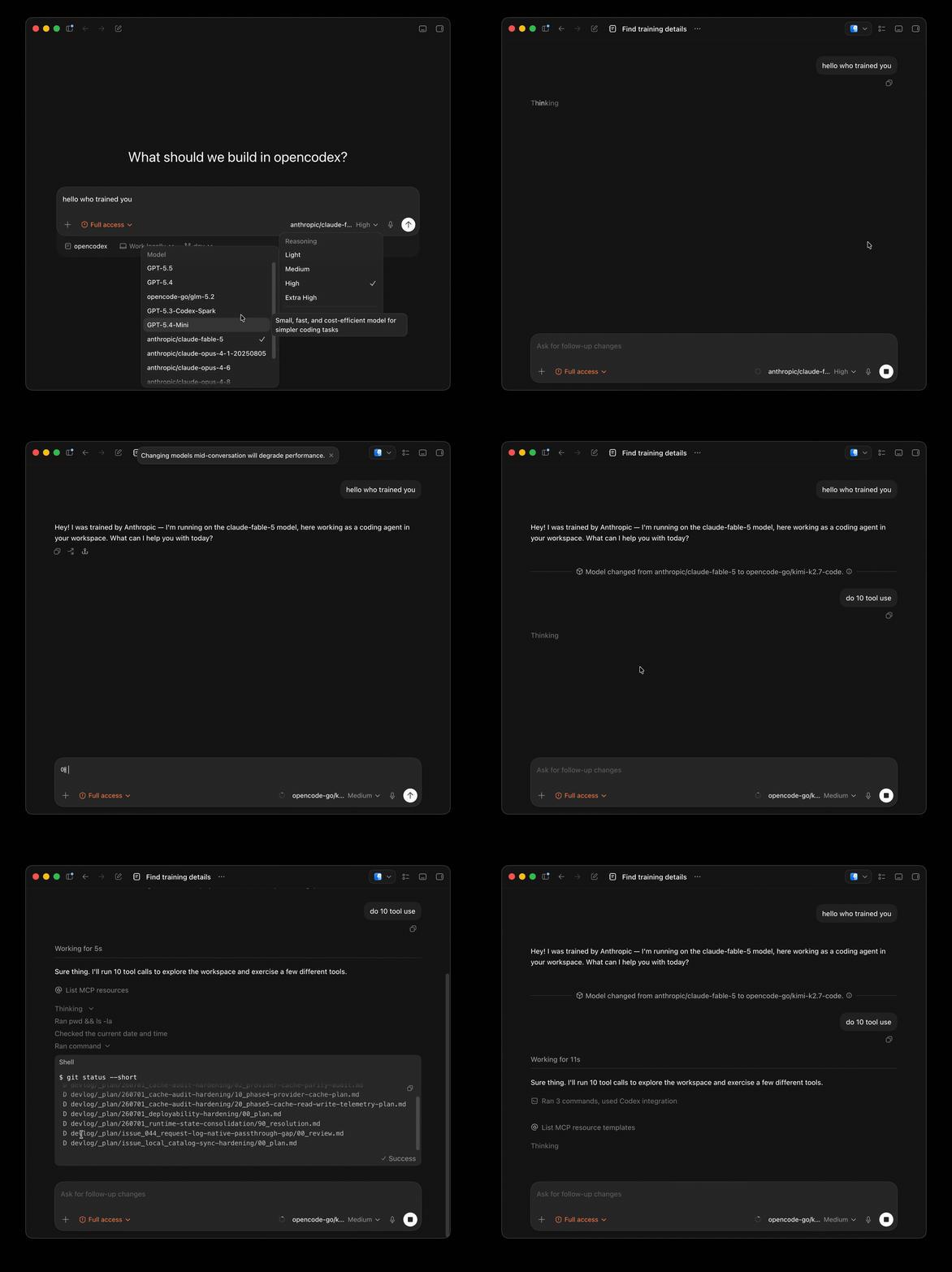
Universal provider proxy for OpenAI Codex & Claude Code — use any LLM (Claude, Gemini, Grok, DeepSeek, Ollama…) with Codex CLI, App, SDK, and Claude Code
Git-native persistent memory for AI coding agents. Implements Google OKF v0.2 with sub-300µs in-memory BM25 search, embedded MCP server, and progressive disclosure. Slashes token bloat by 80% with zero external databases or dependencies. Built in pure Go.
Local-first code intelligence graph for MCP and CLI. Builds a persistent map of your codebase so AI coding tools read only what matters, with benchmarked context reductions on reviews and large-repo workflows.
Stop your AI from making things up — it proposes, deterministic tools decide, every claim checked against ground truth with evidence. Grounded facts and context survive resets. Reverse engineering is the proving ground. MCP server + CLI.