

NousResearch/
hermes-agent

The agent that grows with you
245k
Octomind is a Rust-based runtime that lets you run coding agents from the terminal, scripts, CI, or a daemon. It connects to MCP tools, supports multiple model providers, and uses TOML config for roles, guardrails, workflows, and budgets.
Builders who want one agent runtime they can use in terminal sessions, CI jobs, and background tasks.
You can run agent-led work in a repeatable setup instead of wiring each workflow by hand.
Run the same session interactively, through stdin, as a daemon, over WebSocket, or as an ACP sub-agent.
Use built-in MCP tools and connect to external MCP servers for files, memory, scheduling, and other actions.
Start packaged specialist roles from a tap registry with their own model, system prompt, tools, and credentials.
Define pre-call denies, post-result scripts, and post-turn validators in TOML so agent work follows policy.
Choose different models for different roles and switch models during a session, with cost tracking and thresholds.
Resume named sessions, keep long tasks moving, and compact context automatically as work grows.
# Install (macOS & Linux) — single Rust binary; taps install their own tool dependencies
curl -fsSL https://raw.githubusercontent.com/muvon/octomind/master/install.sh | bash

# Sign in — models included, no API keys to manage
octomind login

# Start with a specialist — first use may install tools and request credentials
octomind run developer:general
Octomind v0.50.1
        Role: developer:general · Model: octohub:auto
        ~/your/project
> _curl -fsSL https://raw.githubusercontent.com/muvon/octomind/master/install.sh | bash
cargo install octomind
git clone https://github.com/muvon/octomind.git
cd octomind
cargo build --release
octomind login





Octomind is an open-source AI agent client: the model calls MCP tools to do real work — read and write files, run shells, search code, delegate to sub-agents. The same runtime supports several entry points: the same session runs interactively, piped through stdin, as a background daemon, over WebSocket, or as an ACP sub-agent inside another agent's stack. Models, tools, roles, guardrails, budgets — all of it is TOML, no framework code.
# Interactive
octomind run developer:general

# Piped — CI, scripts, automation
echo "Explain the auth module" | octomind run developer:general --format plain

# Daemon — long-running; send from another terminal on the same machine
echo "watch the build" | octomind run --name watcher --daemon --format jsonl
octomind send --name watcher "run the test suite"
# Install (macOS & Linux) — single Rust binary; taps install their own tool dependencies
curl -fsSL https://raw.githubusercontent.com/muvon/octomind/master/install.sh | bash

# Sign in — models included, no API keys to manage
octomind login

# Start with a specialist — first use may install tools and request credentials
octomind run developer:general
        Octomind v0.50.1
        Role: developer:general · Model: octohub:auto
        ~/your/project
> _
You're in a session with an agent that can read your code, run commands, edit files, and grow capabilities as needed. Plain-line interface with markdown rendering and shell completions — no TUI to learn, works over SSH, in tmux, in CI logs.
octomind login connects you to Octomind Cloud — a subscription that includes model access through the octohub gateway, so there's nothing to configure. Prefer your own keys? Skip login entirely and bring any provider: OpenRouter, Anthropic, OpenAI, DeepSeek, Ollama, and more. Cloud is the baseline; BYOK is always a first-class path.
developer:general(andlawyer:sg,doctor:blood, …) come from the built-in default tapmuvon/tap, not your local config. The config's own default tag isassistant:concierge, so plainoctomind runstarts that. The banner above is illustrative (the real one renders a pixel icon to the left of the text block).
Other installs: cargo install octomind (Rust 1.95+) or build from source.
We benchmark on octobench: 25 tasks harvested from merged pull requests across python, php, rust, c++, and js. Each agent works in the pre-fix repo; held-out tests from the merged fix decide pass or fail. These are the published July 30, 2026 results, not a measurement of the current checkout:
| solved | judge Σ / 2500 | cost | wall time | |
|---|---|---|---|---|
| octomind + glm-5.2 | 24/25 | 2264 | $63.43 | 3.6h |
| claude code + claude-opus-5 | 23/25 | 2262 | $81.79 | 6.7h |
| codex + gpt-5.6-sol | 21/25 | 2127 | $14.86 | 1.0h |
| opencode + glm-5.2 | 19/25 | 2093 | $129.54 | 3.3h |
The runtime gives you controls for the work that continues after you leave the keyboard:
octomind run developer:general./info.
See Cost.| Pillar | What it gives you |
|---|---|
| Zero config, full flexibility | octomind run lawyer:sg works out of the box. Need a different model, MCP server, or guardrail pipe? Same TOML, no framework code. |
| Sessions stay sharp at hour 4 | Adaptive compaction: cache-aware, structurally preserving. Smaller context = faster responses + lower cost. |
| Cost as a control plane | Per-step model selection across many providers. Spending thresholds and cache-aware accounting come for free. |
| Guardrails: policy as code | Govern autonomous agents with deterministic scripts — pre-call guards, post-result hooks, post-turn validators. No modal approval clicks. Fits CI. |
| Intent-driven context | Skills and capabilities can activate through rules, semantic matching, or explicit requests. Smaller context by default, lower cost, no surprise tools. |
The same session engine, exposed however your workflow needs it:
| Mode | Use for |
|---|---|
| Interactive CLI | Daily work, any domain |
octomind run --format plain pipe | CI/CD pipelines, shell scripts, automation |
| Daemon + send | Background agents, continuous monitoring, long-running tasks |
WebSocket server (octomind server) | IDE plugins, web dashboards, external integrations |
ACP protocol (octomind acp) | Multi-agent orchestration, being called by other agents |
# ACP — drop into any multi-agent system as a sub-agent
octomind acp developer:general

# Non-interactive — the message is read from stdin (pipe it in), output as plain text
echo "Explain the auth module" | octomind run developer:general --format plain

# Structured JSONL output for pipelines
echo "List TODO items" | octomind run developer:general --format jsonl

# Daemon — keep alive; run send in another terminal on the same machine
echo "first task" | octomind run --name watcher --daemon --format jsonl
octomind send --name watcher "now run the test suite"

# Structured output — create the schema first (requires a supporting model)
cat > todos.schema.json <<'JSON'
{
  "type": "object",
  "properties": {"items": {"type": "array", "items": {"type": "string"}}},
  "required": ["items"],
  "additionalProperties": false
}
JSON
echo "List TODO items as JSON" | octomind run developer:general --format jsonl --schema todos.schema.json
octomind run has no message argument: its positional argument is a role or tap tag. Piped stdin runs
non-interactively, defaulting to plain; --format plain or --format jsonl selects the output format.
At a terminal, --format without piped input errors unless you also use --daemon. Without --format,
a terminal starts an interactive session. server and acp do not take --format.
--daemon keeps the process alive; it does not detach it from your terminal. Use another terminal for octomind send.
For schema requirements and model support, see Structured Output.
See WebSocket Server, ACP Protocol, and Daemon & Hooks for the integration modes.
One binary. Every workflow.
A long-running task, CI job, or autonomous loop needs repeatable rules for tool execution and validation.
Policy lives in TOML rules and scripts. Drop a .agents/guardrails.toml in your repo and the runtime enforces it deterministically — pre-call, post-result, post-turn.
# Pre-call deny — block a class of calls before they execute
[[guard]]
match   = "shell(command=^rm\\s+-rf?)"
message = "rm -rf blocked."

# Conditional rule — only fires after the agent ran git status this session
[[guard]]
match   = "shell(command=git push)"
when    = ["+shell(command=git status)"]
message = "Review changes before pushing."
capability(arg_name=regex), gate by history (+used / -unused), require loaded capabilities (has = [...]). A matching call returns a denial instead of executing.when history filters inspect calls since the previous run; without when, they can run every turn. Filter by role and response text. Output is wrapped in <validation> blocks the agent reads on its next turn. This is what replaces "approve this change?" prompts in autonomous loops.The DSL combines capability+arg-regex+history+role+result-regex in one declarative file. No code to compile, no plugin to install. Designed for full automation: fits CI, daemons, scheduled runs, ACP sub-agents. Complete hook and validator script examples: Guardrails.
The world is going autonomous. The choice isn't "ask vs auto" — it's "auto with deterministic policy" vs "auto with hope." Octomind ships the former.
Pick the right model for each step. A cheap one for routine research, a frontier one for review — per-role, per-step, mid-session swap. Real-time cost tracking and spending thresholds come for free.
# Example spending thresholds — both default to 0.0 (disabled)
max_request_spending_threshold = 0.50    # USD per user request, including its tool loop
max_session_spending_threshold = 5.00    # USD per session

# Per-role model selection — pay Opus only where it's worth it
[[roles]]
name = "researcher"
system = "Research the supplied material and explain your findings with evidence."
welcome = "Send the material you want researched."
[roles.model]
name = "openrouter:google/gemini-2.5-flash"   # cheap broad context

[[roles]]
name = "reviewer"
system = "Review the supplied changes for correctness and explain concrete defects."
welcome = "Send the changes you want reviewed."
[roles.model]
name = "anthropic:claude-opus-4-7"            # precision where it counts
/model anthropic:claude-haiku-4-5. Mix providers across roles — cheap model for research, best model for execution. Session totals include usage across model switches.cache_read_tokens, cache_write_tokens separated from input/output).Both thresholds are off by default. Set them explicitly; they are continuation checks, not prepaid billing limits.
Long tasks fill the context window with tool output, intermediate attempts, and decisions you still need.
Octomind's adaptive compaction engine runs automatically:
The benefit: smaller context reduces later input tokens. Compression itself consumes tokens and can invalidate the cache.
Sessions also persist: octomind run --name my-feature saves as you go, octomind run --resume my-feature (or --resume-recent) picks up where you left off — including multi-day tasks. Details: Compression, Sessions.
Use
/doneat a task boundary to force compression and start background learning.
Your role determines the tools loaded at startup. Additional skills and capabilities can activate as the task develops. Skills inject instructions and load their required capabilities; they remain active until forgotten or cleared at a task boundary. Context follows both your starting role and the work you ask for.
semantic(...) phrases for skills
and trigger phrases for capabilities. Skill descriptions alone do not trigger automatic activation.1. Start a session → load the role's configured tools
2. Send a task → evaluate inactive skills' rules and capability triggers
3. A skill matches → load its required capabilities and inject its instructions
4. Work continues → active skills survive automatic compression
5. Forget a skill → release its capability references and request compression
Keeping unused instructions out of context leaves more room for the task.
It compounds with the rest:
mcp mid-session. Enabling a server connects it and exposes its tools. Skill activation also enables required
capability servers when credentials are available; it does not wait for the first tool call.has = ["filesystem-read"] and only fire when that capability is currently loaded. Policy and activation share the same capability namespace.Details: Skills, Token Efficiency.
Start with a focused role, then add skills and capabilities as the task needs them.
octomind run <tag> resolves a specialist — a packaged agent with its model config, system prompt, MCP servers, and tool permissions. Not a prompt file, not a skill injection — the full stack, configured by the community, ready to run.
octomind run developer:general    # general dev, language skills auto-activate
octomind run doctor:blood         # blood-test interpretation specialist
octomind run doctor:nutrition     # nutrition specialist
What happens when you run a specialist:
→ Fetches the agent manifest from the tap registry
→ Installs required binaries automatically (skips if already present)
→ Resolves required credentials; interactive setup can prompt and persist them
→ Spins up the right MCP servers for this domain
→ Loads specialist model config, system prompt, tool permissions
→ Starts the session once setup completes
Roles granted the runtime and orchestration servers can acquire capabilities and delegate work mid-session:
| Tool | What it does |
|---|---|
tap | Delegate work in the background to any specialist role from the tap registry. |
mcp | Enable or disable MCP servers on the fly. Agent picks the server it needs and registers it mid-conversation. |
agent | Register and enable dynamic agents; call the resulting agent_<name> tool to execute one. |
For example, these are model tool calls (not shell commands):
agent({"action":"add","name":"log_reader","description":"Summarize supplied logs","system":"Summarize the log text supplied in the task."})
agent({"action":"enable","name":"log_reader"})
agent_log_reader({"task":"Summarize this deployment log: 09:00 deploy started; 09:02 health check passed."})
agent({"action":"disable","name":"log_reader"})
Octomind starts with the role's configured toolset and can add capabilities while it works. Smaller context, lower cost, faster responses, no surprise tools. See Intent-Driven Context for how activation actually works.
# Scaffold and register a local tap with a known starter tag
octomind tap init yourteam/tap --agent finance:analyst
octomind run finance:analyst

# On another machine, after publishing github.com/yourteam/octomind-tap:
# octomind tap yourteam/tap

# Or register an existing local tap directory
octomind tap yourteam/internal ./octomind-tap
Each tap is a Git repo. Each agent is one TOML file. See Tap System for manifest fields, dependency setup, and publishing. Pull requests are contributions.
Want to publish your expertise? A
doctor:medications, alawyer:us, adevops:terraform. One file, and everyone with that problem gets a specialist instantly. How to write a tap agent →
Octomind is an MCP client for stdio and Streamable HTTP servers, with OAuth support. It also routes built-in tools internally. See MCP Tools for server configuration and tool schemas.
The runtime can expose these according to the active role and configuration. Planning is not a model-callable tool: the supervisor owns it externally, while /plan remains a read-only display command.
| Tool | Purpose |
|---|---|
mcp | Enable/disable MCP servers at runtime |
agent / agent_<name> | Manage dynamic agents / execute an enabled agent |
schedule | Inject messages at future times |
monitor | React to event-stream scripts without active polling |
skill | Inject reusable instruction packs from taps |
tap | Delegate to any specialist role from a tap registry |
capability | Discover, enable, and disable domain tool bundles |
recall | Retrieve archived context blocks when attention or governance is enabled |
view, text_editor, batch_edit, extract_lines, shell, workdir — file operations come from the companion
octofs MCP server. view also lists directories and searches content. Tool exposure depends on the tap's
capabilities; see MCP Tools.
memorize, remember, forget, knowledge — persistent memory and knowledge indexing. memorize can also link
memories through related_to. Taps supply octobrain through memory and knowledge capabilities.
See MCP Tools; the supervisor's learning uses its own file store.
core,orchestration,runtime, andagentare the four built-in MCP servers shipped in the default config. Thefilesystem(octofs) andbrain(octobrain) servers are supplied by tap formulas — a freshly generated config won't list them.
Drop executable scripts with a # @description header into <workdir>/.agents/tools/; they're auto-discovered as MCP
tools for that project. Include a shebang for direct execution. See Local Tools.
For most users, taps are enough. For teams and power users, the configuration system is deep — all TOML, no code.
This custom role uses octofs. Install it through a filesystem capability or follow the MCP Tools setup, then add the role and server to your config:
# Sandbox — OS write restrictions with state/system exceptions; see the config reference
sandbox = true

# Per-role: independent model, temperature, MCP servers, tools, system prompt
[[roles]]
name = "senior-reviewer"
system = "Read the
Sign in to join the discussion.
No comments yet. Be the first to say what this is good for.
The agent that grows with you

Open-source coding agent for your terminal, built in Rust and on a journey of continuous community improvement. Issues and PRs welcome.
A lightweight alternative to OpenClaw that runs in containers for security. Connects to WhatsApp, Telegram, Slack, Discord, Gmail and other messaging apps,, has memory, scheduled jobs, and runs directly on Anthropic's Agents SDK

OpenSquilla — Token-Efficient AI Agent with same budget, higher intelligence density
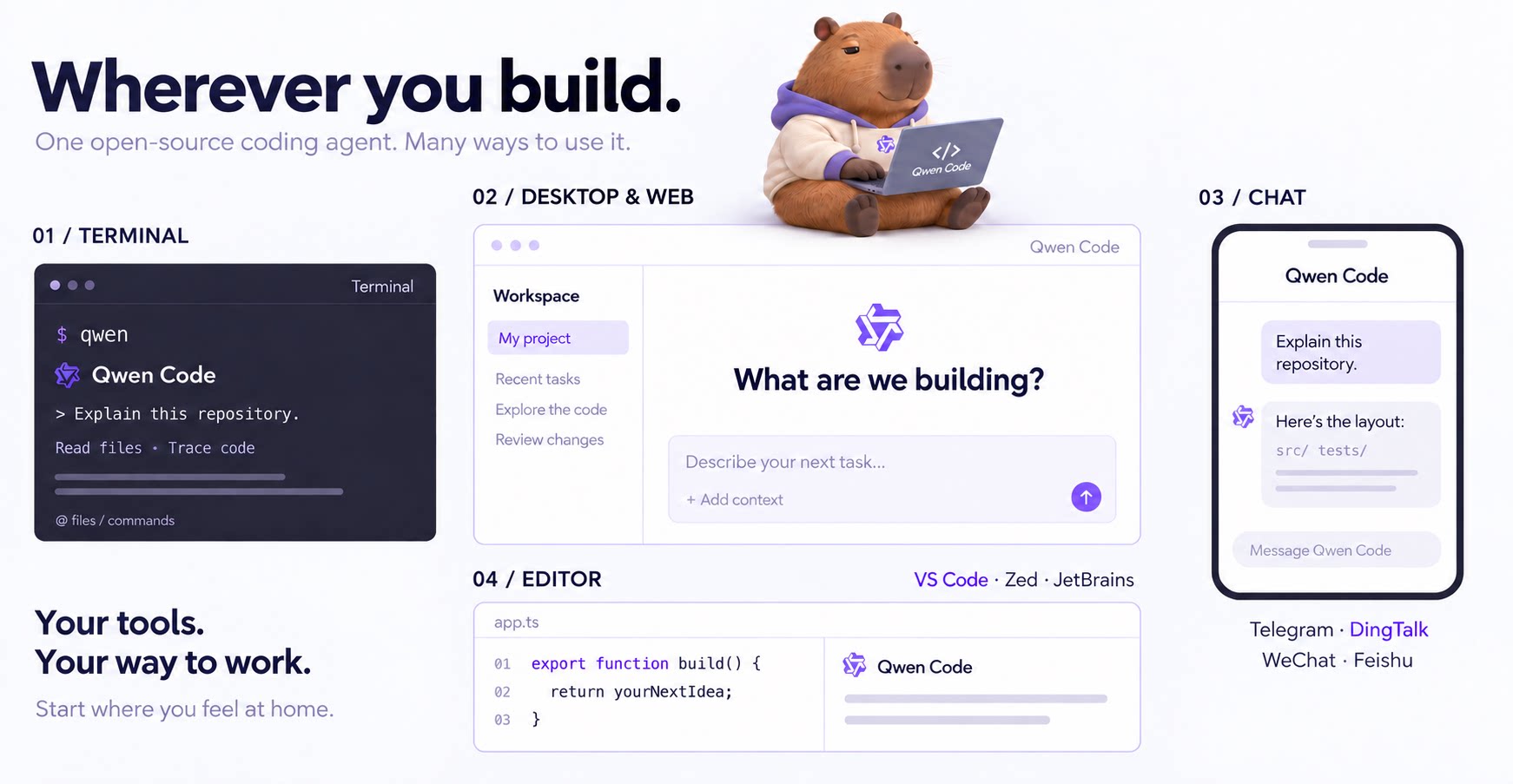
An open-source AI coding agent that lives in your terminal.

Run and supervise teams of coding agents from planning to merge. Any harness (Claude code, codex, +25 more). Desktop, web, mobile, and cloud agents.