
koala73/worldmonitorConnectors
Real-time global intelligence dashboard. AI-powered news aggregation, geopolitical monitoring, and infrastructure tracking in a unified situational awareness interface
86k
Montycat MCP gives connected agents one shared memory store for decisions, preferences, and project facts. It supports semantic search, keyword search, hybrid recall, keyspace management, and live memory watches so one agent can see another agent’s updates.

Builders who use Claude Code, Codex, Cursor, or another MCP client and want shared memory between sessions.
You can stop re-explaining project context and let different agents recall the same facts from one memory store.
Stores memories that survive the chat so later sessions can read earlier decisions and context.
Uses vector search, BM25, and combined search to find memories by meaning or exact wording.
Includes a watch path and `montycat_await_memory_change` so one agent can wait for another agent's write without polling.
Supports private, team, and shared scopes, plus keyspace create, list, and remove tools.
Runs the engine on your machine or connects to your own Montycat URI instead of a hosted memory service.
Provides Claude plugin files, MCP server metadata, and container setup for different client setups.
/plugin marketplace add MontyGovernance/montycat-mcp
/plugin install montycat-mcp@montygovernance
codex mcp add montycat -- uvx montycat-mcp
A self-hosted MCP server that gives AI agents persistent, searchable memory. Claude, Codex, Cursor, and any Model Context Protocol client write to one memory and read each other's.



Claude Desktop — download
montycat-mcp.mcpb
and drag it into Claude Desktop. No Python needed. That link always serves the
current release; every release
also carries a version-named copy and a .sha256 to check it against.
Claude Code — install uv, then:
/plugin marketplace add MontyGovernance/montycat-mcp
/plugin install montycat-mcp@montygovernance
/mcp confirms the montycat server is connected.
Codex, Cursor, other MCP clients — point your client's stdio config at
uvx montycat-mcp (Python 3.10+). For Codex:
codex mcp add montycat -- uvx montycat-mcp
Memory lives in a Montycat Semantic engine. Montycat MCP starts a local one for you, so most people can stop reading here.
Point it at an engine you already run:
export MONTYCAT_URI="montycat://memory-agent:password@localhost:21210/memories"
export MONTYCAT_TLS=true   # remote engines only
Or start one yourself with Docker:
docker run -d --name montycat -p 21210:21210 -p 21211:21211 \
  -e MONTYCAT_SUPEROWNER=admin -e MONTYCAT_PASSWORD=change-me \
  -v montycat_data:/var/lib/.montycat \
  montygovernance/montycat:semantic
On Apple Silicon use the arm64-semantic tag instead — semantic is the amd64
image, and it crashes under emulation. Port 21211 carries live memory watches.
Talk to your agent normally; it picks the tool.
Remember that the team chose PostgreSQL for the billing service.
What did we decide about the billing database?
Save this to the shared
engineeringscope.
scope decides where a memory lives — alice for private, engineering for a
team, shared for common. It is a namespace, not a security boundary: for real
isolation, give each MCP server its own least-privilege Montycat credential.
| Need | Tools |
|---|---|
| Store | montycat_remember, montycat_remember_bulk, montycat_update, montycat_forget |
| Recall | montycat_semantic_search, montycat_recall, montycat_list_memories |
| Inspect schemas | montycat_list_enforced_schemas — check field names and data types before structured writes or filtered retrieval |
| Collaborate | montycat_await_memory_change — wait for another agent's write, no polling |
| Namespaces | montycat_list_keyspaces, montycat_create_keyspace, montycat_remove_keyspace |
| Admin | semantic index, snapshot, and policy tools — see the plugin guide |
Destructive tools are declared as such, so your client's confirmation prompts apply.
| Variable | Purpose |
|---|---|
MONTYCAT_URI | Connection string: montycat://user:password@host:port/store |
MONTYCAT_TLS | true for a remote TLS engine |
MONTYCAT_DEFAULT_KEYSPACE | Memory namespace; memory by default |
MONTYCAT_SCOPE | Default scope when a call omits one |
MONTYCAT_AUTO_PROVISION | Create a permitted scope on first use; true by default |
MONTYCAT_AUTOSTART | off to require an already-running engine |
Compose setup and the full variable list: compose.yaml and the plugin guide.
Changelog · Privacy · Issues · Docs · Docker Hub
Existing MemoCat installs keep working: memocat-mcp, MEMOCAT_*, and
memocat:// are still supported. New setups should use the Montycat names.
MIT
Sign in to join the discussion.
No comments yet. Be the first to say what this is good for.
Real-time global intelligence dashboard. AI-powered news aggregation, geopolitical monitoring, and infrastructure tracking in a unified situational awareness interface
High-performance code intelligence MCP server. Indexes codebases into a persistent knowledge graph — average repo in milliseconds. 158 languages, sub-ms queries, 99% fewer tokens. Single static binary, zero dependencies.
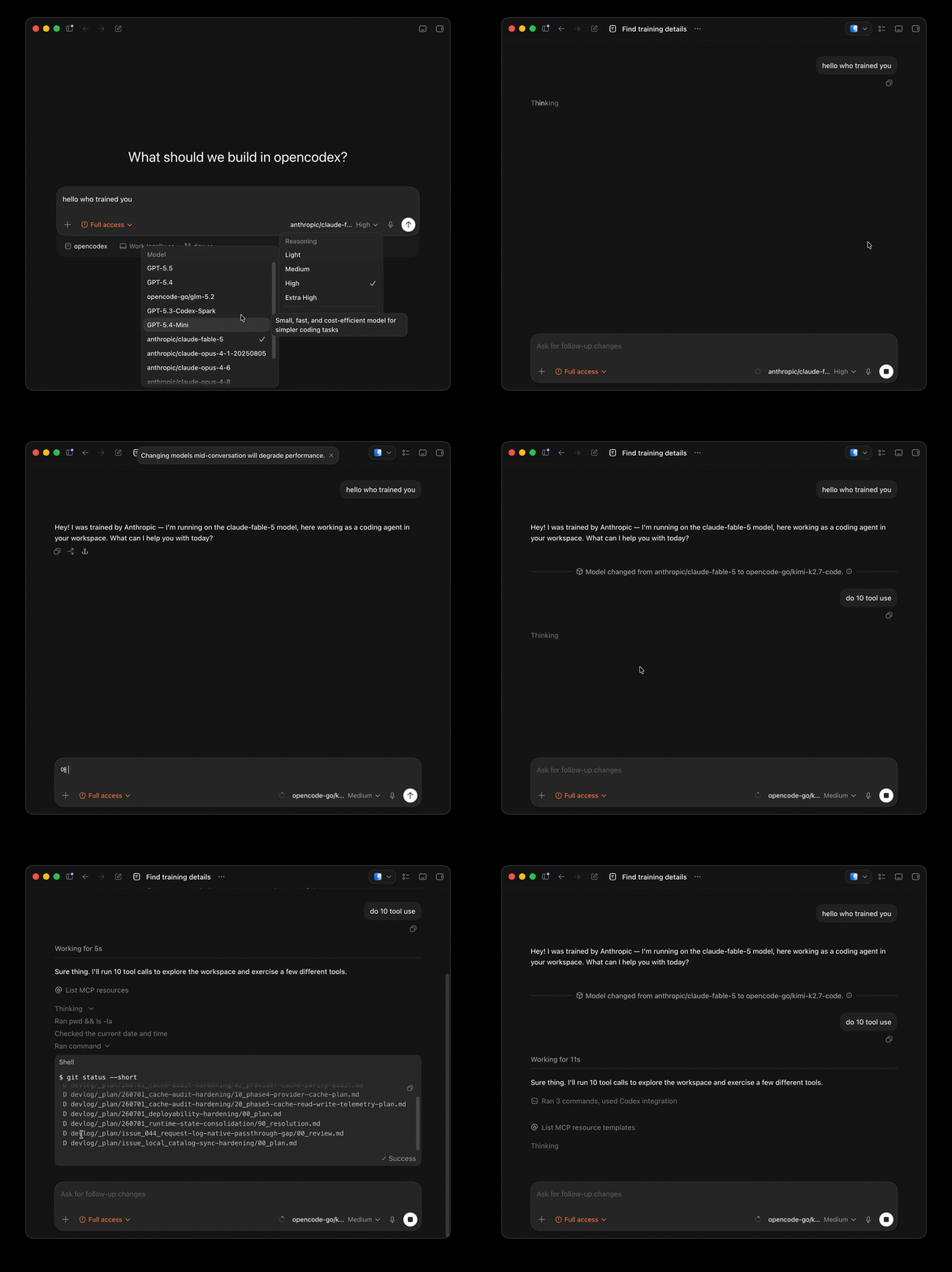
Universal provider proxy for OpenAI Codex & Claude Code — use any LLM (Claude, Gemini, Grok, DeepSeek, Ollama…) with Codex CLI, App, SDK, and Claude Code

Git-native persistent memory for AI coding agents. Implements Google OKF v0.2 with sub-300µs in-memory BM25 search, embedded MCP server, and progressive disclosure. Slashes token bloat by 80% with zero external databases or dependencies. Built in pure Go.

Local-first code intelligence graph for MCP and CLI. Builds a persistent map of your codebase so AI coding tools read only what matters, with benchmarked context reductions on reviews and large-repo workflows.

Stop your AI from making things up — it proposes, deterministic tools decide, every claim checked against ground truth with evidence. Grounded facts and context survive resets. Reverse engineering is the proving ground. MCP server + CLI.