




koala73/worldmonitorConnectors
Real-time global intelligence dashboard. AI-powered news aggregation, geopolitical monitoring, and infrastructure tracking in a unified situational awareness interface
86k
LycheeMemory adds persistent memory to agent sessions by mirroring turns, consolidating them, and retrieving relevant context later. It works as an HTTP MCP server, as a plugin for supported runtimes, or as a Python package you run yourself.
Builders who want their agent to keep useful context across sessions and pull it back when needed.
You can stop re-explaining preferences, past work, and procedures every time you start a new session.
Serves memory tools at `/mcp`, including smart search, raw search, turn append, and consolidation.
Adds persistent memory with hooks, automatic turn mirroring, and boundary consolidation.
Installs as a native plugin for OpenClaw sessions with automatic recall and memory updates.
Ships as `lycheemem` with `lycheemem-cli` to start the backend from anywhere.
Keeps active session turns within a token budget and compresses older context into summaries.
Stores typed memory records such as facts, preferences, events, constraints, procedures, failure patterns, and tool affordances.
Stores reusable skills with Markdown instructions and HyDE-based retrieval.
Stores image-grounded notes with text and visual retrieval across SQLite, LanceDB, and files.
pip install lycheemem
pip install "lycheemem[rerank]"
lycheemem-cli
git clone https://github.com/LycheeMem/LycheeMem.git
cd LycheeMem
pip install -e .
pip install "lycheemem[rerank]"
mkdir -p ~/.cache/lycheemem/models
huggingface-cli download LycheeMem/reranker \
  --local-dir ~/.cache/lycheemem/models/reranker-v0
export TRANSFORMER_RERANK_MODEL_PATH=~/.cache/lycheemem/models/reranker-v0







中文 | English
Works across agent runtimes that support plugins, MCP, or Python integration.

OpenClaw Native plugin |

Claude Code MCP + hooks |

Hermes Runtime plugin |

PyPI Package Python API |

Any MCP Client HTTP MCP server |
LycheeMemory is a compact memory framework for LLM agents. It starts from efficient conversational memory—through structured organization, lightweight consolidation, and adaptive retrieval—and gradually extends toward action-aware, usage-aware memory for more capable agentic systems.
consolidate or store.pip install lycheemem. You can easily start the service from anywhere using lycheemem-cli!LycheeMemory is part of the 3rd-generation Lychee (立知) large model series, which focuses on memory intelligence, continual learning, and long-context reasoning.
We welcome you to explore our related works:
LycheeMemory (ACL 2026, CCF-A): a unified framework for implicit long-term memory and explicit working memory collaboration in large language models


LycheeMem (this project): long-term memory infrastructure for LLM-based agents

LycheeDecode (ICLR 2026, CCF-A): selective recall from massive KV-cache context memory


LycheeCluster (ACL 2026, CCF-A): structured organization and hierarchical indexing for context memory
Install the core package:
pip install lycheemem
Recommended install with the default transformer memory reranker:
pip install "lycheemem[rerank]"
The rerank extra adds PyTorch / Transformers runtime dependencies. With it
installed, LycheeMemory enables the hosted LycheeMem/reranker checkpoint by
default. Without the extra, the core memory system still works and reranking
falls back safely.
Once installed, you can start the backend server instantly using the CLI:
lycheemem-cli
For development or if you prefer to run from source:
git clone https://github.com/LycheeMem/LycheeMem.git
cd LycheeMem
pip install -e .
Create a .env file in your working directory and fill in your values. The full template in .env.example also includes session/user DB paths, JWT settings, and working-memory thresholds; the snippet below shows the most important ones:
# LLM — litellm format: provider/model
LLM_MODEL=openai/gpt-4o-mini
LLM_API_KEY=sk-...
LLM_API_BASE=                     # optional

# Embedder
EMBEDDING_MODEL=openai/text-embedding-3-small
EMBEDDING_DIM=1536
EMBEDDING_API_KEY=                # optional
EMBEDDING_API_BASE=               # optional
Supported LLM providers (via litellm):
openai/gpt-4o-mini·gemini/gemini-2.0-flash·ollama_chat/qwen2.5· any OpenAI-compatible endpoint
LycheeMemory includes a transformer reranker for semantic memory search. It can improve evidence selection when the correct memory is already in the wider candidate pool.
For the smoothest experience, install LycheeMemory with the rerank extra:
pip install "lycheemem[rerank]"
After that, no extra model command is required. The reranker is enabled by default and loads the current v0 checkpoint from Hugging Face on first use:
EXPERIMENTAL_TRANSFORMER_RERANK=true
TRANSFORMER_RERANK_MODEL_PATH=LycheeMem/reranker
To disable it explicitly:
EXPERIMENTAL_TRANSFORMER_RERANK=false
If you prefer to pin the model to a local directory, download it once and point the same variable at that path:
mkdir -p ~/.cache/lycheemem/models
huggingface-cli download LycheeMem/reranker \
  --local-dir ~/.cache/lycheemem/models/reranker-v0
export TRANSFORMER_RERANK_MODEL_PATH=~/.cache/lycheemem/models/reranker-v0
The base install still works without PyTorch or Transformers. If rerank dependencies or the checkpoint are unavailable, LycheeMemory logs a warning, disables reranking for that process, and continues with baseline memory search. See Transformer Reranker v0 for metrics, limitations, and diagnostics.
If you installed via pip, you can start the LycheeMemory background service from anywhere using:
lycheemem-cli
(If running from source, you can also use python main.py to start the server.)
The API is served at http://localhost:8000. Interactive docs at /docs.
main.pycurrently starts Uvicorn without enabling live reload. For development reload, run Uvicorn directly, for example:uvicorn src.api.server:create_app --factory --reload
A frontend demo is included under web-demo/. It provides a chat interface alongside live views of the semantic memory tree, skill library, and working memory state.
cd web-demo
npm install
npm run dev      # served at http://localhost:5173
Make sure the backend is running on port 8000 (or update proxy settings in
web-demo/vite.config.ts) before starting the frontend.
LycheeMemory ships a native OpenClaw plugin that gives any OpenClaw session persistent long-term memory with zero manual wiring.
What the plugin provides:
lychee_memory_smart_search — default long-term memory retrieval entry pointappend_turn manually
/new, /reset, /stop, and session_end automatically trigger boundary consolidationUnder normal operation:
lychee_memory_smart_search when recalling long-term contextlychee_memory_consolidate manually when an immediate persist is warrantedlychee_memory_append_turn at allopenclaw plugins install "/path/to/LycheeMem/openclaw-plugin"
openclaw gateway restart
See the full setup guide: openclaw-plugin/INSTALL_OPENCLAW.md
LycheeMemory also exposes an HTTP MCP endpoint at http://localhost:8000/mcp.
lychee_memory_smart_search, lychee_memory_search, lychee_memory_append_turn, lychee_memory_consolidatelychee_memory_consolidate works for sessions that already contain mirrored turns from /chat, /memory/reason, or lychee_memory_append_turnPOST /mcp handles JSON-RPC requestsGET /mcp exposes the SSE stream used by some MCP clientsMcp-Session-Id during initialize; reuse that header on later requestsFor any MCP client that supports remote HTTP servers, configure the MCP URL as:
http://localhost:8000/mcp
Generic config example:
{
  "mcpServers": {
    "lycheemem": {
      "url": "http://localhost:8000/mcp"
    }
  }
}
initializeMcp-Session-Idinitializedtools/listtools/callInitialize example:
curl -i -X POST http://localhost:8000/mcp \
  -H "Content-Type: application/json" \
  -d '{
    "jsonrpc": "2.0",
    "id": 1,
    "method": "initialize",
    "params": {
      "protocolVersion": "2025-03-26",
      "capabilities": {},
      "clientInfo": {
        "name": "debug-client",
        "version": "0.1.0"
      }
    }
  }'
Tool call example:
curl -X POST http://localhost:8000/mcp \
  -H "Content-Type: application/json" \
  -H "Mcp-Session-Id: <session-id>" \
  -d '{
    "jsonrpc": "2.0",
    "id": 2,
    "method": "tools/call",
    "params": {
      "name": "lychee_memory_smart_search",
      "arguments": {
        "query": "what tools do I use for database backups",
        "top_k": 5,
        "mode": "compact",
        "include_graph": true,
        "include_skills": true
      }
    }
  }'
/chat or /memory/reason with a stable session_id to write conversation turns, or mirror external host turns with lychee_memory_append_turn.lychee_memory_smart_search in compact mode for the default one-shot recall path.lychee_memory_search only when you explicitly want raw retrieval results for debugging or custom host-side processing.lychee_memory_consolidate with the same session_id.LycheeMemory organizes memory into three complementary stores:
| Working Memory | Semantic Memory | Procedural Memory | Visual Memory |
|---|---|---|---|
|
(Episodic)
|
(Typed Action Store)
|
(Skills)
|
(Multimodal)
|
The working memory window holds the active conversation context for a session. It operates under a dual-threshold token budget:
Compression produces summary anchors (past context, distilled) + raw recent turns (last N turns, verbatim). Both are passed downstream as the conversation history.
Semantic memory is organised around typed MemoryRecords plus action-grounded retrieval state. The storage layer is SQLite (FTS5 full-text search) + LanceDB (vector index), while retrieval is conditioned on recent context, tentative action, constraints, and missing slots.
Each memory entry is stored as a MemoryRecord. The memory_type field distinguishes seven semantic categories:
| Type | Description |
|---|---|
fact | Objective facts about the user, environment, or world |
preference | User preferences (style, habits, likes/dislikes) |
event | Specific events that have occurred |
constraint | Conditions that must be respected |
procedure | Reusable step-by-step procedures / methods |
failure_pattern | Previously failed action paths and their causes |
tool_affordance | Capabilities and applicable scenarios of tools/APIs |
Beyond text, every MemoryRecord carries action-facing metadata (tool_tags, constraint_tags, failure_tags, affordance_tags) and usage statistics (retrieval_count, action_success_count, etc.) to seed future reinforcement-learning signals. Retrieval logs also persist retrieval_plan, action_state, response excerpts, and later user feedback so the system can close a lightweight action-outcome loop without training.
Related MemoryRecords can be fused online by the Record Fusion Engine into denser CompositeRecords. Composite entries persist direct child_composite_ids, so long-term semantic memory is organised as a hierarchical memory tree instead of a flat bag of summaries.
A single-pass pipeline that converts conversation turns into a list of MemoryRecords:
memory_type, tool_tags, constraint_tags, failure_tags, affordance_tags, and other structured labels.record_id = SHA256(normalized_text) — naturally idempotent; duplicate content is deduplicated automatically.
Triggered online after each consolidation. No LLM calls — pure embedding cosine similarity math:
memory_type with cosine similarity > 0.85. Near-duplicates are soft-expired; composites covering affected source records are invalidated.semantic_text; entities, tags, and temporal fields are merged from all cluster members. A new CompositeRecord is written to SQLite + LanceDB.composite → composite abstractions and persisting child_composite_ids so the memory tree can keep growing upward.Retrieval is organised around the hierarchical memory tree, using CompositeRecords as the primary retrieval unit. The current query, recent context, and ActionState jointly condition holistic relevance judgement at the composite level; matched composites are expanded down the memory tree to atomic MemoryRecords on demand; and a reflection loop driven by adequacy assessment covers any residual information gaps.
Composite-Level Relevance Judgement
Retrieval first operates at the CompositeRecord level. An ANN vector search pre-filters to the top-20 semantically nearest CompositeRecords, then a single LLM call performs holistic relevance judgement over those candidates: each composite is either selected as relevant or excluded; among those selected, the LLM additionally flags entries whose summary is too abstract to fully answer the query and therefore warrant expansion to their underlying atomic records. The ANN pre-filter keeps the LLM judgement bounded to one call regardless of how many CompositeRecords exist in the database.
Memory Tree Expansion
For composites flagged as requiring expansion, the retrieval engine recursively traverses source_record_ids and child_composite_ids down the memory tree to retrieve the corresponding atomic MemoryRecords. This preserves the broad semantic overview provided by high-level composites while enabling precise access to fine-grained evidence when the query demands it, balancing retrieval efficiency with detail coverage.
Reflection-Based Supplementary Recall
After the initial candidate set is formed, the engine assesses the adequacy of the current context. When a coverage gap is detected, multi-channel supplementary recall is activated: FTS full-text and vector channels (both semantic_text and normalized_text paths) extend coverage at the MemoryRecord level, and a direct vector recall over the episode turns index recovers dialogue content not yet distilled into MemoryRecords. The reflection loop runs for a bounded number of rounds, continuing only while information gaps remain.
After all phases complete, candidates are aggregated and ranked by source tier for top-k selection: composites selected by the composite-level relevance judgement receive the highest priority, followed by atomic MemoryRecords from tree expansion, with supplementary recall results ranked last. All candidates are then enriched with episodic context — original dialogue excerpts from the session store are retrieved and appended to each candidate's display text, providing the downstream SynthesizerAgent with fully sourced, contextualised background.
The skill store preserves reusable how-to knowledge as structured skill entries, each carrying:
doc_markdown — a full Markdown document describing the procedure, commands, parameters, and caveats.Skill retrieval uses HyDE (Hypothetical Document Embeddings): the query is first expanded into a hypothetical ideal answer by the LLM, then that draft text is embedded to produce a query vector that matches well against stored procedure descriptions, even when the user's original phrasing is vague.
Visual Memory stores image-grounded knowledge through a three-layer architecture: SQLite (metadata + FTS5), LanceDB (dual vector index), and local filesyste
Sign in to join the discussion.
No comments yet. Be the first to say what this is good for.
Real-time global intelligence dashboard. AI-powered news aggregation, geopolitical monitoring, and infrastructure tracking in a unified situational awareness interface
High-performance code intelligence MCP server. Indexes codebases into a persistent knowledge graph — average repo in milliseconds. 158 languages, sub-ms queries, 99% fewer tokens. Single static binary, zero dependencies.
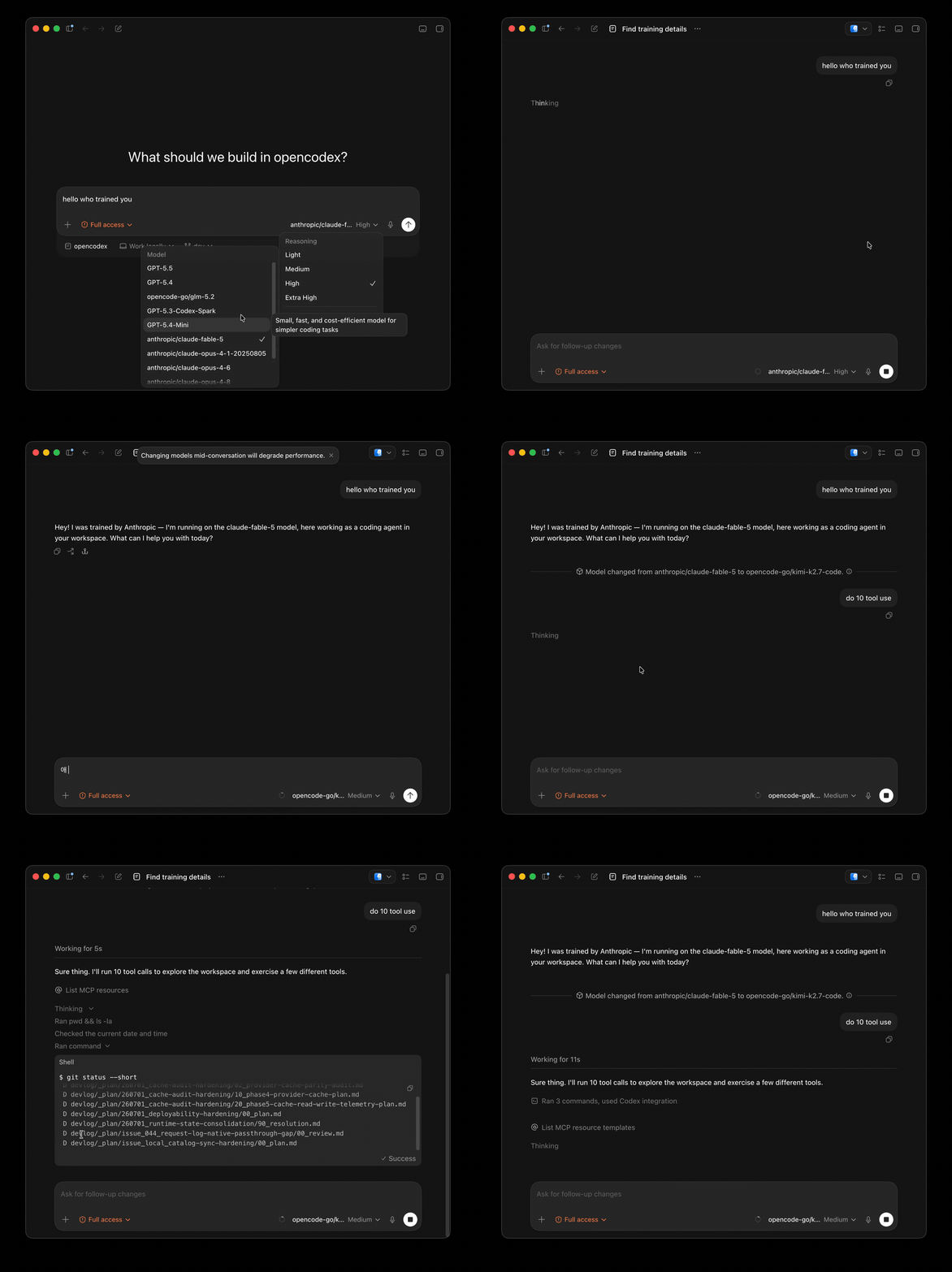
Universal provider proxy for OpenAI Codex & Claude Code — use any LLM (Claude, Gemini, Grok, DeepSeek, Ollama…) with Codex CLI, App, SDK, and Claude Code

Git-native persistent memory for AI coding agents. Implements Google OKF v0.2 with sub-300µs in-memory BM25 search, embedded MCP server, and progressive disclosure. Slashes token bloat by 80% with zero external databases or dependencies. Built in pure Go.

Local-first code intelligence graph for MCP and CLI. Builds a persistent map of your codebase so AI coding tools read only what matters, with benchmarked context reductions on reviews and large-repo workflows.

Stop your AI from making things up — it proposes, deterministic tools decide, every claim checked against ground truth with evidence. Grounded facts and context survive resets. Reverse engineering is the proving ground. MCP server + CLI.