
koala73/worldmonitorConnectors
Real-time global intelligence dashboard. AI-powered news aggregation, geopolitical monitoring, and infrastructure tracking in a unified situational awareness interface
86k
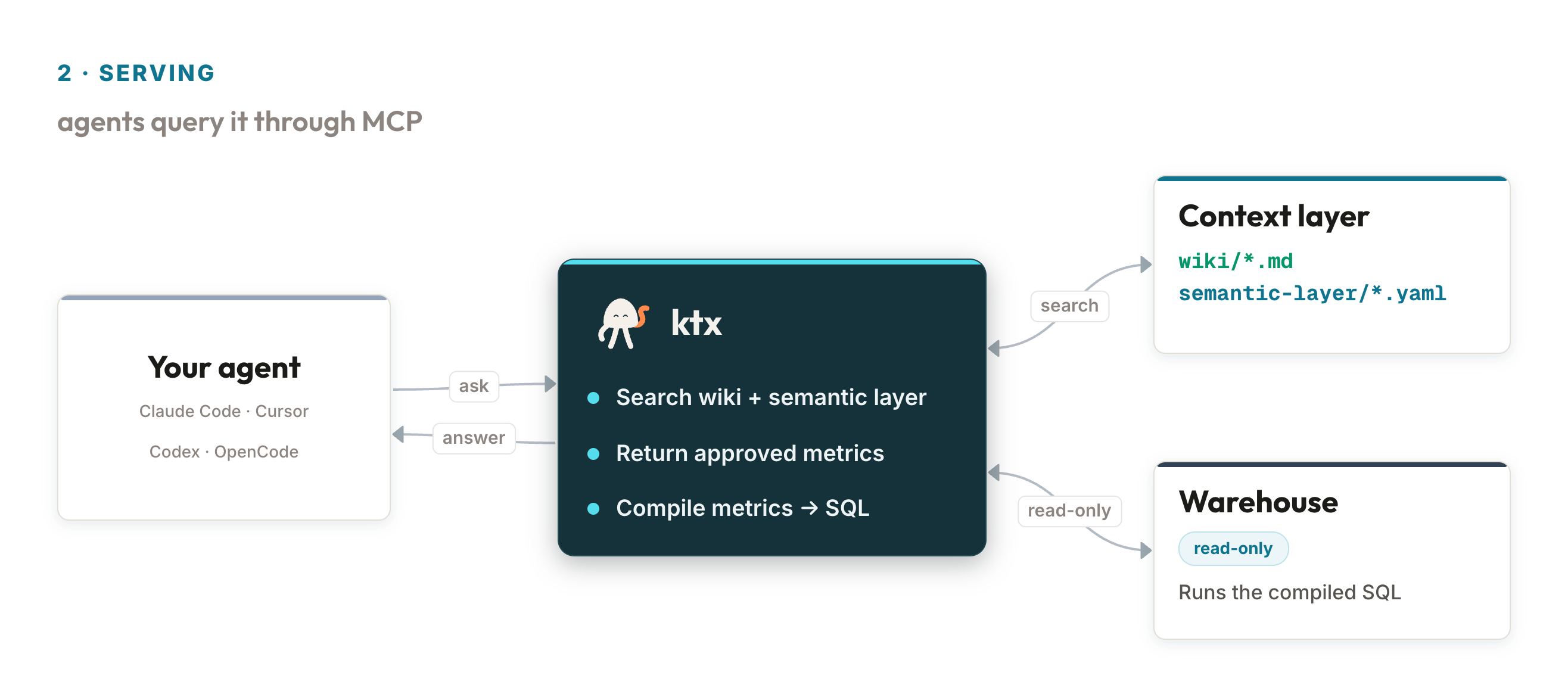
ktx ingests databases, semantic layers, and team docs, then turns them into context agents can query safely. It exposes a CLI and MCP server so Claude Code, Codex, Cursor, and similar tools can search approved metrics, join paths, and wiki knowledge before writing SQL.
Builders who want their agents to query warehouses with company context instead of guessing metric logic.
You can get read-only, company-aligned answers from your agent without re-explaining the warehouse on every prompt.
Pulls in wiki content, modeling code, BI metadata, and database details into one local context layer.
Creates searchable semantic-layer YAML and join graphs so agents can use approved metrics and relationships.
Runs a local MCP daemon that lets agent clients search wiki and semantic-layer content at execution time.
Plans read-only SQL against the warehouse and does not write back to the database.
Works with warehouses like PostgreSQL, Snowflake, BigQuery, ClickHouse, MySQL, SQL Server, SQLite, DuckDB, Athena, and MongoDB.
Provides repo-level instructions and skill assets for Claude Code, Codex, and Gemini-based workflows.
npm install -g @kaelio/ktx
ktx setup
ktx status
ktx project: /home/user/analytics
Project ready: yes
LLM ready: yes (claude-sonnet-4-6)
Embeddings ready: yes (text-embedding-3-small)
Databases configured: yes (warehouse)
Context sources configured: yes (dbt_main)
ktx context built: yes
Agent integration ready: yes (codex:project)
Run npx skills add Kaelio/ktx --skill ktx and use the ktx skill to install
and configure ktx in this project.






Quickstart · CLI Reference · Agent Setup · Slack
Built and maintained by Kaelio
ktx is a self-improving context layer that teaches agents how to query your warehouse accurately - from approved metric definitions, joinable columns, and business knowledge it builds and maintains for you.
[!NOTE] Run ktx with your own LLM API keys or a local agent sign-in — a Claude Pro/Max subscription through Claude Code, or your local Codex authentication. No extra usage billing from ktx.
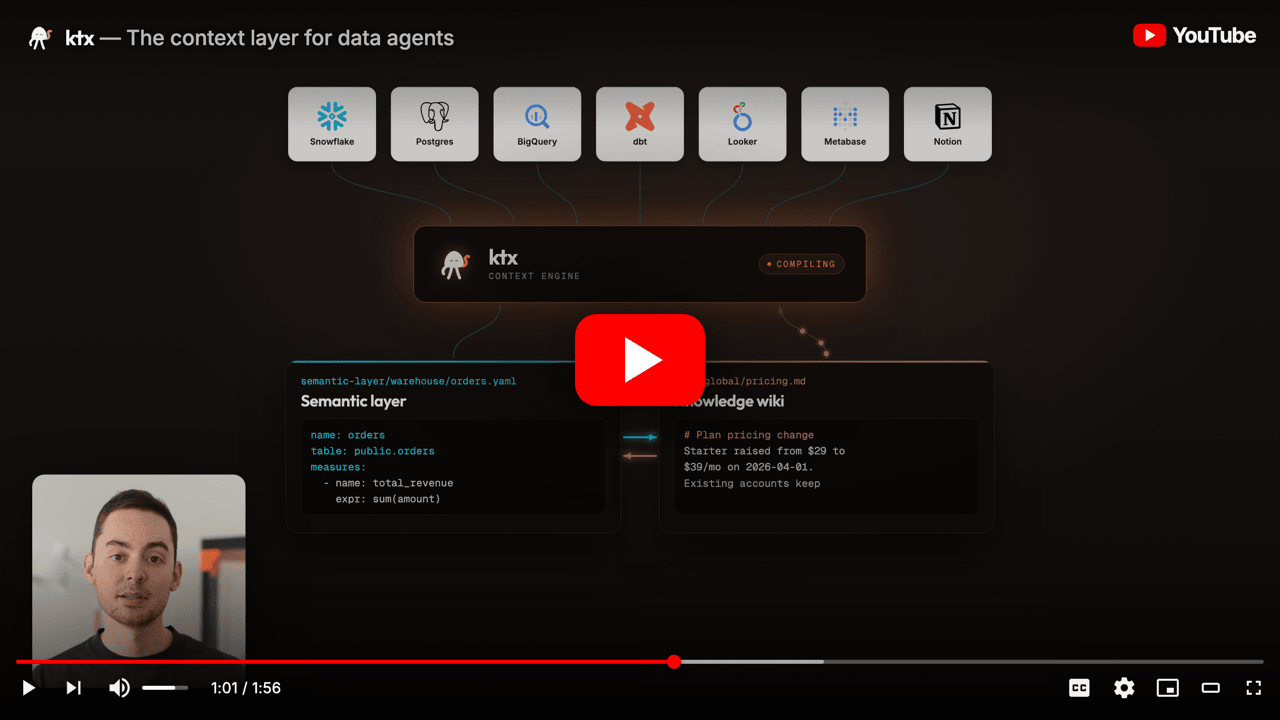
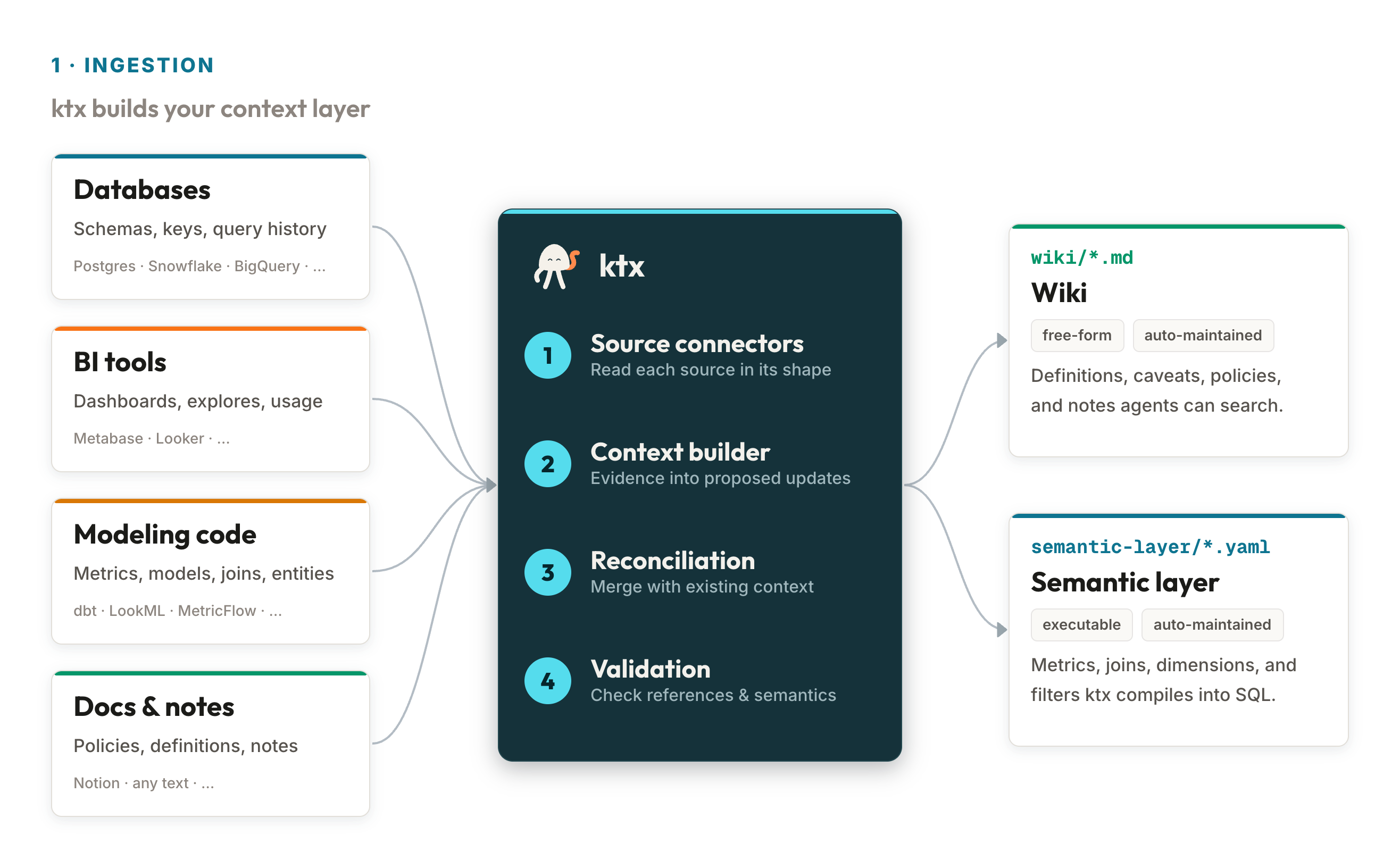
General-purpose agents struggle on data tasks. They re-explore your warehouse on every question, invent their own metric logic, and return numbers that don't match approved definitions.
Traditional semantic layers don't fix this. They demand constant manual upkeep and don't absorb the rest of your company's knowledge.
ktx does both, automatically:
| General-purpose agent | Traditional semantic layer | ktx | |
|---|---|---|---|
| Builds warehouse context automatically | — | — | ✓ |
| Detects joinable columns + resolves fan/chasm traps | — | Manual | ✓ |
| Approved, reusable metric definitions | — | ✓ | ✓ |
| Absorbs wiki / Notion / team knowledge | — | — | ✓ |
| Flags contradictions across sources | — | — | ✓ |
| Ships CLI + MCP for agent execution | Partial | — | ✓ |
| Read-only by design | n/a | n/a | ✓ |
Use ktx if you:
Skip ktx if you:
psql or a notebook will doWorks with PostgreSQL, Snowflake, BigQuery, ClickHouse, MySQL, SQL Server, SQLite, DuckDB, Amazon Athena, and MongoDB. Integrates with dbt, MetricFlow, LookML, Looker, Metabase, Sigma, Notion, and Google Drive.
npm install -g @kaelio/ktx
ktx setup
ktx status
ktx setup creates or resumes a local ktx project, configures providers
and connections, builds context, and installs agent integration.
Example ktx status after setup:
ktx project: /home/user/analytics
Project ready: yes
LLM ready: yes (claude-sonnet-4-6)
Embeddings ready: yes (text-embedding-3-small)
Databases configured: yes (warehouse)
Context sources configured: yes (dbt_main)
ktx context built: yes
Agent integration ready: yes (codex:project)
[!TIP] Already using an agent? Ask Claude Code, Codex, Cursor, or OpenCode from your project directory:
Run npx skills add Kaelio/ktx --skill ktx and use the ktx skill to install
and configure ktx in this project.
[!IMPORTANT] If
ktx statusprintsktx mcp start --project-dir ..., run it before opening your agent client.
Re-run the global install with the @latest tag:
npm install -g @kaelio/ktx@latest
| Command | Purpose |
|---|---|
ktx setup | Create, resume, or update a ktx project |
ktx status | Check project readiness |
ktx ingest | Build context for every configured connection |
ktx sl "revenue" | Search semantic sources |
ktx wiki "refund policy" | Search local wiki pages |
ktx mcp start | Start the MCP server for agent clients |
See the CLI Reference for every command, flag, and option.
my-project/
├── ktx.yaml                         # Project configuration
├── semantic-layer/<connection-id>/  # YAML semantic sources
├── wiki/global/                     # Shared business context
├── wiki/user/<user-id>/             # User-scoped notes
├── raw-sources/<connection-id>/     # Ingest artifacts and reports
└── .ktx/                            # Local state and secrets, git-ignored
Commit ktx.yaml, semantic-layer/, and wiki/. Keep .ktx/ local.
Project resolution defaults to KTX_PROJECT_DIR, then the nearest ktx.yaml,
then the current directory. Pass --project-dir <path> when scripting.
ktx mcp start when an agent client needs it.git clone https://github.com/kaelio/ktx.git
cd ktx
pnpm install
uv sync --all-groups
pnpm run build
pnpm run check
ktx is a pnpm + uv workspace:
| Path | Purpose |
|---|---|
packages/cli | TypeScript CLI and published npm package source |
packages/cli/src/context | Core context engine |
packages/cli/src/llm | LLM and embedding providers |
packages/cli/src/connectors | Database scan connectors |
python/ktx-sl | Semantic-layer query planning |
python/ktx-daemon | Portable compute service |
Local development CLI:
pnpm run setup:dev
pnpm run link:dev
ktx-dev --help
Useful checks:
pnpm run type-check
pnpm run test
pnpm run dead-code
uv run pytest -q
ktx collects privacy-conscious usage telemetry to understand installs and
improve setup, command reliability, and data-agent workflows. Catalog telemetry
events do not record file paths, hostnames, SQL, schema names, table names,
column names, error messages, raw environment values, or argv. Error reports use
PostHog Error Tracking and can include stack frames and raw error messages,
which may contain local file paths or the local username in those paths.
ktx redacts secrets, credentials, database URLs, auth headers, argv, raw
environment values, SQL text, row data, and user-typed prompt or MCP argument
text from the explicit $exception payload. See
Telemetry for the event
catalog and opt-out options.
ktx is licensed under the Apache License, Version 2.0. See LICENSE.
Sign in to join the discussion.
No comments yet. Be the first to say what this is good for.
Real-time global intelligence dashboard. AI-powered news aggregation, geopolitical monitoring, and infrastructure tracking in a unified situational awareness interface
High-performance code intelligence MCP server. Indexes codebases into a persistent knowledge graph — average repo in milliseconds. 158 languages, sub-ms queries, 99% fewer tokens. Single static binary, zero dependencies.
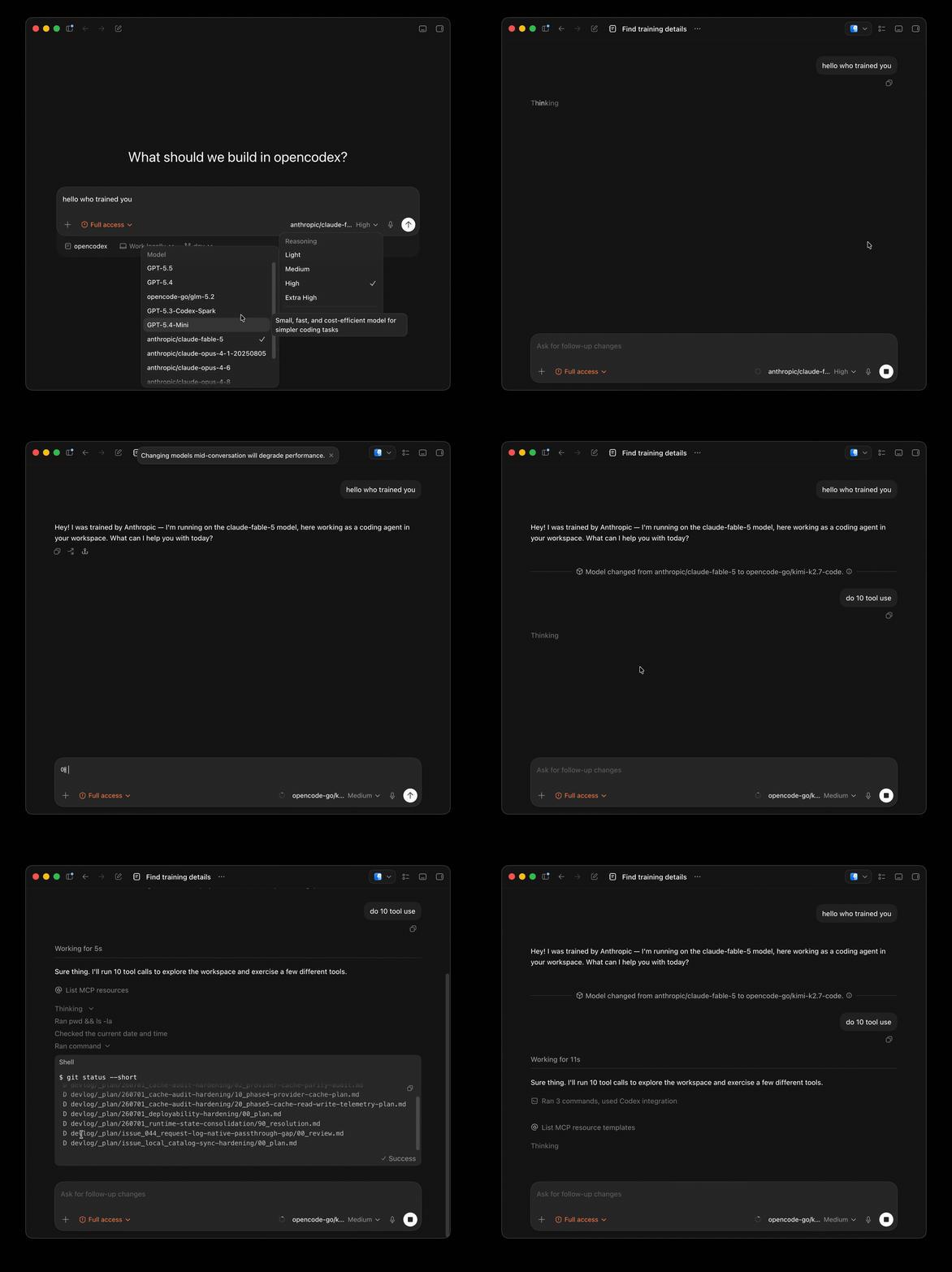
Universal provider proxy for OpenAI Codex & Claude Code — use any LLM (Claude, Gemini, Grok, DeepSeek, Ollama…) with Codex CLI, App, SDK, and Claude Code

Git-native persistent memory for AI coding agents. Implements Google OKF v0.2 with sub-300µs in-memory BM25 search, embedded MCP server, and progressive disclosure. Slashes token bloat by 80% with zero external databases or dependencies. Built in pure Go.

Local-first code intelligence graph for MCP and CLI. Builds a persistent map of your codebase so AI coding tools read only what matters, with benchmarked context reductions on reviews and large-repo workflows.

Stop your AI from making things up — it proposes, deterministic tools decide, every claim checked against ground truth with evidence. Grounded facts and context survive resets. Reverse engineering is the proving ground. MCP server + CLI.