

koala73/worldmonitorConnectors
Real-time global intelligence dashboard. AI-powered news aggregation, geopolitical monitoring, and infrastructure tracking in a unified situational awareness interface
86k
This project gives agents a controlled Python environment for running code, installing packages, and handling output files. It works by creating Docker sandboxes and exposing tools like sandbox creation, code execution, package installation, file upload, and terminal commands over MCP.
Builders who want Claude Code, Codex, or any MCP client to execute Python in isolated containers.
You can let your agent run Python and manage packages without using your local machine directly.
Runs Python code inside isolated Docker containers.
Lets you install Python packages in a sandbox, including custom PyPI mirrors.
Returns generated files through web links for viewing or reuse.
Supports optional API key authentication for multi-user setups.
Includes a browser interface for managing sandboxes and viewing results.
Exposes the tools through Server-Sent Events for MCP clients.




中文文档 | English
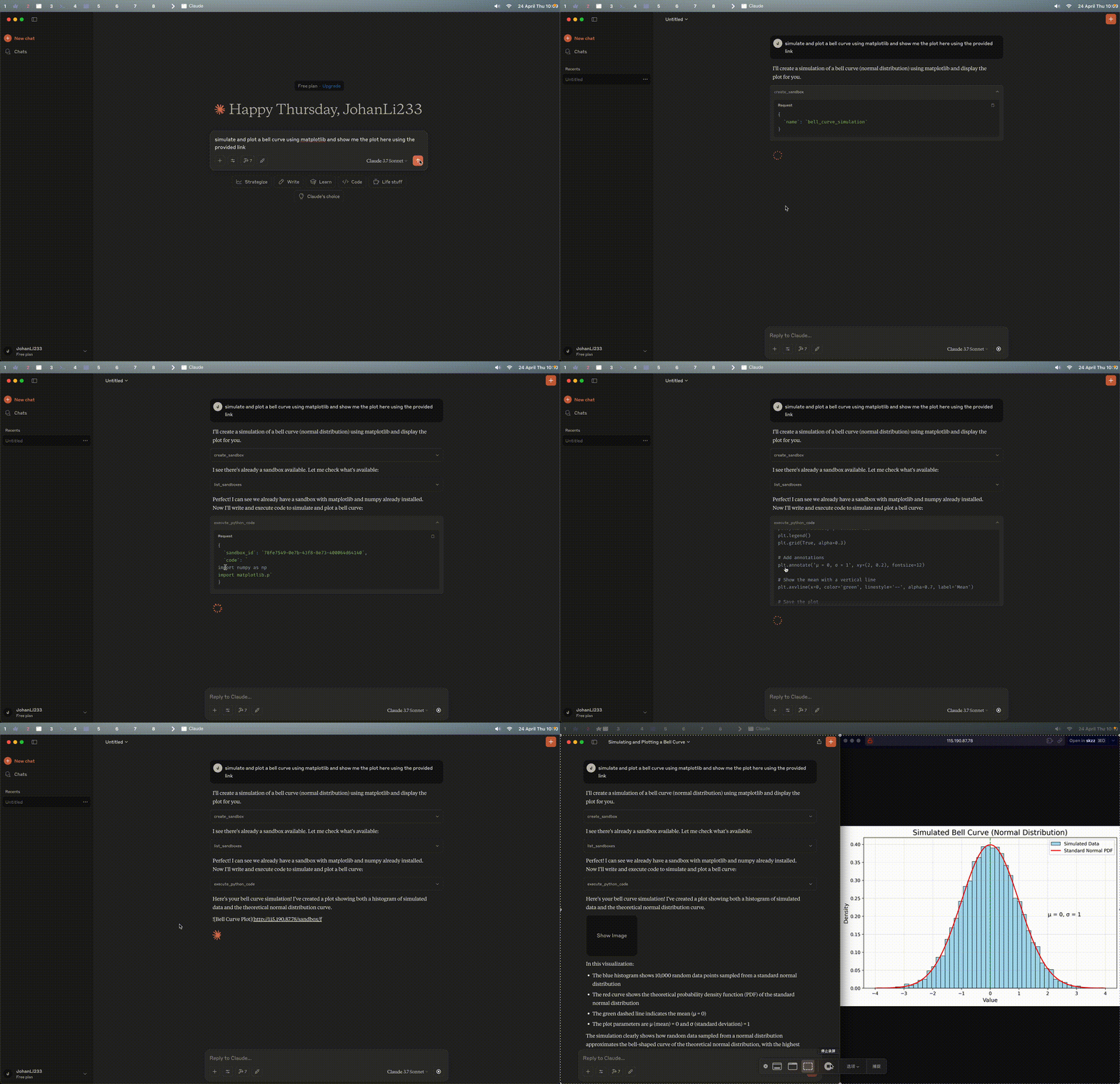
Python MCP Sandbox is an interactive Python code execution tool that allows users and LLMs to safely execute Python code and install packages in isolated Docker containers.
Viby works with mcp sandbox
# Clone the repository
git clone https://github.com/JohanLi233/python-mcp-sandbox.git
cd python-mcp-sandbox

# Install dependencies using uv
uv venv
uv sync

# Start the server
uv run main.py
The default SSE endpoint is http://127.0.0.1:8181/sse, and you can interact with it via the MCP Inspector through SSE or any other client that supports SSE connections.
The server configuration can be customized in config.toml:
127.0.0.1 (localhost only)8181To allow external access, change the host to 0.0.0.0 in the configuration file.
sandbox_id (string), command (string). Returns stdout, stderr, exit_code.sandbox_id (string), local_file_path (string), dest_path (string, optional, default: /app/results).python-mcp-sandbox/
├── main.py # Application entry point
├── requirements.txt # Project dependencies
├── Dockerfile # Docker configuration for Python containers
├── results/ # Directory for generated files
├── mcp_sandbox/ # Main package directory
│ ├── __init__.py
│ ├── models.py # Pydantic models
│ ├── api/ # API related components
│ │ ├── __init__.py
│ │ └── routes.py # API route definitions
│ ├── core/ # Core functionality
│ │ ├── __init__.py
│ │ ├── docker_manager.py # Docker container management
│ │ └── mcp_tools.py # MCP tools
│ └── utils/ # Utilities
│ ├── __init__.py
│ ├── config.py # Configuration constants
│ ├── file_manager.py # File management
│ └── task_manager.py # Periodic task management
└── README.md # Project documentation
I've configured a Python code execution sandbox for you. You can run Python code using the following steps:

1. First, use the "list_sandboxes" tool to view all existing sandboxes (Docker containers).
   - You can reuse an existing sandbox_id if a sandbox exists, do not create a new one.
   - If you need a new sandbox, use the "create_sandbox" tool.
   - Each sandbox is an isolated Python environment, and the sandbox_id is required for all subsequent operations.

2. If you need to install packages, use the "install_package_in_sandbox" tool
   - Parameters: sandbox_id and package_name (e.g., numpy, pandas)
   - This starts asynchronous installation and returns immediately with status

3. After installing packages, you can check their installation status using the "check_package_installation_status" tool
   - Parameters: sandbox_id and package_name (name of the package to check)
   - If the package is still installing, you need to check again using this tool

4. Use the "execute_python_code" tool to run your code
   - Parameters: sandbox_id and code (Python code)
   - Returns output, errors and links to any generated files
   - All generated files are stored inside the sandbox, and file_links are direct HTTP links for inline viewing

Example workflow:
- Use list_sandboxes to check for available sandboxes, if no available sandboxes, use create_sandbox to create a new one → Get sandbox_id
- Use install_package_in_sandbox to install necessary packages (like pandas, matplotlib), with the sandbox_id parameter
- Use check_package_installation_status to verify package installation, with the same sandbox_id parameter
- Use execute_python_code to run your code, with the sandbox_id parameter

Code execution happens in a secure sandbox. Generated files (images, CSVs, etc.) will be provided as direct HTTP links, which can viewed inline in the browser.

Remember not to use plt.show() in your Python code. For visualizations:
- Save figures to files using plt.savefig() instead of plt.show()
- For data, use methods like df.to_csv() or df.to_excel() to save as files
- All saved files will automatically appear as HTTP links in the results, which you can open or embed directly.
Below is an example config for Claude Desktop:
{
  "mcpServers": {
    "mcpSandbox": {
      "command": "npx",
      "args": ["-y", "supergateway", "--sse",  "http://127.0.0.1:8181/sse"]
    }
  }
}
If authentication is enabled, include the API key:
{
  "mcpServers": {
    "mcpSandbox": {
      "command": "npx",
      "args": ["-y", "supergateway", "--sse",  "http://127.0.0.1:8181/sse?api_key=<YOUR_API_KEY>"]
    }
  }
}
{
  "mcpServers": {
    "mcpSandbox": {
      "command": "npx",
      "args": ["-y", "supergateway", "--sse",  "http://115.190.87.78/sse?api_key=<API_KEY>"]
    }
  }
}
Modify the serverUrl as needed for your environment.
Sign in to join the discussion.
No comments yet. Be the first to say what this is good for.
Real-time global intelligence dashboard. AI-powered news aggregation, geopolitical monitoring, and infrastructure tracking in a unified situational awareness interface
High-performance code intelligence MCP server. Indexes codebases into a persistent knowledge graph — average repo in milliseconds. 158 languages, sub-ms queries, 99% fewer tokens. Single static binary, zero dependencies.
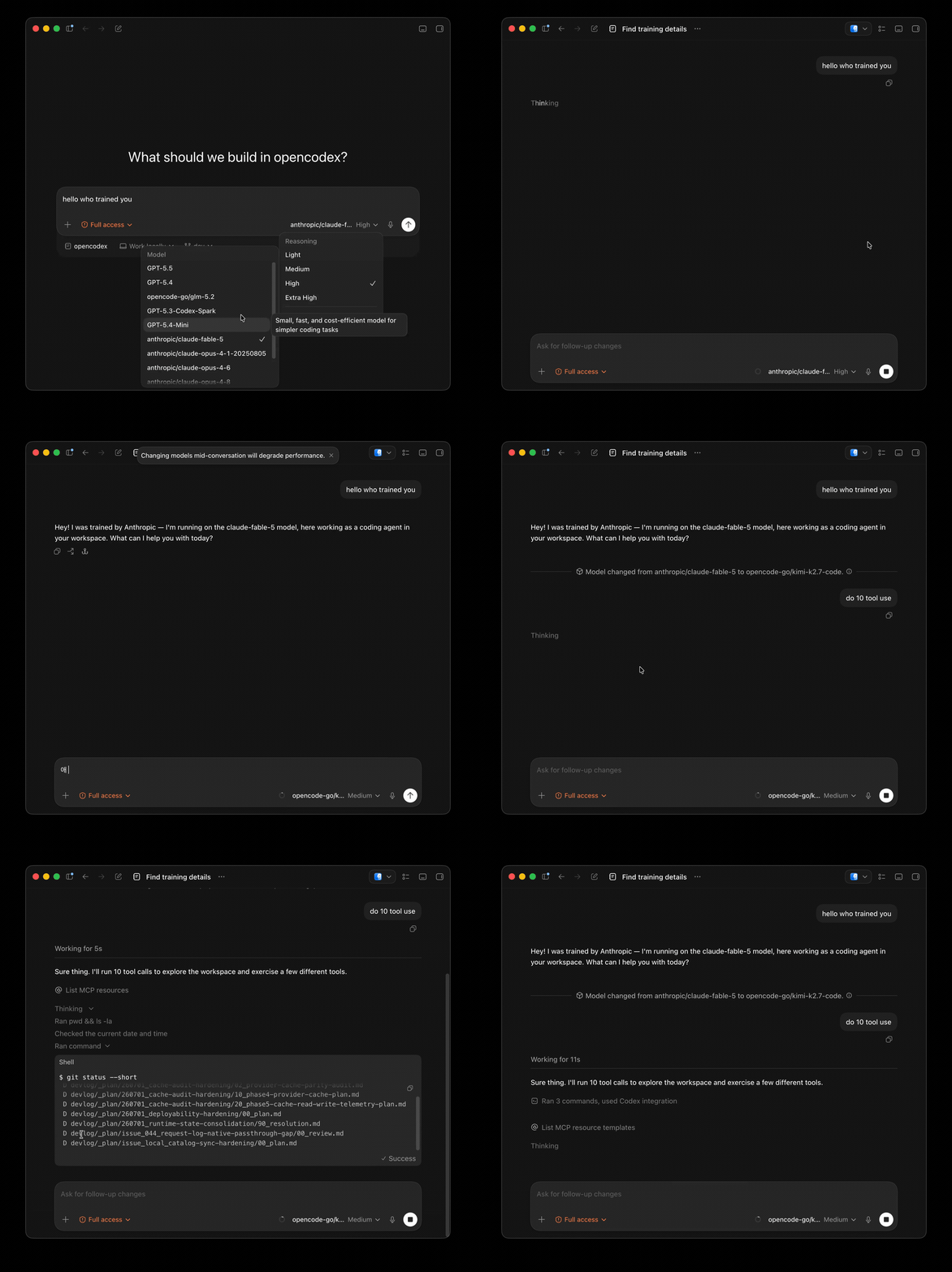
Universal provider proxy for OpenAI Codex & Claude Code — use any LLM (Claude, Gemini, Grok, DeepSeek, Ollama…) with Codex CLI, App, SDK, and Claude Code

Git-native persistent memory for AI coding agents. Implements Google OKF v0.2 with sub-300µs in-memory BM25 search, embedded MCP server, and progressive disclosure. Slashes token bloat by 80% with zero external databases or dependencies. Built in pure Go.

Local-first code intelligence graph for MCP and CLI. Builds a persistent map of your codebase so AI coding tools read only what matters, with benchmarked context reductions on reviews and large-repo workflows.

Stop your AI from making things up — it proposes, deterministic tools decide, every claim checked against ground truth with evidence. Grounded facts and context survive resets. Reverse engineering is the proving ground. MCP server + CLI.