


koala73/worldmonitorConnectors
Real-time global intelligence dashboard. AI-powered news aggregation, geopolitical monitoring, and infrastructure tracking in a unified situational awareness interface
86k
causal-memory adds a persistent causal memory store to agent workflows. It keeps facts, decision→outcome records, and causal chains in SQLite, then exposes them through MCP tools, HTTP, and integrations for Claude Code, Codex, Cursor, and other clients.
Builders who want their agent to recall past decisions, outcomes, and lessons instead of re-deriving them after compaction.
You can ask an agent to look up what happened before, predict what may happen next, and avoid repeating the same mistake.
Records `decision → outcome` links with relation types like caused, enabled, and prevented.
Offers `search_causal`, `search_facts`, and unified `search_memory` over the stored memory graph.
Includes `intervention_query`, `counterfactual_query`, `trace_cause`, and `trace_cause_chain` for prediction and root-cause lookup.
Runs a sleep consolidation cycle that replays, strengthens, weakens, and prunes memory without compacting the original graph.
Ships Claude Code and Codex setup paths, plus Hermes and DeepSeek Harness plugins and a bundled skill.
git clone https://github.com/JingxuanC/causal-memory.git
cd causal-memory
cargo build --release
./install.sh                     # interactive, walks you through each step
./install.sh --yes               # non-interactive, accept all defaults
./install.sh --uninstall         # remove the skill (+ optional MCP)
# Skills CLI (skills.sh ecosystem) — works with Claude Code, Cursor,
# Kimi Code CLI, Codex, Copilot and more:
npx skills add JingxuanC/causal-memory@causal-memory
./target/release/causal-memory http --port 9938 # MCP Streamable HTTP
cargo build --release --features local-embed
# Uses BAAI/bge-small-en-v1.5 (384 dims, ~130MB, downloads once then offline)
export CAUSAL_MEMORY_EMBED_API=https://open.bigmodel.cn/api/paas/v4
export CAUSAL_MEMORY_EMBED_KEY=your-key
export CAUSAL_MEMORY_EMBED_MODEL=embedding-3
An agent memory system with a causal core — and the only one that models inhibition.
Facts, temporal state, and
decision → outcomecausal edges on one SQLite store, powered by a hippocampus-style engine: typed spreading activation (excitatory and inhibitory), Hebbian co-occurrence reinforcement, Q-value dynamics, and immutable SWR consolidation. Agents recall what happened, when it was true, why it worked — and what would happen if they acted differently.





English · 简体中文
Every agent forgets why it made past decisions after a few context compactions. It re-fixes the same bug the same wrong way, re-debates the same architecture choice, relearns the same lesson.
This happens because causal information is the most fragile type under text compaction. Real-LLM benchmark (grok-build's production compaction prompt):
| Compactions (k) | Textual recall | Causal-table recall |
|---|---|---|
| 1 | 100% | 100% |
| 2 | 85% | 100% |
| 3 | 55% | 100% |
| 5 | 45% | 100% |
The causal table survives because it lives outside the agent's context window — compaction cannot touch it.
30-second single scene — the agent is about to git push --no-verify;
intervention_query fires a DANGER chain citing the lesson it recorded last
time ("production login failed for 40 minutes; emergency rollback"):
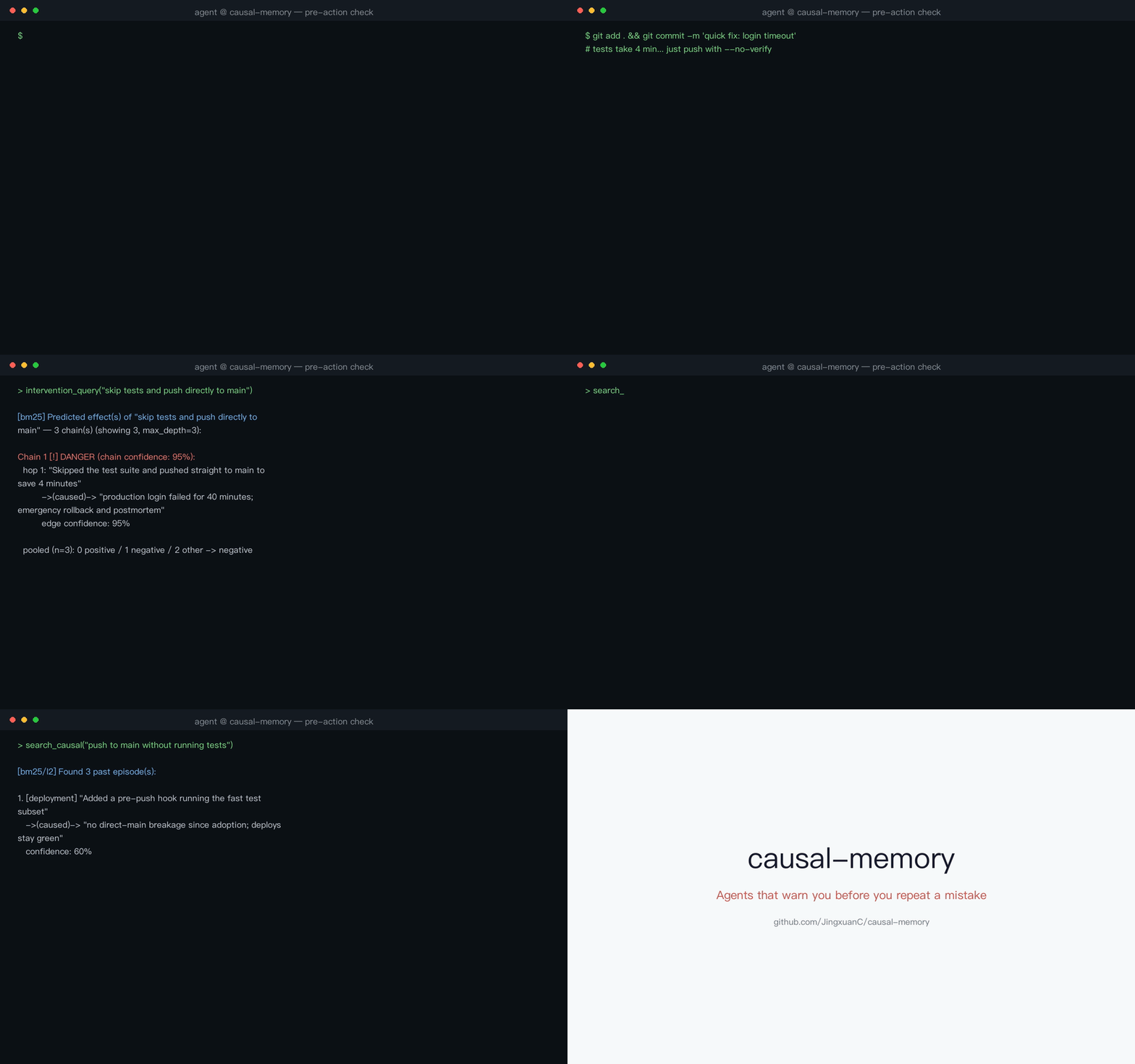
Download video ·
DANGER-scene screenshot ·
Regenerate: scripts/capture_demo30.py → scripts/render_demo30.py
A 21-second hands-on demo (real memory store, no mocks): pre-action warning
(intervention_query → DANGER chain) → experience recall (search_causal)
→ counterfactual comparison (counterfactual_query) → write loop
(record_decision → immediately searchable).
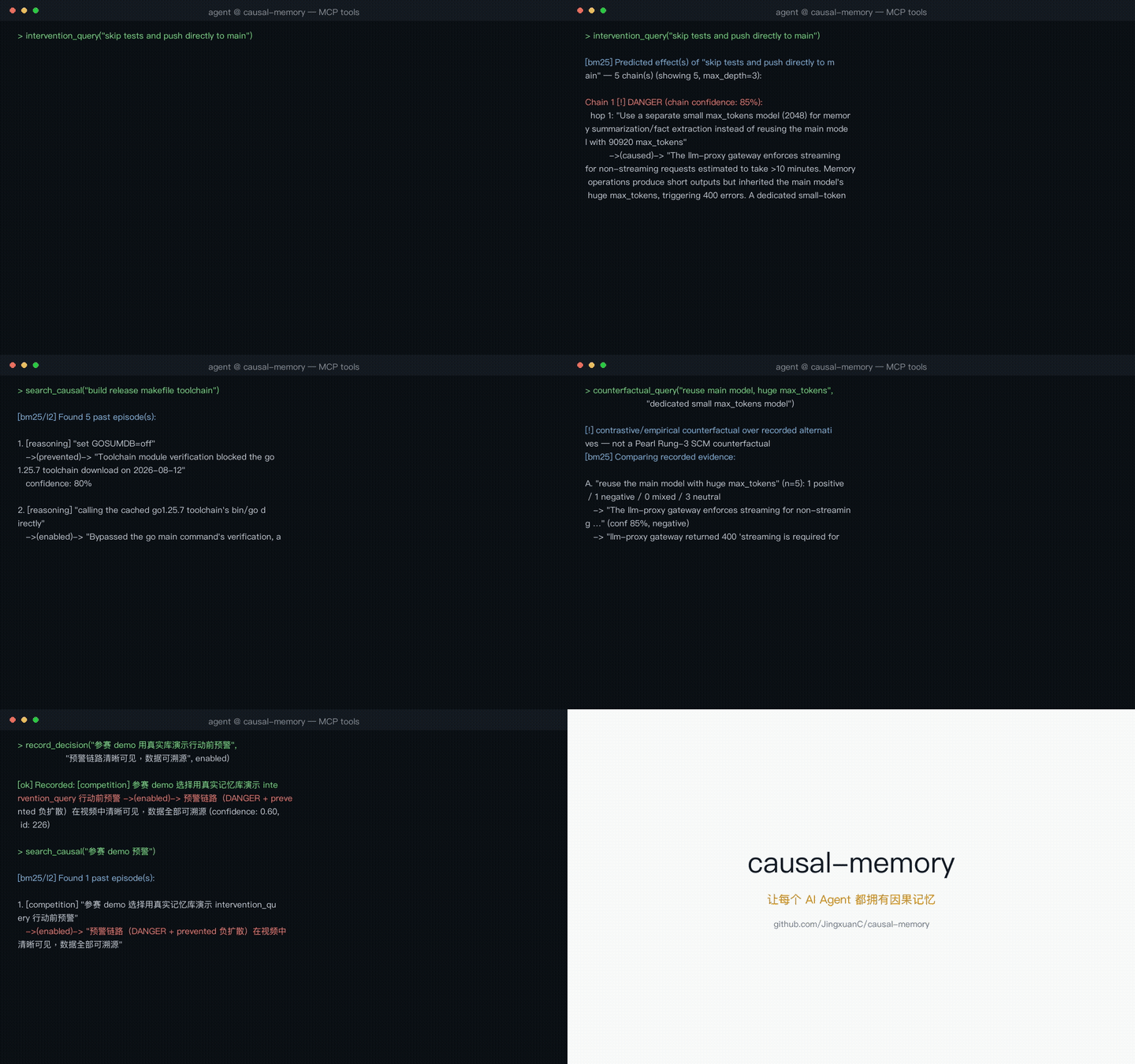
Download video ·
Warning-scene screenshot ·
Brand card ·
Regenerate: scripts/render_demo.py
Most agent-memory benchmarks (LoCoMo, LongMemEval, Memora) test fact recall ("what is the user's preference"). causal-memory's differentiators — typed causal edges, inhibition, intervention prediction, cross-task transfer — are invisible on those suites. CausalEval measures them.
Design: the causal graph is the answer key. Typed DAGs are generated deterministically; conversations are narrated from the graph; gold answers are derived from graph structure — zero hand annotation, zero ambiguity.
CausalEval v13 (soft supersession) — 140 questions, 20 graphs (same LLM, same judge; v12 baseline was 70q/10 graphs; mem0 comparison ran on the 70q protocol):
| Capability | causal-memory | v12 (70q) | mem0 (70q) | What it tests |
|---|---|---|---|---|
| C7 Update | 100% | 50% | 80% | Supersede old belief after falsification (soft superseded_by annotation) |
| C3 Counterfactual | 95% | 90% | 80% | Choosing between alternatives with known outcomes |
| C2 Intervention | 75% | 70% | 40% | Forward prediction: "if X again, what happens?" |
| C4 Inhibition | 80% | 90% | 50% | Distinguishing root-cause fix vs blast-radius limiter (prevented edges) |
| C1 Attribution | 85% | 90% | 90% | Backward causal chain → root cause |
| C5 Temporal-causal | 90% | 100% | 90% | Ordering on a causal chain |
| C6 Lesson transfer | 20% | 20% | 30% | Cross-task analogy via meta edges (open limitation) |
| Overall | 78% | 81% | 65% |
Key result: C7 update 50% → 100% (+50pp, 20/20 questions) and it holds at
doubled sample size. Soft supersession annotates superseded edges
(superseded_by) instead of hiding them — the falsification signal reaches
the answer model while the old lesson stays retrievable for counterfactuals
(C3 unharmed at 95%). The C6 gap (20% vs mem0 30%) is the remaining open
limitation; C1/C4/C5 dips vs v12 are within re-distillation variance and
new-graph difficulty (v12 and v13 do not share a distilled corpus).
On traditional fact-recall suites, causal-memory performs competitively but does not beat mem0 — this is expected, because fact recall is mem0's specialty and not where causal-memory adds value.
| Benchmark | causal-memory | mem0 | Note |
|---|---|---|---|
| LoCoMo (strict judge) | 79.1% | 91.6% | mem0's home turf |
| LongMemEval-S (full pipeline, deepseek-chat) | 76.4% @ 11.5K tok/q | 94.4% @ 6.8K tok/q (official) · 73.8% (ind. repro) | single-model stack vs platform stack; see docs/benchmarks/longmemeval.md |
| Memora MPA | 67.4% | 71.8% | −4.4pp |
| Compaction survival | 100% | 45% | External table = immune to compaction |
| Agent repeat-mistake | 33% | 67% | −34pp on trap-world |
These test capabilities that no fact store (mem0, Zep, Letta) can offer.
| Capability | What it proves | Tests |
|---|---|---|
| Prevented-edge warning | prevented edge spreads −0.3 activation (GABA analogue) | 2 |
| Trace-cause attribution | Backward CSR traversal finds root cause | 2 |
| Multi-hop causal chain | Forward K-hop spreading reaches 2-3 hop outcomes | 2 |
| Inhibitory filtering | Prevented outcomes appear as negative, not false positives | 1 |
| Intervention comparison | Same outcome has +0.9 for "skip tests" and −0.3 for "add tests" | 4 |
| SWR consolidation | LTP strengthens replayed edges, LTD weakens unvisited, GC forgets dormant | 5 |
| Q-value dynamics | Good decisions rank higher; Bellman propagates to parents | 3 |
| Novelty entropy | Diverse experience triggers consolidation; uniform does not | 3 |
| Meta-edge mining | Cross-session pattern discovery (similar_to / repeated) | 3 |
| Hebbian co-occurrence | Repeated co-activation strengthens connection | 3 |
| Capability | causal-memory | mem0 | Zep | Letta | HeLa-Mem |
|---|---|---|---|---|---|
| Typed causal semantics (caused/enabled/prevented) | ✅ | ❌ | ❌ | ❌ | ❌ |
| prevented negative spread (inhibitory) | ✅ | ❌ | ❌ | ❌ | ❌ |
| Hebbian co-occurrence edges (excitatory) | ✅ | ❌ | ❌ | ❌ | ✅ |
| Immutable consolidation (delta + clone) | ✅ | ❌ | ❌ | ❌ | ❌ |
| Q-value dynamic utility | ✅ | ❌ | ❌ | ❌ | ❌ |
| Forward simulation (intervention_query) | ✅ | ❌ | ❌ | ❌ | ❌ |
| SWR offline consolidation (LTP/LTD/GC) | ✅ | ❌ | ❌ | ❌ | ❌ |
| Novelty-entropy consolidation trigger | ✅ | ❌ | ❌ | ❌ | ❌ |
| Meta-edge cross-session pattern mining | ✅ | ❌ | ❌ | ❌ | ❌ |
| Compaction survival evidence | ✅ +20.8pp | ❌ | ❌ | ❌ | ❌ |
| One graph unifying all memory types | ✅ | ❌ | ⚠️ | ❌ | ⚠️ |
| Write-time gatekeeping (raw → session_logs) | ✅ | ✅ | ❌ | ❌ | ❌ |
| Local ONNX embedding (offline) | ✅ | ✅ | ❌ | ❌ | ❌ |
Core innovation: the excitatory/inhibitory duality. HeLa-Mem (ACL 2026) builds
the excitatory side (Hebbian co-activation, positive spread). causal-memory adds
the inhibitory side (prevented edges spread negative activation — a GABA
analogue). A complete memory needs both: "what caused this" and "what prevents
this from happening again."
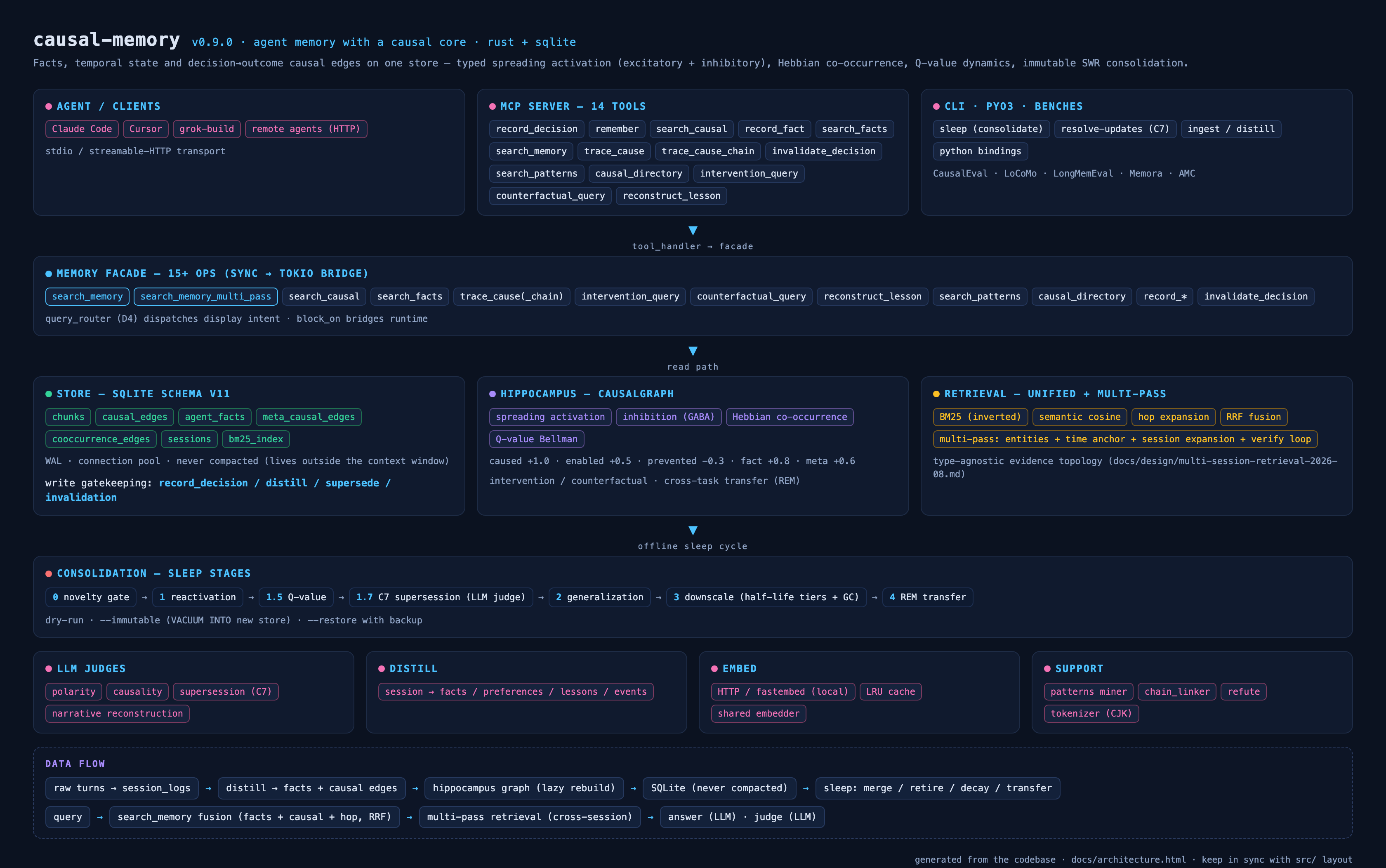
Interactive version: docs/architecture.html
  ┌───────────────────────────────────────────────┐
  │           causal-memory (Rust, MCP)            │
  │                                                │
  │  14 tools ← Agent (stdio / HTTP)                 │
  │    ↓                                           │
  │  Write-time gatekeeping                        │
  │    raw turns → session_logs (audit only)       │
  │    distill → facts + causal edges (searchable) │
  │    ↓                                           │
  │  Unified retrieval (RRF fusion)                │
  │    BM25 + semantic cosine → RRF merge          │
  │    Fact layer (BM25 + embeddings)              │
  │    ↓                                           │
  │  ┌──── Hippocampus engine ──────────────────┐  │
  │  │ CSR graph + spreading activation          │  │
  │  │  caused (+1.0)   enabled (+0.5)           │  │
  │  │  prevented (−0.3) ← GABA inhibitory       │  │
  │  │  fact (+0.8)     meta (+0.6)              │  │
  │  │  co_occurrence (Hebbian, dynamic)         │  │
  │  │                                            │  │
  │  │ DG: SimHash pattern separation             │  │
  │  │ CA3: K-hop spreading (forward + reverse)   │  │
  │  │ CA1: Novelty entropy trigger               │  │
  │  │ SWR: LTP/LTD/GC (immutable delta + clone)  │  │
  │  │ Q-value: Bellman dynamics (MemRL-style)    │  │
  │  └────────────────────────────────────────────┘  │
  │    ↓                                           │
  │  SQLite (causal.db) — never compacted          │
  └───────────────────────────────────────────────┘
The causal_edges table is never compacted — it lives outside the agent's context
window. That's the entire point.
| Edge type | Spread coeff | Biological analogue | Meaning |
|---|---|---|---|
caused | +1.0 | Glutamate (strong excitatory) | "Doing X caused Y" |
fact | +0.8 | Semantic association | "User is/has Z" |
meta | +0.6 | Cortical top-down | Cross-task pattern link |
enabled | +0.5 | Weak excitatory | "Doing X enabled Y" |
co_occurrence | dynamic | Hebbian LTP | "X and Y frequently co-occur" |
prevented | −0.3 | GABA (inhibitory) | "Doing X prevented Y" |
no_effect | 0.0 | — | No causal relationship |
git clone https://github.com/JingxuanC/causal-memory.git
cd causal-memory
cargo build --release
First-class installers: Claude Code (integrations/claude-code/) and
Codex CLI (integrations/codex/) — MCP registration + activation
prompt/skill in one idempotent script each.
{
  "mcpServers": {
    "causal-memory": {
      "command": "/path/to/causal-memory/target/release/causal-memory",
      "env": {
        "CAUSAL_MEMORY_DB": "~/.local/share/causal-memory/causal.db"
      }
    }
  }
}
No Rust toolchain? pip install causal-memory puts the same causal-memory
console script on your PATH (the full CLI — bare invocation is the stdio MCP
server), so "command": "causal-memory" works as the MCP entry too.
To teach the agent when to use the memory tools (agents don't call them proactively without instruction), install the bundled agent skill skills/causal-memory/SKILL.md:
Guided installer (recommended) — one command installs the skill, the
causal-memory server, and the MCP registration across every detected client
(Claude Code / Cursor / Opencode / Claude Desktop / Kimi Code):
./install.sh                     # interactive, walks you through each step
./install.sh --yes               # non-interactive, accept all defaults
./install.sh --uninstall         # remove the skill (+ optional MCP)
Or via the Skills CLI, or by hand:
# Skills CLI (skills.sh ecosystem) — works with Claude Code, Cursor,
# Kimi Code CLI, Codex, Copilot and more:
npx skills add JingxuanC/causal-memory@causal-memory
…or copy skills/causal-memory/ into your agent's skills directory
(e.g. ~/.agents/skills/causal-memory/), or paste CLAUDE.md
into your system prompt / AGENTS.md.
./target/release/causal-memory http --port 9938 # MCP Streamable HTTP
Observability endpoints on the same port:
GET /metrics                    Prometheus text (RED + recall metrics)
GET /healthz / /readyz          liveness / readiness (readiness probes the store)
GET /debug/recall?query=...     run a recall now, return the full JSON trace
                                (seeds, hop summary, per-result provenance)
GET /debug/recalls              newest-first recall audit rows (persisted,
                                schema v13 recall_audit table; survives restarts)
/metrics and /debug/* expose the recall corpus, so they accept opt-in
bearer auth: set CAUSAL_MEMORY_HTTP_AUTH_TOKEN (env or
causal-memory setconfig) and they require
Authorization: Bearer <token> (unset = open, the previous behavior).
/healthz / /readyz stay open on purpose — kubelet probes cannot send
bearer headers and leak nothing. /mcp client auth is a separate
mechanism: per-tenant bearer tokens (see Multi-tenant HTTP below).
Without the token, do not expose
the port to the public internet.
Structured JSON logs on stderr: CAUSAL_MEMORY_LOG_FORMAT=json.
Point CAUSAL_MEMORY_TOKENS_FILE (env or causal-memory setconfig) at a
JSON file mapping bearer tokens to tenant names:
{ "token-for-alice": "alice", "token-for-bob": "bob" }
With the file configured and non-empty, /mcp requires
Authorization: Bearer <token>, and each tenant reads and writes its own
SQLite store at <db-dir>/tenants/<tenant>.<fnv1a-hash>.db — one database
per tenant, opened lazily on first request, so one tenant can never see
another's facts or causal edges (covered by an end-to-end isolation test).
Missing or unknown tokens get 401 and never create a database file. The
file is reloaded when its mtime changes, so tenants can be added or revoked
without a restart; if the file turns unreadable at runtime the last-good
map stays in force (fail closed).
Unset (or an empty/unreadable file) keeps the previous behavior: no /mcp
auth, one shared store — local and stdio usage are unaffected. The startup
log states the mode: auth=multi-tenant (N tokens) vs auth=open.
Memory residency: every active tenant holds its own CausalStore and
in-memory graph, so RSS grows with the tenant count — see
docs/design/enterprise-scaling.md
before packing many tenants into one process. The observability endpoints
(/metrics, /debug/*) keep reporting on the default store and are still
gated by CAUSAL_MEMORY_HTTP_AUTH_TOKEN, independently of tenant auth.
cargo build --release --features local-embed
# Uses BAAI/bge-small-en-v1.5 (384 dims, ~130MB, downloads once then offline)
export CAUSAL_MEMORY_EMBED_API=https://open.bigmodel.cn/api/paas/v4
export CAUSAL_MEMORY_EMBED_KEY=your-key
export CAUSAL_MEMORY_EMBED_MODEL=embedding-3
All 14 memory operations are also available as a Python package, built on the
same causal_memory::memory::Memory facade the MCP server uses:
cd crates/causal-memory-py
pip install maturin
maturin develop          # builds and installs into the active venv
from causal_memory import CausalMemory

mem = CausalMemory("~/.local/share/causal-memory/causal.db")  # or CausalMemory.in_memory()
mem.record_decision("used Redis mutex for cache stampede protection",
                    "deadlock under load", "caused", "concurrency",
                    context="go 1.22, single redis, 5k rps")
print(mem.search_causal(query="cache stampede protection"))
print(mem.intervention_query("skip the test suite before shipping"))
Methods mirror the 17 MCP tools one-to-one and return the same text. Embedding
and LLM features use the same CAUSAL_MEMORY_EMBED_* / CAUSAL_MEMORY_LLM_*
environment variables; without them the bindings degrade gracefully to
BM25-only retrieval. Smoke tests: maturin develop && pytest tests/.
macOS note: always build the bindings through maturin. Plain
cargo build -p causal-memory-py --releasefails to link — the Xcode CLT Python ships nolibpython3.9dylib (this is why the py crate sits outside the workspacedefault-members).
hermes-plugin/ turns causal-memory into a drop-in Hermes
MemoryProvider — flat facts + decision→outcome causal lessons on one local
SQLite store, per-profile by construction
(<hermes_home>/causal-memory/causal.db). Wired hooks: system-prompt causal
directory, budgeted prefetch recall, non-blocking sync_turn write-behind,
and a hermes causal-memory stats CLI. Because the store lives outside the
context window, Hermes compaction can't touch it. Install and configuration:
hermes-plugin/README.md.
dsh-plugin/ mounts all 16 causal-memory tools onto DSH's
ctx.tools with clean names (no mcp__ prefix) and injects a system-prompt
block telling the model when to consult the causal store. Zero runtime
dependencies — JSON-RPC over stdio straight to the causal-memory binary.
One-line install: dsh plugin --profile web add "$PWD/dsh-plugin" (needs the
causal-memory binary — pip install causal-memory, or a repo
cargo build --release).
Details: dsh-plugin/README.md.
| Tool | When to call | What it does |
|---|---|---|
record_decision | After acting on a decision | Logs decision → outcome as a causal edge with relation type; optional context records the world state — same task_tag + context becomes a comparable branch (fork) |
remember | After any meaningful exchange | Zero-friction alternative: paste conversation text, LLM auto-extracts facts/lessons/causal edges |
search_causal | Before a non-trivial decision | BM25 + semantic retrieval of past causal episodes |
record_fact | When learning a stable fact | Records flat facts with scope + confidence; idempotent |
search_facts | When you need "what is" info | BM25 + semantic retrieval over the fact layer |
search_memory | When unsure which type | Unified: facts + causal lessons fused by RRF |
trace_cause | When something fails | Single-hop reverse: which decision caused this outcome |
trace_cause_chain | Deep failure analysis | Multi-hop backward traversal through the causal graph |
invalidate_decision | When a lesson is wrong | Soft-invalidate (hidden from search, kept for audit) |
invalidate_pattern | When a mined pattern is wrong | Soft-invalidate a meta edge (the #N handle from search_patterns) |
resolve_updates | After contradicting outcomes | LLM-judged supersession pass over diverged repeated decisions |
search_patterns | To recall cross-task lessons | Mined meta edges: similar_to / repeated / contradicts / refines |
causal_directory | Pinned in system prompt | L0 compact pointer list of what the agent knows |
intervention_query | Before taking an action | Forward simulation: predicts outcomes (safe/warning/danger) |
counterfactual_query | When choosing between options | Contrastive: compares recorded outcomes of two alternatives; renders same-context branches (natural experiments) when they exist; every verdict logs a falsifiable prediction |
prediction_report | Periodic calibration check | Prediction-ledger accuracy overall / per method / per task_tag + pending list |
reconstruct_lesson | When you want the distilled lesson | Reconstructive retrieval: Markov-blanket subgraph → coherent narrative, with optional N-way calibration |
causal-memory sleep --dry-run   # preview what would change
causal-memory sleep             # run consolidation cycle
Immutable SWR 2.0: produces a delta + clone (original graph untouched), with full audit log. Triple-criterion GC (weak AND dormant AND zero-access). Triggers automatically when novelty entropy exceeds threshold.
The distiller extracts structured memories from raw conversations:
Raw conversation → V3 extraction prompt (130 lines, 6 rules, 5 few-shot)
                   ↓
  Fact/Preference → agent_facts table (BM25 + embedding searchable)
  Lesson/Event    → causal edges (self-referential, searchable)
  Causal          → proper directed edge: decision → outcome
                    with relation type (caused/enabled/prevented)
Raw turns go to session_logs (audit/replay only) — they never enter the
retrieval pool. This write-time gatekeeping keeps BM25 precision high.
All 16 designed layers have end-to-end validation (322 workspace tests):
| Layer | Benchmark | Tests |
|---|---|---|
| Fact layer | Memora / LoCoMo | — |
| Causal edges (caused/enabled/prevented) | Capability | 12 |
| Hippocampus spreading activation | Capability | — |
| SWR consolidation (LTP/LTD/GC) | Longitudinal | 5 |
| Q-value dynamics | Longitudinal | 3 |
| Novelty entropy trigger | Longitudinal | 3 |
| Sleep-wake cycle | Longitudinal | 1 |
| Meta-edge pattern mining | Advanced | 3 |
| Co-occurrence Hebbian | Advanced | 3 |
| Intervention query (forward sim) | Advanced | 4 |
| Trace cause chain | Capability | 2 |
| Inhibitory ablation | Inhibition | 2 |
| Distill / retrieval / facts | Memora / LoCoMo / LME | — |
| Compaction survival | Compact | — |
| Agent trap-world | Agent | — |
| Pipeline e2e | Migration / Pipeline | 2 |
cargo build --release                    # Build binary
cargo test --workspace --no-fail-fast  # Run 322 tests
cargo test --features local-embed     # Run with ONNX embedding tests
cargo clippy --workspace -- -D warnings # Lint
causal-memory enters the Agent Memory Leaderboard
first evaluation cycle via an Add/Search integration server — a thin HTTP
frontend over the same Memory facade the MCP server runs (BM25 + semantic +
entity retrieval, RRF-fused; one store per user_id):
cargo build --release --bin causal-memory-amc
./target/release/causal-memory-amc --db-dir amc_data --port 8787 --write-mode raw
# --write-mode raw (no LLM, platform default) | distill (write-time LLM extraction)
# POST /add (store memory, user_id-isolated) · POST /search (ordered evidence) · GET /health
Docker route: docker build -t causal-memory-amc . && docker run -p 8787:8787 -v amc-data:/data causal-memory-amc.
Submission details, method description, and the participation checklist live in
docs/benchmarks/amc-2026.md.
Test suite breakdown:
Full documentation map: docs/README.md — design docs,
benchmark protocols, evaluation reports, paper drafts, and the literature
survey.
This project is the engineering output of 17 research notes on agent memory architecture ([insights/01-17](https://github.com/Jin
Sign in to join the discussion.
No comments yet. Be the first to say what this is good for.
Real-time global intelligence dashboard. AI-powered news aggregation, geopolitical monitoring, and infrastructure tracking in a unified situational awareness interface
High-performance code intelligence MCP server. Indexes codebases into a persistent knowledge graph — average repo in milliseconds. 158 languages, sub-ms queries, 99% fewer tokens. Single static binary, zero dependencies.
Universal provider proxy for OpenAI Codex & Claude Code — use any LLM (Claude, Gemini, Grok, DeepSeek, Ollama…) with Codex CLI, App, SDK, and Claude Code

Git-native persistent memory for AI coding agents. Implements Google OKF v0.2 with sub-300µs in-memory BM25 search, embedded MCP server, and progressive disclosure. Slashes token bloat by 80% with zero external databases or dependencies. Built in pure Go.

Local-first code intelligence graph for MCP and CLI. Builds a persistent map of your codebase so AI coding tools read only what matters, with benchmarked context reductions on reviews and large-repo workflows.

Stop your AI from making things up — it proposes, deterministic tools decide, every claim checked against ground truth with evidence. Grounded facts and context survive resets. Reverse engineering is the proving ground. MCP server + CLI.