
koala73/worldmonitorConnectors
Real-time global intelligence dashboard. AI-powered news aggregation, geopolitical monitoring, and infrastructure tracking in a unified situational awareness interface
86k
pdf-mcp connects an agent to PDF files through MCP. It can read metadata, extract page text in several formats, render page images, and search across the whole document. The server is stateless, so each request passes the PDF filename directly.
Builders who want their agent to inspect datasheets, manuals, and other technical PDFs.
You can ask an agent to read, search, and render PDFs instead of opening them yourself.
Returns page count, author, title, and other file details with `get_pdf_info`.
Pulls the outline and page numbers for each section with `get_table_of_contents`.
Extracts page ranges as JSON, text, markdown, or HTML, with an option to skip headers and footers.
Renders a single page as a PNG image, returned as base64 or written to a temp file, with configurable DPI.
Searches case-insensitively across the PDF and returns matching page numbers plus surrounding context.
An MCP server for reading, rendering, and searching PDF files. Built with PyMuPDF and PyMuPDF4LLM.
Designed for use with LLMs that need to read datasheets and other PDFs containing diagrams, tables, and technical content.
| Tool | Description |
|---|---|
get_pdf_info | Get metadata about a PDF (page count, author, title, etc.) |
get_table_of_contents | Get the outline/bookmarks with page numbers for each section |
get_page_text | Extract text from a page range in json (default), text, markdown, or html format. Optionally exclude headers/footers |
get_page_image | Render a single page as a PNG image, returned as base64 or written to a temp file. Configurable DPI (default 150) |
search_text | Case-insensitive text search across the entire PDF, returning page numbers and surrounding context |
All requests are stateless and take the PDF filename as a parameter.
Add the following to your .mcp.json:
{
  "mcpServers": {
    "pdf-mcp": {
      "command": "uvx",
      "args": ["--from", "git+https://github.com/I-CAN-hack/pdf-mcp.git", "pdf-mcp"]
    }
  }
}
Or for codex run codex mcp add pdf-mcp -- uvx --from git+https://github.com/I-CAN-hack/pdf-mcp.git pdf-mcp.
This will automatically install and run the server using uvx.
# Install dependencies
uv sync

# Generate test PDFs
uv run python assets/generate.py

# Run tests
uv run pytest tests/ -v

# Run the server locally
uv run pdf-mcp
Sign in to join the discussion.
No comments yet. Be the first to say what this is good for.
Real-time global intelligence dashboard. AI-powered news aggregation, geopolitical monitoring, and infrastructure tracking in a unified situational awareness interface
High-performance code intelligence MCP server. Indexes codebases into a persistent knowledge graph — average repo in milliseconds. 158 languages, sub-ms queries, 99% fewer tokens. Single static binary, zero dependencies.
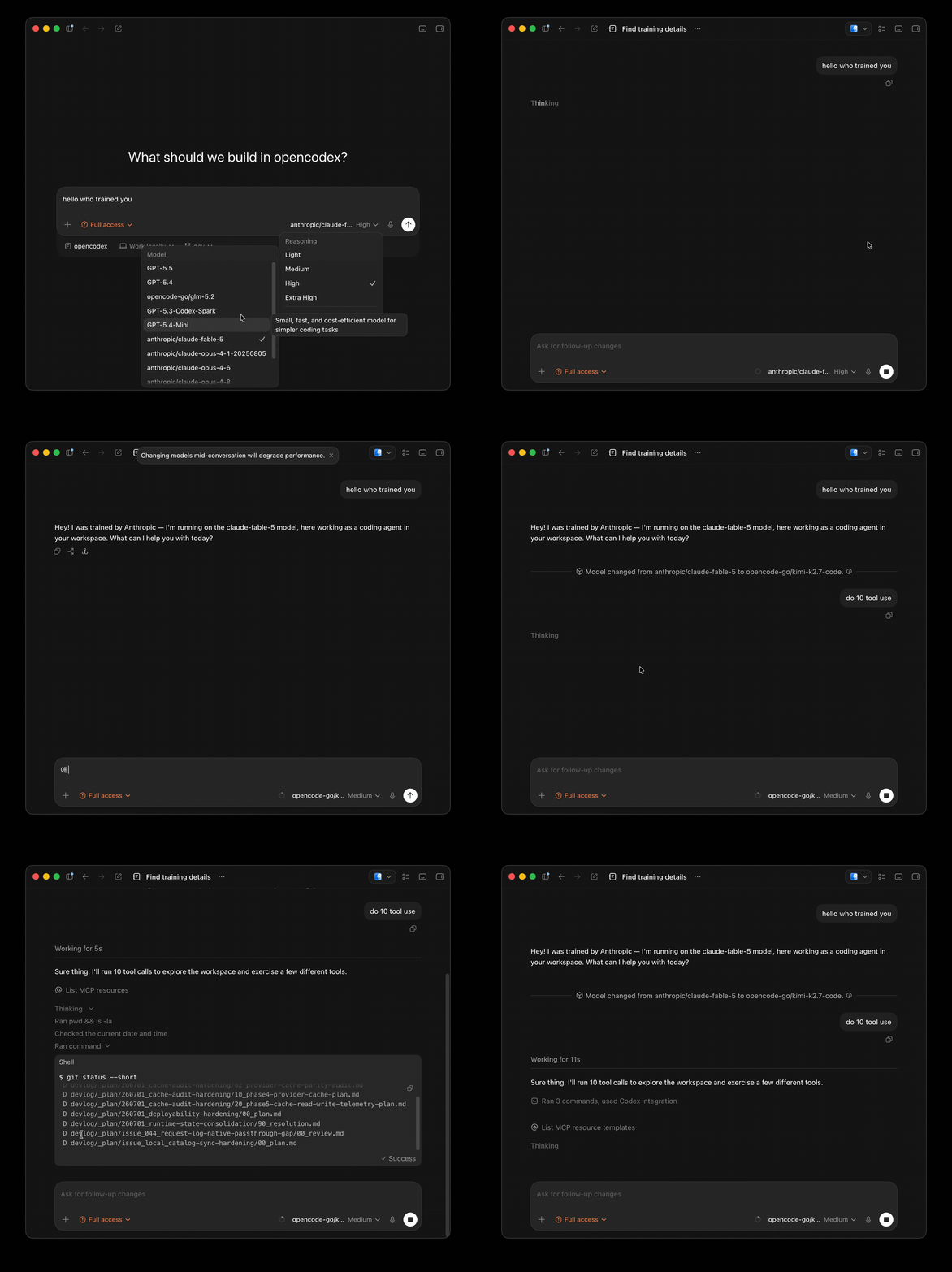
Universal provider proxy for OpenAI Codex & Claude Code — use any LLM (Claude, Gemini, Grok, DeepSeek, Ollama…) with Codex CLI, App, SDK, and Claude Code

Git-native persistent memory for AI coding agents. Implements Google OKF v0.2 with sub-300µs in-memory BM25 search, embedded MCP server, and progressive disclosure. Slashes token bloat by 80% with zero external databases or dependencies. Built in pure Go.

Local-first code intelligence graph for MCP and CLI. Builds a persistent map of your codebase so AI coding tools read only what matters, with benchmarked context reductions on reviews and large-repo workflows.

Stop your AI from making things up — it proposes, deterministic tools decide, every claim checked against ground truth with evidence. Grounded facts and context survive resets. Reverse engineering is the proving ground. MCP server + CLI.