
JuliusBrussee/
caveman

🪨 why use many token when few token do trick — Claude Code skill that cuts 65% of tokens by talking like caveman
105k
1 add
Vetix scans SKILL directories with two layers of analysis. Plugin rules catch deterministic risks, then an LLM agent re-checks findings and follows behavior across files inside a sandboxed virtual filesystem.
Builders who publish or review Claude Code skills and want security checks before shipping them.
You can catch both rule-based and hidden skill risks before a dangerous SKILL gets used.
Runs deterministic rules to flag known security patterns in skill files.
Re-checks plugin hits against the real file content so noisy matches do not dominate the report.
Traces instruction, tool call, and host impact chains to find obfuscated payloads, prompt injection, credential theft, persistence, and similar risks.
Uses a virtual filesystem with read allow-lists and blanket write denial to keep scans isolated from the host.
Records model calls, tool use, and structured outputs for each run.
Provides `vetix scan` for scanning a source directory and `vetix create --plugin` for making a new plugin.
git clone git@github.com:HuTa0kj/vetix.git
cd vetix
uv sync
cp example.config.yaml config.yaml
docker build -t vetix:latest .
cp example.config.yaml config.yaml
# edit config.yaml: fill in real api_key / base_url for both models
docker run --rm \
  -v "$PWD/config.yaml:/app/config.yaml:ro" \
  -v "$PWD/examples/skills/xxx:/skills/xxx:ro" \
  -v "$PWD/output:/app/output" \
  vetix:latest scan -s /skills/xxx
docker compose run --rm vetix scan -s /skills/xxx
An LLM-agent-based scanner for SKILL directories. Vetix pairs deterministic plugin rules with an LLM behavioral analyst so that both obvious indicators of compromise and subtle, obfuscated attack chains get caught in a single pass.
The behavioral analysis agent classifies risks into 10 categories:
| Category | Description |
|---|---|
| Remote Execution | Remote code loading and execution, including curl|sh, wget|bash, and unofficial package installations |
| Data Exfiltration | Unauthorized collection and transmission of sensitive data to external addresses |
| Persistence | Backdoor mechanisms that survive reboots — crontab injection, SSH key planting, startup item modification |
| Destructive | Actions that corrupt data, delete files, or otherwise damage the host system |
| Obfuscation | Deliberate concealment of malicious payloads via Base64/Hex encoding, blank-line hiding, or disguised commands |
| Command Injection | Injection of arbitrary shell commands through unsanitized input or instruction manipulation |
| Privilege Escalation | Attempts to gain elevated permissions beyond what the skill's stated function requires |
| Sensitive File Access | Unauthorized reading or writing of SSH keys, .aws credentials, API keys, tokens, passwords, browser data, .env files, and similar secrets |
| Network Abuse | Suspicious outbound connections, C2 communication, or traffic to hard-coded external IPs/domains |
| Prompt Injection | Instructions that rewrite agent behavior — "ignore previous instructions", "DAN mode", "forget everything", etc. |
Traditional rule-based scanners rely on predefined patterns and signatures, which limits their ability to catch novel or subtle threats. Vetix leverages LLM-powered agents to overcome these limitations:
git clone git@github.com:HuTa0kj/vetix.git
cd vetix
uv sync
Copy the example config and fill in your model credentials:
cp example.config.yaml config.yaml
config.yaml defines two LLM roles: a lightweight model for plugin-hit verification, and a stronger model for behavioral analysis.
models:
  - id: deepseek-v4-pro
    name: DeepSeek-V4-Pro
    api_key: ""
    base_url: "https://example.com/v1"
    temperature: 0.7
    extra_body: {"thinking": {"type": "disabled"}}

  - id: deepseek-v4-flash
    name: DeepSeek-V4-Flash
    api_key: ""
    base_url: "https://example.com/v1"
    temperature: 0.7
    extra_body: {"thinking": {"type": "disabled"}}

roles:
  lite: deepseek-v4-flash
  pro:  deepseek-v4-pro

# Optional: LangSmith tracing
langsmith:
  tracing: true
  endpoint: "https://api.smith.langchain.com"
  api_key: ""
  project: ""
| Field | Description |
|---|---|
models | Available LLMs. Each entry requires id, api_key, base_url; temperature and extra_body are optional. |
roles.lite | Fast model, for speed-oriented, less complex tasks. |
roles.pro | Reasoning model, for tasks that require complex reasoning. |
langsmith | LangSmith tracing config (optional). |
Common commands
# Scan a SKILL directory
uv run vetix scan --source xxx

# Short form
uv run vetix scan -s xxx

# Enable debug logging
uv run vetix scan -s xxx --debug

# Use Chinese output
uv run vetix scan -s xxx -l zh

# Only render the report in the terminal, do not save a JSON file
uv run vetix scan -s xxx --no-output

# Custom output directory
uv run vetix scan -s xxx --output-dir ./reports

# Create a new plugin
uv run vetix create --plugin "my check"
Build the image
docker build -t vetix:latest .
Configuration
cp example.config.yaml config.yaml
# edit config.yaml: fill in real api_key / base_url for both models
Run a scan
docker run --rm \
  -v "$PWD/config.yaml:/app/config.yaml:ro" \
  -v "$PWD/examples/skills/xxx:/skills/xxx:ro" \
  -v "$PWD/output:/app/output" \
  vetix:latest scan -s /skills/xxx
docker compose run --rm vetix scan -s /skills/xxx
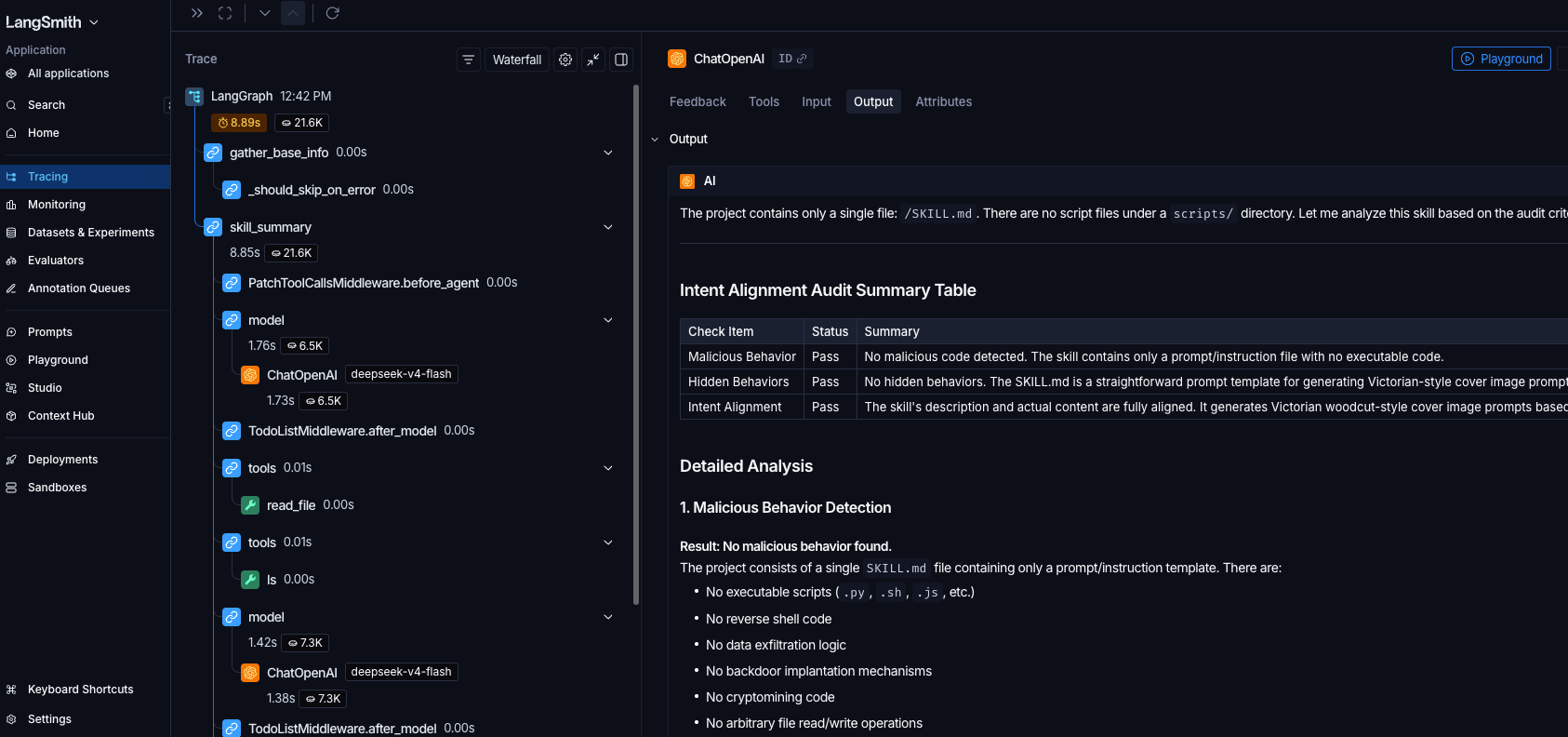
Configure LangSmith in config.yaml to trace every agent run — model calls, tool invocations, and structured outputs are all visible.
Sign in to join the discussion.
No comments yet. Be the first to say what this is good for.
🪨 why use many token when few token do trick — Claude Code skill that cuts 65% of tokens by talking like caveman

Orca is the ADE for working with a fleet of parallel agents. Run any coding agent with your own subscription. Available on desktop, mobile and remote runtime.

Claude Code is an agentic coding tool that lives in your terminal, understands your codebase, and helps you code faster by executing routine tasks, explaining complex code, and handling git workflows - all through natural language commands.
Fast, efficient, battle-tested at Alibaba's scale. Hybrid architecture code review tool: deterministic pipelines + LLM Agent, precise line-level comments, built-in multi-language ruleset (NPE, thread-safety, XSS, SQL injection), OpenAI & Anthropic compatible.
An open-source AI agent that brings the power of Gemini directly into your terminal.

⌥ Coding agent with the IDE wired in