The context and communication layer for coding agents.
basemind turns any repo into an always-current map of its code, documents, history, and memory —
so agents answer from structure and search instead of burning their context window on grep and
file reads — and gives a team of agents a shared channel to coordinate while they work. One
server does both.
Code map across 300+ languages · documents in 90+ formats · semantic + full-text search ·
git history & blame · shared memory · web crawl · agent-to-agent comms




Docs · Install · Features · How it works · Performance · CLI
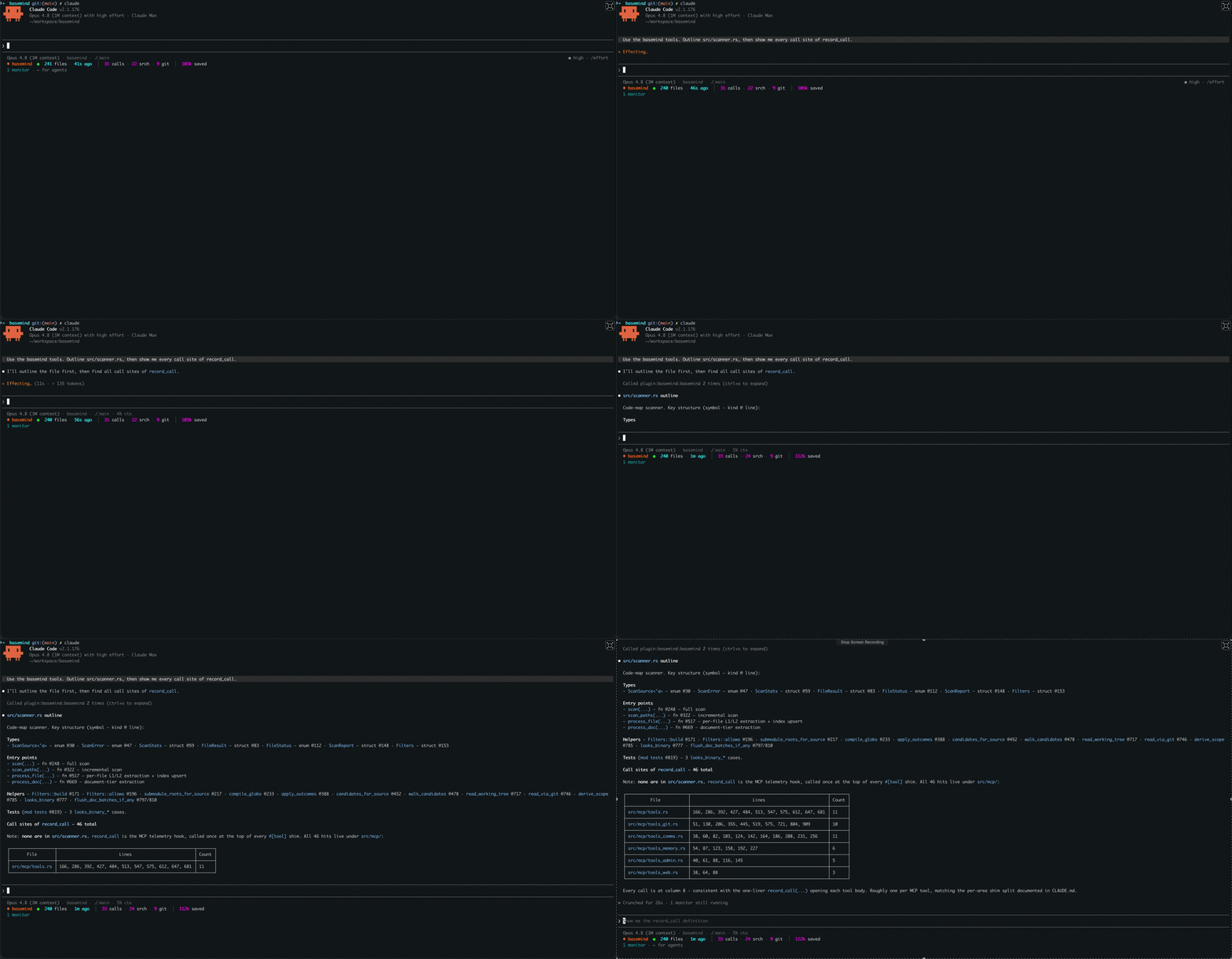
An agent reasoning from structure — code modes outline and references in a live session, statusline tracking tokens saved.
What you get
basemind answers with file paths, line numbers, and signatures — not whole files — so a question
about your code costs a small fraction of the tokens it takes to read the source.
| Capability | What it does | Key tools |
|---|
| Code intelligence | Read the code map instead of opening files: a file's structure (outline), find a definition by name (symbols), regex content search (grep), enumerate or fuzzy-find files (files · find), resolve a reference position to the definition it binds to (definition — scope- and import-aware, JS/TS via oxc, Python & Java via in-tree stack-graphs), every call site of a name (references, name-only) or of one specific definition (callers), implementors of a trait / interface / base class (implementations), the reverse import lookup (dependents), one symbol's raw body (expand), and search by meaning over indexed chunks (semantic → chunk, needs --features code-search). Layered over 300+ languages. | code (outline · symbols · grep · files · find · definition · references · callers · implementations · dependents · expand · semantic · chunk) |
| Code graph | Walk the typed code-graph: who calls what and what a function reaches (calls), a symbol's n-hop blast radius (neighbors), the confidence-weighted shortest route between two symbols (path), a readable centrality-cut neighborhood (subgraph), the repo's de-facto modules (communities), and the whole-repo architecture ranked by PageRank + git churn with its dependency cycles (map). Render it as node-link JSON / DOT / Mermaid / GraphML / Cypher / offline interactive HTML / static SVG (export), show it to a human in their desktop viewer (display), or open the interactive UI at a live http://…/ui URL (open, which needs the daemon's opt-in HTTP front-end and otherwise falls back to a file:// export) — both take open: false to return the path or URL without launching anything. Every edge carries provenance + confidence; every result is deterministic and bounded. | graph (calls · neighbors · path · subgraph · communities · map · export · display · open) |
| Git intelligence | Ask what changed recently, who last touched a function or a line, where the churn is, when a symbol's body actually changed, how a file's structure differs across commits, and full-text search commit authors + messages at full branch depth. | git (status · recent · touching · by_path · churn · diff · diff_outline · blame · blame_symbol · symbol_history · search) |
| Memory & documents | A per-repo memory agents write to and search by meaning — clones of the same repo share it, unrelated repos stay separate — plus semantic search over PDFs, Office files, HTML, email, and images (OCR included, no extra setup), and a review queue of notes mined from files that change together, which you approve before anything is kept. | memory (put · get · list · search · delete · audit · documents · mine · proposals · accept · reject) |
| Web crawl | Fetch a page or follow links from a starting URL; results join the document search above. | web (scrape · crawl · map) |
| Agent comms | Threads addressed by subject, path-glob, and members; scope discovery; inbox delivery; lifecycle status; and dry-run/apply retention cleanup. | agents (register · list · thread_start · thread_list · join · leave · members · add_member · remove_member · archive · post · history · message · inbox · ack · wait · cleanup · status) |
| Agent shells | Run headless terminal sessions in the background, capture recent retained output after commands exit, and explicitly stop sessions when their work is done. Visual terminal attachment is opt-in through [shells].visual. | shell (spawn · send · capture · kill · list · broadcast) |
| Admin | Refresh the index after edits, check index health and repo identity, see what's been queried and how many tokens were saved, inspect or clean the on-disk cache, and shrink what an agent carries: a file's outline instead of its text, a diff instead of a re-read, a checkpoint instead of a transcript, plus a wasteful-tool-use report. | admin (status · repo · rescan · cache_stats · gc · cache_clear · telemetry · compress · delta · checkpoint · waste) |
| Machine registry | Machine-wide repo/worktree/branch coordination, backed by the daemon's always-on registry. Advisory claims let agent sessions avoid colliding on the same worktree. | workspace (workspaces · worktrees · branches · claim · release) |
Installation
Three ways to run basemind, easiest first. All three share the same local index and are safe to run
side by side.
The plugin downloads the basemind program for you on first use. The MCP-server and CLI paths
need it installed yourself — see Install the program.
1. As a plugin (recommended)
The plugin sets up everything for you — the server, the helper skills, the agent-comms features, and
the slash commands. Pick your coding tool.
Claude Code
In the session (not your shell), run in order:
/plugin marketplace add Goldziher/basemind
/plugin install basemind@basemind
Restart, then run /bm-statusline once to turn on the live statusline (a one-time step — see
Statusline). Turn on auto-update for the basemind marketplace
(Claude Code's plugin manager): the plugin then tracks each new release automatically, and the
launcher resolves the latest published release, so you always get the current index format and
tool set and startup stays reliable even during a release. Prefer to control timing? Update the
marketplace regularly by hand instead.
Codex
codex plugin marketplace add Goldziher/basemind
codex plugin add basemind@basemind
In the app: open the Plugins sidebar and add basemind. The CLI and IDE share one config file.
The plugin starts the latest published GitHub release from the project workspace; it never runs from
the installed plugin cache or races a shared npx install.
Cursor
In Agent chat: /add-plugin basemind (once listed), or go to Dashboard → Settings → Plugins →
Team Marketplaces → Import from Repo and point it at https://github.com/Goldziher/basemind.
Gemini CLI
gemini extensions install https://github.com/Goldziher/basemind
Update later with gemini extensions update basemind.
Factory Droid
droid plugin marketplace add https://github.com/Goldziher/basemind
droid plugin install basemind@basemind
GitHub Copilot CLI
copilot plugin marketplace add Goldziher/basemind
copilot plugin install basemind@basemind
OpenCode
Add to opencode.json (project) or ~/.config/opencode/opencode.json (global):
{ "plugin": ["basemind-opencode@latest"] }
Kimi Code
/plugins install https://github.com/Goldziher/basemind
Kimi doesn't support the comms auto-notifications, but the chat tools still work.
Hermes
Hermes exposes MCP servers through config, so basemind's tools are wired there. Two steps — the
binary + MCP wiring gives you the tools; a small standalone plugin package adds the helper skills,
slash commands, and comms notifications.
First install the program (Homebrew / npm / cargo / release — not pip),
then add the server to ~/.hermes/config.yaml (this is what gives you the nine domain tools):
mcp_servers:
  basemind:
    command: basemind
    args: [serve]
For the helper skills, slash commands, and agent-comms notifications, install the standalone plugin
into the same Python environment Hermes runs in, then enable it (general plugins are opt-in):
pip install basemind-hermes-plugin
hermes plugins enable basemind
The plugin is pure-Python and ships no binary — it shells out to the basemind you installed above.
Comms auto-notifications are best-effort; the chat tools work regardless.
Antigravity & pi
Antigravity uses a shared MCP config — install the program, then add the
generic MCP block. If you already use the Gemini extension,
agy plugin import gemini brings it across.
pi: pi install git:github.com/Goldziher/basemind. pi has no MCP support, so basemind runs
through its CLI here.
2. As an MCP server
If your tool speaks MCP but you're not using the plugin, install the program,
then register it:
{
  "mcpServers": {
    "basemind": { "command": "basemind", "args": ["serve"] }
  }
}
Each tool says whether it only reads or can change things, so your client can auto-approve the safe
ones and ask before the rest. If basemind isn't found, use the full path from which basemind.
Per-tool specifics (Claude Code · Cursor · Windsurf · Codex · Gemini · Copilot · Droid · Cline · Continue · OpenCode · Hermes)
- Claude Code —
claude mcp add basemind -- basemind serve (add --scope user for all
projects; the -- is required). Or commit a .mcp.json at the repo root with the block above.
- Cursor — put the block above in
.cursor/mcp.json (project) or ~/.cursor/mcp.json (global).
- Windsurf —
~/.codeium/windsurf/mcp_config.json (or Cascade → MCP servers → manage), then
Refresh.
- Codex —
codex mcp add basemind -- basemind serve, shared by the CLI and IDE.
- Gemini CLI —
gemini mcp add basemind basemind serve, or the block above in
~/.gemini/settings.json.
- GitHub Copilot CLI —
/mcp add in-session, or ~/.copilot/mcp-config.json with
"type": "local" and "tools": ["*"].
- Factory Droid —
droid mcp add basemind "basemind serve", or ~/.factory/mcp.json.
- Cline — MCP Servers icon → Configure → add the block above.
- Continue —
.continue/mcpServers/basemind.yaml with command: basemind, args: [serve].
- OpenCode (without the plugin) —
opencode.json under key mcp, with command as an array
["basemind", "serve"].
- Hermes —
mcp_servers.basemind in ~/.hermes/config.yaml (YAML: command: basemind,
args: [serve]). For helper skills + comms notifications, pip install basemind-hermes-plugin
(a standalone pure-Python plugin, no binary), then hermes plugins enable basemind — see the
Hermes plugin section above.
- Any other tool — point it at the command
basemind with the argument serve.
3. As a CLI
The standalone program, for scripts, headless runs, and CI. Install it, then:
basemind scan                          # index the project once
basemind code symbols "parseQuery"     # find a definition by name
basemind code references "processFile" # find everywhere it's called
basemind git blame src/main.rs         # who last changed each line
basemind watch                         # keep the index fresh as files change
Full command list in the CLI reference.
Install the program
The MCP and CLI paths need basemind available on your system. (The plugin does this for you.)
| Channel | Command | Includes |
|---|
| Homebrew | brew install Goldziher/tap/basemind | everything |
| npm | npm install -g basemind | everything |
| pip | pip install basemind | everything |
| cargo | cargo install basemind --locked | code + git only |
| cargo (full) | cargo install basemind --features full --locked | everything |
| GitHub releases | Download a binary | everything |
The Homebrew / npm / pip / GitHub downloads include the full feature set — documents, OCR, search,
web crawl, shared memory, agent comms, and agent shells — so the first run downloads the models it
needs. The plain cargo install builds the code-map and git tools only.
Get started
After installing, run basemind init (CLI) — or /bm-init if your tool supports slash
commands — from the repo root. It's re-runnable and safe to call again later:
- Writes a commented
basemind.toml scaffold at the repo root, if one doesn't already exist.
- Lets you pick which capabilities to advertise (interactive prompt in a TTY, or non-interactive
with
--yes, --with <capability>, --without <capability>). Capability slugs:
code-search-navigation, code-mapping-architecture, git-history, agent-comms,
documents-rag, semantic-search.
- Injects a "prefer basemind over grep/read/git" rules block into your repo's agent-instructions
file —
.ai-rulez/rules/basemind-usage.md if .ai-rulez/config.toml is present (run
ai-rulez generate afterward), else CLAUDE.md, else AGENTS.md, else a new CLAUDE.md. The
block is delimited (<!-- BEGIN basemind ... --> / <!-- END basemind -->) so re-running
replaces it in place instead of duplicating it.
Preview changes without writing with --print; skip the rules step with --no-rules; steer the
target explicitly with --rules-target <auto|claude|agents|ai-rulez|none>.
Statusline (Claude Code)
Run /bm-statusline once. This is a one-time step because Claude Code doesn't let plugins set the
main statusline themselves — so basemind asks the assistant to make the one-line settings change on
your behalf, and it sticks from then on.
It shows two lines:
Opus · basemind · ⎇ main · 12% ctx
◆ basemind  ●  1,247 files · 23m ago  │  312 calls · 180 srch · 44 git · 12 docs  │  1.4M saved  │  ✉ 3 @reviewer
The dot is green when basemind is live and fresh, amber when idle, red when stale. The middle shows
activity by type, then tokens saved, then unread messages. Adjust with
BASEMIND_STATUSLINE=full|compact|minimal, or hide the top line with BASEMIND_STATUSLINE_CONTEXT=0.
Demos

The same engine from the CLI — scan, then symbol / reference / call-graph / blame queries.
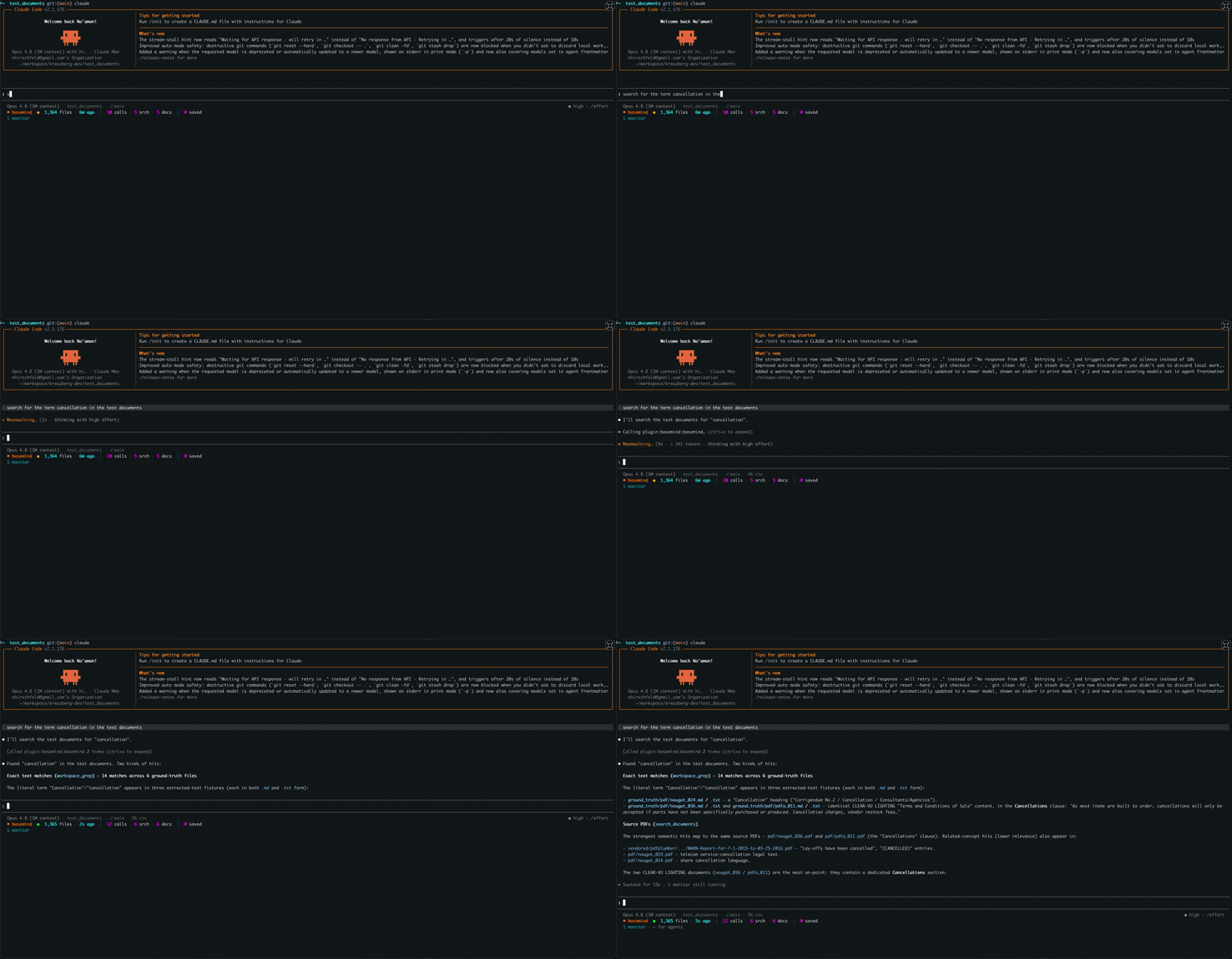
Searching documents by meaning, not keywords, across 90+ formats.
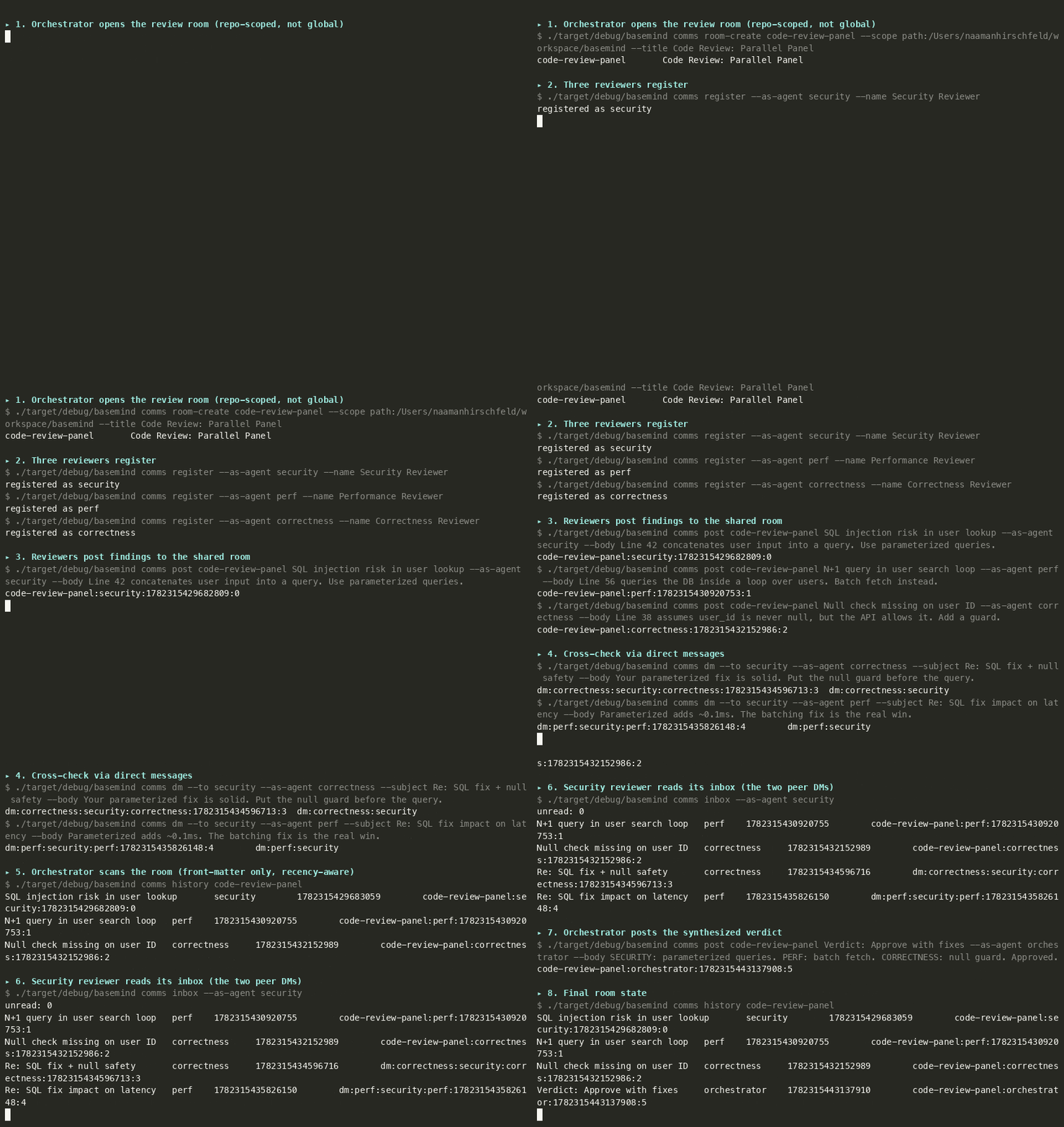
Multi-agent code-review panel: named reviewers coordinate in a repo-scoped thread (post, reply, synthesize) — entirely over basemind agents.
How it works
From one scan to instant answers
basemind scan reads your project once, in parallel. It maps your code with
[tree-sitter] (across [300+ languages][tslp]) and pulls text out of your documents with
[xberg], then saves the result to a global cache under the XDG data directory, keyed by workspace —
nothing is written into your repo. After that, basemind serve keeps the map in memory and answers
questions instantly — no re-reading the project for each one. When files change, it updates only what
changed. A single background daemon on the machine is the sole writer to that cache, so multiple
serve sessions on the same repo (or on different worktrees of it) all read and write concurrently
instead of one falling back read-only. See Global cache & the daemon below.
Navigation is scope- and import-aware for JavaScript/TypeScript, Python, and Java: basemind
resolves each use to the definition it actually binds to, so a shadowed local isn't confused with an
import and code mode definition lands on the right target (including across files for imports). Every
other language still gets fast tree-sitter scope binding. Precise Python/Java resolution runs GitHub
stack-graphs-style .tsg name-binding rules via an in-tree engine (crates/), with no per-language
LSP server.
Resolution refines, but never shrinks, a result set. code mode callers reports every call site
whose callee matches the name — the same sound floor mode references uses — and marks each hit resolved
when resolution proved it binds to that definition (resolved_total counts them). It deliberately
does not return only the resolved subset: resolution cannot see through a module-object import
(from pkg import mod then mod.f()) or an unresolvable path alias, so filtering to it would drop
real callers and report the remainder as complete. Filter on resolved when you want precision; trust
total when you need completeness.
Markdown and Obsidian vaults are first-class: headings become navigable symbols (so code modes
outline and symbols work over a notes vault); [[wikilinks]], ![[embeds]], and standard
[text](Note.md) links all become references — so mode references on "Note" returns that note's
backlinks regardless of link style; and #tags (inline or in YAML frontmatter) become references
too, so mode references on "#project" lists every note carrying that tag.
flowchart LR
  A(["Coding agent"])
  R["Your project<br/>code · documents · git"]
  S["basemind scan<br/>map code & read documents"]
  D[("Global cache<br/>per-OS data dir")]
  V["basemind serve<br/>answers questions"]
  R --> S --> D --> V
  A <-->|asks questions| V
  classDef accent fill:#2563eb,stroke:#1e40af,color:#fff
  class S,V accent
Search and memory are powered by a vector store ([LanceDB]).
Index lifecycle & freshness
basemind serve answers the MCP handshake immediately and warms the code map into memory in the
background, so a client never blocks waiting for a large repo to load. The status tool reports
warming (still loading) and, once done, warm_ms; a first-time index build similarly reports
indexing / index_build_ms.
While the server isn't fully ready, status and every code-map read tool may carry a notice
object — { state, message, retry } — instead of (or alongside) their normal result:
state | Meaning | retry |
|---|
warming_up | Loading an existing index into memory. | true |
building_index | Indexing from scratch (no cache entry for this workspace yet). | true |
rescanning | Incremental rescan after a file change; current results are usable but may be stale. | false |
Treat an empty or partial result carrying a notice as "retry shortly," not "no matches" — poll
status (or just retry the call) until the notice clears.
Global cache & the daemon
Index state lives under a single global cache — ~/.local/share/basemind/ on Linux,
~/Library/Application Support/basemind/ on macOS (override with BASEMIND_DATA_HOME) — keyed by
workspace, never inside your repo. The
content-addressed blob store is machine-wide too: identical file content scanned from different repos
or worktrees is extracted and stored once.
A workspace root must be a project: a git repository, or a directory containing basemind.toml.
Anything else is refused, because basemind opens a root read-write and indexes every file beneath
it — so an accidentally inherited root (/, your home directory, or wherever an MCP host happened
to start) would become a whole-filesystem scan. Run basemind init to mark a directory you do want
indexed, or set BASEMIND_ALLOW_ANY_ROOT=1 to skip the check. A filesystem or volume root is
refused unconditionally and cannot be overridden.
A single background daemon per machine is the sole writer to that cache. basemind serve opens its
store read-only and forwards writes (scan / rescan) to the daemon over a local socket, so N serve
sessions on the same repo — or on different worktrees of it — all read and write concurrently instead
of a second session silently falling back to a stale, read-only view. The daemon also keeps a cheap,
always-on registry of repos, worktrees, and branches (workspaces / worktrees / branches), and
worktree_claim / worktree_release give agent sessions an advisory way to avoid colliding on the
same worktree.
basemind statusline queries the daemon for the workspaces currently active and prints a compact
line for your shell prompt; it prints nothing when no daemon is running.
The daemon is started on demand, detached with setsid(2). That changes the session and the process
group but not the cgroup, so on Linux an auto-spawned daemon lives in the cgroup of whatever
shell or editor happened to start it — outside any MemoryMax you configured for basemind. No code
in basemind can change th